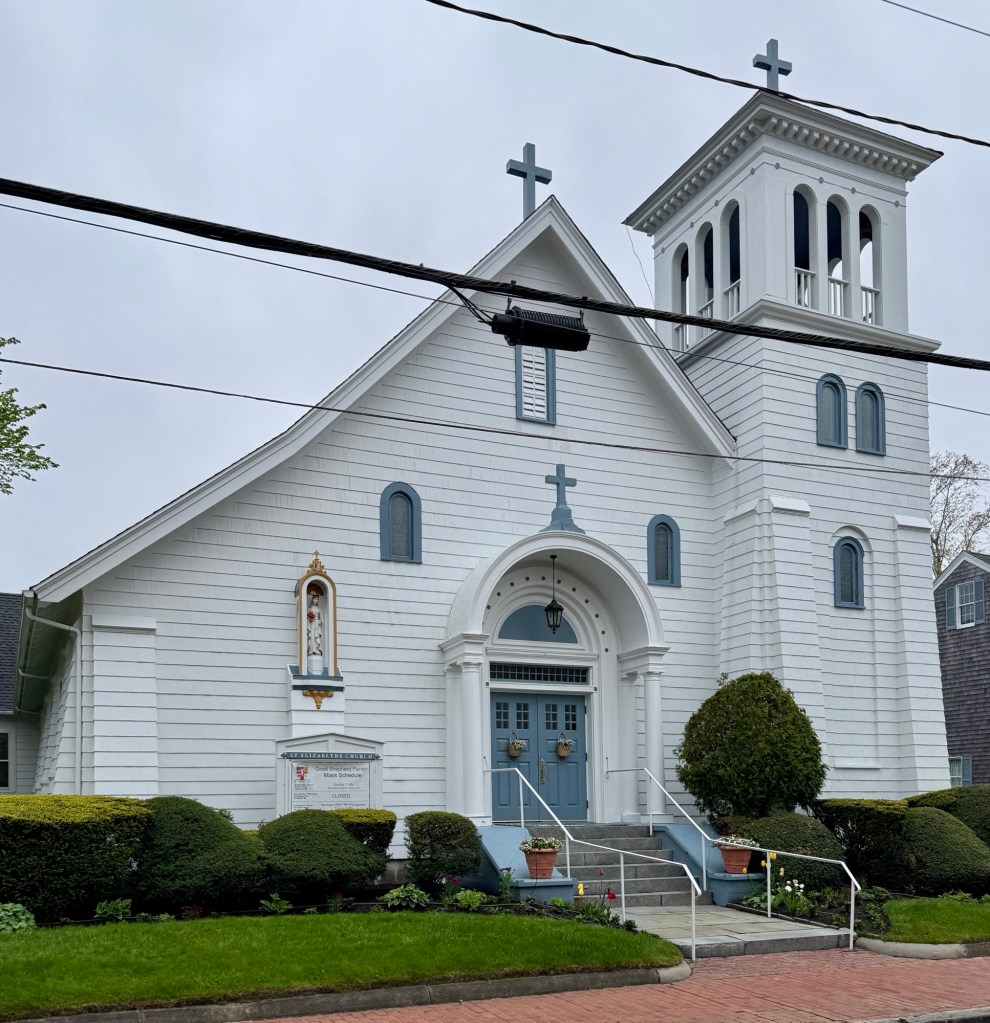
St. Elizabeth’s Catholic Church, Edgartown // 1925

Catholics on Martha’s Vineyard began worshipping in the late-1870s when a small group, mostly of Portuguese origin, began meeting in homes. As the island grew into a summer vacation destination, Catholic summer residents desired a place to have Mass celebrated on the island. Throughout the 19th century, an occasional priest from New Bedford or Cape Cod would come to the Vineyard to celebrate Mass in private residences. Residents in Edgartown purchased land in the village for a small chapel, rectory for it’s full-time summer priest, and cemetery. As the summer populations grew, it was decided that a larger Catholic church was needed for Edgartown, and the Roman Catholic Bishop of Fall River, Daniel Feehan, funded the new church and hired architect, Joseph I. Higgins, to design the new building. The church was dedicated in the summer of 1925 and features elements of Gothic and Colonial Revival styles.

Edgartown Town Hall – Old Edgartown Methodist Church // 1828

Edgartown, the historic whaling harbor village, is Martha’s Vineyard’s first colonial settlement and has prospered as one of the best-preserved collections of 19th century architecture in the United States. The streets of Edgartown’s village are lined by historic residences, shops and churches built by and for prosperous whaling captains and preserved today as part of New England’s elite summer destinations. Presently occupied by the local government of Edgartown as its Town Hall, this handsome Federal style building on Main Street was originally used as the community’s first purpose-built Methodist Church. Methodism on Martha’s Vineyard began after 1787, when a vessel commanded by Capt. Thomas Luce arrived to the island containing two stowaways escaping enslavement in Virginia; John Saunders and Priscilla, his wife. They were slaves to a Virginia planter, and both were zealous christians, and Methodist speakers, who helped foster a larger community on island. A methodist church was established in Edgartown in a building shared with Baptists until this handsome building was constructed in 1828 by local architect and builder, Frederick Baylies Jr. Just fifteen years later, the town grew in population and wealth and the local Methodists felt it necessary to build a much larger church, now known as the Old Whaling Church in 1843. This building was acquired by the Town in the 1840s and converted to a town hall with space for a fire engine and police. More recently, the building served as the fictional town hall of “Amity” in the 1975 film, Jaws, where the infamous chalkboard scratch scene took place.

Edgartown Customs House // c.1825

Edgartown in the early 19th century was booming as one of the major whaling towns in America. As goods were imported and exported in and out of the burgeoning town, a Customs House was required to essentially tax the goods. Until around 1825, the Customs House in Edgartown was located in private homes until the demand grew for a stand-alone structure on Main Street. This Federal style building was constructed to house a Customs office upstairs with two commercial spaces on the ground floor.