Daniel Walker House // 1784

One of the older extant homes in Kennebunkport is the Daniel Walker House on Maine Street. After the American Revolution, shipbuilding and other maritime industries grew along the Maine coast, especially in Kennebunkport (then still named Arundel). Sea captain Daniel Walker built the home on ample land on the outskirts of the village at the time. By the early 19th century, he sold off much of his land closer to the river to family and friends. The Georgian home is minimal, yet commanding with its massive facade, rusticated lintels and corners, an elaborate entry and a large central fireplace.

Clock Farm // ca.1850

Away from the busy coast of Kennebunkport, Clock Farm, a mid-19th century farmhouse with an odd clock-tower caught my eye while driving by. Clock Farm is a rambling extended farm complex that remains a landmark in the more rural section of town. According to historians, the oldest part of the complex was a home that was later converted to one of the ells, was built in 1773 by a Peter Johnson. By the 1850s, the 1 1/2-story Greek Revival home and barn were built. In the late 19th century, the property was purchased as a summer residence by Thomas Lemmons, factory owner in Lawrence, MA. The story associated with the clock is that originally was mounted on his factory, but kept such bad time that his employees complained. In the early 20th century Emmons had the tower specially built to house the clock, which was transported here from Lawrence.

Louis T. Graves Memorial Library // 1813

What is known today as the public library of Kennebunkport, the Louis T. Graves Memorial Library was not always used for books and learning. Built in 1813 as a branch office of the Kennebunk National Bank, the brick structure was valuable as a local bank for the growing port neighborhood. By 1831, the Kennebunk Bank’s charter was revoked and they sold their branch location to the U.S. Government as a Customs House (the second floor was already partially occupied as a Customs House). By the end of the 19th century, the second floor was leased out to the Kennebunkport Public Library. The Customs District was eliminated in 1913, and by 1920, the building was acquired by Mr. and Mrs. Abbott Graves, who purchased the property at auction for $1,350., the couple lived just a couple blocks away in a rare Prairie style home. In 1921, the Graves family deeded the property to the Library Association on the condition that the Library be named in memory of their deceased son Louis T. Graves who valued books all his life.

St. Martha’s Catholic Church // 1903

A happy blending of Mission, Colonial Revival and Shingle Styles for the Maine coastal community of Kennebunkport, the St. Martha’s Catholic Church exemplifies the charm of this town. The church is sited on a corner lot with a belfry at its corner. The nave features a central entry with Colonial pilasters and pediment above the second floor windows. The roofline is shaped with Mission style parapet walls and arched openings at the tower, showcasing the Spanish influence in the design. The entire building is wrapped with cedar shingles, as a nod to the coastal summer resort it resides. The church operated here until the mid-late 20th century when it was converted to an art gallery, and now is home to condos.

Captain George Nowell House // 1854

Captain George W. Nowell and his wife, Frances, the daughter of the wealthy Capt. William Jefferds, built this elegant Italianate style home in 1854 that stands on Temple Street, next door to the Kennebunkport Post Office. George was a sea captain, following in his father’s footsteps and also invested in several of the ships he sailed, but had the fiscal foresight to insure his interests against loss. His prized ship was named “Tropic” and she was launched in 1855, less than a year after his house was built. On a cold December day in 1862, Nowell, captaining The Tropic left Philadelphia with a cargo of coal for the Pacific Mail Steamship Company in San Francisco. She and her crew of 20 were never heard from again. George was not yet 40 when he perished. His youngest son, Frank, never met his father and was only 8 years-old when his mother passed in 1872. Shipbuilder David Clark bought their Temple Street home and George’s brother took his children to live in Bangor.

The captain’s reputation as a prudent and charitable man was recognized by Victoria, Queen of England. She awarded Capt. George W. Nowell, of the ship Tropic, an engraved spyglass in testimony of his humanity in rescuing her subjects, the crew of the Village Belle, of Nova Scotia. The telescope and a certificate, signed by the Queen, have been proudly protected by the Kennebunkport Historical Society.

The family home features bold corner quoins, bracketed door and window hoods, and paired rounded arch windows at the top floor.

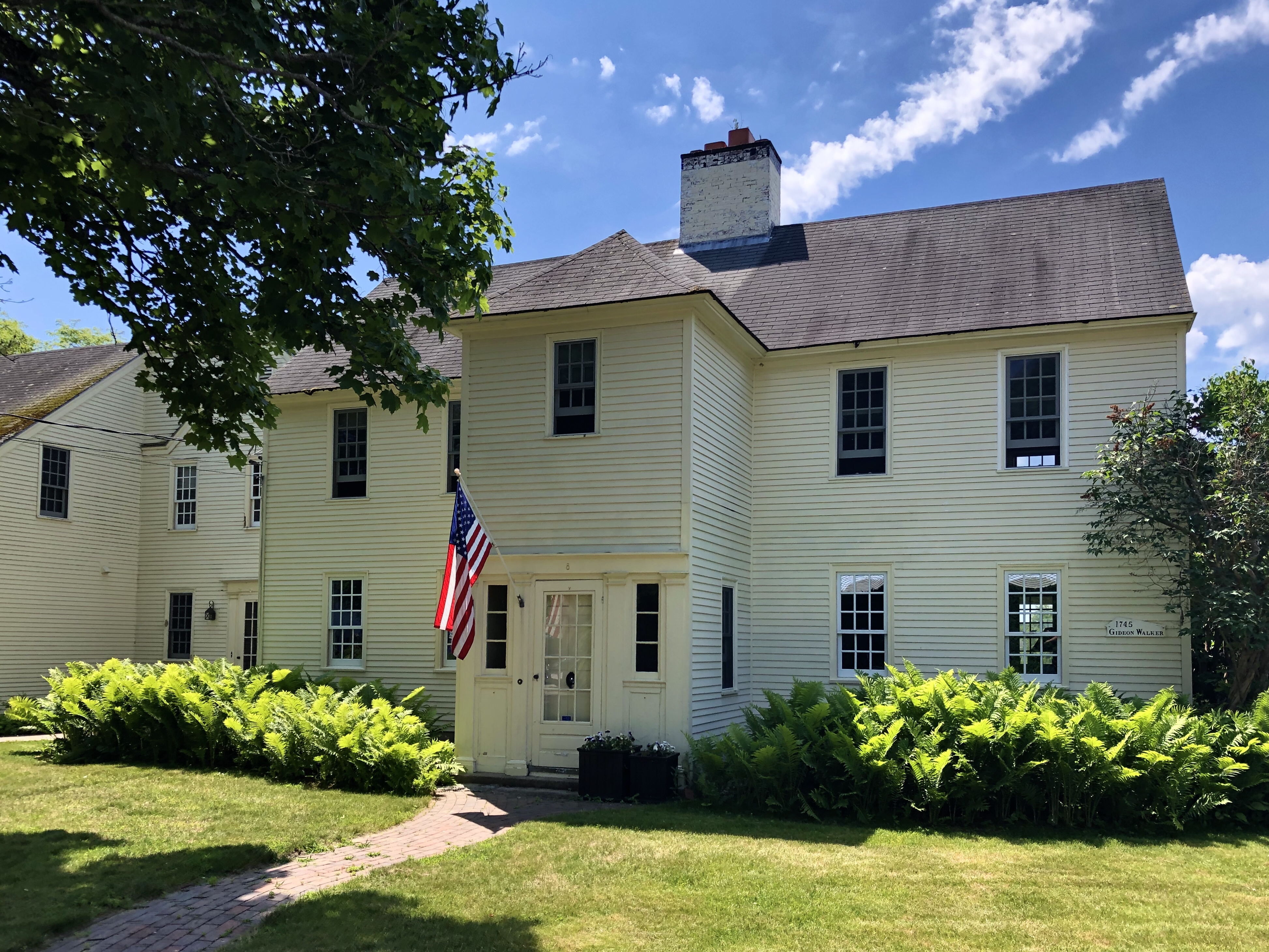
Gideon Walker Farmhouse // 1745

One of the older extant homes in Kennebunkport is the Gideon Walker Farmhouse, built in 1745. The home once sat on a larger parcel of land, on the outside of the village, which at the time, only had a handful of other homes nearby. At the time, the town was named Arundel, and was later renamed Kennebunkport, in reflection to its economy becoming one of shipbuilding and trade along the Kennebunk River. As the village population grew, the Walker land was sold off and developed for other large estates. The Georgian house featured a small, one-story projecting entry, typical of the period. In 1910, owner Anson McKim of Montreal, hired Portland architect John Calvin Stevens to update the home, which included the addition of the front entry’s second story and a large side addition approximating the size and location of the former barn which once stood there. The home has since been renovated a few more times on the interior and exterior, yet it still retains its historic integrity.

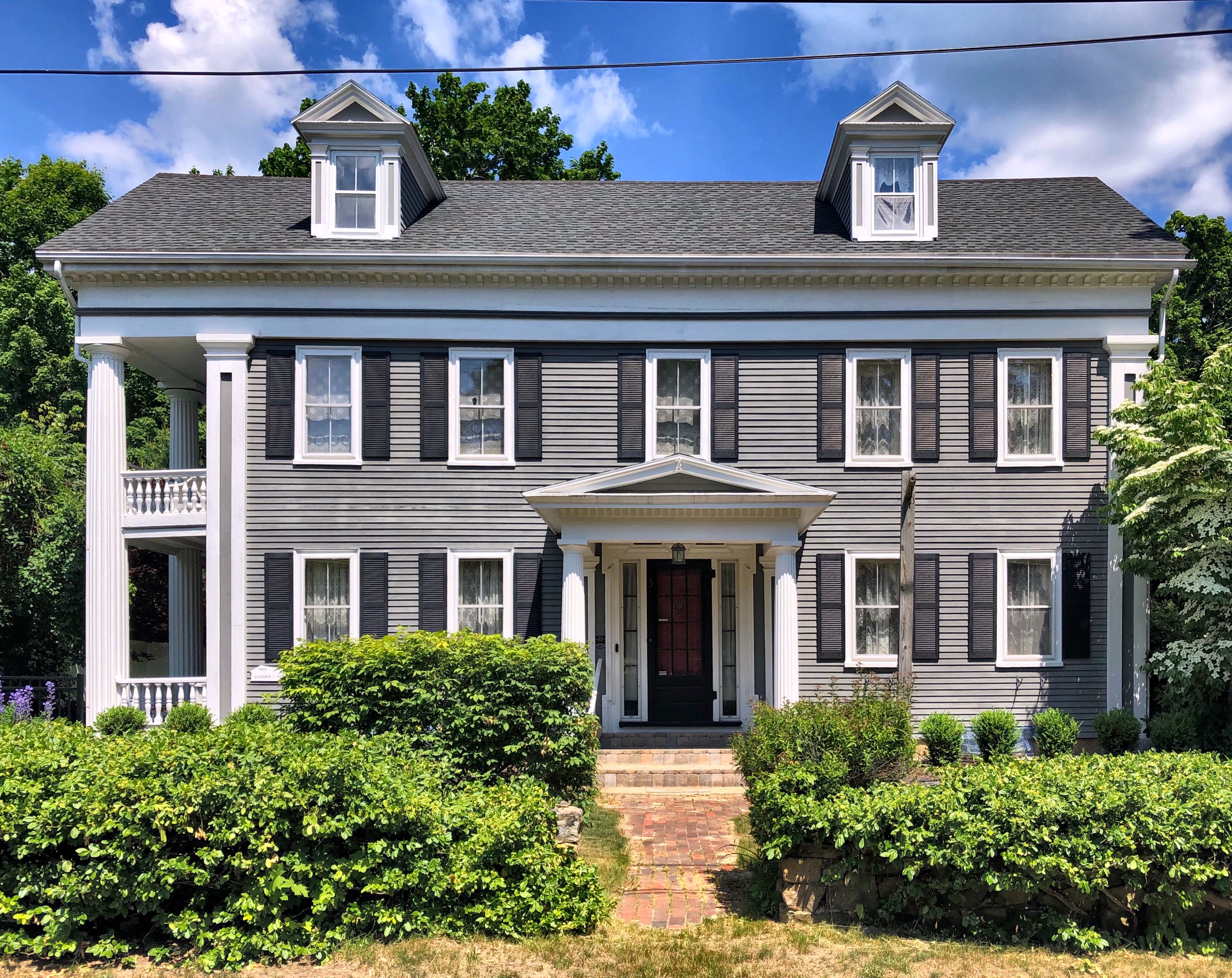
John Hovey Perkins House // c.1850

This large house in Kennebunkport Village was built in the 19th century for John Hovey Perkins (1804-1859). The Federal home was constructed sometime in the early 19th century, and by 1857, it was updated by the local master-builder, Bernard Littlefield, who likely added the two-story columned side porch and other detailing. The home was originally located at the corner of Green and Pleasant Streets, across from the Captain Lord Mansion, and was moved in 1900 to its present location on South Street. The house was converted to a bed & breakfast, known as The Inn on South Street, and it has seemingly been converted back to a single-family home.