Hills-Claflin House // 1871

This grand home was built in 1871 for George Hills, one of the original investors in the Oak Bluffs Land & Wharf Company development, a development to the east of Wesleyan Grove. The home was designed by Samuel Freeman Pratt, a Boston carpenter turned premier architect of Oak Bluffs, who likely designed the home in his distinct Stick Style with intricate wood carvings and posts. In 1877, the home was purchased by Governor William Claflin after his time in office as a summer retreat from his home in Newton, MA. The governor was an ardent Methodist who was involved with liberal causes such as abolition and Native American and female enfranchisement. Within 10 years of his purchasing of the home, he modified and enlarged it with Colonial Revival motifs including the gambrel roof, Tuscan columned porch, and simplified dormers.

Corbin-Norton House // 1891

Sited prominently on Ocean Park in Oak Bluffs, the Corbin-Norton House overlooks the Nantucket Sound with no buildings obscuring the gorgeous sunrises. When the home was originally built in 1891, it belonged to Philip Corbin, a manufacturer of household hardware and locks from New Britain. Conn., who got his start as a locksmith apprentice and grew his business until it employed 15,000 people. Corbin summered on Martha’s Vineyard and saw the shift from Cottage City, a Methodist-oriented summer resort town to Oak Bluffs, an exclusive summer colony. The house was built by Eli A. Leighton, a carpenter from Oak Bluffs whose descendants still live on the Is­land. The house remained in the Corbin family for some 40 years, after which it changed hands a number of times, at one point, housing a doctor’s office. By that time, nearly all of the historic character had been stripped of the home with replacement vinyl windows, removed trim and finials, and a monochrome color scheme. In 1991, when Peter Norton, the computer soft­ware magnate, and his wife, Eileen, de­cided to buy the old Corbin house for a reported $350,000, it was begging for someone with the resources to restore it. The restoration would take three years to complete, and Mr. Norton commissioned a team of consultants, ar­chitects and contractors to do the job. They meticulously restored the home, only to have the misfortune of a fire which destroyed the home. Norton funded the replica which was completed soon after, and passers-by wouldn’t be able to tell the difference!

The Arcade // 1870

Prior to 1866 the area now called Oak Bluffs was largely undeveloped with the exception of the famed Methodist meeting camp at Wesleyan Grove that had been established in 1835. By the 1860s the meeting camp was attracting large numbers of middle class visitors from Boston and surrounding towns who came for summer retreats; in 1868 approximately 600 tent and cottage lots were being leased in the Methodist compound. The Land & Wharf Company catalyzed this success into profit, by developing a more commercial presence on Circuit Avenue and developed housing on large lots to the east.

The first major structure built by the Land & Wharf Company was the Arcade Building. In it, they established their office from which they directed development of the resort. The central open arcade provided access to the campground from the heart of Oak Bluffs’ commercial area. The Arcade was designed by Boston carpenter/architect/inventor Samuel Pratt (1824-1920) who was also responsible for many of the cottages in Oak Bluffs. The Arcade remains a historically significant and well-preserved commercial building in town. My bad photo doesn’t do it justice! 😦

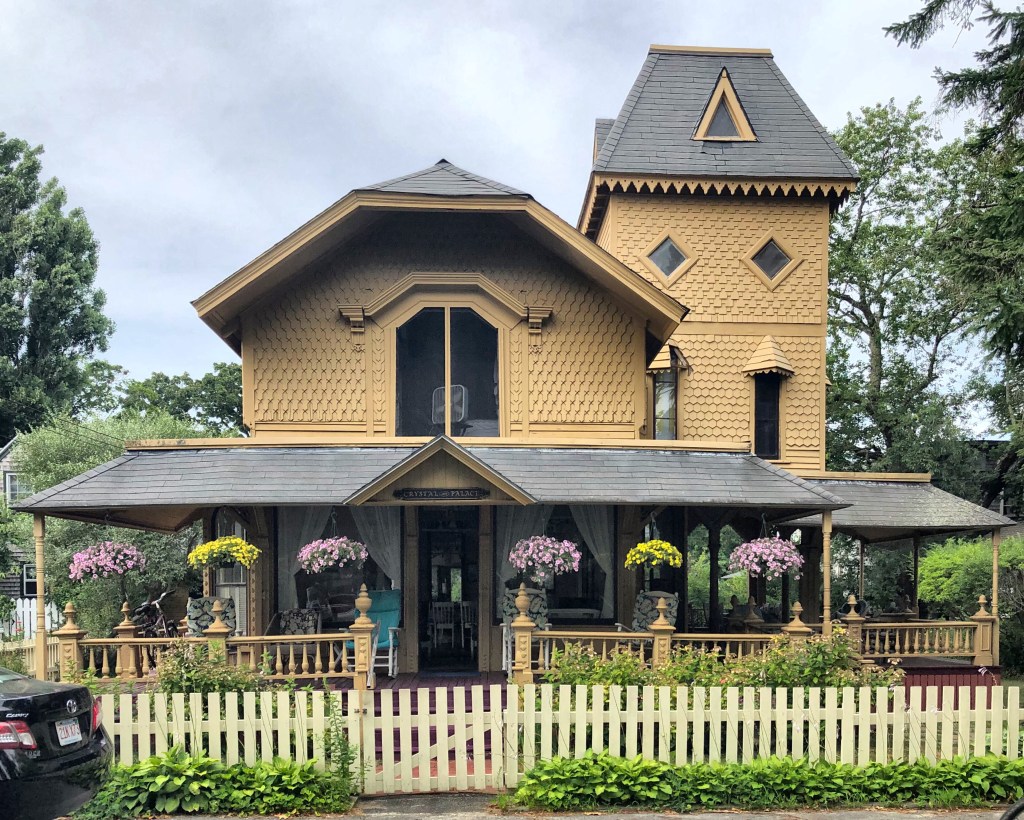
Crystal Palace // c.1870

The Crystal Palace cottage Pequot Avenue in Oak Bluffs was built by Henry Clark, a local builder of many summer homes on the island of Martha’s Vineyard. The cottage is a charming blend of Stick, Shingle, and Queen Anne styles, which works perfectly. The wrap-around porch is supported by turned posts with a balustrade capped by urns, the square tower has two elongated windows with eyebrow lintels resembling a face with bushy eyebrows. Oh the charm of Oak Bluffs, architectural eccentricity on every street!

The Tabernacle // 1879

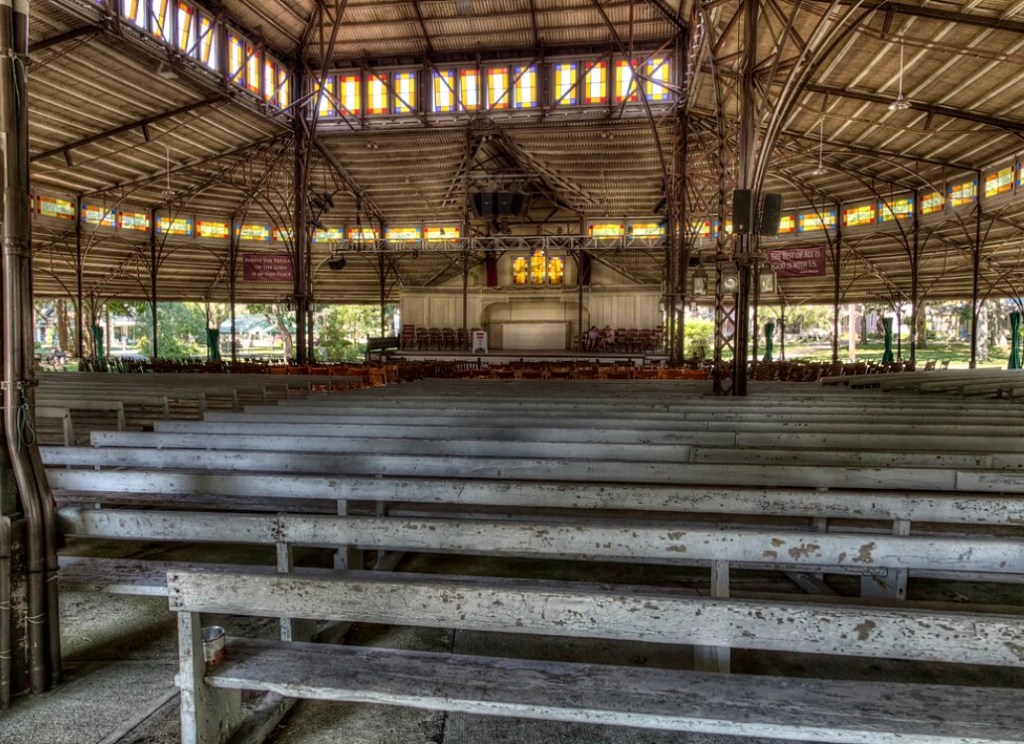
The year after Trinity Methodist Church was constructed, the Martha’s Vineyard Camp Meeting Association at Wesleyan Grove, built the wrought-iron Tabernacle, the most significant single building in the campground. The beautiful iron Tabernacle, which seats over 2,000, was designed and built in 1879 by John W. Hoyt of Springfield, Massachusetts. The building was completed in less than four months after the contract was signed. The Tabernacle covers the original consecrated ground of 1835 where the first Methodists erected canvas tents to worship under the trees. By 1869, the attendees at the revival meetings needed more protection from the sun and rain because the large oaks that had attracted the founders 35 years before had begun to die. Since 1870, the Association erected a mammoth canvas tent supported on tall poles every summer. The tent proved unsatisfactory because of ventilation problems and a tendency to collapse in storms. In 1878 the Association solicited designs for a large wooden tabernacle a building of vast roofs, minimal supports, and open walls. The plans it received, which were elaborate versions of the wooden
tabernacles or “arbors” of southern camp meetings, proved too expensive to build on this site. Campground resident John W. Hoyt solved the problem with a much cheaper wrought iron structure that was largely prefabricated and could be speedily erected on the uneven site. The gorgeous Victorian Gothic tabernacle remains today as the centerpiece of the Wesleyan Grove National Historic Landmark District, an esteemed historical designation.

Image courtesy of John G. Hoey.

Trinity Methodist Church // 1878

Located on Trinity Park in Wesleyan Grove (aka the Martha’s Vineyard Camp Meeting Association), this 1878 church served the year round Methodist community in Oak Bluffs. The Trinity Methodist Church is a towered, Victorian Gothic structure of some distinction. Edward M. Hyde, a Methodist minister who had trained in architecture and art, designed it. The property that the church and Parish House sit on belongs to the Association, but the buildings are maintained by the congregation. Interestingly, should the congregation disband, the buildings would return to the Association.

Union Chapel // 1870

One of the most unique buildings I have ever seen is the Union Chapel in Oak Bluffs on Martha’s Vineyard. The chapel, built in 1870 in the American Stick Style, is in the form of an Octagon, very unique for churches. Built as an inter-denominational house of worship, it is significant as the first non-sectarian religious building to be erected in a community that until 1870, was noted primarily for its strong association with the Methodist Church and its summer camp meeting (Wesleyan Grove) assemblies. The Chapel offered islanders and seasonal visitors regardless of religious affiliation
not only an opportunity to worship but a gathering place for cultural activities. According to historic images, the chapel once had more elaborate stick work and finials, since removed, likely due to storms and general maintenance concerns. The chapel was designed by island resident Samuel Freeman Pratt (1824-1920) who had no known architectural training besides working as a wood carver in Boston, yet his work is characterized as having a dynamic and festive style. Pratt’s other major contribution to Oak Bluffs’ architecture, the Sea View Hotel, was erected at the head of the wharf in 1872, but burned down in 1892.

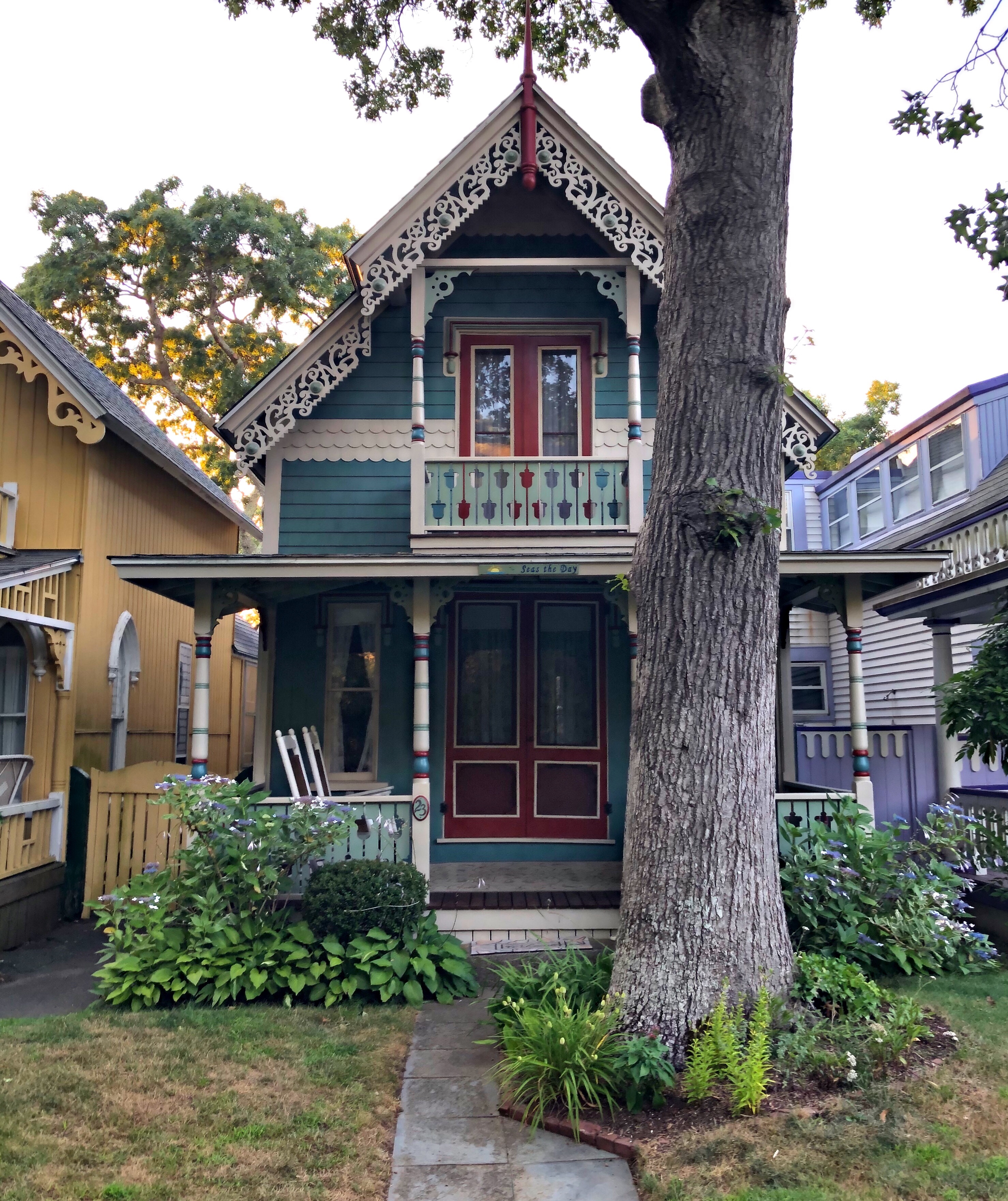
“Seas the Day” Cottage // 1875

This quaint little summer cottage in Wesleyan Grove was built in 1875 for Hanson Arnold, a merchant and methodist from Woonsocket, R.I. The home is typical of many other summer cottages in Oak Bluffs on Martha’s Vineyard, with its delicate stick work, turned posts, full-length porch, and second story balcony with pierced bargeboards. The home was at one point named “Seas the Day”, a trend of naming the cottages occurred sometime in the 20th century by families who summered on the island, many incorporating the family’s name somehow. The home was restored recently with all new detailing and a reversion back to the original porch configuration.

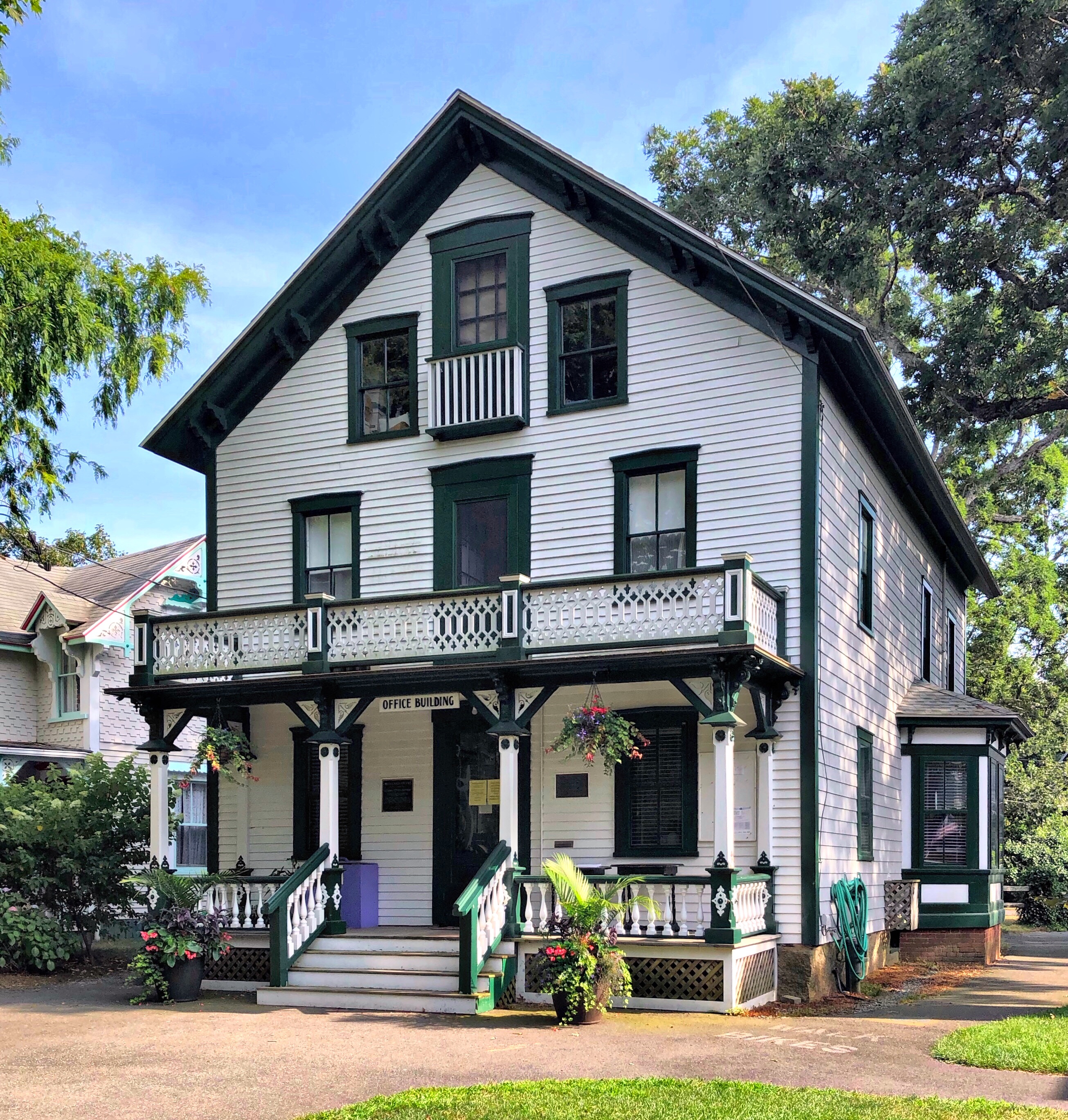
Methodist Camp Meeting Association Office // 1859

Located at the center of the Wesleyan Grove, – the Martha’s Vineyard Camp Meeting Association – this Italianate building has long served as a hub of the active summer community. The building was constructed in 1859, before any cottages were built in the newly formed summer colony. The office building was not only the headquarters for the Camp Meeting Association, it also served as a storage space for the baggage of the many who stayed in tents, many who didn’t have the means to purchase or rent a cottage. The building even was home to the associations’ post office. It now houses the Association director’s offices and contains the lease holders records back to 1864, a great way to learn about the diverse groups of people who visited and worshiped in this camp.

Riday-Evans Cottage // c.1880

This cottage on Ocean Ave in Oak Bluffs was built before 1880 for J.F. Riday, a manager at the American Mail and Export Journal at the Wesleyan Building on Bromfield Street in Boston. The quaint cottage was photographed shortly after it was built with Riday and two women (one likely being his wife) posing on the front porch overlooking the ocean. By the early 20th century, the home was owned by George and Corielle Evans, a couple from Mexico. They likely modified the home with the shingled siding and front porch with sheltered balcony above, while the original lancet windows and doors remained.