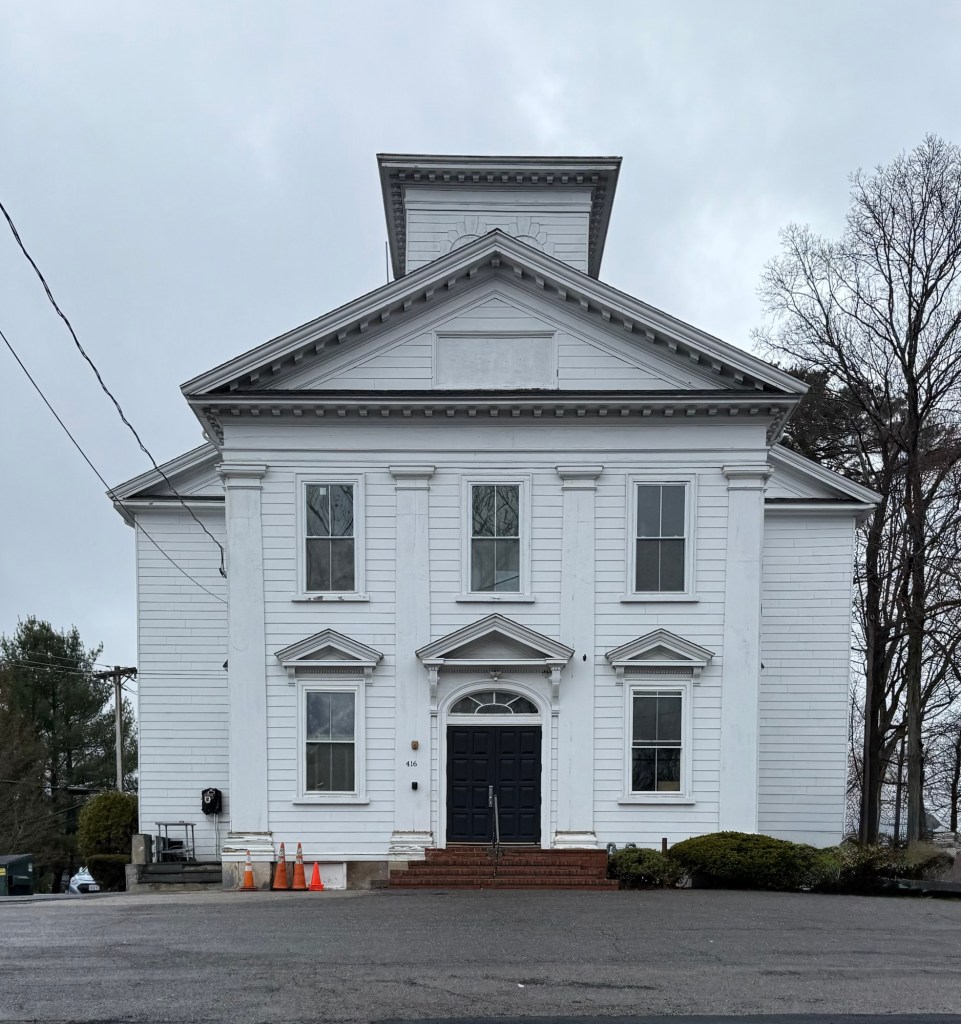
First Congregational Church of Abington – Abington Masonic Hall // 1819

The First Congregational Church of Abington, Massachusetts, was established in 1711. Besides the First Church, there were three additional churches founded in the town’s other villages: The Second Church in South Abington (now Whitman) Third Church of East Abington (now Rockland), and the Fourth Church at North Abington. This edifice was the third building of the congregation, and was built in 1819. The structure was only used as a church for 30 years until 1849, when the congregation built a new church nearby. This structure was sold and converted to a Masonic Hall and District Court for some years. Major changes to the building include the destruction of the steeple from the Gale of 1869, and in 1885, the present entryway was added, extending about 20 feet from the facade to provide a more adequate stairway to the second floor. Today, the building is used as a church for a local Brazilian congregation.

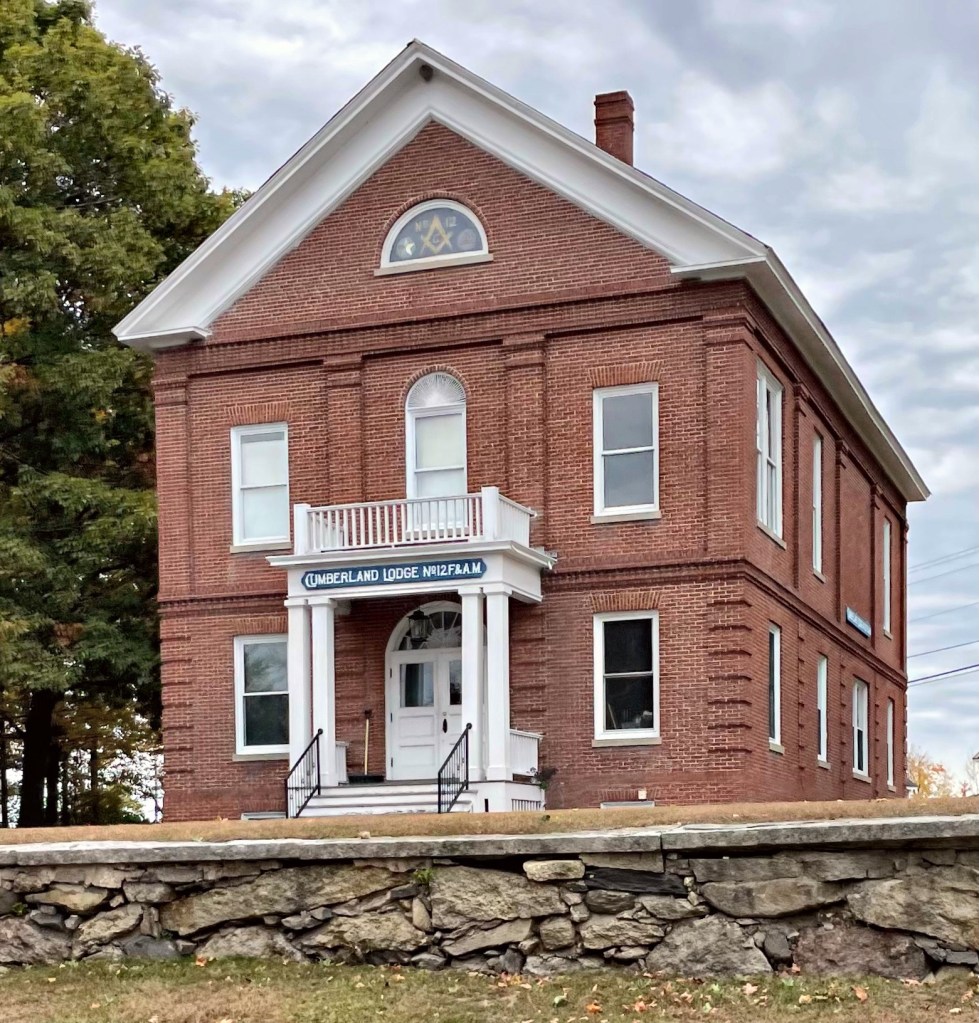
New Gloucester Masonic Lodge // 1902

Built in 1902 and dedicated in June 1903, the Cumberland Lodge of Ancient, Free and Accepted Masons #12 is located at the corner of Route 100 and Bald Hill Road in New Gloucester, Maine. The building was constructed as a centennial celebration of the local Masonic Lodge chapter’s founding a century earlier. The impressive and detailed brick structure exhibits engaged brick pilasters and a stained glass lunette (half-round) window in the gable. The building is still occupied and owned by the local Masons who hold meetings in the hall.

Everett Masonic Hall // 1910

Further up Broadway from Everett City Hall, you’ll find the town’s Masonic Hall, a now-vacant institutional building which contributes to the diverse streetscape and character of Everett’s built environment. The local Palestine Lodge of the Masons in Everett originally met in its original lodge, built in 1870. A corporation known as the Everett Associates, which included only Masons, subsequently constructed the original Masonic Building. The property burned in a fire in 1908, leading to a new building campaign by members. A site was acquired further up Broadway, and the groundbreaking was held on June 11, 1910, led by Everett Mayor Charles Bruce, a past master of the Palestine Lodge. Mayor Bruce also served as the chair of the Building Committee. In his remarks at the groundbreaking, Bruce noted the membership of the lodge as over 500 men! Inside the cornerstone, members placed: original papers from the former Masonic Building, a history of the Palestine Lodge, a list of lodge members, photographs, news articles, and other ephemera. The Boston architectural firm Loring and Phipps was responsible for the design of the building, which is constructed of water-struck brick and is of the Classical Revival style. After WWII, membership declined sharply, and the organization sold the building in the 1980s. From the mid-1990s to 2019 the building was owned by the Islamic Association of Massachusetts, and suffered from deferred maintenance. The red “X” on the building is for firefighters not to enter the building in case of fire or emergency. Luckily, the building was purchased and the new owner hopes to convert the building into housing, preserving the structure and using Historic Preservation Tax Credits. Fingers crossed!!

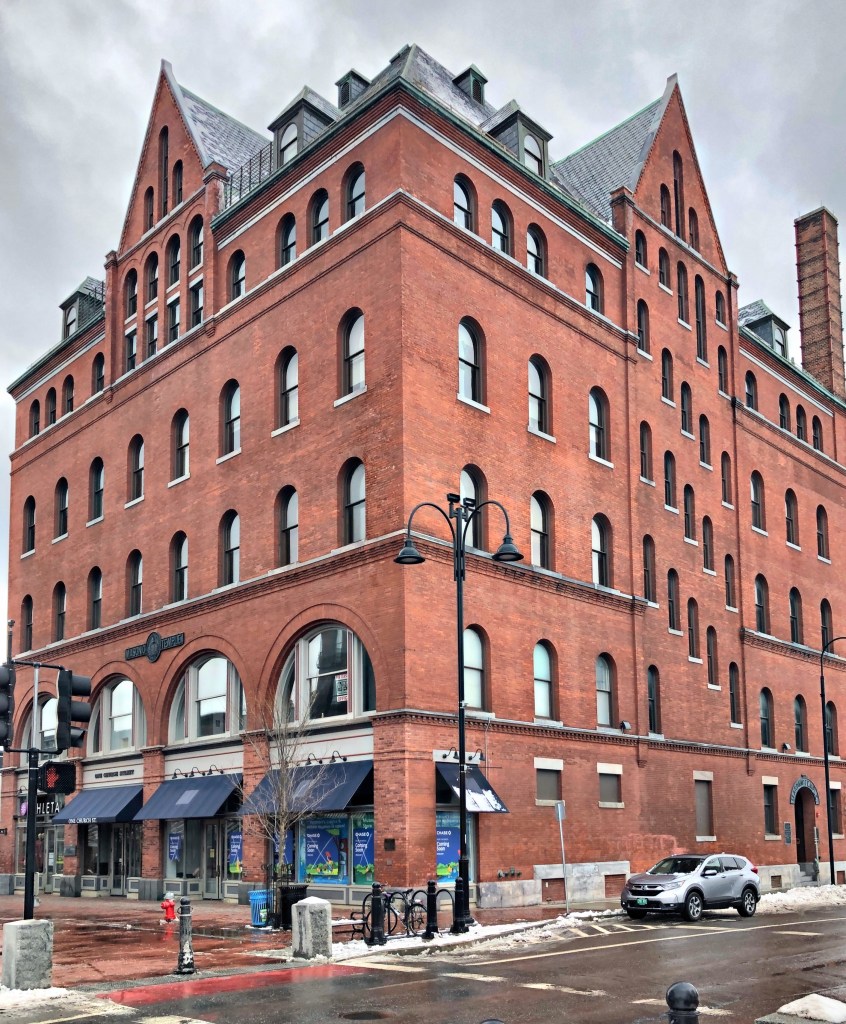
Burlington Masonic Temple // 1898

This large, imposing brick structure across from the Unitarian Church in Burlington, Vermont, was built in 1898 as the state headquarters of the Grand Lodge of Vermont, Free and Accepted Masons. Masonry, also known as Freemasonry, is the oldest and largest fraternity in the world, and they erected architectural landmarks in cities and towns all over the globe. At the end of the 19th century, the Masons in Vermont wanted a large new headquarters to host events and meetings for those visiting from all over. The building was designed by John McArthur Harris of Wilson Brothers & Company of Philadelphia at the time the firm was working on major buildings for the UVM campus. Above the retail use at the ground floor for rental income, multiple floors of meeting and banquet rooms, parlors, library, offices, and regalia spaces culminated in a fifth-floor assembly hall surrounded on three sides by a sixth-floor gallery. At the roof, the gables, along with small hipped dormers, animate a great hipped roof that evokes the symbolic Masonic pyramid. The massive roof, round arches, and a striking stair-step side elevation give the building a purely Richardsonian character, minus the carved sandstone and monumental arches.