Located on Tolland Turnpike in Willington, east of the Town Common, this temple-front Greek Revival home stands in an excellent state of preservation. The home was built for General Orrin Holt (1792-1855) in about 1840 after his work as a member of the Connecticut State House of Representatives 1830–1832, and in the Connecticut Senate in 1835 and 1836. He was re-elected as a Democrat to the Twenty-fifth Congress, serving until 1839. After leaving Congress, he served as Inspector General of the Connecticut State Militia, until his death in 1855. He likely built this home after leaving Congress in 1839, in his hometown. There is something about a temple-front home like this, they are so stately!
The Daniel Glazier Tavern is located at the west end of the Willington Green, an area showcasing great vernacular examples of Federal and Greek Revival architecture. The tavern was apparently built by Daniel Glazier as a stop along the route connecting Norwich, CT to Springfield, MA, where visitors could grab a bite to eat and/or stay the night to rest. Daniel’s son Isaac was the first tavern-keeper, followed by Daniel’s son-in-law Arial Eldridge until his death in 1849. The ballroom of the tavern had long been used in the winter months for town meetings, as he basement of the Town Meetinghouse, used for town meetings, lacked any form of heat. Since 2009, the property has been owned by the Willington Historical Society, who have restored the building.
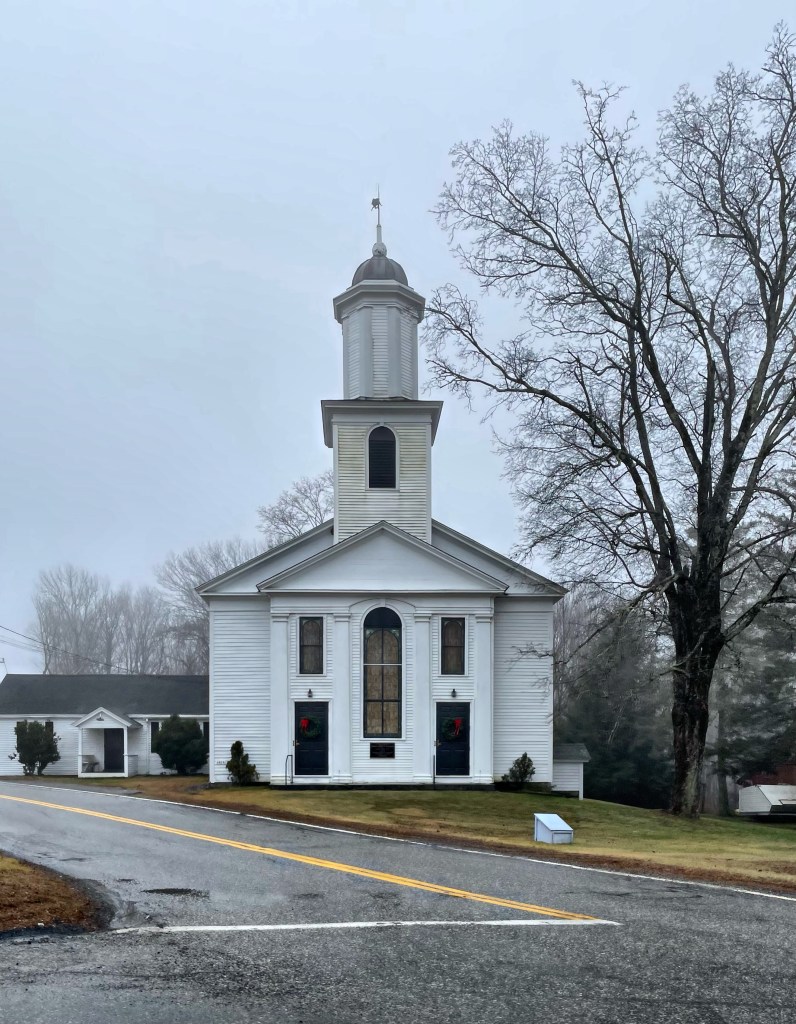
The Baptist Meetinghouse in Willington was built in 1829 by a local carpenter Albert Sharp, in a transitional Federal/Greek Revival style, common for the period. Its clapboarded facade has a projecting pavilion with two entrances flanking a two-story round-arched window. Four pilasters are surmounted by a wide entablature and the flushboarded pediment of the pavilion. Round-arched windows are repeated on the side elevations and the belfry, which is topped by an octagonal drum and a small dome. The Willington Baptist Church was organized in 1828, started by Rev. Hubbell Loomis, the fourth pastor of the Congregational Church across the common. Rev. Loomis was prominent both as a minister and an educator, and founder of Shurtleff College of Illinois. During his pastorate at the Willington Congregational Church, Mr. Loomis had strong tendencies toward Baptist sentiments. From this, membership of the congregational church split, some leaving for a new Baptist belief and others remained at the congregational church. The two congregations were split until 1911, when they again worshiped under the same roof, as the Federated Church of Willington, meeting in this building.
The Congregational or Town Church of Willington, Connecticut, has existed since the town’s incorporation in 1728, but originally met in a member’s small home on the Town Green. The Victorian Gothic style church we see today was built in 1876, after members gathered funds to construct the building. Land, materials, and labor were donated to offset costs for the small congregation. The church flourished until a split in the beliefs led to the formation of the Baptist Church of Willington. Eventually, the Congregational Church merged with the Willington Baptist Church in 1911 to form The Federated Church of Willington. The congregation then moved to the Baptist meeting house across the Green. In 1924, the Old Congregational meeting house, which was erected in 1877, was sold for $1 to the Town of Willington with certain restrictions, the most important of which was that, if it should cease to be used for public meetings under the control of the selectmen, possession would revert to the Congregational Ecclesiastical Society. From 1926-1974, the church was used as town hall (when the smaller building next door was outgrown. The church’s bell was removed during World War II to allow plane-spotters to use the tower. Instead of being placed back in the tower, it was mounted on a pedestal outside the building, where it remains today. The Willington Town Offices moved to a former industrial building a short distance away, but retain and maintain the building.
The Deacon Turner House, built in 1849, is an impressive Greek Revival house located at the Town Common in Willington, Connecticut. The Greek Revival portion was constructed onto an earlier house or store that was built 50 years prior. The one-story structure was likely moved and incorporated into the current house as a rear ell. The present house was designed by architect Augustus Treusdel of Coventry and built for Deacon John Turner by Emery Williams a well known local builder. John Turner was Deacon of the Willington Congregational Church, nearby.
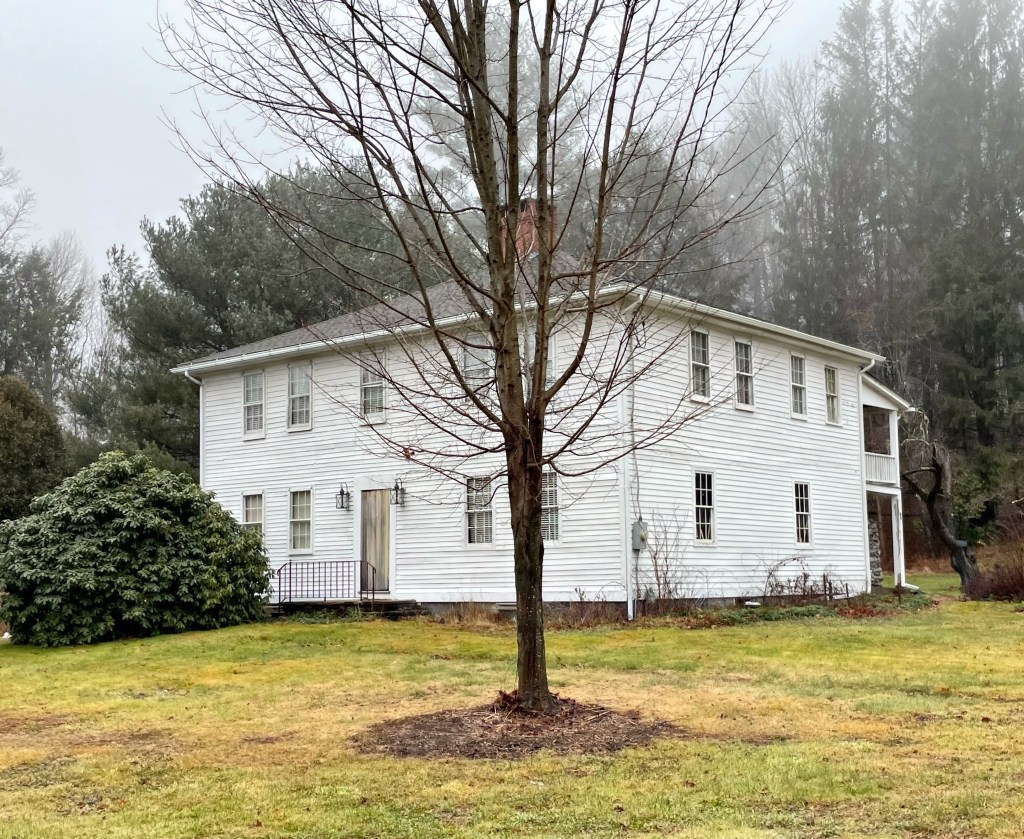
Located on the southern edge of Willington Connecticut’s town common, this vernacular example of the Federal style with later alterations is really appealing, mostly for its simplicity and proportions. The house was built around 1820 for Hiran Rider, who served as a judge, county sheriff, and town selectman. The Rider Family were hit by tragedy in 1851 when dysentery hit the household, killing Hiram, his wife Sarah, and their daughter. The home was altered by a later owner with 2-over-2 windows, an Italianate style door, and a door hood.
In 1824, prosperous gunsmith Asa Waters II set out to build the stateliest residence in the country. It took two full years to amass the necessary materials for what is now known as the Asa Waters Mansion and Mr. Waters spared no expense. Asa Waters II (1769-1841) was born in Millbury in 1813 to Asa Sr. and Sarah Waters. Asa earned the art of gunsmithing from his father, and in 1808 the junior Asa and his brother Elijah opened the Waters & Co. Armory along the banks of the Blackstone River, in what is now Millbury Center. Following the untimely death of his brother in 1814, Asa Waters carried on the business solo and secured lucrative arms contracts with the United States government. His invention of a lathe to turn gun barrels into the first seamless barrels revolutionized the manufacture of guns throughout the world, and provided his company a stockpile of cash. As a result, he hired Boston-based architect Asher Benjamin, to design a country house suitable of his stature. The mansion features two prominent facades with the primary distinguished by a colonnade of fluted two-story columns with composite capitals. The mansion remained in the Waters Family until 1929, when it was sold to the Roman Catholic Diocese of Worcester, as a rectory of a local church. In 1977 the Town of Millbury acquired the Asa Waters Mansion, and with little funding to maintain the property; in 1994, the Asa Waters Mansion had fallen into quite a bit of disrepair. The town proposed to demolish the mansion for a parking lot, but a group of locals worked together as the Asa Waters Task Force and petitioned to save the house: funds were raised, tradesmen in the community donated materials and labor. Saving the architectural landmark for generations to come.
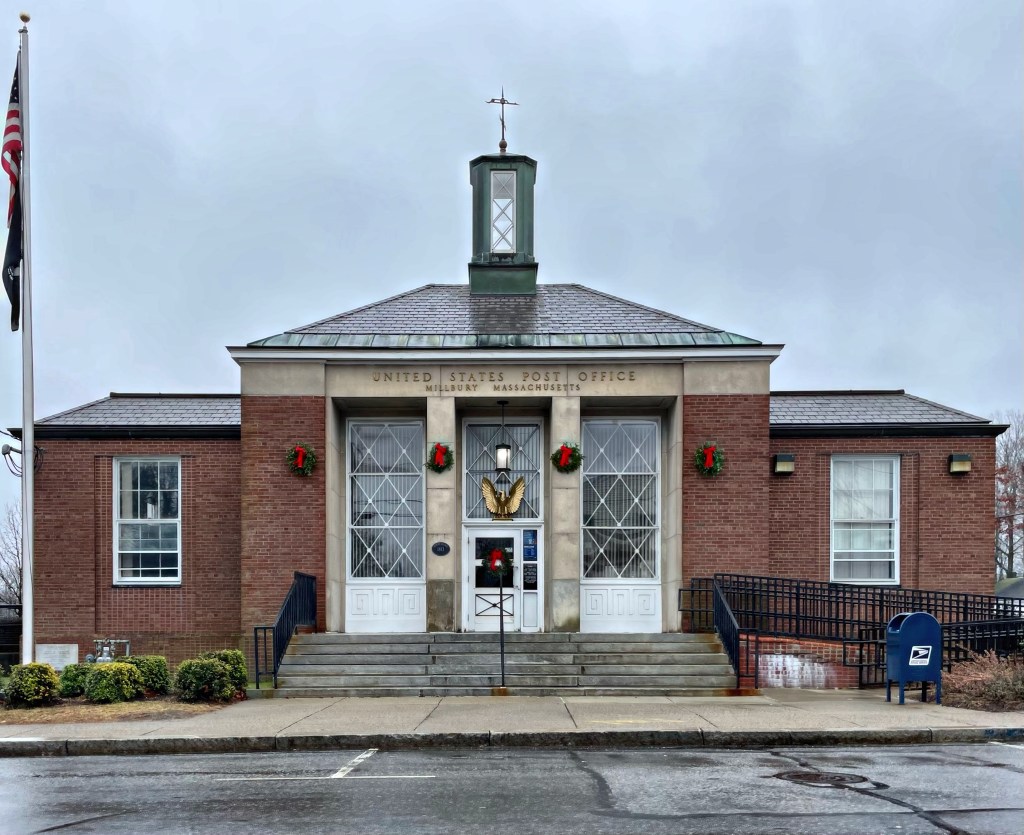
Located in downtown Millbury, MA, the town’s local post office stands as a great example of Art Deco and Colonial Revival architecture styles, showing how well different styles can be incorporated into a single, complimentary design. The Millbury Post Office building was constructed in 1940 from plans by Louis Adolph Simon, who served as Supervising Architect in the Office of the Supervising Architect for the U.S. Treasury from 1933 until 1939, when the office was moved to the Public Works Administration / Works Progress Administration. The post office was designed at the tail end of the New Deal programs to help stimulate local economies by building infrastructure and providing jobs to locals. Inside, a mural “An Incident in the King Philip’s War, 1670” was painted by Joe Lasker and installed in 1941 and was “revivified” in 1991.
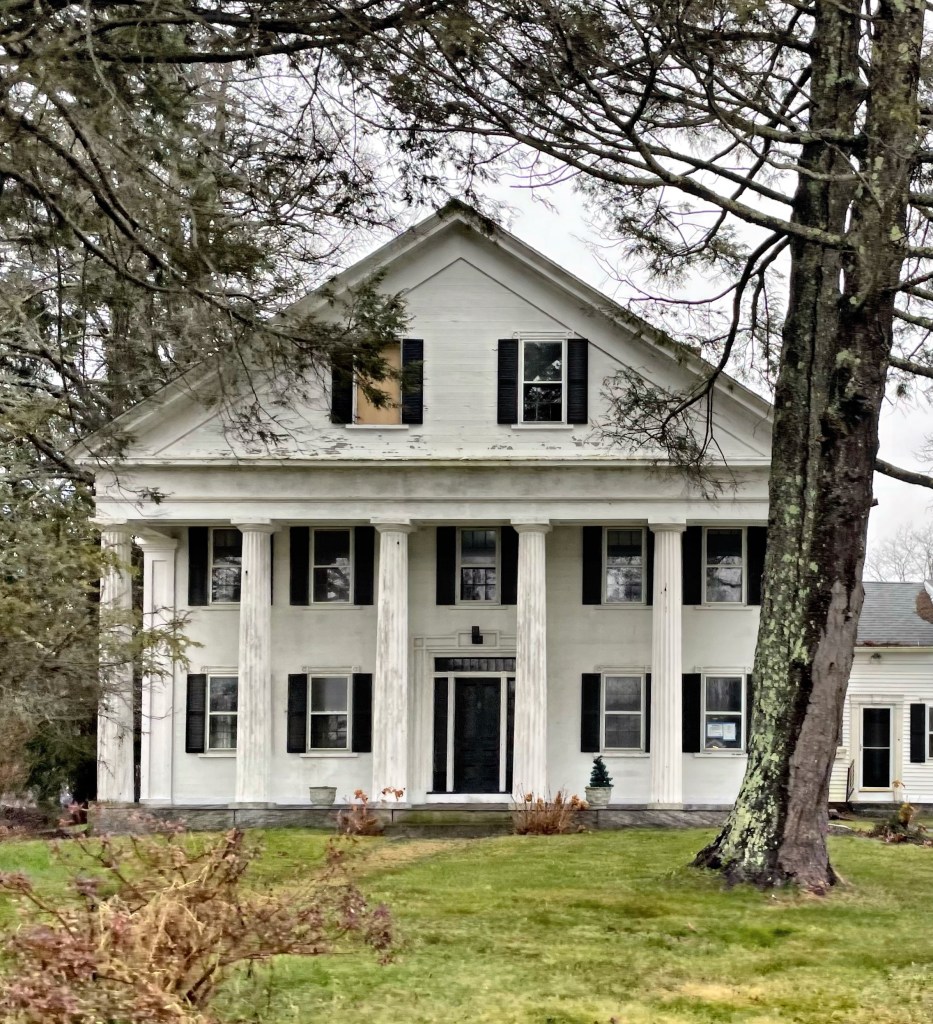
Elijah Waters (1773-1846), a hardscrabble farmer in West Millbury inherited his father’s large farm and resided there for over thirty years before wanting something more his style. Unmarried and without children, Elijah (who was 72 at the time), had this impressive Greek Revival farmhouse constructed near his old family homestead. He was possibly looking to spend money saved up and without a wife or heirs to will it to. The massive temple-front Greek Revival mansion has a stunning doorway and six columns supporting a projecting pediment. Within a year after the home was built, Elijah died. The home was willed to his nephew, Jonathan Waters. The house is for sale for $384,000 which is a STEAL!
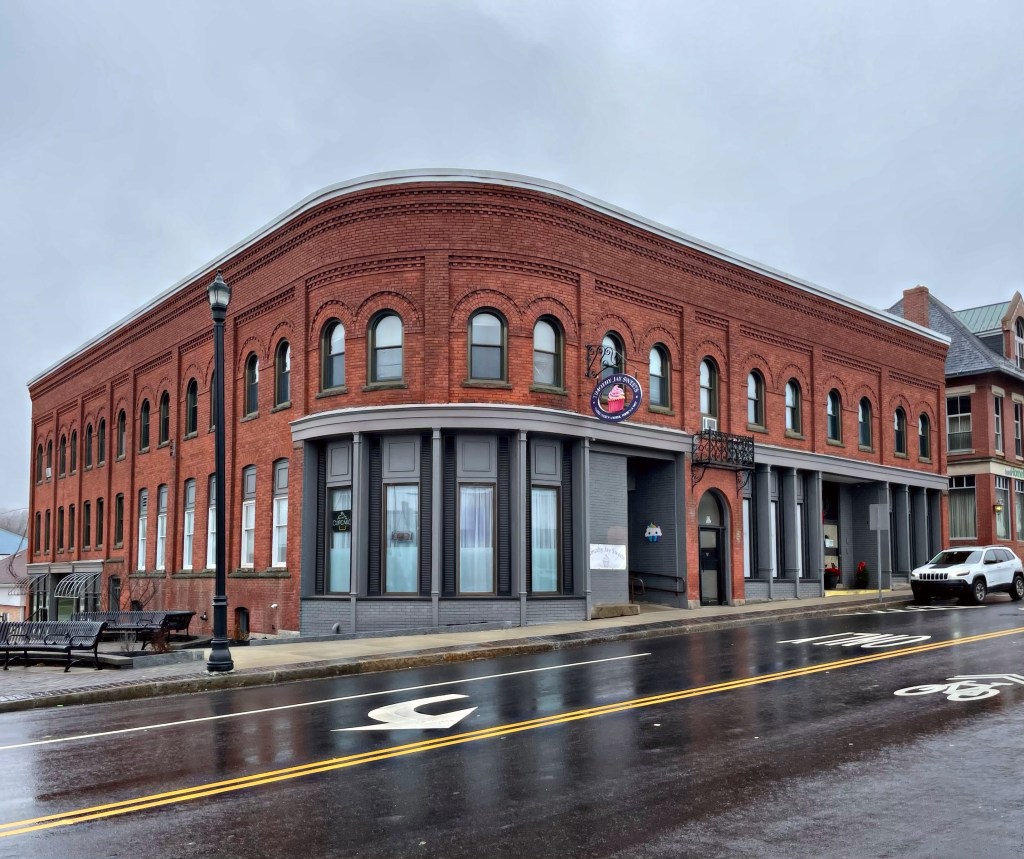
The Cunningham Block in Millbury was constructed by, and named for Winthrop P. Cunningham (1820-1895), and his son and business partner, Russell Clark Cunningham (1845-1907). Winthrop Cunningham had come to Millbury in about 1837 and worked for Waters, Flagg & Harrington prominent gun manufacturers in town. His foundry work there brought him into a partnership with Matthias Felton in the Millbury Foundry Company. The Cunningham Block is sited on a prominent corner lot and built into the slope of the hill which drops down toward the river. I am especially fond of the curved corner facade and repetition of the paired round-arched windows on the second floor.



 Buildings of New England