Old Chaplin Town Hall // 1840

The area that is now Chaplin, Connecticut was settled in the 18th century. The impetus to separate the community occurred due to the difficulty of area residents in reaching the churches in nearby town centers. Benjamin Chaplin (1719-1795), bequeathed funds for the establishment of a church near his (now no longer standing) home. A village center developed around the church, and the town was incorporated in 1822. The village is unusual in Connecticut for its relatively late development, and because the center is not near usable water power, and was bypassed by railroads, it was not affected by later industrialization. The main street is extremely well-preserved and a visual link to 19th century Connecticut. In 1840, the town erected this one-story Greek Revival building to serve as the town hall. The gable end reads as a pediment with the walls constructed of smooth vertical boards. The town outgrew this building and it became the town’s museum after the present town hall building was constructed in the northern part of the village. The museum closed and the building appears unused today. Hopefully the town can find a way to use the structure and maintain it.

Highgate Manor // c.1870

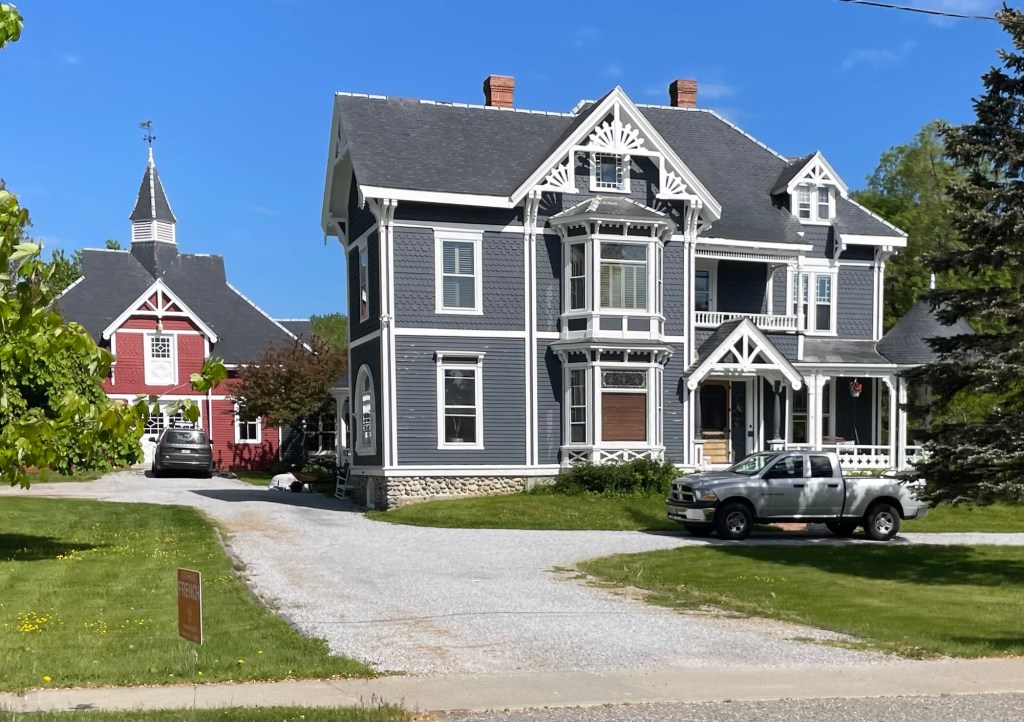
Henry Baxter (1821-1897), a doctor and owner of a local mill and multiple area farms, built one of the most remarkable Second Empire style houses in New England, and it can be found in the small town of Highgate, Vermont! Dr. Baxter was said to have acquired an earlier Federal period house on the site in the 1860s and began planning a high-style Mansard estate here for his family. The earlier Federal house was incorporated as a rear ell and the new Second Empire mansion was built in front. Architecturally, the house stands out for its bellcast mansard slate roof topped by a square belvedere with arched windows and heavy scrolled brackets. His patented medicine, Dr. Baxter’s Mandrake Bitters, was sold throughout Vermont in the late 19th century and afforded him the wealth to erect this stately home. There are many unsubstantiated claims of Dr. Baxter “performing experiments on his children” for the sake of people to state that the house is haunted, but this appears to be lore in poor taste. It is said that the house was also a stop on the Underground Railroad, but that appears unproven as well. After Dr. Baxter’s death in 1897, the property became a lodge and restaurant. A basement bar was built and during prohibition, was said to have hosted the likes of Al Capone. Today, Highgate Manor, with its larger-than-life lore, remains one of New England’s most important and high-style Second Empire houses in one of the most unlikely places. It goes to show that it is worth exploring all of New England!

St. John’s Episcopal Church, Highgate // 1831

St. John’s Episcopal Church stands in a grove of pine trees at the southeastern end of the Highgate Falls village green in Highgate, Vermont. The church is built in a transitional style which combines the pointed arches of Gothic architecture with a unique Gothic-Palladian window, but with a traditional plan and massing commonly found in Federal style churches in New England. The church was built between 1831-1833 by Joel Whitney of nearby Enosburg, and was consecrated on May 21, 1834, by Rev. John Henry Hopkins, the first Bishop of the Episcopal Diocese of Vermont. The congregation was a full parish until 1896 and maintenance has since struggled due to dwindling use. The wooden steeple was removed in the late 20th century, but the church stands as an important architectural landmark for the small town.

Highgate Springs Union Church // 1877

Rural parts of Vermont always surprises me with amazing old buildings. This white wood-frame church is known as the Highgate Springs Union Church, an 1877 edifice which effortlessly blends Victorian Gothic and Stick style details. The building became the village’s union church, providing a worship space for members of all denominations who on their own, could not afford the cost of building and maintaining a building. The small congregations eventually moved out and the church appears to now be largely unused beyond small events or weddings/funerals. I am glad to see it is kept up well at least!

Old Highgate Post Office and General Store // c.1830

In the small village of Highgate Falls, Vermont you will find this unique Federal period commercial building, and if you are like me, want to know more about it! According to historians, the building was constructed around 1830 and had multiple uses: a U.S. Customs House, a Post Office, and later as a general store for owners Stockwell & Steele. The brick structure suffers from some deferred maintenance, but is a significant piece of vernacular architecture in this sparsely visited part of the state!

Highgate Union Methodist Church // 1868

The Highgate Union Methodist Church in Highgate, Vermont was built in 1868 and is a high-style example of the Italianate architecture style in a relatively quiet part of the state. Built of brick, the church’s form is typical for small Vermont churches in the third quarter of the nineteenth century. Here, however, the builders were conscious of Italianate fashion, and they applied its round and segmental arches, corbels, and brackets, painted in a lighter color, with consistency and to remarkable effect.

Place House – Highgate Historical Society // c.1868

Highgate, Vermont sits at the Canadian border and first white settlement occurred in the 1780s. The new town of Highgate was named after the London suburb of the same name. The town grew in population and was largely a farming town with small industry along the the Missisquoi river. Most houses in town were built in the second half of the 19th century and into the 20th century, like this brick building in Highgate Center. The structure was originally built as a residence for James P. Place (1822-1888), who was employed as Sheriff beginning in 1868. The building may have even included a jail cell! After his death, the building became a catholic school and later became the home of the local Independent Order of Odd Fellows (IOOF) Hall. Today, the former Place House is home to the Highgate Historical Society and used as the town’s museum.

Benjamin Bosworth House // 1800

One of the most unique houses in Connecticut is this massive Federal style residence located in the small town of Eastford. Built next to the Congregational Church of Eastford (1829-2023), which burned down in 2023 by arson, the massive house has been known as both the Benjamin Bosworth House and Squire Bosworth’s Castle due to its first owner, Benjamin Bosworth (1762-1850). According to the Bosworth Family, the house was built in 1800 by Bosworth was a wealthy merchant, who hired Vini Goodell, a local carpenter to design and build the large Federal home. The house was completed by 1801 when the local Masonic group met in the building. As Bosworth was also a merchant, he used the basement as a storeroom. The house is also unusual for its monitor roof, a rarity in Federal period construction, which reads like a second structure on the house, due to the building’s size. After Bosworth’s death, the house was occupied by his niece, and was later purchased by Elisha Grant Trowbridge in 1897. Trowbridge was a grand-nephew of General Nathaniel Lyon (1818-1861), a local hero who was the first Union general killed during the Civil War. Trowbridge, an engineer, lived here until he died in 1963 at the age of 96. Later owners have had the monumental task of restoring and maintaining this behemoth of a house, to great success.

Ivy Glenn Memorial Hall // 1847

Methodists established a small congregation in Eastford, Connecticut by 1826, and by 1831, a new meeting house was built in the center of the village. The meeting house was used jointly by Methodists and Universalists, each having the right to occupy it half the time. By 1847, Methodists here were able to erect their own church, this building, in the Greek Revival style. Originally, the building had two doors on either side of a center window in the façade. There was a steeple and, rare in those days, a pipe organ in the sanctuary.  In 1916, the church joined with the nearby Congregational church, requiring them to sell the building ten years later. The town of Eastford bought the structure for $200 in 1926 for use as a town hall. In 1934, the Civil Works Administration provided funds to renovate the building with the town library being installed in a portion of the basement along with town offices and a vault. Town meetings were held in the former sanctuary space upstairs. When the space was outgrown for town offices, a new building was constructed elsewhere and this building transitioned to solely library use. The renovation project was paid for by money bequeathed by Wilmer Glenn, a New York stockbroker who spent summers town. He donated funds in memory of his late wife, Ivy.  The present-day name of the building came to be the Ivy Glenn Memorial and the library moved into its new spacious home in 1972.

Sumner-Carpenter House // 1806

I don’t think any state does the Federal style as well as Connecticut (Massachusetts is a close second)! This is the Sumner-Carpenter House, a high-style example of a Federal residence that is located on the backroads of the small town of Eastford, Connecticut. The house was built in 1806 for John Newman Sumner (1775-1831) who resided here until just before his death. The elaborate Federal period house was sold out of the family. After trading hands a half-dozen times, the property was purchased by David and Harriet Carpenter in 1881. The property remained in the Carpenter family for generations, and remained as such after Orlo Carpenter (1865-1938) was killed in the collapse of a barn during the hurricane of 1938. Architecturally, the house has all of the hallmarks of the Federal style, with the symmetrical main facade five bays wide, with a center entrance flanked by wide sidelights, and topped by a fanlight transom and corniced entablature. The window above the entrance is in the Palladian style, with a rounded center window flanked by narrower sashes. The house is very well preserved and was listed on the National Register of Historic Places for its architectural quality and preservation.