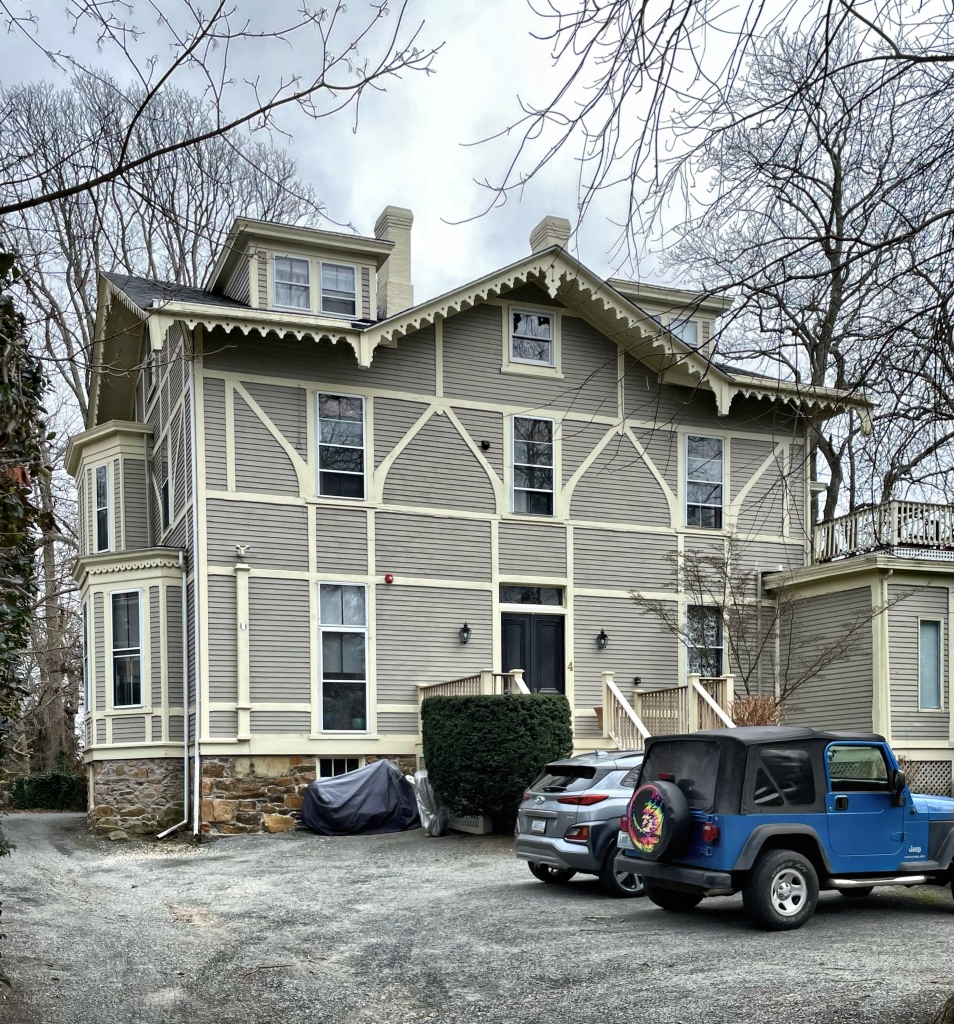
Sunnycroft in Newport was built in 1873 as the summer cottage for Philadelphia socialite couple Elizabeth K. Ashhurst Willing and her husband Richard Willing on land given to them by Elizabeth’s father William. The house is a blending of Gothic and Stick styles, with half-timbering and bracing across wall surfaces and bargeboard at the eaves. By the turn of the 20th century, the house was owned by Henry Casimir DeRham and his second wife, Georgiana. DeRham was the grandson of a wealthy New York banker of the same name. This house (while still ornate) is a more modest example of the summer cottages in Newport and shows the wide-range of tastes seen in the Gilded Age.
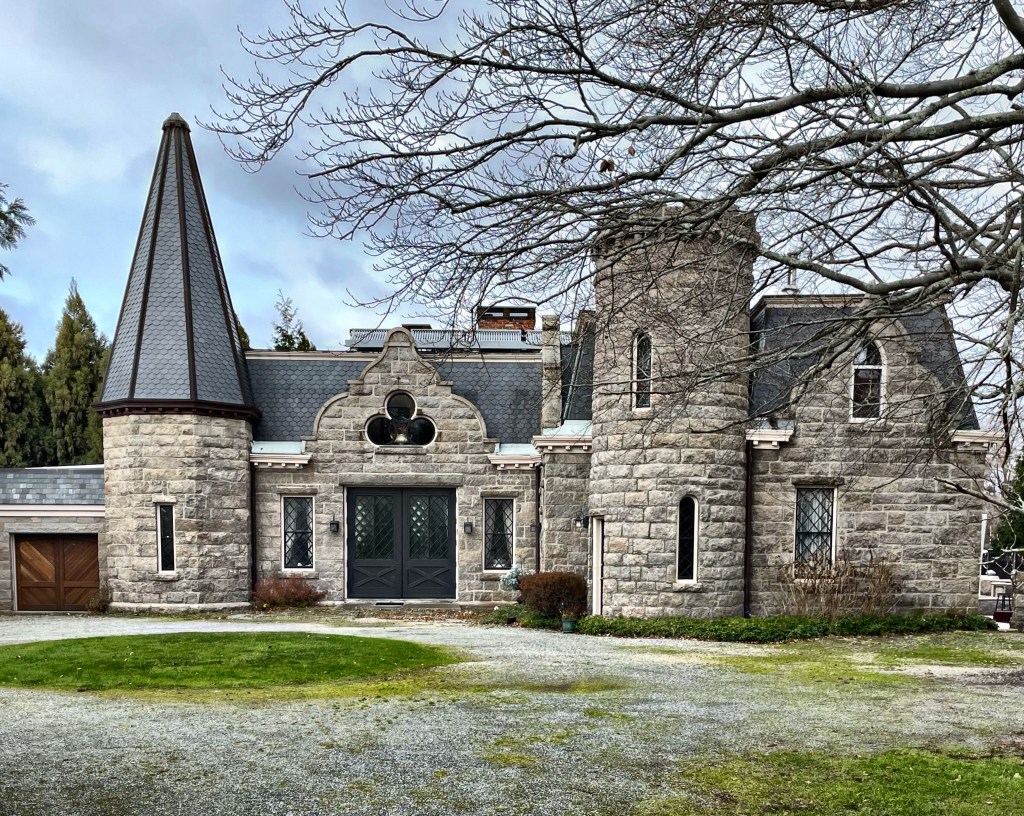
Just past the Belair Gate Lodge (1870), you w5ll find one of the most eclectic and interesting buildings in Newport, Rhode Island. This structure was built around 1875 as the stable to the larger Belair estate, just a stone’s throw away. When it was built, local papers stated the building was “probably one of the most expensive stables in the city.” It was designed by Newport architect Dudley Newton at the same time he redesigned the main mansion and furnished plans for the new gate lodge for owner George H. Norman. Architecturally, there is A LOT going on here. The 1½-story, rough-face-granite-ashlar building is capped by a hexagonal-tile slate mansard roof. On the left is an octagonal tower with an out-of-scale roof pitch and at the other side of the carriage door is a circular-plan tower with battlemented parapet. At the center is a really unique trefoil gable with trefoil window centered within. So cool to stumble upon this!! Oh, and it’s now a single-family home. Swoon.
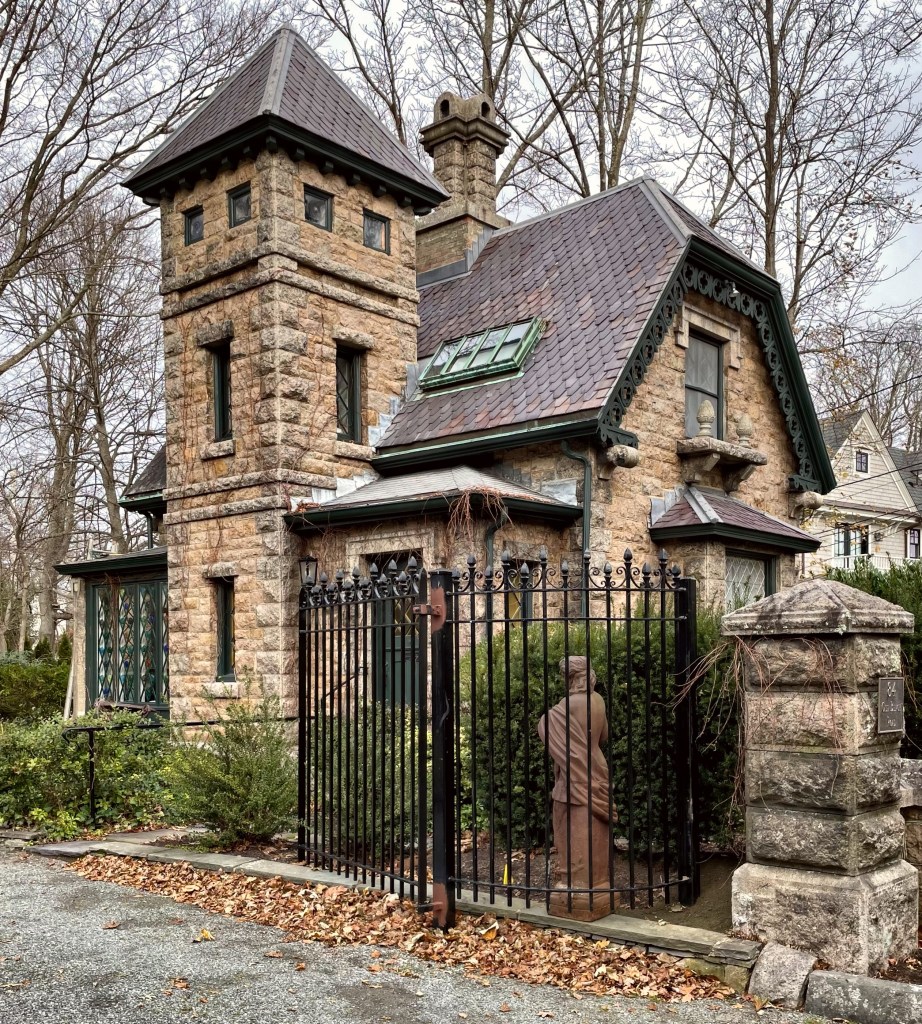
Located at the historic entry to Belair (last post), one of the largest estates in Newport, you would be greeted by this charming stone building, the Belair Gate Lodge. The building is symmetrically massed, 1½-story and built of rough-face-granite-ashlar, similar to the main house. This building can be classified as French Eclectic in style and was designed by Newport architect Dudley Newton, who also designed the 1870 Second Empire renovations to the main house at the same time for owner George Henry Norman. When the Belair estate was subdivided, the gate lodge was sold off as a separate unit, and is now a single family home, aka my dream home. There is something so enchanting about gatehouses!
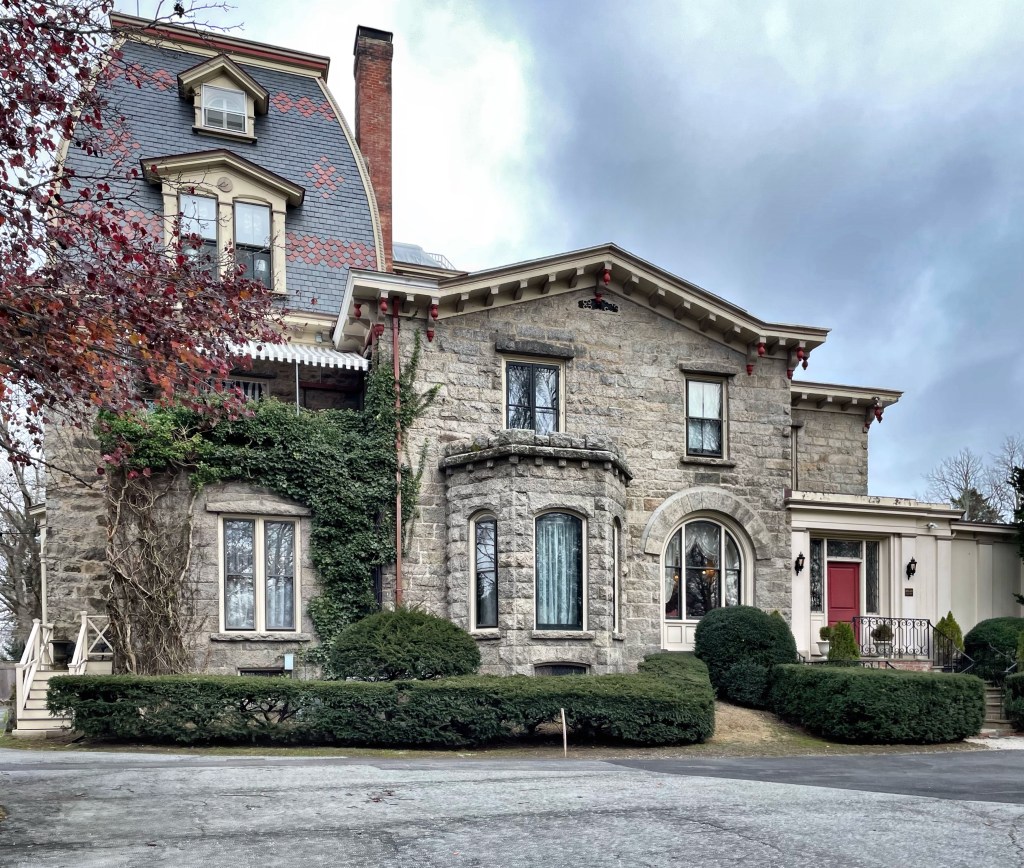
One of the most stunning summer “cottages” in Newport, Rhode Island is this stone behemoth named “Belair”. The house is set back way off the street and was one of the first summer estates built in this section of Newport. Belair was built in 1850 for New York oil baron H. Allen Wright in the Italianate style and constructed of roughly dressed stone and was originally about half of the size of the current footprint. The mansion was designed by architect Seth C. Bradford, who is also credited as architect of the similarly designed Chateau-sur-Mer, built one year later. Wright sold this house to George H. Norman two years after its completion. Norman (1827-1900), founded the Newport Daily News in 1848 and made his fortune as an engineer, first establishing gas works and later water works systems across New England, New York, and the Midwest. Norman made a fortune, and renovated and expanded his mansion in 1870 from plans by Newport architect Dudley Newton, with grand Second Empire additions, including the high convex-mansard corner tower. The original four acre Belair property has been extensively subdivided, and this house now occupies a lot of about an acre; with the original outbuildings sold off, and Belair is now 11 condominium units!
One of the most eccentric and over-the-top houses in Newport (a town full of over-the top houses) is this home on Cottage Street. The original house was built around 1850, likely as an Italianate style residence with a flat roof. Early owner Elbert J. Anderson (1800-1888) who was born and raised in New York City. In Manhattan, Anderson was a director of The Manhattan Fire Insurance Company; the Farmers’ Loan & Trust Company; and The Phoenix Bank. He married Martha Maria Ellery, the eldest daughter of the late Abraham Redwood Ellery. In 1847, his wife inherited the Redwood Farm at Portsmouth, six miles from Newport, and they eventually moved there permanently. They maintained this summer cottage in Newport to remain close to high-society. The home was sold to George and Annie Collins, who likely modernized the residence with the bays, porches, and frilly details. By the early 20th century, the property was owned by Gustave and Amanda Muenchinger, who ran a hotel at the corner of Bellevue and Catherine streets.
This large frame house in Newport, Rhode Island was built for Tillinghast Tompkins in 1854. The house is a formal example of the Italianate style of architecture, of which many great examples can be found in the coastal town. Character-defining features of the style on this house include the elaborate round-arch bargeboard with acorn pendants, tripartite round-arch windows in façade’s attic, and the important wide cornice with large triple-arch paired brackets with acorn pendants. The house was occupied by Tillinghast for just a few years until his death in 1860. His widow, Charlotte owned the property until her death in 1899, upon which time it was inherited by their son, Hamilton Bullock Tompkins, a historian and author.
Completed in 1880, the Newport Casino building is one of the best examples of Shingle style architecture in the world, and despite its name, it was never a gambling facility. Planning for the casino began a year earlier in August, 1879. Per legend, James Gordon Bennett, Jr., the influential publisher of the New York Herald and a summer resident of Newport, bet his polo partner, Captain Henry Augustus Candy, a retired officer of the Queen’s 9th Royal Lancers and skillful British polo player, to ride his horse onto the front porch of the exclusive gentlemen’s-only club, the Newport Reading Room. Candy took the dare one step further and rode straight through the clubrooms, which disturbed the members. After Candy’s guest membership was revoked, Bennett purchased the land across the street from his home, on Bellevue Avenue, and sought to build his own social club. Within a year, Bennett hired the newly formed architectural firm of McKim, Mead & White, who designed the U-shaped building for the new club. The Newport Casino was the firm’s first major commission and helped to establish MMW’s national reputation. The building included tennis courts, facilities for other games such as squash and lawn bowling, club rooms for reading, socializing, cards, and billiards, shops, and a convertible theater and ballroom. In the 20th century, the casino was threatened with demolition as Newport began to fall out of fashion as a summer resort. Saviors Candy and Jimmy Van Alen took over operating the club, and by 1954, had established the International Tennis Hall of Fame in the Newport Casino. The combination of prominent headliners at the tennis matches and the museum allowed the building to be saved. The building remains a National Landmark for its connections with gilded age society and possibly the first commission by McKim, Mead and White, who became one of the most prominent architectural firms in American history.
Ochre Court, one of the grandest mansions in America was built in 1892 for New York banker and real estate developer Ogden Goelet (1846-1897) and his wife, Mary Wilson (1855-1929). In 1879, Ogden and his brother, Robert, inherited a real estate empire in Manhattan of 259 houses then worth a combined $40 million which was second only to the Astors. In 1892, Goelet and his wife Mary were included in Ward McAllister‘s “Four Hundred“, purported to be an index of New York’s best families, published in The New York Times, a position only solidified after his summer “cottage” was completed that year in Newport, Rhode Island. Named Ochre Court, the 50-room chateau overlooks the Cliff Walk and Atlantic Ocean and is the second-largest mansion in Newport (after The Breakers). Ochre Court was designed by architect Richard Morris Hunt, who also designed The Breakers, and summered in town himself. Shockingly, the Goelet’s only occupied the home during an eight-week summer season, and they spent the rest of the year in their homes in New York City, France, or London. The operation of Ochre Court usually required twenty-seven house servants, eight coachmen and grooms for horses and their carriages, and twelve gardeners for the grounds. In 1947 the Goelets’ son, railroad, hotel, and real estate developer Robert Goelet IV (1880-1966), gave ‘Ochre Court’ to the Religious Sisters of Mercy to establish Salve Regina College after it became too expensive to maintain. ‘Ochre Court’, which housed the entire college during its first years, is still in use and remains the heart of the greatly expanded Salve Regina University.
You know you’ve “made it” if you have a music room, especially if you have one in your summer mansion in Newport! The Music Room in The Breakers evokes the opulent Parisian interiors of the Second Period and when inside the room, you just feel sensory overload (in the best way possible. The room is located off the Great Room and Morning Room, at the southern end of the house. The Music Room was used for recitals and dances for the Vanderbilt Family and guests. The room displays ornate woodwork and furnishings designed by Richard Van der Boyen and built by J. Allard of Paris. The room looks like it was plucked out of a French building and dropped into the mansion, and that is because it was! The room’s interior was constructed completely in France and then sent to America where it was installed at The Breakers by French craftsmen. My favorite parts of the interior are the bay window at the end and the gilt gold coffered ceiling.
Possibly my favorite room in The Breakers mansion is the Morning Room, found on the first floor, just off the Great Hall and lower loggia. The Morning Room is executed in a late Renaissance style and faces east to catch the morning sun and provides sweeping views of the Atlantic. It served as a family sitting room at all times of the day. The interior design, including the fixtures, woodworking, and furniture, were designed by French architect Richard Bouwens van der Boijen and designer Jules Allard. The predominant grey, and gold colors of the Morning Room are echoed in its fireplace which is made of Campan marble. On the walls, you will find the most stunning shimmering silver wall panels, depicting ancient Greek goddesses. It was originally believed that these features were silver leaf, but the Newport County Preservation Society investigated further, determining it is actually platinum! The Vanderbilts clearly wanted this room to shimmer with the sunrise, so the use of platinum, which never tarnishes, was a great solution!


 Buildings of New England