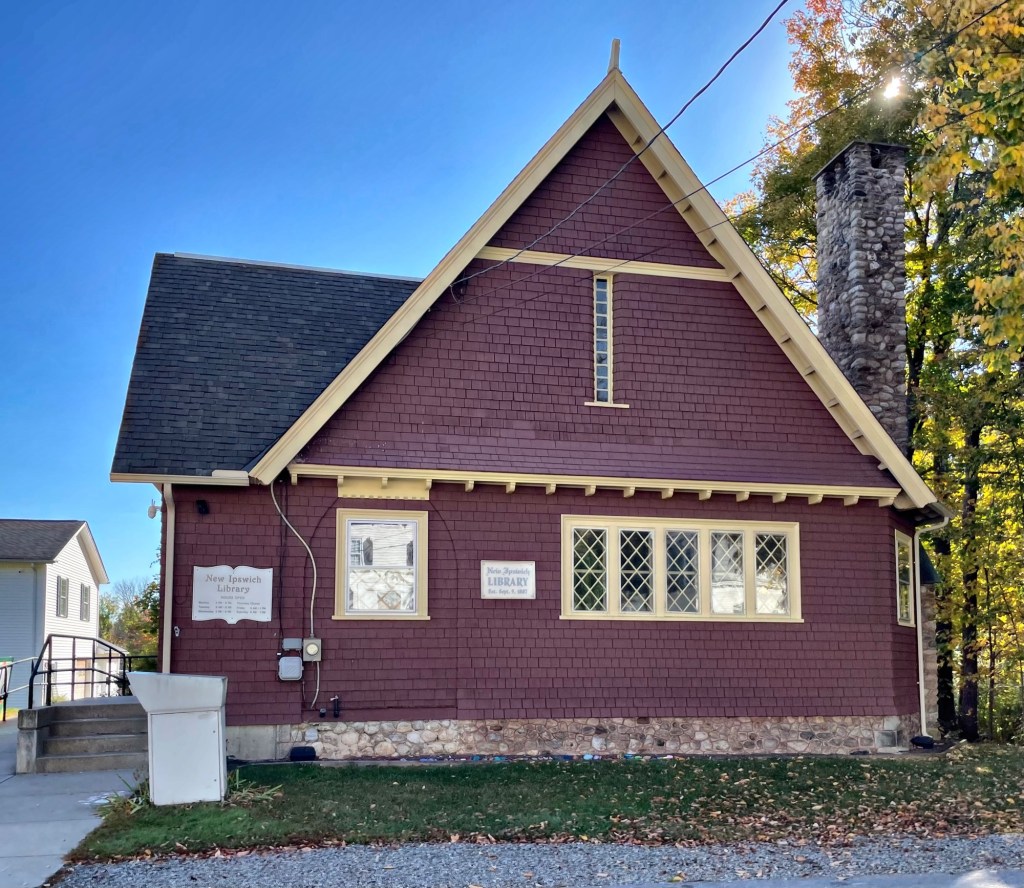
The New Ipswich Public Library is a one-story Shingle style building on Main Street in the charming village of New Ipswich, New Hampshire. The library building was likely designed by Ernest M. A. Machado, one of the best, and relatively unknown architects of the late 19th and early 20th century in Salem. The entrance which faces the side, is flanked by two diamond-pane windows, which can also be found on the primary facade. A special ten-light vertical window is recessed within a shingled depression in the gable, which adds some complexity to the design.
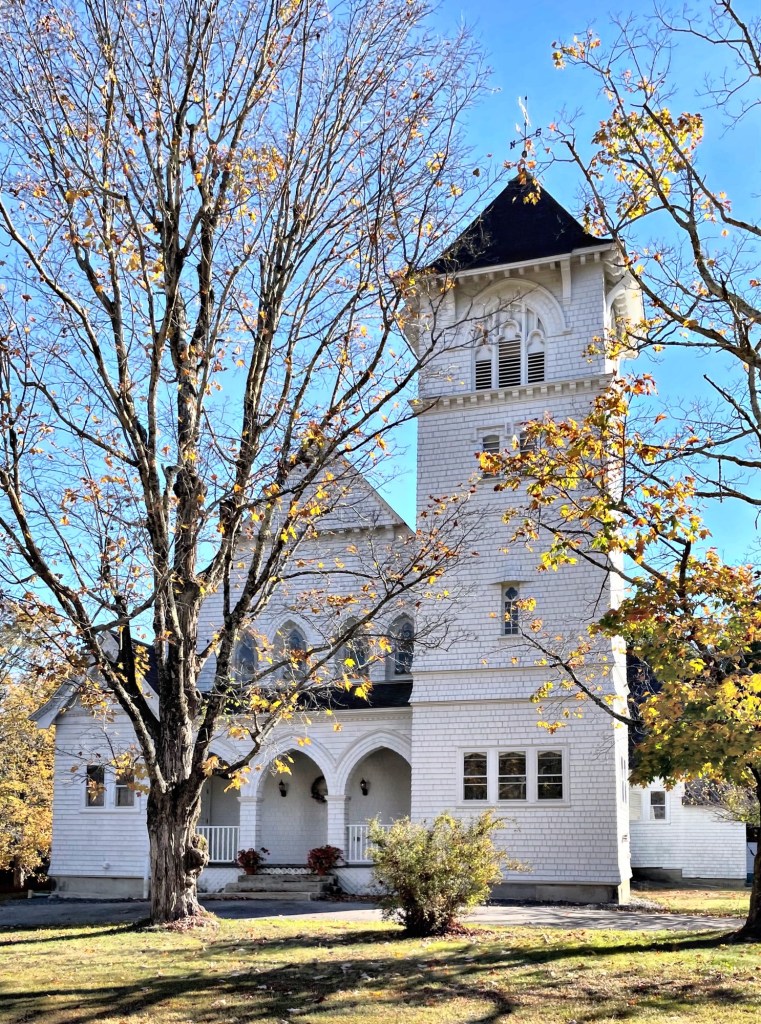
The New Ipswich Congregational Church was built in 1903, replacing the former 1813 Meeting House on the site, the fourth in the town, which stood here until a fire caused by lightning destroyed it in 1902. Interestingly, the design is more Victorian than Colonial Revival, which makes this church stand out amongst the village dominated by Georgian, Federal and Greek Revival style residences. The present building blends the Shingle style with Gothic elements with the tracery at the belfry and lancet windows. The architects were Gay & Proctor of Massachusetts who created a statement building with iconic tower that has been well-preserved by the congregation ever since.
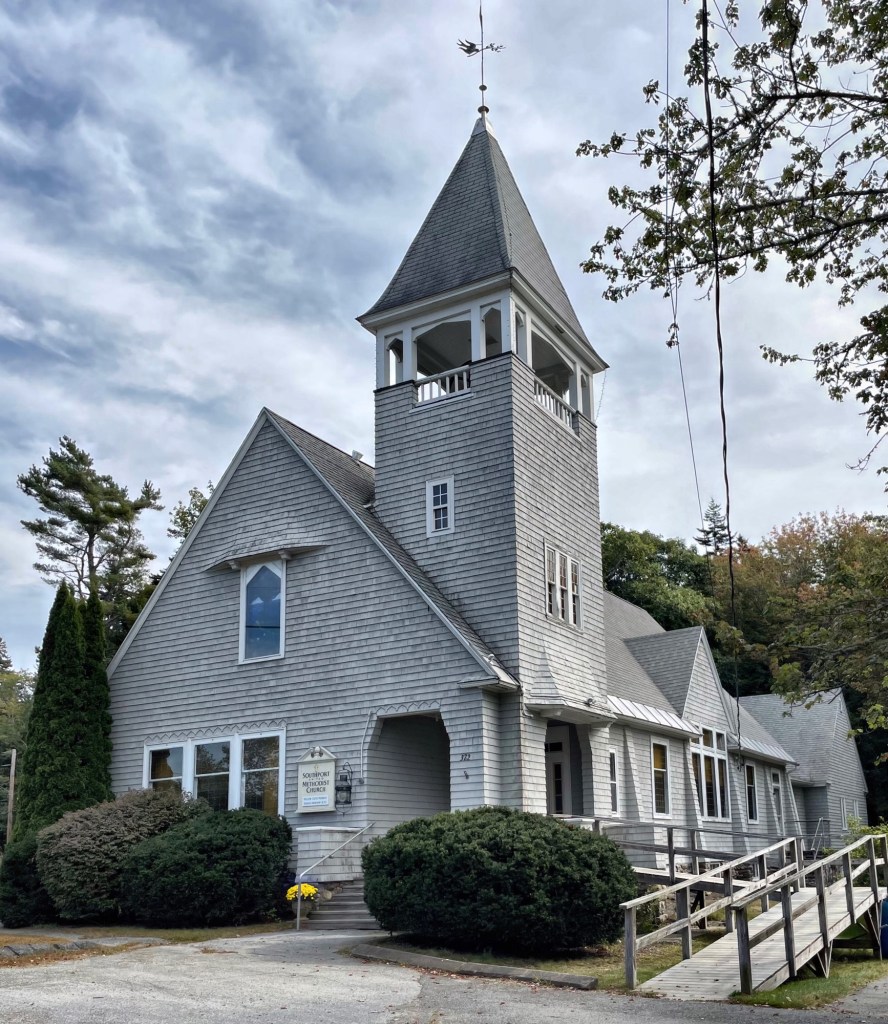
The Southport United Methodist Church of Southport sits cross the street from the Town Hall of Southport, Maine, and is one of the best examples of a Shingle style church in the state. The modestly sized church was built in 1904, shortly after a fire destroyed the local Methodist congregation’s former church building. Members hired the great Maine architect, John Calvin Stevens, who had just joined in a professional partnership with his son, John Howard Stevens, to design the new church. It remains as one of the more notable architectural landmarks in the town of roughly 600 year-round residents.
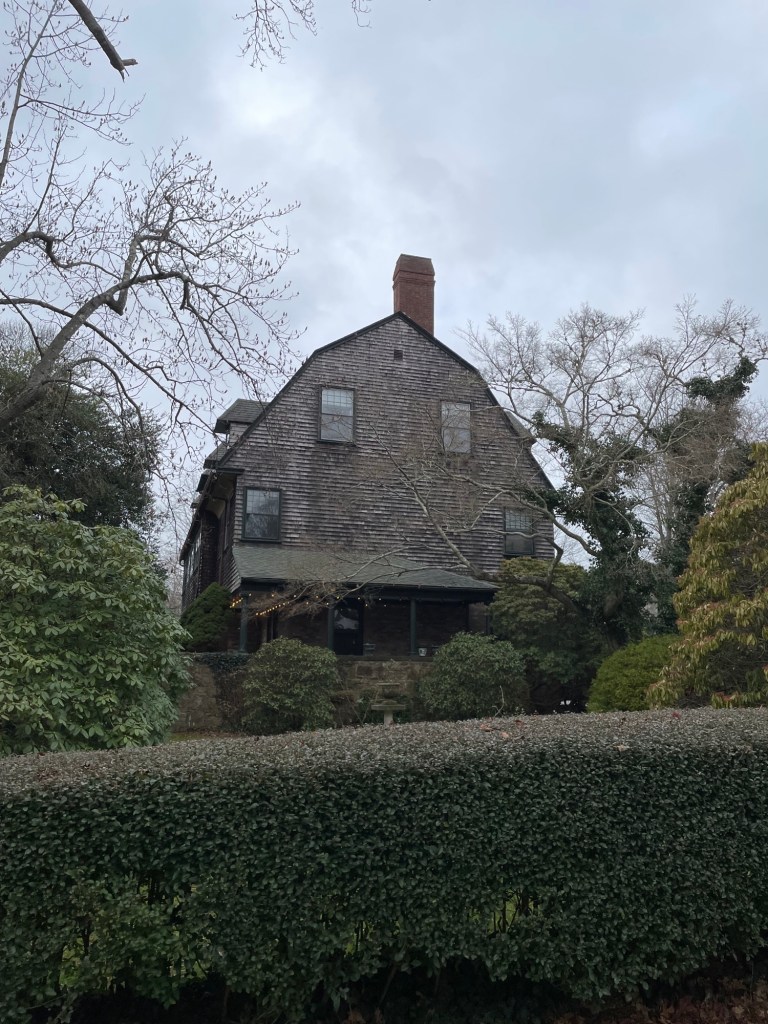
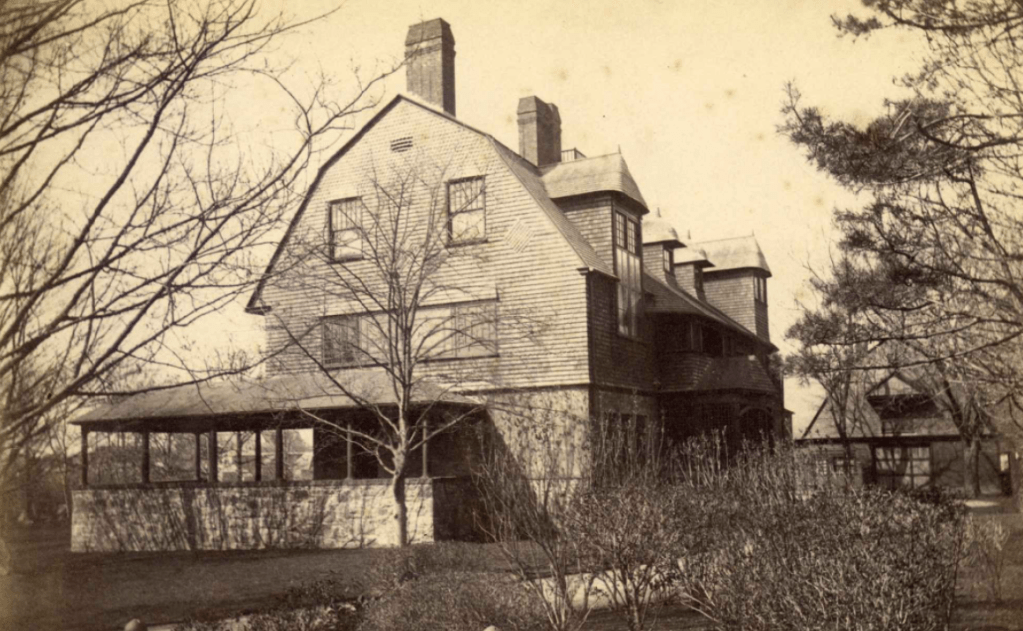
“Boxcroft” (also known as “Whileaway”) is a historic Shingle style summer “cottage” on Red Cross Avenue in Newport, Rhode Island. While it is surrounded by vegetation and tucked away, not facing the road, the house is a landmark example of the architecture style and very significant. The house was completed in 1883 from plans by the architectural firm of McKim, Mead & White a white shoe firm who designed many summer cottages in Newport for social elite. The original owner was Samuel Colman (1832-1920), a well-known landscape artist, the first President of the American Water Color Society, a connoisseur of Oriental art and an interior designer in business with Louis Comfort Tiffany specializing in fabrics and wallpaper. Colman lived here with his first wife, Ann Lawrence Dunham until her death in 1902. The property was later owned by Mary Appleton, an unmarried daughter of publisher William Henry Appleton. She would sell Boxcroft to lawyer and socialite J. Coleman Drayton, years following his bitter (and very public) divorce from Charlotte Augusta Astor, a member of the prominent New York Astor family, following a cheating scandal by Charlotte. Mr. Drayton died in Newport in 1934. Boxcroft remains an architecturally and historically significant piece of Newport’s Gilded Age.
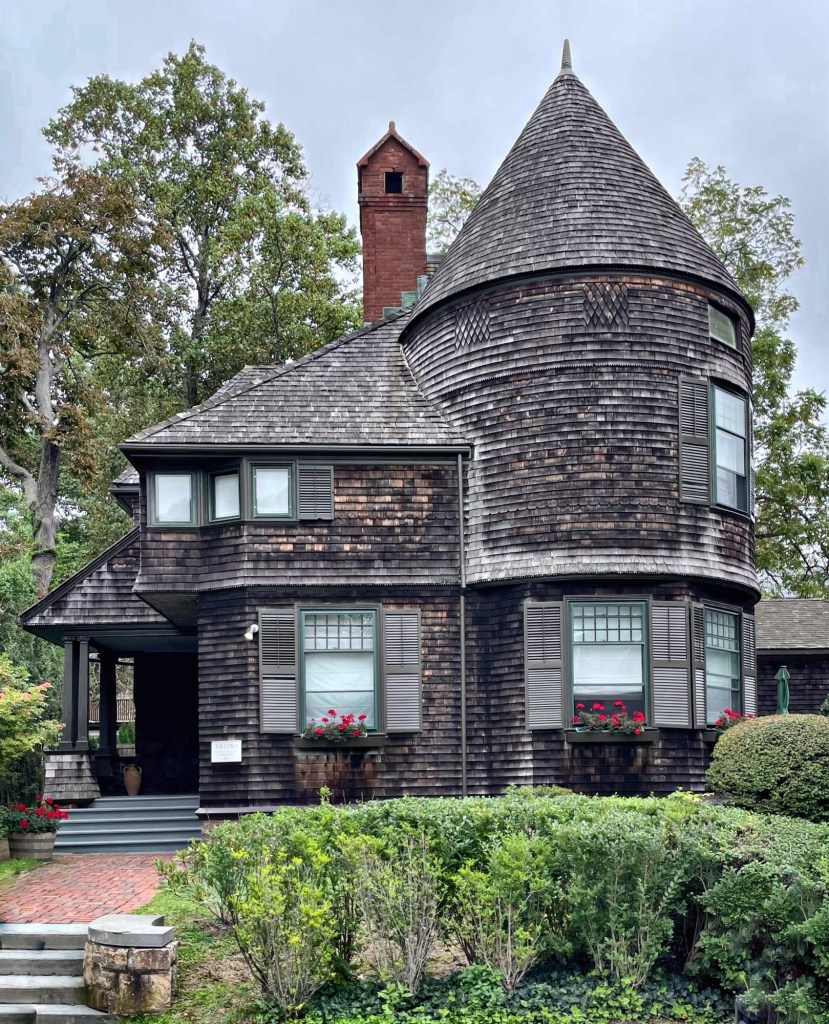
“Villino” was built in 1882 for $7,553, as a summer residence for Ms. Frances L. Skinner, a widow of the late Reverend Thomas Skinner. “Villino” was the work of the young firm of McKim, Mead & White, and it is one of the firm’s many Shingle style buildings, but one of the most compact. The asymmetrical 2½-story Shingle Style cottage sits atop a granite foundation with continuous shingles above. The entrance porch is tucked into the building mass on the side and its prominent tower with conical roof. The house is sited well into the landscape and unlike many other summer “cottages” the name Villino which is Italian for cottage, actually fits!
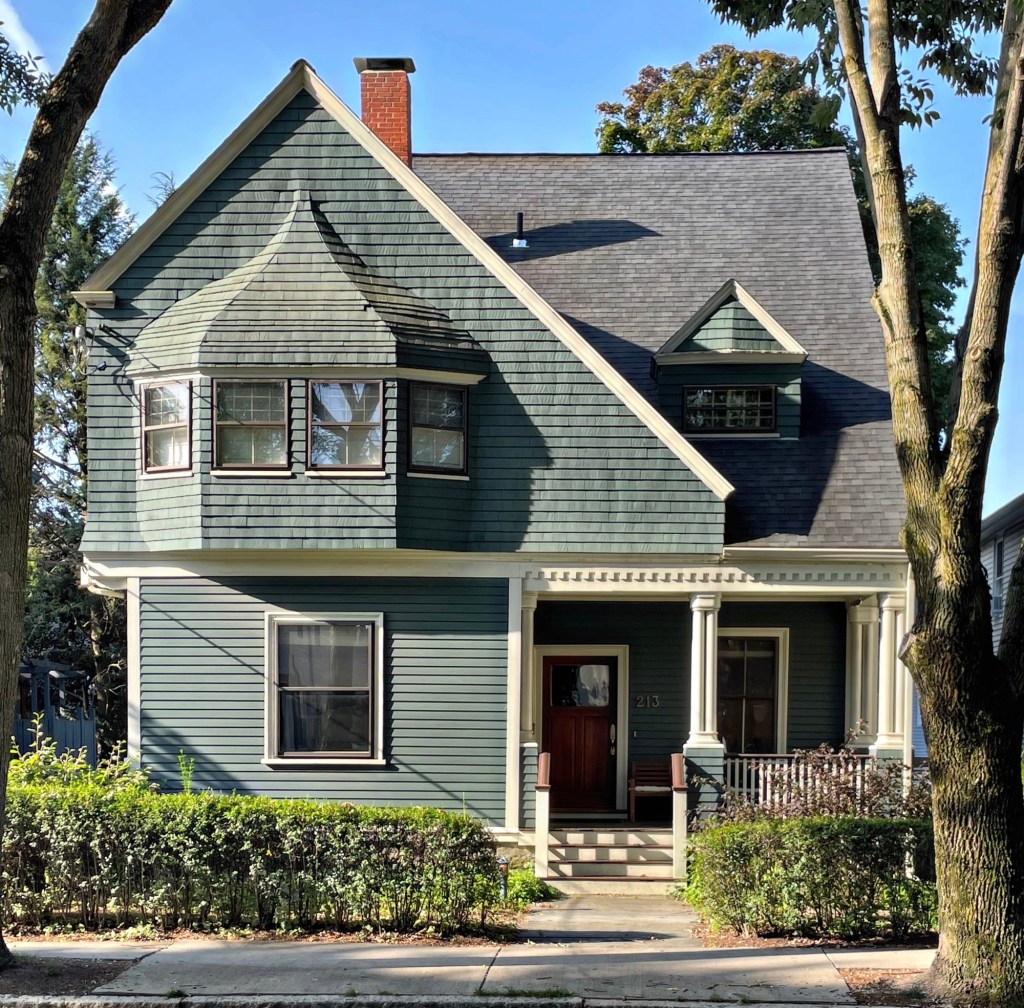
The Frederick & Arabella Holden House sits on Aspinwall Avenue in the Brookline Village neighborhood of Brookline, Massachusetts. Built in 1893, the excellently designed Shingle style dwelling was actually built on speculation by developers, and sold upon completion to the couple. Fred G. Holden (1858-1927) was a marble dealer who managed the Boston Marble Company and had connections in his home state, Vermont for the highest quality marble to sell around Boston, largely for building products and grave memorials. Arabella Proctor Holden (1859-1905) was born in Cavendish, Vermont, as the eldest daughter of Redfield Proctor, 37th Governor of Vermont and the founder of the Vermont Marble Company, the largest such company in the world. I could not find the architect of the house, so any more information, let me know. I’d love to solve the mystery!
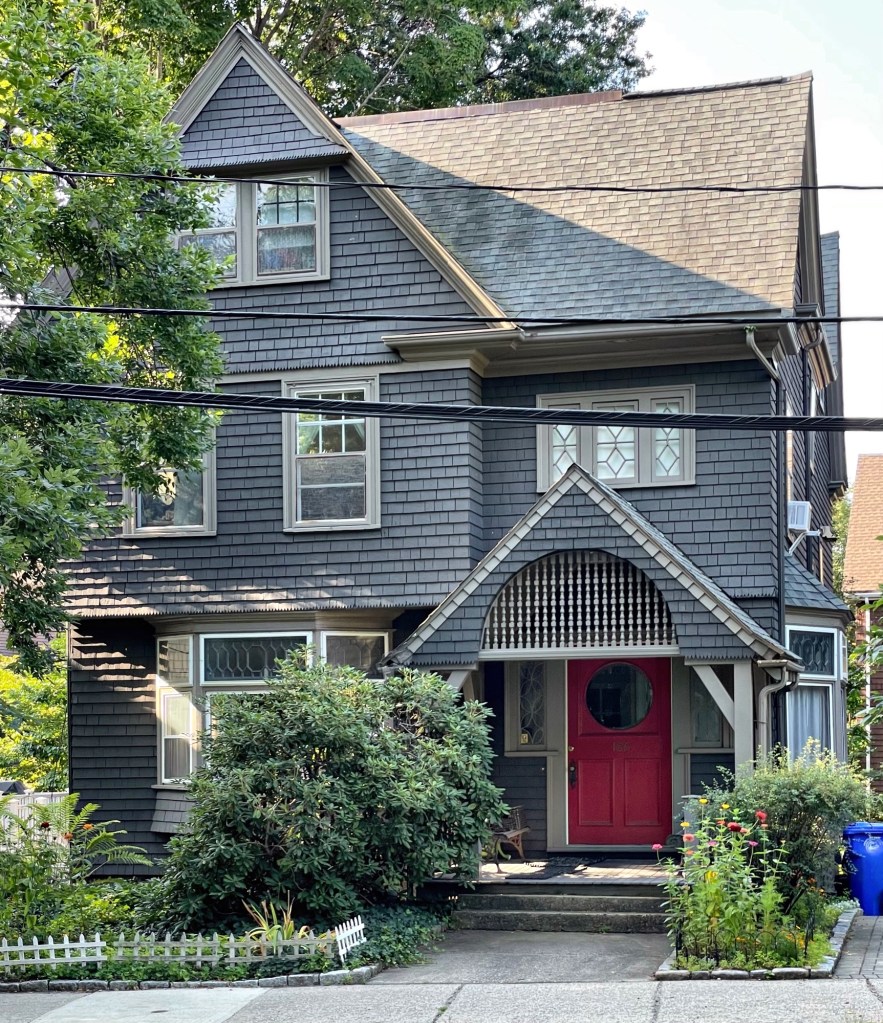
Dr. Thomas Joseph Shanahan (1873-1929) was born in Lawrence and graduated from Harvard Medical School in 1896. He practiced medicine in Brookline and Boston and was engaged in local organizations. He purchased this 1892 house on Aspinwall Avenue in Brookline in 1911, which had previously been rented to families. Two generations of Shanahans would own the house until the 1970s. After Dr. Shanahan’s death in 1929, the widowed Margaret Shanahan remained in this house with their daughter, Mary Margaret Shanahan, who was employed in 1940 as a medical secretary for a hospital. Mrs. Shanahan transferred title to the property in 1947 to her daughter, who converted the house to a two-family dwelling in 1953 for supplemental income. Architecturally, the house is Queen Anne and Shingle styles with continuous shingle siding, complex form with bays and oriels, and a unique arched opening in the gable over the entrance filled with a spindle screen. Architects were William Langley Morrison and Peter J. McEwen.
When Brookline Village filled in with multi-family housing in the late 19th and early 20th centuries, many speculative real estate developments sprouted up from larger residential estates. As so many were built on speculation, high-quality designs and construction were a necessity to bring in picky buyers. This two-family house was built on the corner of Brook and Toxeth streets by Levi T. Lyon, a builder and developer, who lived on Brook Street. This house was designed by F. Manton Wakefield, a relatively unknown architect who apprenticed under Shingle-style maestro William Ralph Emerson, before opening his own firm. Buildings like this are great as they provide much-needed housing, while being built of a good scale that allows residents to know their neighbors, not as easy in a high-rise.
Built in 1908 as a late example of the Queen Anne and Shingle styles, the Oliver J. Barr House is one of the finest Victorian buildings in Norwood, Massachusetts. The residence was built for Oliver J. Barr (1863-1935), who served as the General Manager of the Norwood Press in town, following his company from Boston to Norwood. The house was designed by Eugene Clark a Boston-area architect who specialized in suburban houses in the late 19th and early 20th centuries. The dwelling is noteworthy for its distinctive form, intact and rough textured wood shingle siding, and complex roof configuration. Particularly noteworthy is the verandah which encircles its northeast corner and rounded conically capped tower.
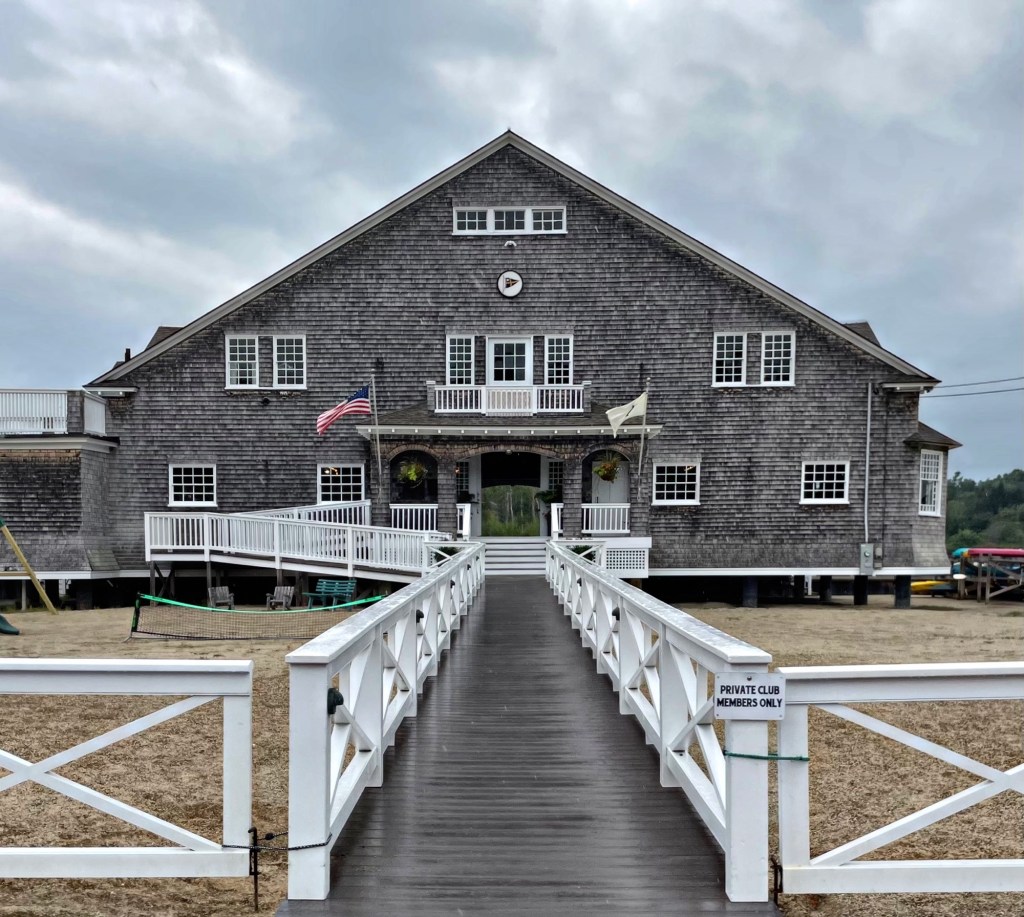
A canoe club formed by John B. McMaster, Prosper L. Senat and Henry E. Woods in the early 1880’s grew to a large “Lobster Club” by 1888. In 1889, the club decided to build this Shingle style boat house and the organization changed their name to the ‘Kennebunk River Club’ and hired Lowell, Massachusetts architect, Frederick W. Stickney to design a new boathouse. It opened in August 1890. The club grew quickly as Kennebunkport continued to become a premier summer destination with wealthy residents building summer “cottages” in town. In the building, canoes were built and hired out to club members by members of the Penobscot tribe who came to Kennebunkport from Old Town each summer working here. The clubhouse is one of the finest Shingle style recreational buildings in New England.


 Buildings of New England