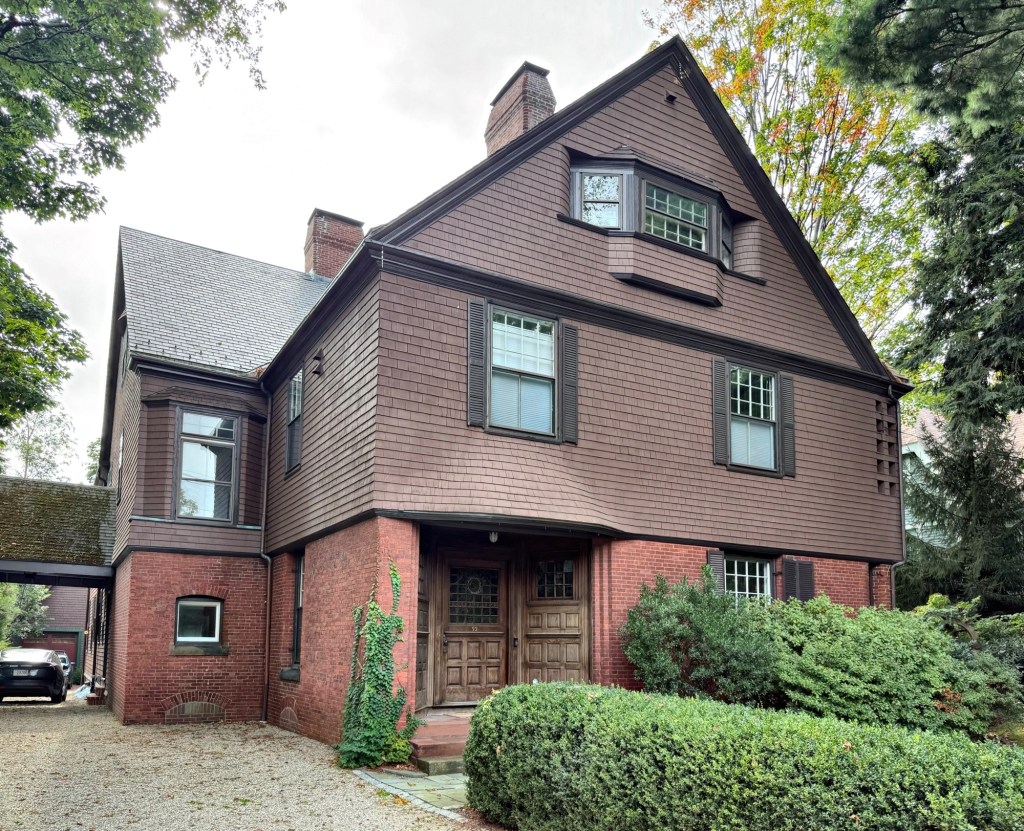
Loring-Sherburne House // 1883

One of the many great Queen Anne/Shingle style homes in Brookline is this residence at 92 High Street built for Thacher Loring (1844-1928), president and treasurer of the National Dock and Warehouse Company, of Boston, founded by his father, Elisha Thacher Loring. For their Brookline home, Mr. Loring hired architect, William Ralph Emerson, one of the great architects who mastered the Shingle style of architecture. The Loring Family lived here until the early 1900s, when they sold the property and moved to the Back Bay in Boston. The property was purchased by John Henry Sherburne (1877-1959), who lived here with his family for over sixty years. John Sherburne was an attorney, politician, and military officer who served during the Pancho Villa ExpeditionWorld War I, and World War II and attained the rank of brigadier general receiving numerous military awards, including the Silver Star and Purple Heart. During WWI, he commanded the U.S. Army’s first “negro” artillery battalion in France. After the war he testified before Congress about orders that pointlessly sent hundreds of U.S. soldiers from other units “over the top” to their deaths on the morning of November 11, 1918, when the armistice hour was already known. Following his World War I service, Sherburne advocated for civil rights for African Americans, including support for anti-lynching laws and from 1926 to 1931, he served on the board of trustees for Howard University. The Loring-Sherburne House is significant for its residents and for its architecture, including the use of brick and shingle siding, and the show-stopping recessed panel-wood entry with bulging shingles above.

Naulakha // 1893

Located on a hillside in rural Dummerston, Vermont, you will find Naulakha, one of the most significant properties in the region. Naulakha (pronounced now-LAH-kuh) was built in 1893 for Rudyard Kipling an english journalist and author born in British India, an upbringing which inspired much of his professional work. In 1892, Kipling married Caroline Balestier, who was born into a prominent New England family. The couple honeymooned in Vermont near Carrie’s family home. The couple would settle in Vermont in a cottage which was soon outgrown, leading the couple to buy 10 acres of land from Carrie’s brother Beatty Balestier and built their own house. The new Shingle-style home they had built was named Naulakha after a book written by Rudyard and Caroline’s late-brother Wolcott. Kipling wanted a home that merged the distinctive qualities of the Indian bungalow with those of the American Shingle Style and he worked closely with his architect, Henry Rutgers Marshall of New York City, a Balestier family friend to achieve this.

The rectangular mass of the home parallels the contours the hill upon which its sited, and sits atop a raised fieldstone basement salvaged from stone walls on the property. From the home, Kipling wrote some of his most influential work, including the Jungle Books (1894, 1895), Captains Courageous (1896, The Seven Seas (1896), and The Day’s Work (1898). Sadly, the Kipling’s moved out of Naulakha after just a few years, largely from familial disputes with Caroline’s brother, Beatty. The family removed to England where they settled, though Rudyard always mentioned how much he missed his secluded life in Vermont. The property was then purchased by the Holbrook family, who made slight modifications to the property, but all maintaining the original design and feeling. In 1992, the British-based Landmark Trust acquired Naulakha as its first American building, later creating the Landmark Trust USA to maintain the property and more. The Landmark Trust USA rents out Naulakha and the adjacent carriage house for short-term rentals to provide revenue for maintaining these properties.

For more on my stay at the absolutely stunning Kipling Carriage House, check out my later blog post here.