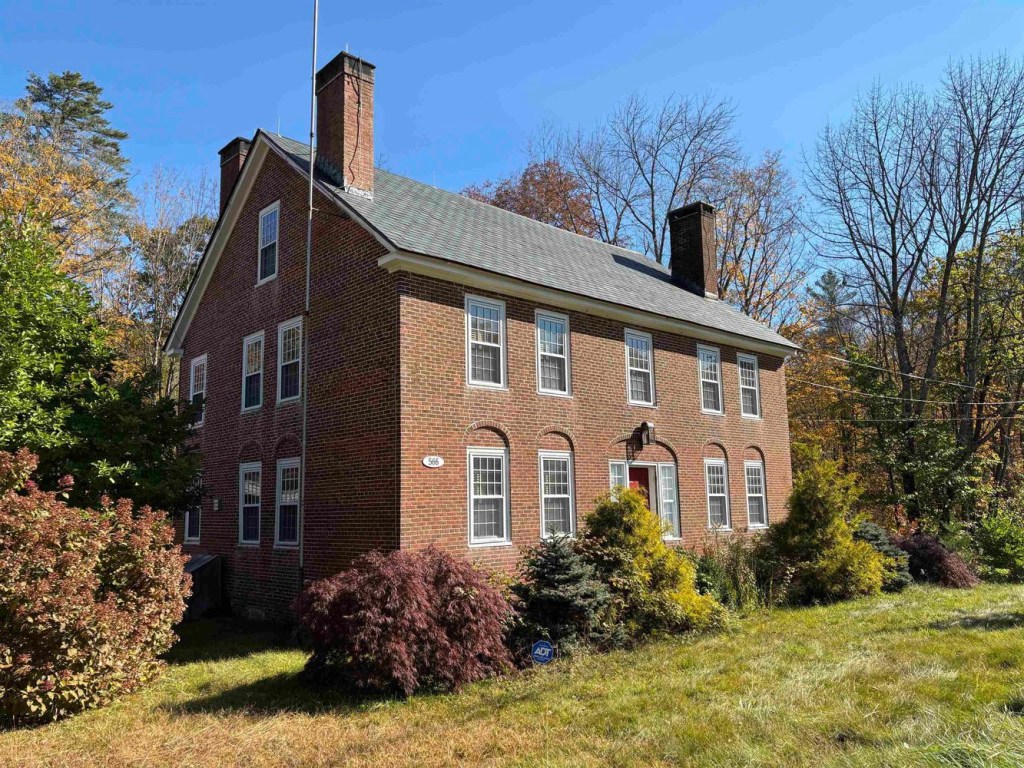
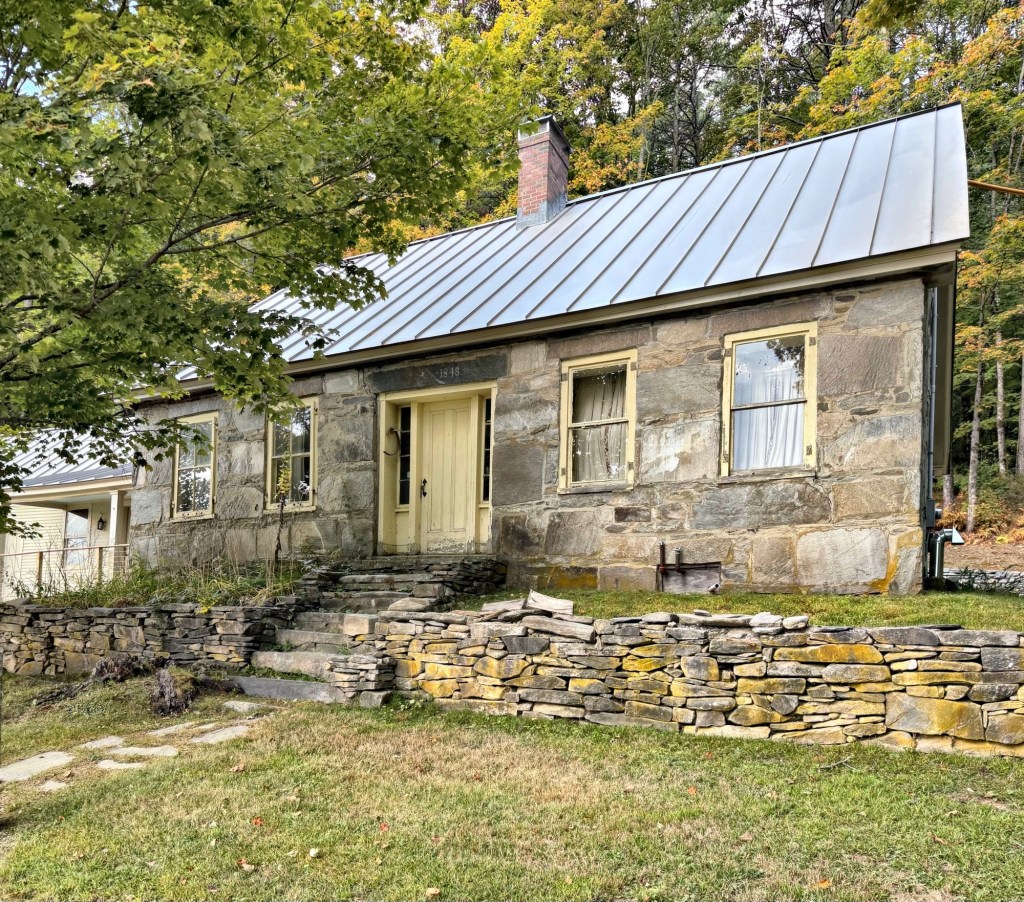
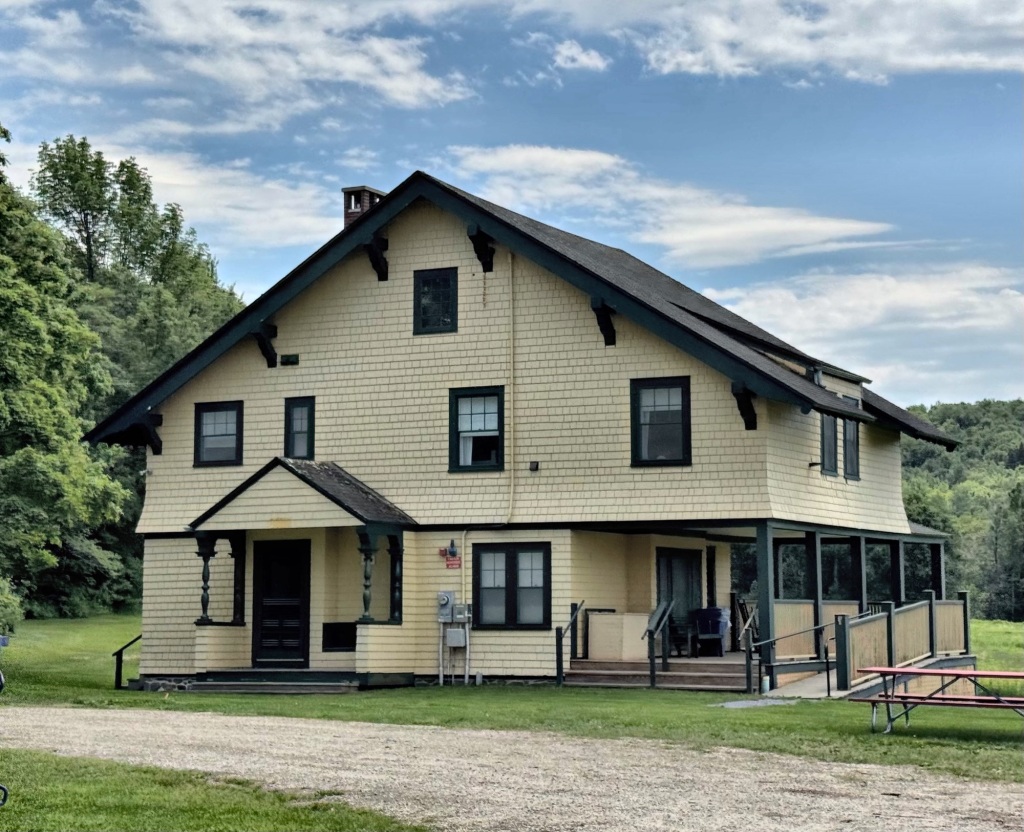
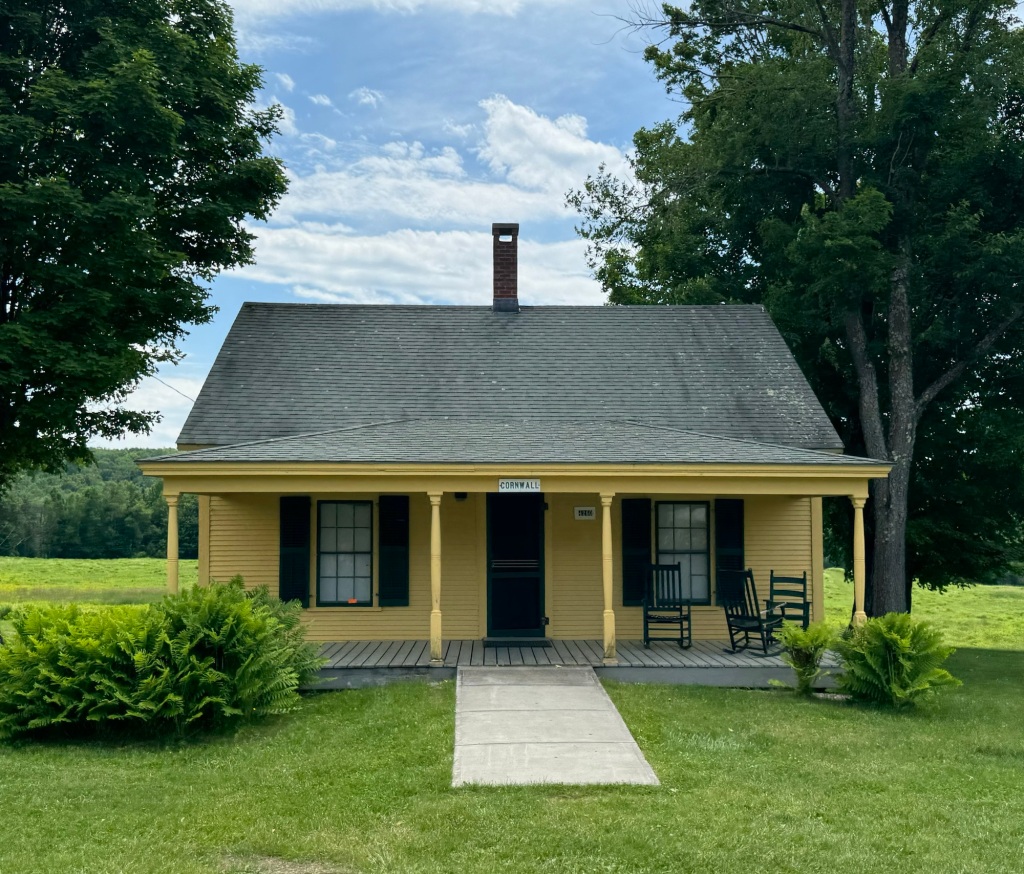
Robert Frost Farm // c.1820

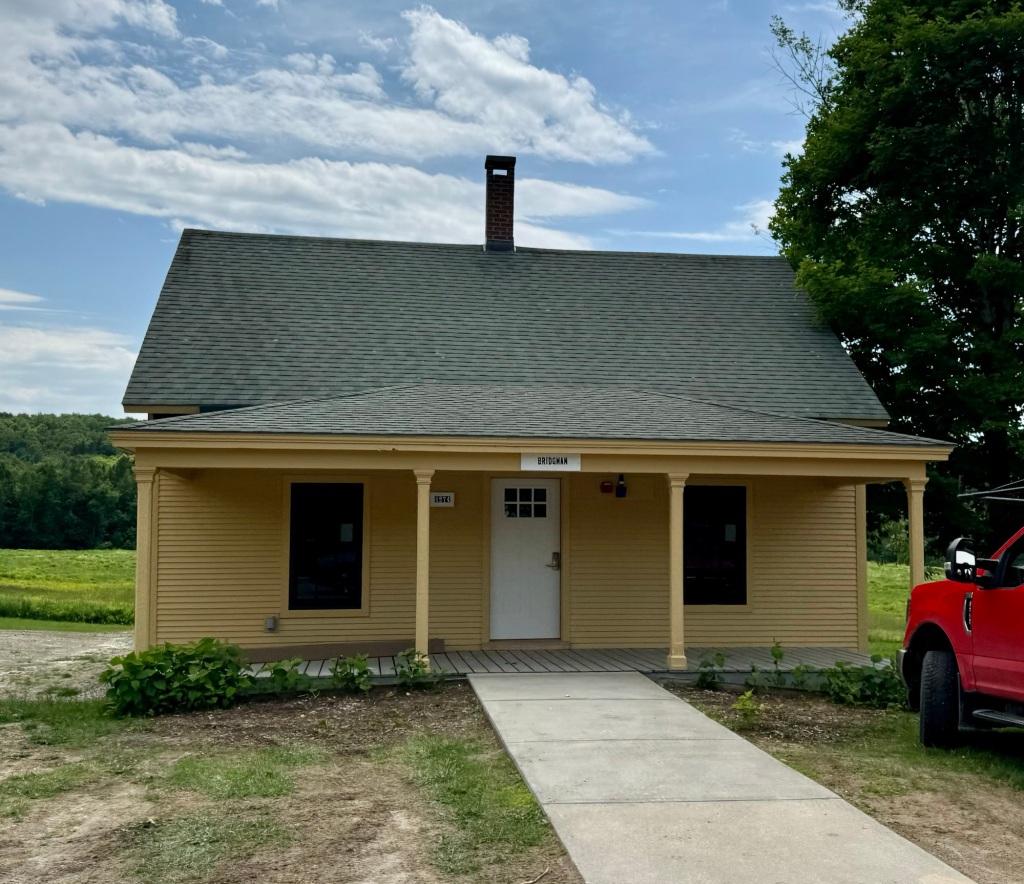
Robert Frost, the famed American poet is best known for his realistic depictions of rural life in New England. Frequently honored during his lifetime, Frost is the only poet to receive four Pulitzer Prizes for Poetry, and in 1961, he was named poet laureate of Vermont, one of his favorite places to write. Though his writing is often beautiful, Robert Frost did suffer tragedies. His beloved wife, Elinor, died in 1938, causing him to resign from a teaching position at Amherst College. In the fall of 1940, the Frost family experienced another tragedy when Robert’s only son Carol committed suicide at 38 years of age. Robert Frost, who suffered from depression himself, would buy this farm in rural Ripton, Vermont, that year. The farm was a respite to escape to nature and be free from painful memories of the past. Frost chose the site eight miles from Middlebury College, and two miles from the Broad Loaf Inn, where each summer the college sponsored the Bread Loaf Writers’ Conference, the oldest and most prestigious writers conference in the country. The farm he purchased was established by and known as the Homer Noble Farm. The farmhouse seemingly dates to the early 19th century, and the property was added to by a cabin built for Mr. Frost to write and occupy when spending summers on the farm. The property would serve as his country retreat for summers away from his main residence in Cambridge, Massachusetts, until his death in 1963. The property is now owned by Middlebury College. The grounds are open to the public during daylight hours.

Ripton Community Church // 1864

Located a stone’s throw from the Ripton Community House in Ripton, Vermont, this church building helps contribute to the village center’s distinguished architectural presence for such a small community. The vernacular church building was constructed in 1864, the same time that the Congregational Church (now the Community House) was built. The Methodist Episcopal parishioners in town met in local homes and schools even before formally organizing their society in 1829, but it wasn’t until the onset of the Civil War that they started construction of a church building. During its full life as a methodist church, the building has also housed members of all faiths, and has been the place of worship for poets, authors and lecturers including Robert Frost, who was a summer resident. The building is well-preserved 160 years later!

Ripton Community House // 1864

The Ripton Community House stands at the center of the rural village center of Ripton, Vermont, a town in the midst of the Green Mountains. The community house was built in 1864 and is an excellent late-example of the Greek Revival style in this part of the state. The building was constructed on land that was deeded by Sylvester Fisher in 1864 to the local Congregational Society with the proviso that a house of worship costing not less than $2000 must be erected within two years. The church was built and maintained by the Congregational Society until 1920 when it was deeded to the Methodist Episcopal Church to be used for religious, social and educational purposes. This restriction was removed in 1928 and it was deeded to the Ripton Community Club which made renovations and used the facilities for club meetings, social events, community dinners, square dancing and more. The club dissolved in 1964 and the building began to deterioriate for years until the town banded together to protect and applied for grants to restore the building to its former glory, what we can all appreciate today when driving through the quaint town.

The Old Hancock Tavern // c.1810

Before the Centre Turnpike was laid out in 1808, better-connecting Middlebury, Vermont to towns east of the Green Mountains, visitors would have to travel hours longer to divert around the mountains. This new route cut right through the small village of Hancock, Vermont and the town prospered as a result. Along the route, this vernacular, Federal period tavern was built shortly after the turnpike aimed to take advantage of the new visitors driving through the town. This tavern/inn was operated for a time by a J. E. Wright as a hotel and the building has a perfect wrap-around porch.

Hancock Town House // c.1850

Hancock, Vermont is located in Addison County, and sits on the east side of the Green Mountains. The land here was granted November 7, 1780 and chartered July 31, 1781 by Governor Chittenden, to Samuel Wilcox and 129 associates. Hancock grew as pioneers sought new land and opportunity after the Revolutionary War with some taking up farming and others engaging in the lumber trade. The population in the rural town reached its peak of 472 residents in 1830, a number it has never seen again – the current population is 359. As the town saw its largest growth in the early decades of the 19th century, the town officials decided to erect a joint Town House and Union Church to serve multiple uses. This structure, built in the Greek Revival style by around 1850, has two stories, with the ground floor historically housing town offices, and the second floor formerly housing a meeting space and church hall. The classically designed building has a box cornice, frieze, and molded corner pilasters. The double entrance doors have pilaster and entablature surround and the three-stage steeple has a clapboarded base with corner pilasters. The structure has survived generations and natural disasters and is a testament to this small, but proud town in rural Vermont.

Highgate Manor // c.1870

Henry Baxter (1821-1897), a doctor and owner of a local mill and multiple area farms, built one of the most remarkable Second Empire style houses in New England, and it can be found in the small town of Highgate, Vermont! Dr. Baxter was said to have acquired an earlier Federal period house on the site in the 1860s and began planning a high-style Mansard estate here for his family. The earlier Federal house was incorporated as a rear ell and the new Second Empire mansion was built in front. Architecturally, the house stands out for its bellcast mansard slate roof topped by a square belvedere with arched windows and heavy scrolled brackets. His patented medicine, Dr. Baxter’s Mandrake Bitters, was sold throughout Vermont in the late 19th century and afforded him the wealth to erect this stately home. There are many unsubstantiated claims of Dr. Baxter “performing experiments on his children” for the sake of people to state that the house is haunted, but this appears to be lore in poor taste. It is said that the house was also a stop on the Underground Railroad, but that appears unproven as well. After Dr. Baxter’s death in 1897, the property became a lodge and restaurant. A basement bar was built and during prohibition, was said to have hosted the likes of Al Capone. Today, Highgate Manor, with its larger-than-life lore, remains one of New England’s most important and high-style Second Empire houses in one of the most unlikely places. It goes to show that it is worth exploring all of New England!

St. John’s Episcopal Church, Highgate // 1831

St. John’s Episcopal Church stands in a grove of pine trees at the southeastern end of the Highgate Falls village green in Highgate, Vermont. The church is built in a transitional style which combines the pointed arches of Gothic architecture with a unique Gothic-Palladian window, but with a traditional plan and massing commonly found in Federal style churches in New England. The church was built between 1831-1833 by Joel Whitney of nearby Enosburg, and was consecrated on May 21, 1834, by Rev. John Henry Hopkins, the first Bishop of the Episcopal Diocese of Vermont. The congregation was a full parish until 1896 and maintenance has since struggled due to dwindling use. The wooden steeple was removed in the late 20th century, but the church stands as an important architectural landmark for the small town.

Highgate Springs Union Church // 1877

Rural parts of Vermont always surprises me with amazing old buildings. This white wood-frame church is known as the Highgate Springs Union Church, an 1877 edifice which effortlessly blends Victorian Gothic and Stick style details. The building became the village’s union church, providing a worship space for members of all denominations who on their own, could not afford the cost of building and maintaining a building. The small congregations eventually moved out and the church appears to now be largely unused beyond small events or weddings/funerals. I am glad to see it is kept up well at least!

Old Highgate Post Office and General Store // c.1830

In the small village of Highgate Falls, Vermont you will find this unique Federal period commercial building, and if you are like me, want to know more about it! According to historians, the building was constructed around 1830 and had multiple uses: a U.S. Customs House, a Post Office, and later as a general store for owners Stockwell & Steele. The brick structure suffers from some deferred maintenance, but is a significant piece of vernacular architecture in this sparsely visited part of the state!

Highgate Union Methodist Church // 1868

The Highgate Union Methodist Church in Highgate, Vermont was built in 1868 and is a high-style example of the Italianate architecture style in a relatively quiet part of the state. Built of brick, the church’s form is typical for small Vermont churches in the third quarter of the nineteenth century. Here, however, the builders were conscious of Italianate fashion, and they applied its round and segmental arches, corbels, and brackets, painted in a lighter color, with consistency and to remarkable effect.