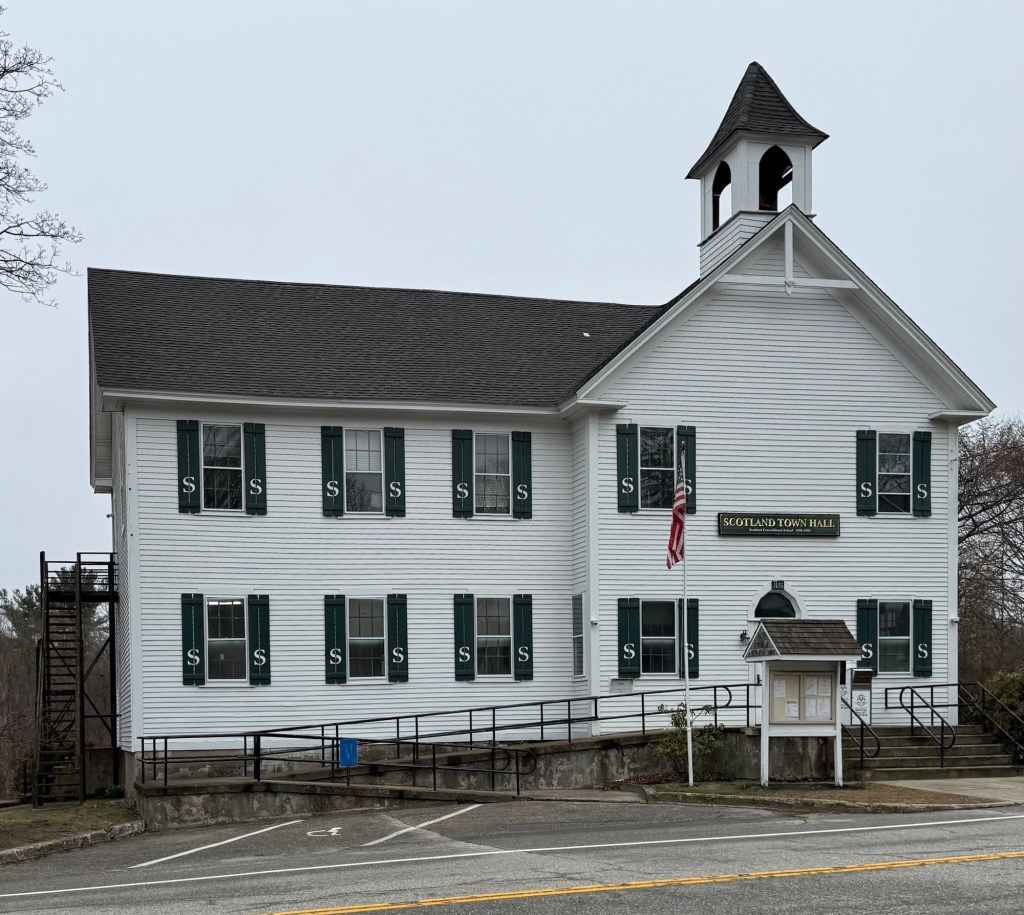
Scotland Town Hall // 1896

The town of Scotland, Connecticut, is a rural community centered around agriculture and is the smallest municipality in Windham County’s ‘Quiet Corner‘. European settlement began in earnest following the purchase of 1,950 acres of land from then Windham, by Isaac Magoon, a Scotsman, who named the new village after his ancestral home. The present-day town hall and offices of Scotland, was originally built in the 1840s as a one-room schoolhouse. In 1894, the town voted to consolidate all the school districts in a single building, and to expand the one-room village school to accommodate them. The present two-story structure was completed in 1896 and was added to the front of the old building. It is unclear if anything remains of the original schoolhouse. The vernacular, Stick style building served as the town’s consolidated school until a modern school building was constructed in the 1960s. This building became the town hall/offices and remains a significant visual anchor to the town’s common.

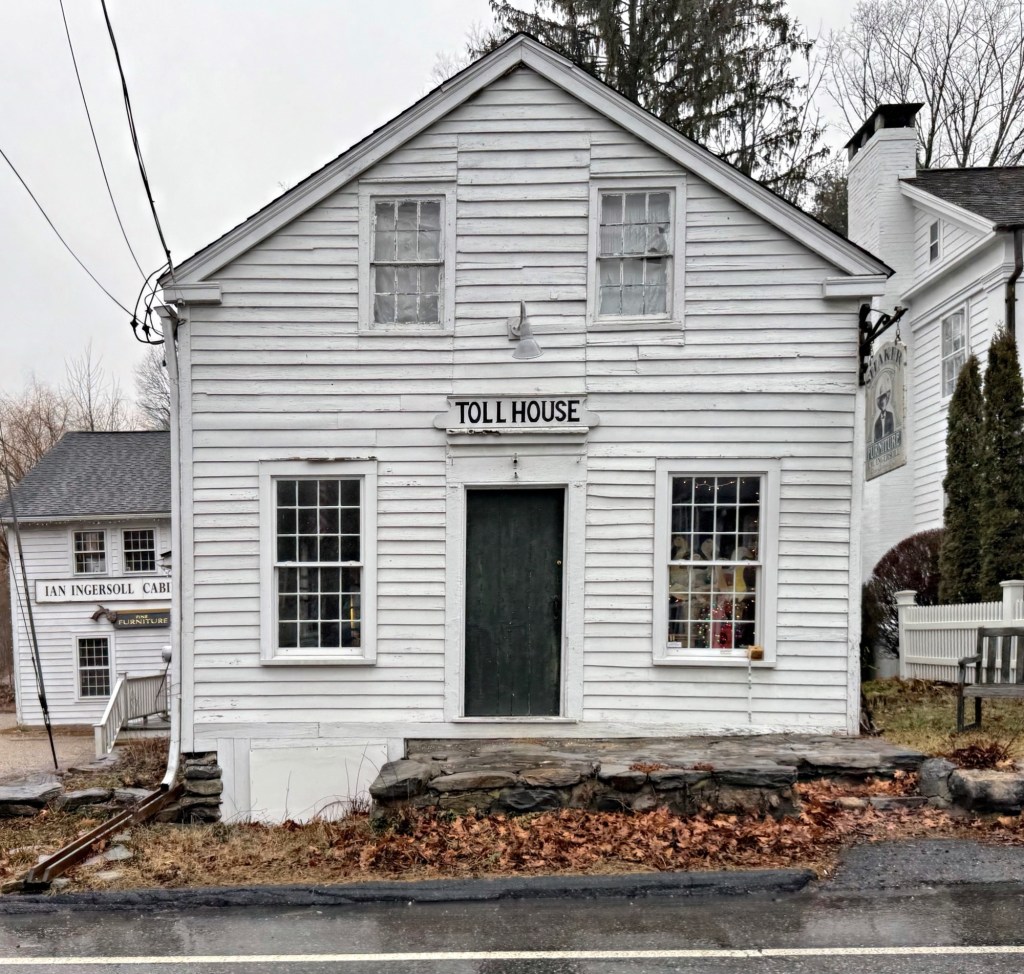
West Cornwall Old Toll House // c.1800

This modest, vernacular frame structure in West Cornwall, Connecticut, perhaps erected as early as 1800, has served a number of commercial purposes in its history, most significantly as a toll house. The structure was a toll booth for the two turnpikes which crossed near the site – the Sharon-Goshen Turnpike, and the Warren Turnpike, which ran along the Housatonic River. Before the days of EZ-Pass and transponders, travellers would pay their tolls to a worker in this building. Eventually the street became free to use, and the building was acquired for commercial use. It now serves as a showroom for a local cabinetmaker, but retains the original charm and historic sign above the door. How charming is that?

Georgetown Engine House No.5 // c.1860

Following a devastating fire in Georgetown in 1874, local residents of the town petitioned at a town meeting to purchase a fire engine and a lot to erect a new engine house to prevent such a loss again. Within a year, voters approved not only the construction of a new engine house on Middle Street, near the commercial center of town, but also to move this charming single-engine firehouse at to a site to “the south part the town”. This structure was deemed inadequate for the dense commercial village and instead of demolishing it, town voters decided it could be relocated to another area and put to use. A volunteer company was formed for the new engine house and the small structure remained as a firehouse until the early 20th century when modern fire apparatus would no longer fit in the building. The building was sold by the town and has remained in private ownership since the 1920s, and its use is unknown to me, but the owners are doing a great job maintaining this significant structure.

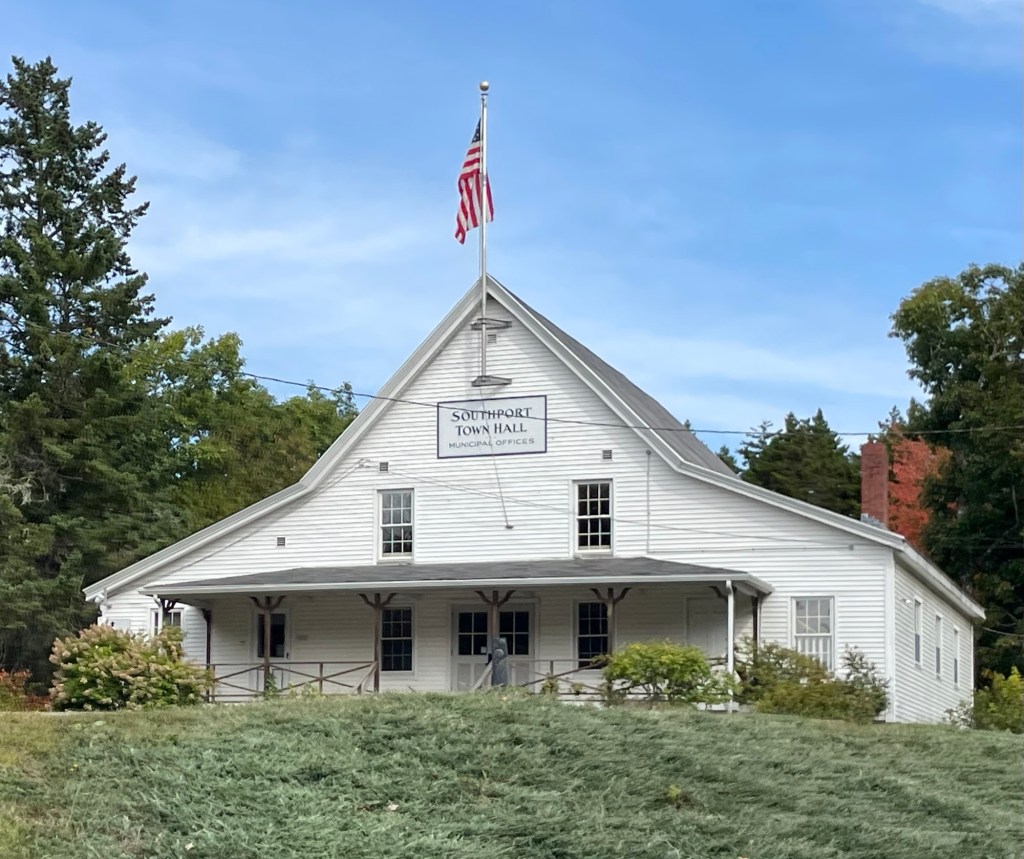
Southport Town Hall // 1866

While staying at the Spruce Point Inn in Boothbay Harbor, Maine, I took the chance to visit the nearby island-town of Southport! The town of Southport incorporated in 1842 when it separated from Boothbay and became known as Townsend, Maine. Just eight years later, in 1850, Townsend changed its name to Southport, after SouthportEngland. The town has a population of just over 600, which grows in the summer months as the island and nearby Squirrel Island (also a part of Southport) has many summer homes dotted along the coastline. The present-day Southport Town Hall was built in 1866 by the Ladies Sewing Circle of the Southport Methodist Episcopal Church as a meeting place for the women of town to meet and socialize, it also was rented to the town for town meetings. Eventually, the town purchased the building in 1900, where it has remained the town hall ever since.

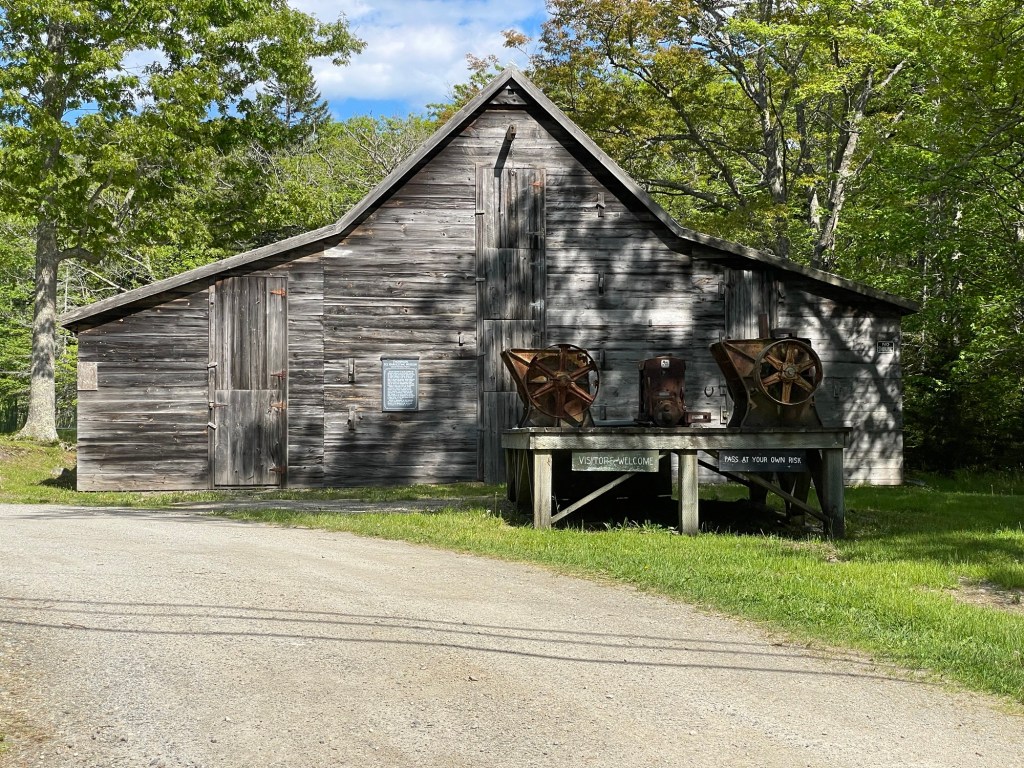
Thompson Ice House // c.1826

In 1826, a man named Asa Thompson, dammed a small brook from natural springs on his property in present-day South Bristol, Maine, and created Thompson Pond. He began cutting ice blocks for his own use. His neighbors began to purchase blocks of ice from him and he built this ice house sometime after to store blocks after harvesting from the pond. Thompson created a business, harvesting, shipping and selling ice blocks to residents in town and beyond. The property remained in the Thompson family until 1987, when it was gifted to a non-profit board to preserve the site indefinitely. Today, the Thompson Ice House Harvesting Museum showcases the tools of the trade with a participatory ice harvest takes place there annually. The building is opened on appointments or certain events.

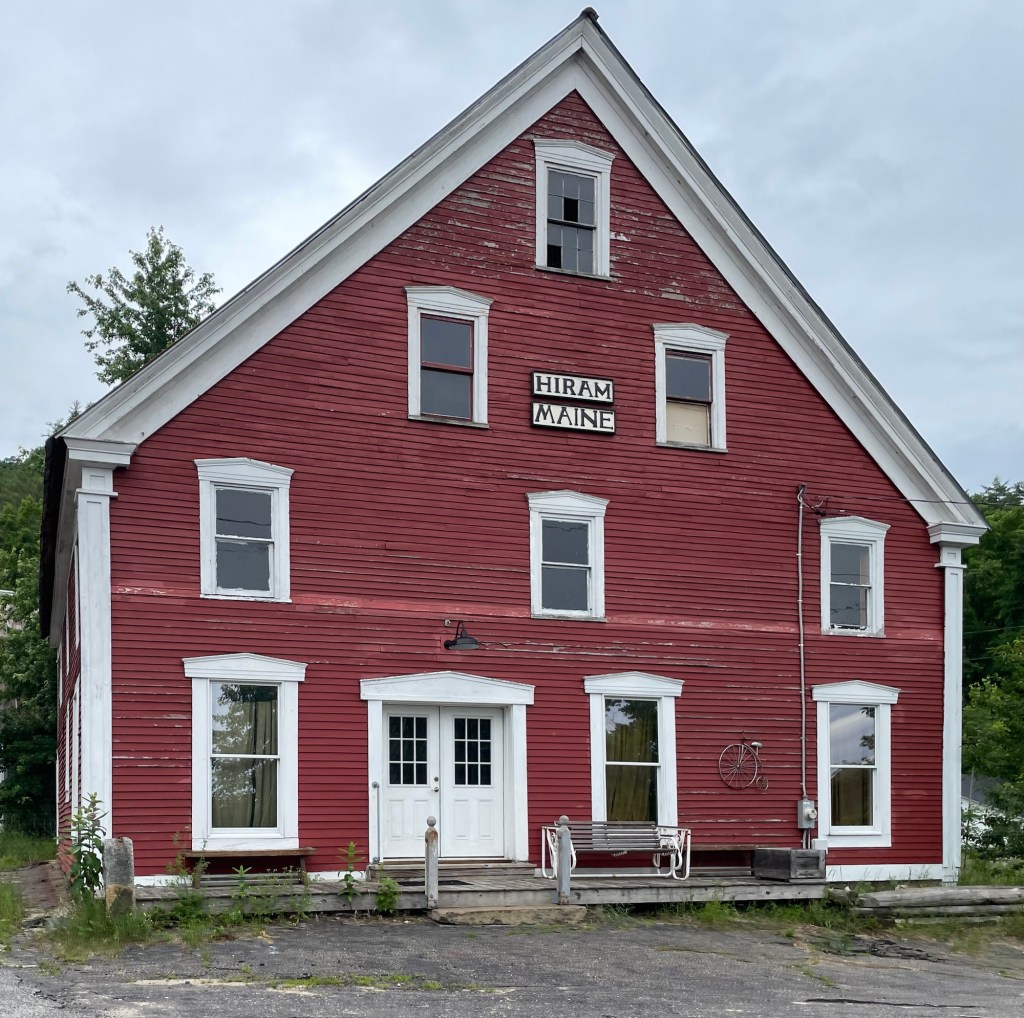
Hiram Village Store // c. 1850

Hiram is a small, rural town in Oxford County, Maine, and has a handful of notable old buildings. The town was incorporated in 1814 and was occupied by white settlers as early as 1774. The land here has long been heavily wooded and the town’s name was inspired by the biblical King Hiram of Tyre whose kingdom was set among “timber of cedar and timber of fir.” The town’s two villages, Hiram Village and South Hiram, grew along the Saco River, and are typical rural villages built around industry and modest frame dwellings. This commercial building is one of the larger structures in Hiram Village and it dates to the mid 19th century. The structure was owned by Thomas B. Seavey, who purchased a store built on the site as early as 1816, from a Simeon Chadbourne. The store was enlarged and became a major hub of the sleepy town in the 19th and 20th centuries, but like many such structures, struggled due to changing of shopping habits and rural decline. The building, with its vernacular and Greek Revival lintels, appears vacant today.

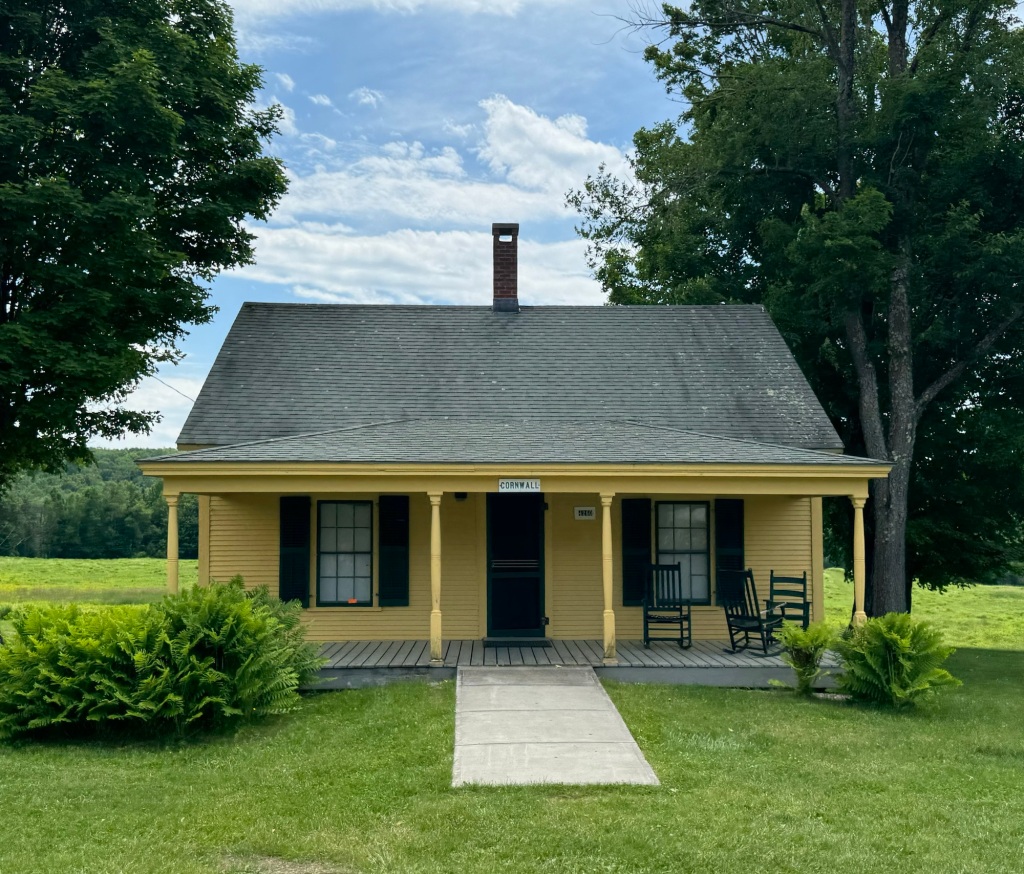
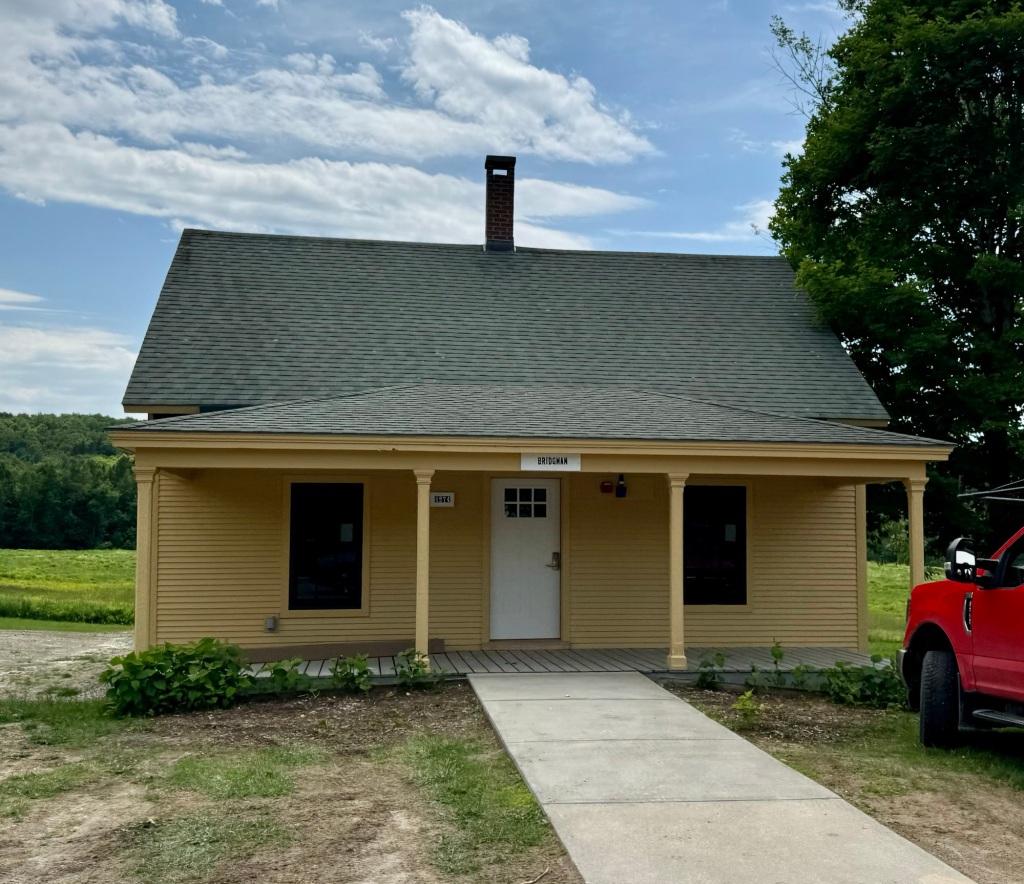
Bread Loaf Campus – Bridgman & Cornwall Cottages // 1881

Welcome back to the Bread Loaf Campus! For more early history and context of the complex, check out the post on the Bread Loaf Inn. By 1900, owner Joseph Battell’s enterprise exceeded the capacity of the original inn, and cottages were added to accommodate more guests visiting his new permanent home in the mountains of Ripton, Vermont. Special friends who summered regularly at Bread Loaf purchased lots with water and sewage rights, and with Battell’s assistance, built their own family cottages to spend their summers. The first two, Bridgman and Cornwall, were constructed across the street from the Inn around 1881 and are near-identical, modest vernacular cape houses with full-length front porches. The original owners were Charles William and Ellen Campbell Bridgman and Henry Bedinger Cornwall respectively. Both cottages have since been donated to Middlebury College and are important preserved pieces of its Bread Loaf campus.

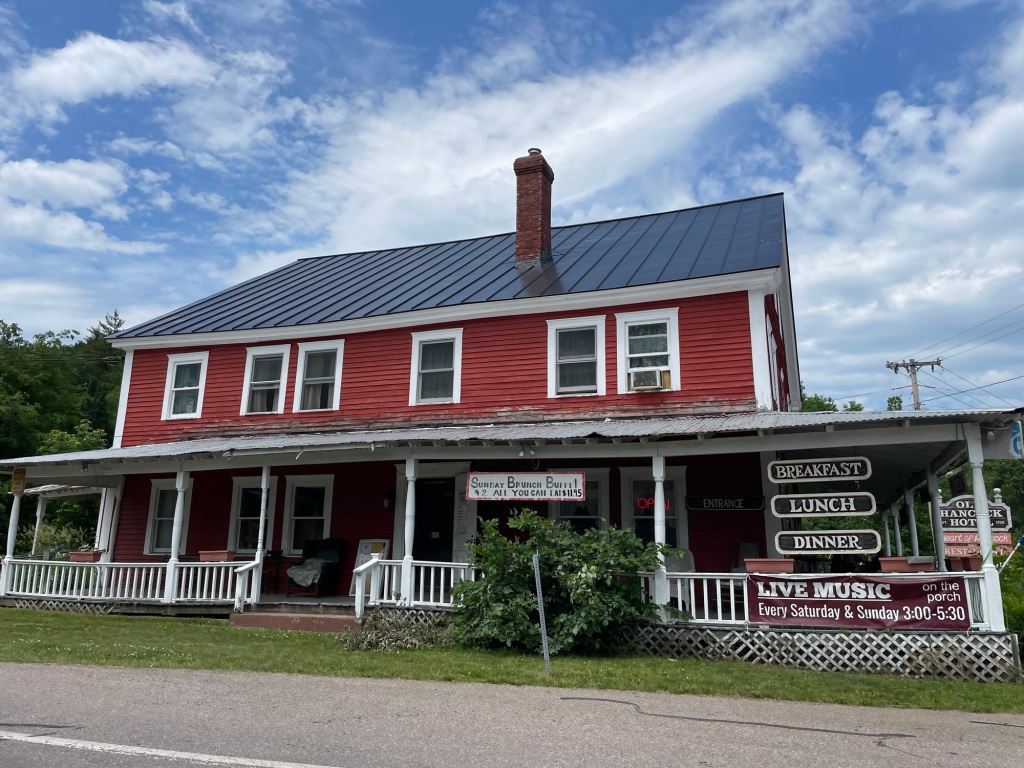
The Old Hancock Tavern // c.1810

Before the Centre Turnpike was laid out in 1808, better-connecting Middlebury, Vermont to towns east of the Green Mountains, visitors would have to travel hours longer to divert around the mountains. This new route cut right through the small village of Hancock, Vermont and the town prospered as a result. Along the route, this vernacular, Federal period tavern was built shortly after the turnpike aimed to take advantage of the new visitors driving through the town. This tavern/inn was operated for a time by a J. E. Wright as a hotel and the building has a perfect wrap-around porch.

Chaplin Congregational Church // c.1815

Years before the small town of Chaplin, Connecticut was incorporated as a town, early residents here had this Congregational church built at the future town’s center. The following decades would see the village develop into a cohesive street of Federal and Greek Revival style dwellings and shops, many of which remain to this day. The church was technically completed by 1815, but it would be decades until funding was acquired to add the steeple, pews, and other finishings for the edifice. The structure sits on a raised stone foundation and is prominently sited on the town’s main street.

Old Head Tide Store // c.1890

Every village needs a general store, and the store in the Head Tide village of Alna was this vernacular building constructed around 1886. The store was operated for years by John Allen Jewett, who’s ancestors settled in Alna generations before. Jewett sold grain from the building to local farmers and residents and lived across the street in the family home. Vernacular “mom and pop” stores like this are becoming more rare, but they are among the most charming in New England. Be sure to shop local and support small businesses when you can!