Cheapside Block // 1880

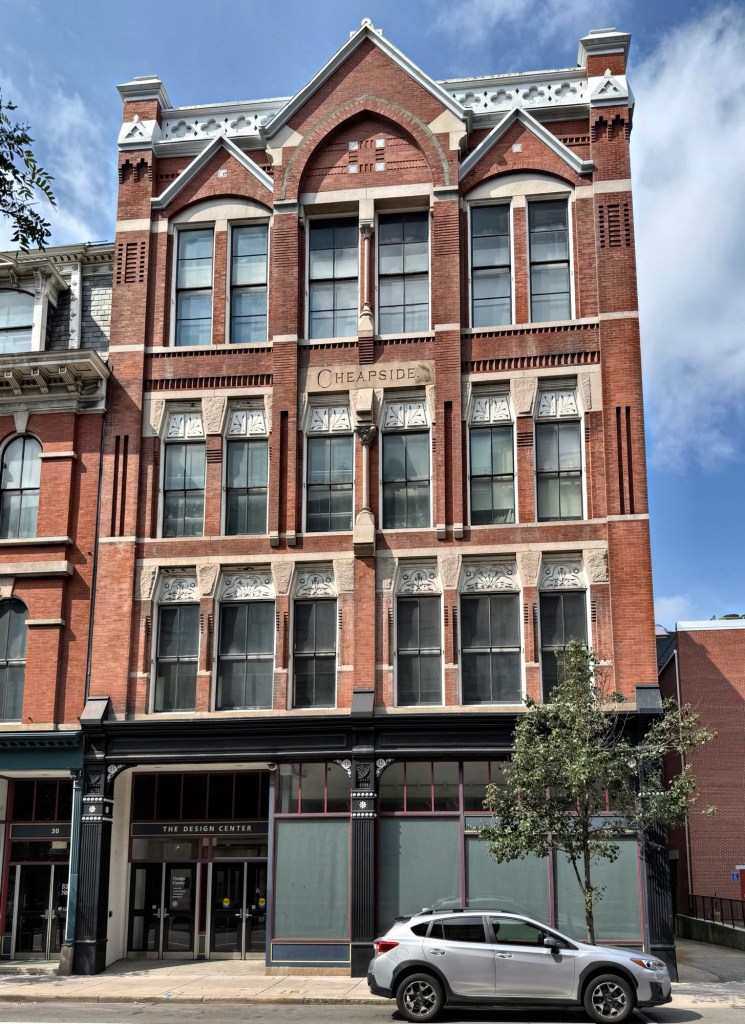
The Cheapside Block on N. Main Street in the East Side district of Providence, Rhode Island, is significant as a remaining Victorian-era commercial block that retains much of its original architectural detailing. Built in 1880 and designed by local architects Stone & Carpenter, the Cheapside Block was named after the early nineteenth century name given to the commercial district running along the west side of Main Street, north from the eighteenth century Market House, after the London commercial district of the same name. The word “cheapside” is derived from the Anglo-Saxon word “to barter.” The block here is an excellent example of the High Victorian Gothic architecture style, with intricate brick and stonework, pointed gables with inlaid tile, quatrefoil motif in the parapet, and the original cast iron storefronts. The building was acquired by the Rhode Island School of Design and renovated in the 1980s. Today, the Cheapside Block is home to the RISD Design Center

Rosevale // 1876

“Rosevale” was built in 1876 as a summer residence in Newport, Rhode Island, for couple, Grace Sears Rives and William Cabell Rives. Grace was the daughter of David Sears of Boston, who developed the Longwood neighborhood of Brookline; and William was the son of William C. Rives Sr., a Virginia congressman and Senator. The High Victorian Gothic mansion was designed by the Boston architectural firm of Peabody & Stearns who formed their practice just years earlier. The house was enlarged in 1881 by architect George Champlin Mason, Sr. The stonework of the lancet windows, the large octagonal tower, and the carved moldings give the relatively boxy home a more ecclesiastical feeling. The estate retains its original siting, at the middle of a large lot between Red Cross and Rhode Island avenues, which has thus far resisted infill housing on the estate. For years, Rosevale has been occupied as a funeral home, but it appears to have sold a couple years ago.

Channing Memorial Church // 1880

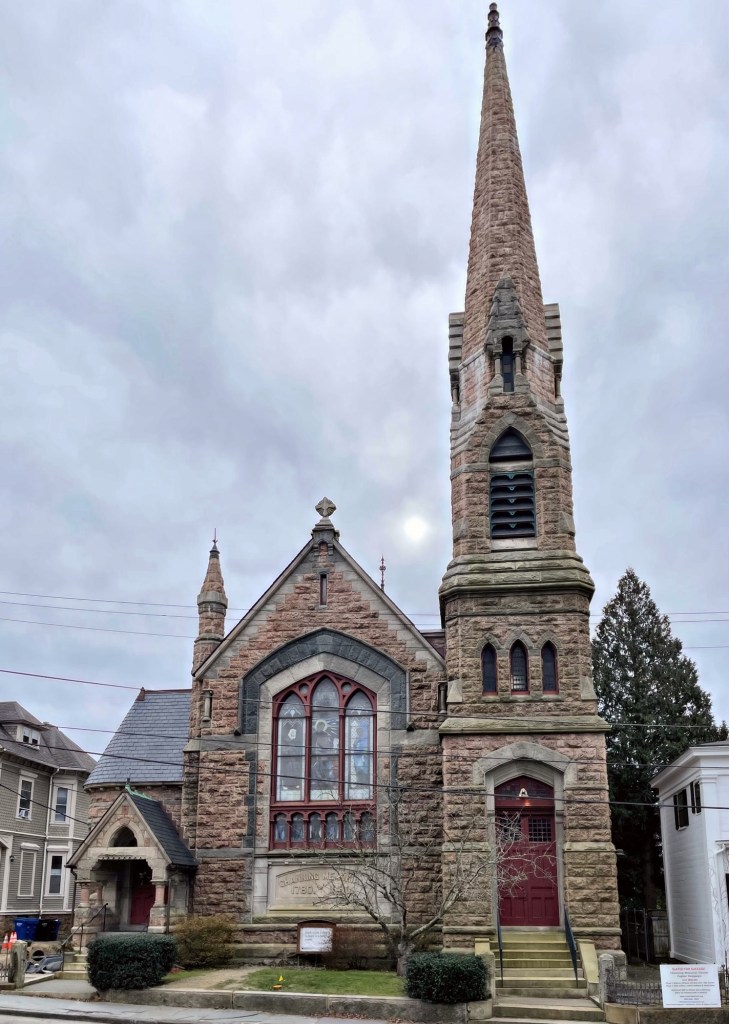
The Channing Memorial Church of Newport, Rhode Island was named in the memory of William Ellery Channing (1780-1842), an ardent abolitionist and founder of the Unitarian faith in America. In 1835, ten men formed the first Unitarian Society in Newport in October 1835 and met in the home of Channing’s grandfather, William Ellery, one of the 56 signers of the United States Declaration of Independence. In 1879, the congregation’s minister, Rev. M. K. Schermerhorn, conceived the idea of a memorial to William Emery Channing, whose centenary would be the following year. He decided upon the ambitious project of a new church building and planning began immediately. On Rev. Channing’s 100th birthday, the cornerstone laying ceremony occurred in 1880. The Victorian Gothic stone church designed by Elbridge Boyden took a year to be completed and was was built from granite, cut in Lyme, Connecticut. Inside, two stained glass windows, the first ecclesiastical commission of John LaFarge, flood the interior spaces with warm colored light. The church looks much as it did when completed almost 150 years ago, thanks to an active congregation preserving this great landmark.

Richmond Building // 1876

The Victorian Gothic style Richmond Building in Downtown Providence always catches my eye for its polychrome brickwork. The building was constructed in 1876, seemingly as an investment property for Dr. F. H. Peckham, a surgeon. The Richmond Building was used for many years for offices and retail use. Also, look at that amazing curved sash window!

Sisters of Mercy Convent // 1894

Mary Francis Xavier Warde was the American foundress of the Sisters of Mercy. Born in Ireland in 1810 to fairly prosperous parents, she was orphaned in her teens. At age sixteen she moved to Dublin, where she met Catherine McAuley, a social service worker who established the Sisters of Mercy in 1831 to provide for the education and social needs of poor children, orphans, the sick, and homeless young women. Mary moved to the United States after establishing several convents in Ireland. Her educational work on behalf of the Irish immigrants in that city prompted Irish-born Bishop Bernard O’Reilly to invite the Sisters of Mercy to Providence in 1851. The convent acquired a Federal style house in present-day Downtown and provided services to poor residents for decades until a more substantial convent was deemed necessary. The one-block site was cleared and a cornerstone was laid for the new building in 1894. The brick and terra cotta building is Victorian Gothic in style with amazing proportions and really great detail. The chapel in one of the wings was completed soon after. After WWII, the building saw dwindling funds and the building was sold to Johnson & Wales University in the 1980s, who renamed the building Xavier Hall, and it now houses over 300 students in Downtown Providence.