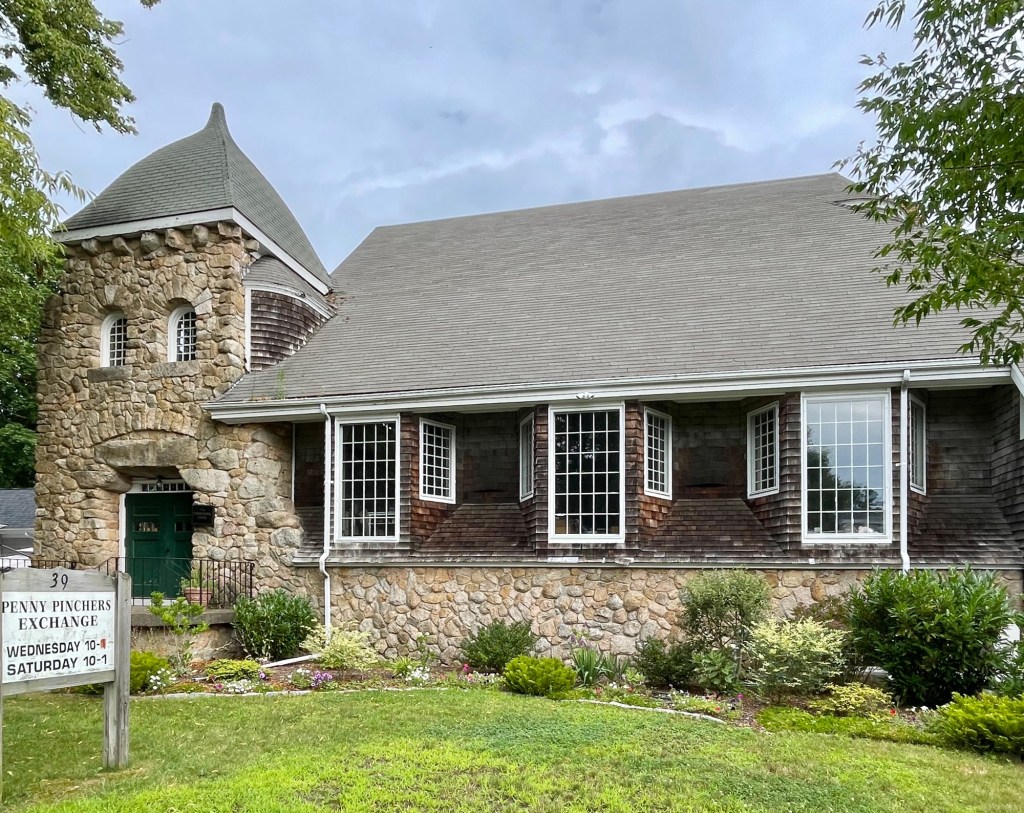
Completed in 1885 in the small coastal village of Marion, Massachusetts, the Marion Congregational Chapel was one of the last major gifts from Elizabeth Pitcher Taber (1791–1888), the wealthy widow whose patronage shaped the town’s entire civic landscape. Ms. Taber in her later years had already funded Marion’s library, founded Tabor Academy, and built its academy hall before purchasing a vacant lot on Main Street to build this chapel for her church, the First Congregational Church of Marion. Built in 1885, the chapel is designed in the texturally rich Shingle Style that was then sweeping New England’s coastal towns by the late 19th century with its continuous wood-shingle siding and gabled massing gave it a warmer, more approachable character than the town’s earlier Greek Revival and Italianate landmarks. The chapel stands out for its rubblestone entry tower and the trio of polygonal bays on the primary facade. For its first several years it doubled as Marion’s only real venue for public lectures and amateur theater, an arrangement that reportedly so dismayed Taber over the poor quality of the “worldly theatricals” staged there that she went on to fund a dedicated Music Hall, designed by architect William Gibbons Preston nearby. Given the fact Ms. Taber so-often utilized Preston as architect for her gifts to Marion (and as he was a summer resident here), it is probable that he too designed this Shingle style chapel. The Congregational Chapel stands today as a smaller, later addition to Marion’s Congregational history, which stretches back to the town’s original 1799 meetinghouse (now the Marion General Store) and the Greek Revival church built across the street in 1841 which is still home to the First Congregational Church of Marion.
 Buildings of New England
Quite a wonderful design. Do we know the name of the architect?
LikeLike