Bailey Homestead // c.1815

Located on a hill overlooking the Head Tide Village of Alna, Maine, this stately brick farmhouse has sat for roughly 200 years. According to old maps of the area, the property was occupied by the Bailey Family as far back as the land was surveyed in 1813. The property was owned by Ezra Bailey, who possibly built the house soon after as the village began to develop. By 1857, the property and its house were owned by I. H. Bailey, seemingly Ezra’s son, Isaac, who married his first cousin, Laura Palmer. The couple resided in the old homestead until they sold it in 1866, moving to Boston. The brick, Federal style house has a four bay facade with the entry door surrounded by a recessed arched relief. Above the door is a blind fan with sidelights.

Head Tide Church // 1838

In the early 19th century, Head Tide was a bustling village within the Town of Alna, Maine, supported by mills at the dam, agriculture and apple orchards, boat building, fishing and forestry. As Head Tide grew in population, village leaders determined to build their own Congregational church so they would not have to travel the three miles to the 1789 Meeting House in Alna Center. The Head Tide Church in Alna, Maine was dedicated in November 1838 and sits on a hill overlooking the village. The Head Tide Church is a handsome rural Maine house of worship which exhibits a combination of Federal style, Greek Revival, and Gothic Revival elements in its design. The facade displays the outline of a Grecian temple front with its six pilasters and strongly accented triangular pediment. The Federal fan motif appears above the two facade windows as well as in the center of the pediment and the Gothic Revival influence is felt in the two pointed arch windows on either side of the church and in the simple pinnacle at the top of each corner of the belfry. The church is a high-style building for the rural Maine village and is kept very well by the community. The congregation disbanded, but the church remains an important part of the town and is rented for memorial services, events, weddings.

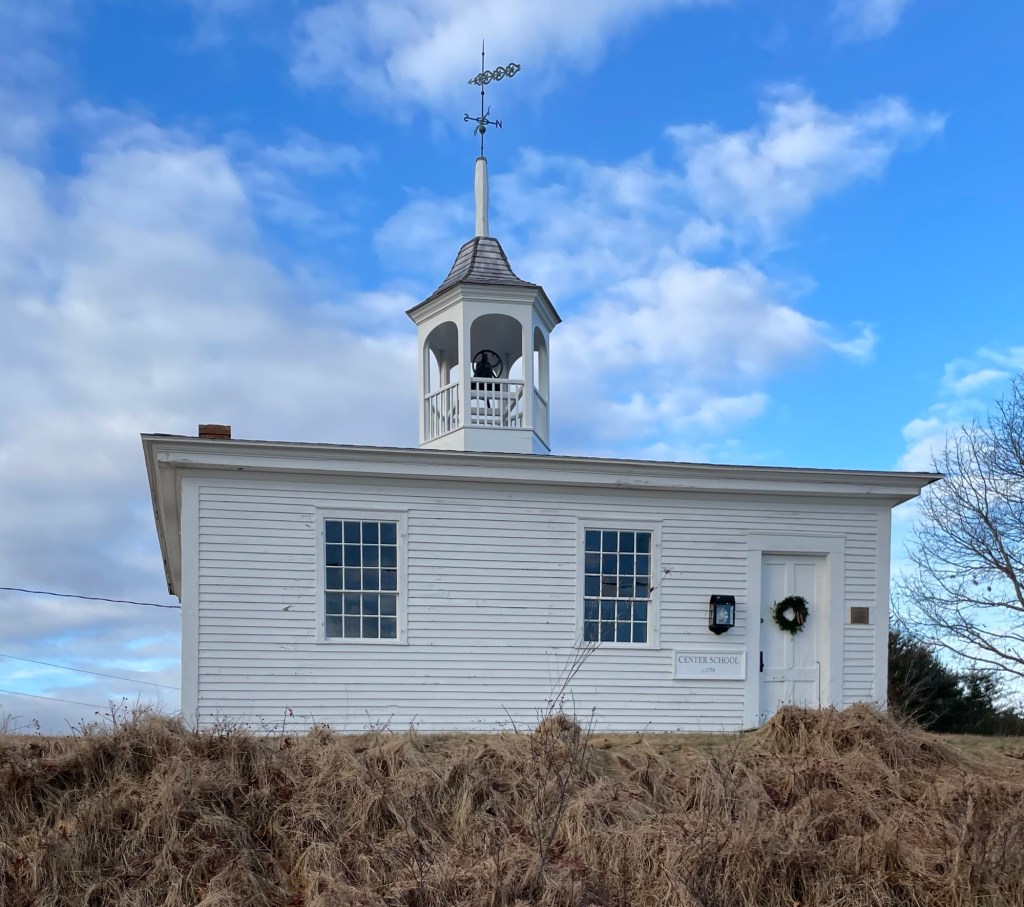
Alna Center School // 1795

Built in 1795, the Alna School is one of the oldest extant purpose-built school buildings in New England. The small frame structure sits a short distance from the Old Alna Meetinghouse and is one of the finest 18th century buildings in town. The Federal period one-room school building features a square footprint with graceful cupola housing a bell projecting from the roof, which was added a few years after the building was completed. The school was one of two early school buildings for the newly incorporated town of Alna, soon after its separation from Pownalborough and incorporation in 1794 (originally as New Milford, and later at Alna in 1811). The school remained in operation through the 20th century and is no longer used.

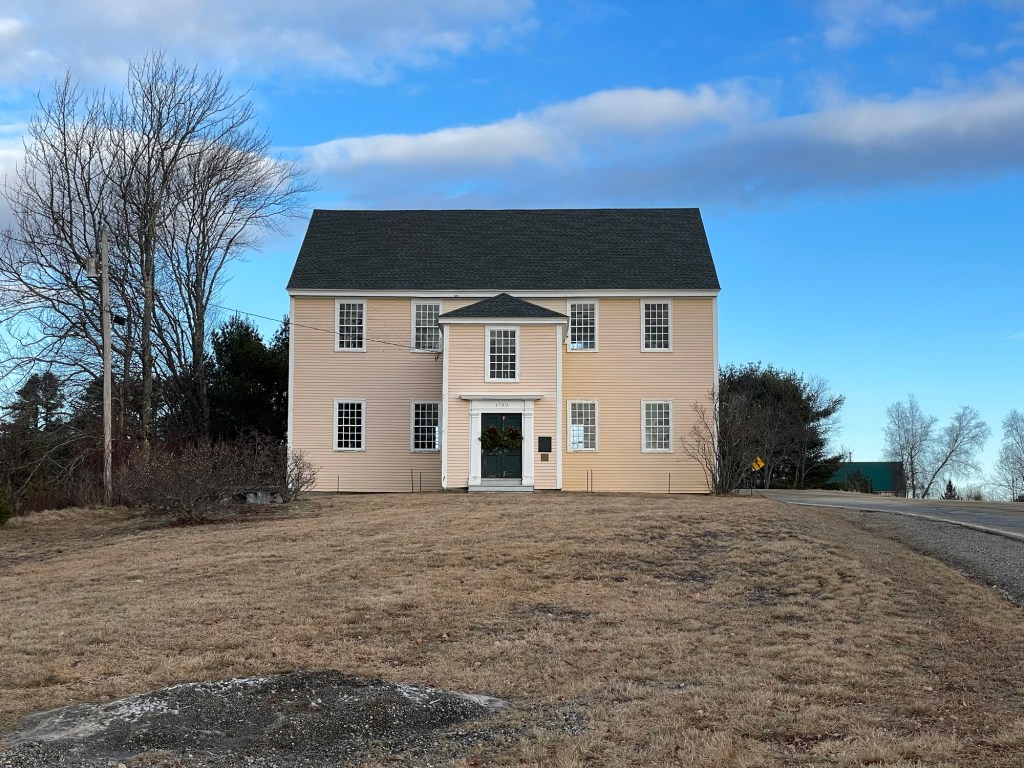
Alna Meetinghouse // 1789

The Alna Meetinghouse in Alna, Maine was built in 1789, and incorporated in 1796 as a Congregational church. The 40′ by 52′ foot building is one of the finest examples of a traditional New England meetinghouse in the state of Maine and Regular church services were held here until 1876. In recent years the building has been used for Town Meetings. Unlike many of the other meetinghouses of this period, the Alna meetinghouse has only one door. This door leads into a vestibule that contains the stairway to the gallery. The original box pews are still in place, as is the original pulpit with a sounding board hung from the ceiling. The building remains well-preserved and sits right on the side of the road!

West-Hathaway House // c.1800

Located on Mill Street, overlooking Queen Anne Square, the West-Hathaway House is one of the most charming Federal period houses in Newport, but it didn’t always call this city “home”! Believe it or not, this five-bay Federal style house was originally built in Tiverton, Rhode Island around 1800 and relocated to Newport about fifty years ago. The house was built by Samuel West (1774-1838), of a line of physicians, and later sold to Samuel Hathaway. The house was located on large farmland presently occupied by the Pardon Gray Preserve in Tiverton but was later donated to the Newport Preservation Foundation in 1977 by the owners who likely hoped to redevelop the area where this house sat. The West-Hathaway House was dismantled, moved, and reassembled on this site that same year!

Billings Coggeshall Double House // c.1784

This unique double-house on Mill Street is stopped me in my tracks when strolling around Newport. The two-family house was built around 1784 by Billings Coggeshall (1733-1810) and is unique architecturally as it is comprised of two houses, each with its own separate pedimented entry, into a single lengthy block. Both houses have interior chimneys and are just one-room deep! When urban renewal hit Newport in the second half of the 20th century, traffic patterns and revitalization of the waterfront were top of mind (not necessarily slum clearance and wholesale redevelopment of neighborhoods like in Boston). To bring traffic into the downtown shopping area, Memorial Boulevard was laid out by 1969, and the Newport Restoration Foundation was integral to saving this building from the wrecking ball, as it was in the path of the new road. As luck would have it, an area around Trinity Church was cleared to establish Queen Anne Square, a town common-like park in the center of town. To provide the quintessential “New England charm”, many historic buildings were relocated to line the square, including this house. When the Billings Coggeshall House was moved here, it replaced a gas station, and it was given an even longer side addition with breezeway, providing screened parking and a rear addition for offices. Here’s to preservation!

Hadley Homestead // c.1776

George Hadley (1740-1823) moved to Weare, NH in 1775, buying lot sixty-one in town from the proprietors. Captain Hadley served in the French and Indian War and later in the Revolutionary War, though he was not so eager to serve again. He built his home soon after, living here with his family. The original Hadley Homestead would have been a more traditional Georgian farmhouse with large central chimney and minimal glass/windows. Sometime in the early 19th century – after his wife’s death in 1806 or after his own death in 1823 – the house was modernized in the Federal style. The stunning home has a fan light transom over the door, narrow corner pilasters and twin chimneys projecting through the roof. It sits next door to the South Weare Union Church.

Yale University – Connecticut Hall // 1752

Welcome to Yale! When Yale College, one of the nine Colonial Colleges moved to New Haven in 1718, a wooden building was soon constructed and known as the College House. By 1747, the College House held less than half of the college’s enrolled students, and college president Thomas Clap announced that funds would be raised from the Colony of Connecticut for a “new College House” of three stories. The design followed the traditional Georgian appearance of Harvard College’s Massachusetts Hall, but by the 1790s, it was already outdated. The building was threatened with demolition, but Connecticut Hall was instead given an additional story and a new gambrel roof by 1820, being incorporated into the Brick Row, fronting the Green along College Street. But by the middle of the century the Brick Row was out of style and Connecticut Hall was being described as “dilapidated, scabby and malodorous.” After the Civil War Yale decided to raze all its old Georgian architecture and redevelop the West side of the Green with larger and more modern buildings. Luckily for us, by the 1890’s the Colonial Revival style was booming in popularity and before Connecticut Hall could be demolished, a group of alumni organized to save and restore it. Connecticut Hall stands today as the third-oldest of only seven surviving American colonial-era college buildings, and the second-oldest structure built for Yale College in New Haven (the oldest exant). It was built, in part, by at least five enslaved Africans, including one of whom was owned by Yale president Thomas Clap.

Tontine Hotel // 1824-1913

Historically, inns and taverns offered short-term stays for visitors to New Haven, Connecticut. As the town developed and Yale College grew, land-owners began to realize the potential for larger, centrally located hotels. Established in 1824 and fronting the Town Green, the Tontine Hotel stood for less than 100 years, but was a prominent establishment in the city. The hotel was designed by architect David Hoadley and it hosted many well-known individuals including Native American chief and orator Red Jacket, who gave a speech here in 1829, and Daniel Webster, who came here in 1832. When more modern hotels were built in the early 20th century, the Tontine saw declining and less fancy clientele. The site was slated for redevelopment and the block was demolished in 1913 for the new Federal Courthouse and Post Office (last post).

Preston Double-House // c.1830

Until recently, the Clam Point neighborhood of Dorchester was called Harrison Square. The name commemorated President William Henry Harrison’s visit to Dorchester during the presidential campaign of 1840 and honored his memory, as he died of pneumonia shortly after taking office. Development in the neighborhood was initiated following the arrival of the Old Colony Railroad depot (1844). When rail service to Harrison Square was discontinued in 1957, the Harrison name began to fade from the memories of area inhabitants. The name “Clam Point” is said to have been coined during the 1970s by realtors intent on touting the area as a desirable coastal community of antique homes, it stuck. Likely the oldest extant house in the neighborhood (built before the railroad depot) is this house on Mill Street, constructed as a double-house around 1830 for brothers Elisha and John Preston. The vernacular, late-Federal style house has later shed dormers and lancet windows in the side gables. The Preston’s land holdings and sale before the Civil War led to much of the later development in the neighborhood.