Located adjacent to the Mary Immaculate of Lourdes Roman Catholic Church in Upper Falls, this rectory building, built in 1938 adds much to the streetscape. Although the building permit for this building was issued in 1938, it was not occupied until 1943, according to City Directories. The building was designed by architect Timothy G. O’Connell of Boston, who specialized in ecclesiastical design. The 3 1/2-story gambrel Colonial Revival building has a center entrance with projecting balustraded porch with turned balusters and urn finials.
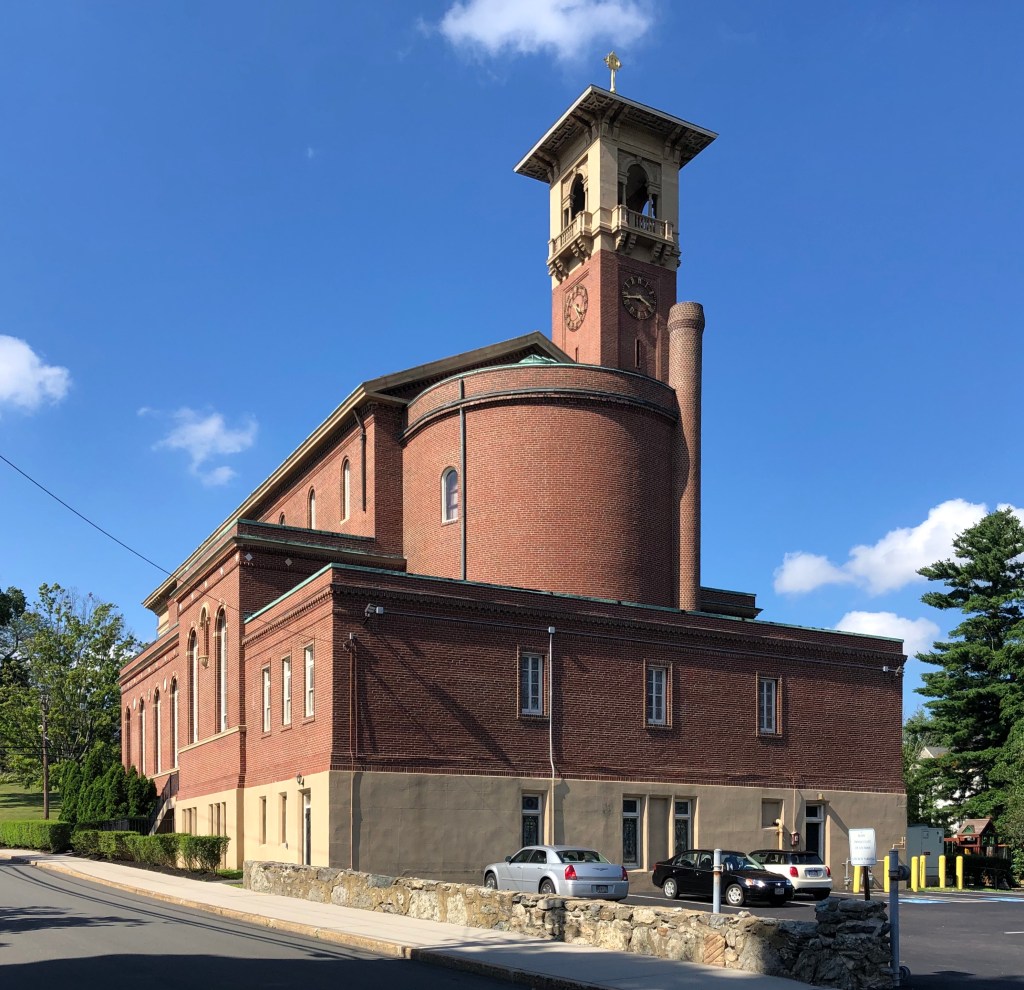
One of the grandest churches around Boston, Mary Immaculate of Lourdes R.C. Church, is in Upper Falls Newton, a working class village which developed around industrial mills in the 19th century. The church, built in 1909, towers above the workers cottages and smaller frame homes in the neighborhood showing the wealth and importance of the Catholic Church to Irish immigrants who worked and lived nearby. This parish was the first in the town of Newton and it comprised of multiple villages along with parts of Wellesley and Needham. The parish was formed in the 1840s and eventually grew so much it petitioned the Archdiocese to construct a new house of worship worthy of the population. In the early 20th century, a site was secured, and the house on the lot was moved for the erection of a new church. Edward T. P. Graham was selected as the architect, who designed this Renaissance Revival church. The commanding monumental columned portico rises over two stories and supports a projecting pediment which has decorative modillion blocks, cast figures within depicting religious figures. A campanile (bell tower) is located at the rear corner and is of Italian Renaissance design. In 2004, the Archdiocese had put Mary Immaculate on the closing list of churches; however, in 2006, the Cardinal had reconsidered his plan to close the church and decided to close a church in nearby Waban Village instead.
Built adjacent to the stone cottage, this stone barn was also constructed in around 1840 by Otis Pettee (1795-1853) as part of his business venture. Pettee was a major mill owner in the Upper Falls Village of Newton and was a major silk manufacturer in the area. The stone barn was used as a warehouse and later as the location for raising silk worms for the silk mills down the street. As with the adjacent stone cottage/shop, Pettee likely built the barn of mostly stone on the site as a fireproof design to protect his valuable product. It is now home to Danish Country & Modern, an amazing furniture shop which sells Scandinavian furniture and accessories.
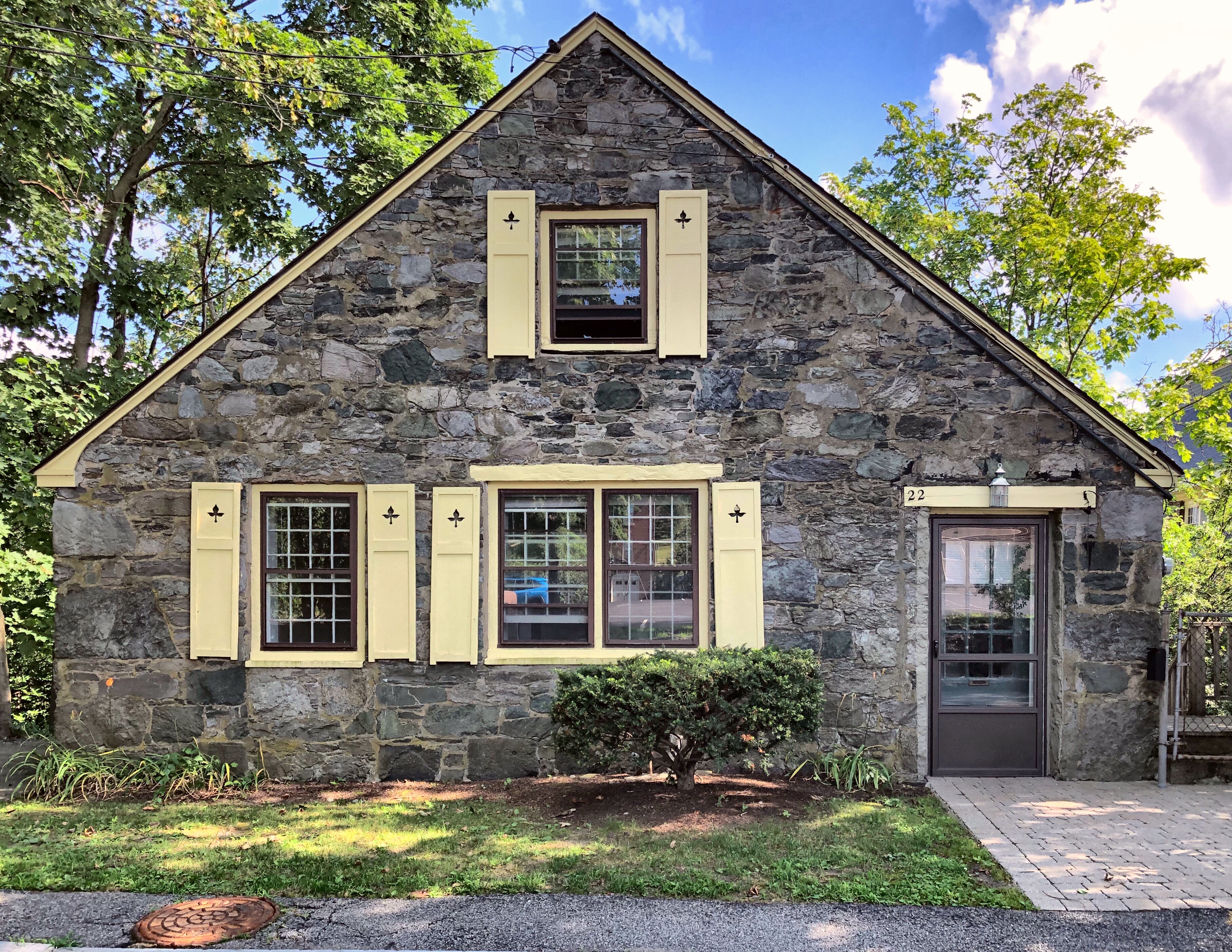
One of the rare early stone cottages in Newton, this charming building in Upper Falls Village has an interesting history! The stone cottage was built around 1840 by Otis Pettee (1795-1853), a major mill owner in town. This cottage specifically served as a shop and later as the residence of the caretaker of the silk mill a couple blocks away. Pettee likely had this building and the adjacent barn constructed with stone to limit the chance of a fire, destroying any valuable silk inside.
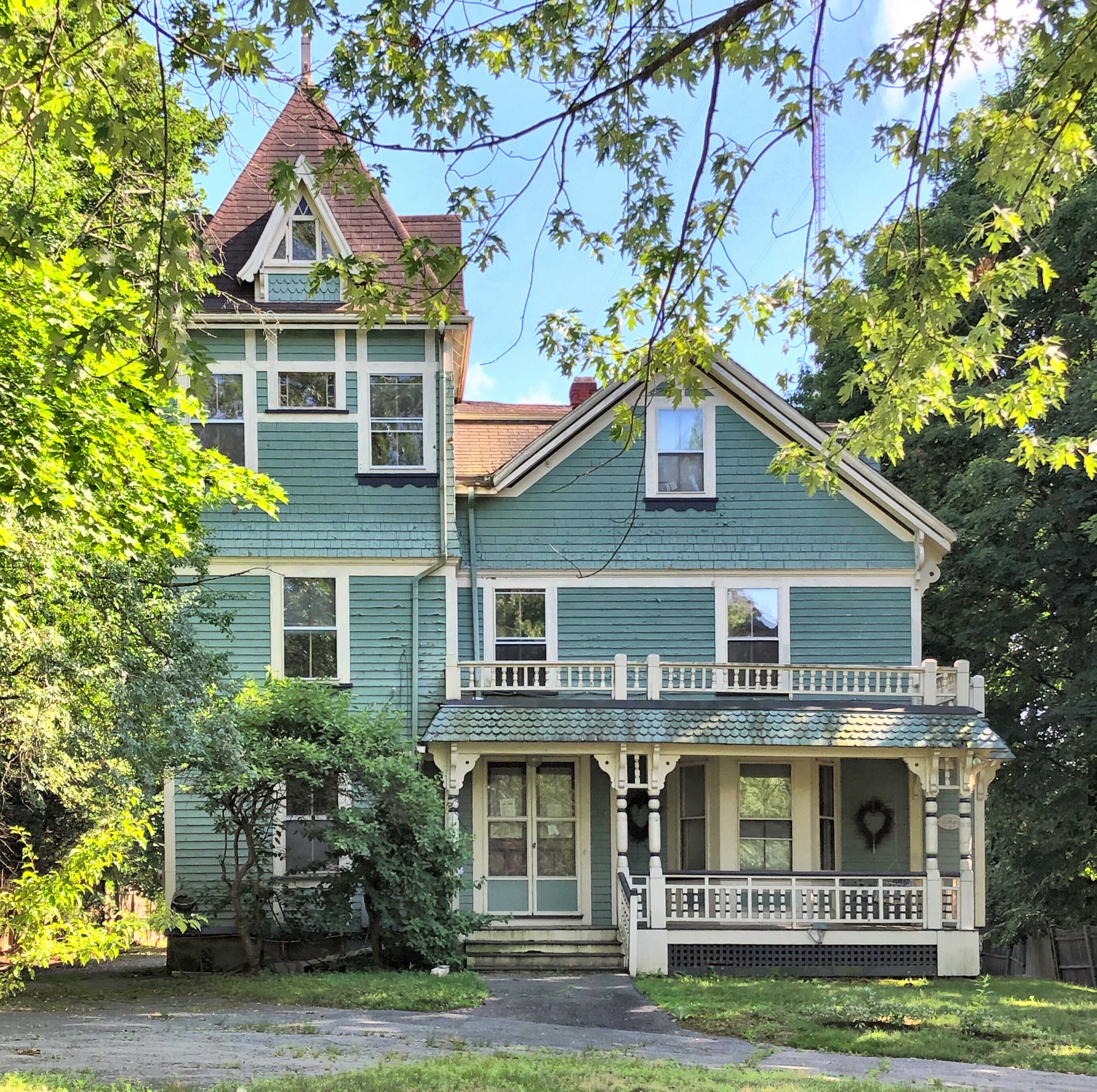
This house was built by 1850 for Charles Winslow, a mill-owner in the Upper Falls Village of Newton. The house was likely a gable-end Greek Revival home consisting of the two right bays seen today. By 1882, another mill owner, Richard Sullivan, purchased the home and completely renovated it with a square tower, stick-work, double door entry, and a porch. He owned a cotton mill near the river and built workers housing between his house and the mills for his workers and their families.
One of the few architect designed buildings in Upper Falls Village in Newton is the Ralph Waldo Emerson School built in 1904-1905. The village school in Upper Falls consistently was outgrown by the rapidly growing population in the 19th century, leading to new schools being built every couple decades. The 1846 Village School (featured previously) was outgrown and a major landowner, Otis Pettee willed a valuable piece of land to the town for the erection of a new school and firehouse, both were built that next year. By 1869, a second schoolhouse was built on the site in the fashionable Second Empire style, named the Wade School. As expected, the two adjacent school buildings were deemed obsolete and the town, inflated by the industrial wealth of Upper Falls, hired the architectural firm of Hartwell, Richardson & Driver to design a large brick schoolhouse, with a cost of $92,000. The building was occupied as a school until the 1990s until (you guessed it) the schools in the town consolidated, and the Emerson School was then converted to residential units.
Spanning the Charles River between Upper Falls Village in Newton and Needham, the Echo Bridge, is one of the most stunning structures around Boston. While not technically a building, I couldn’t help but share one of my favorite off-the-grid places to explore in the region.
The bridge served as crossing for water to be transported from the Sudbury River to the growing City of Boston. The entire aqueduct transported water over 18 miles from Farm Pond in Framingham and was stored in the Chestnut Hill Reservoir in Boston. Due to the topography of Hemlock Gorge in Newton, a large elevated bridge was required, creating one of the biggest engineering marvels around Boston. George W. Phelps, a contractor from Springfield, MA was selected as the builder of the bridge with a low bid. The 500′ bridge features a total of seven arches, with the largest spanning the Charles River being 137′, the second largest masonry arch span in the U.S. upon its completion.
Echo Bridge is constructed of large granite block and brick, which was held in place by wooden framework until the arches would be able to support their own weight at the top of the arches. Echo Bridge gets its name from the acoustical phenomenon when you stand at the base of the arch at the river and when speaking, the sound reverberates and echoes back and forth.
The Upper Falls Village in Newton, MA is a small industrial neighborhood which grew after the Revolutionary War due to its location on the Charles River where rapids and falls occur. Mills and factories were built in the village and thus, workers from other towns and even Europe moved here to work in the dozen manufacturing facilities. By 1850, the village had 1,500 residents, a quarter of those living in the town of Newton at the time, in a much denser area. With workers and families moving here, the need for a school was paramount. As the Upper Falls Village continued to grow, schools were built and demolished for newer and larger structures to house the growing population. In 1846, this two-story schoolhouse was constructed in the then popular Greek Revival style. The schoolhouse was quickly deemed inadequate and was sold when a new school closer to the center of the village was built in 1855. This building was then converted to commercial use, serving as a grocery and dry goods store and later a watchmaking shop, with the storefront added at the time.





 Buildings of New England