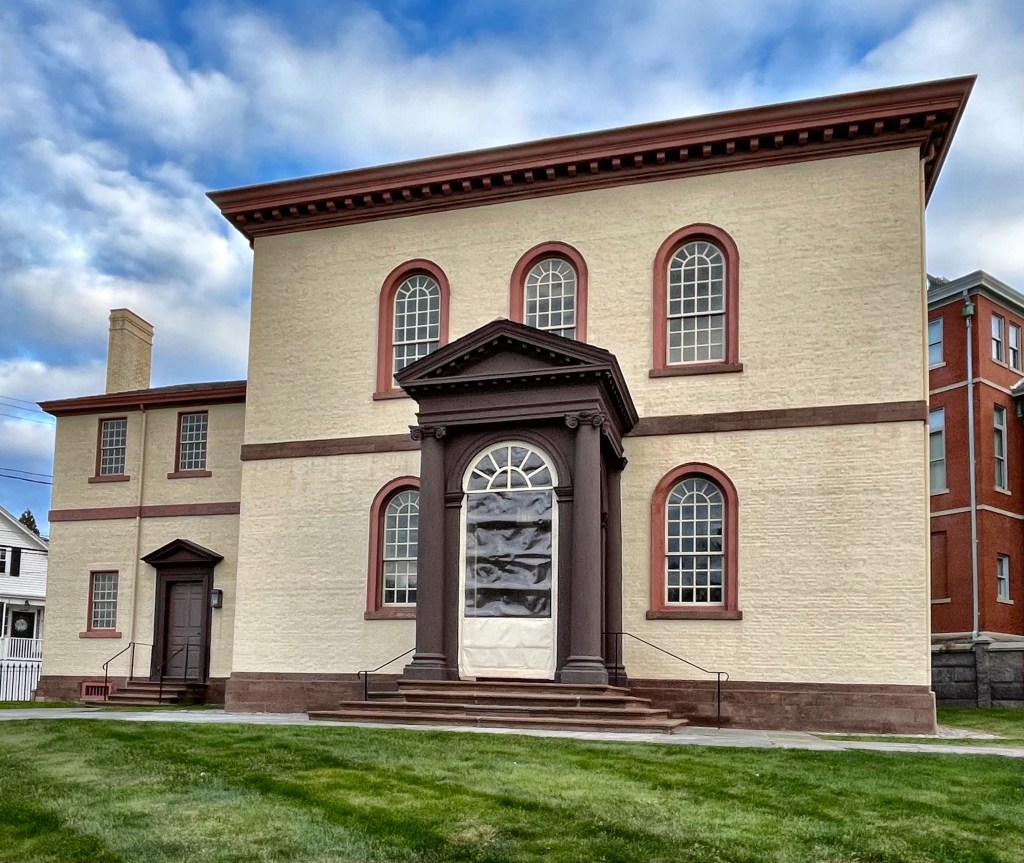
Touro Synagogue // 1763

While Newport is arguably best-known for the Newport mansions from the Gilded Age, there are soooo many amazing buildings from the Colonial era, including some of the most significant and historic in the United States. Touro Synagogue in Newport is the oldest synagogue building still standing in the United States, the only surviving synagogue building in the U.S. dating to the colonial era, and the oldest surviving Jewish synagogue building in North America (for reference, second-oldest extant synagogue in North America was built in 1833, seventy years later)! Its history begins in the 17th century when the small but growing colony of Newport received its first Jewish residents possibly as early as 1658. The earliest known Jewish settlers arrived from Barbados, where they participated in the triangular trade along with Dutch and English settlements. By 1758, the Jewish population had grown sufficiently that there was a need for a house of worship. The Congregation now known as Congregation Jeshuat Israel (Salvation of Israel) engaged Newport resident Peter Harrison to design the synagogue. Harrison, a British American merchant and sea captain, who was self-tutored in architecture, studying mostly from books and drawings. By the time he designed Touro Synagogue, he had already completed iconic buildings including Newport’s Redwood Library and King’s Chapel in Boston. Construction began on the “Jews Synagogue” in 1759, which was completed years later in 1763. The building is one of the most significant buildings in America, and is open to tours where you can see the immaculately restored interiors.
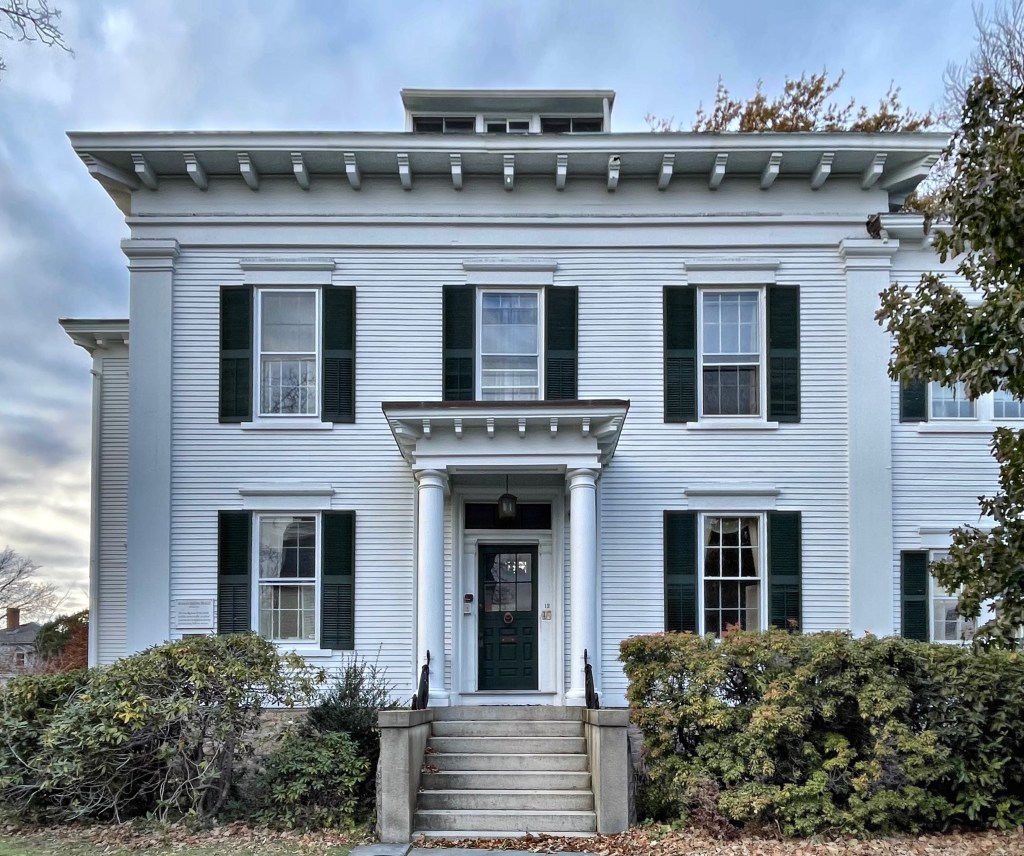
Alfred Smith House // c.1843

Alfred Smith (1809-1886) was known as “Newport’s Millionaire Real Estate Agent”, working in the mid-late 19th century to get some of America’s most well-connected upper-class acquire properties to build their summer cottages. In his early days, he prospered by assisting prospective developers and buyers to purchase house lots on newly platted streets, including Bellevue Avenue. By the time of his marriage in 1843, he built this stunning Greek Revival mansion, equipped with stunning proportions and corner pilasters. Decades later, to “keep up with the Joneses”, he modernized the house by extending the eaves and adding brackets and the addition of a belvedere at the roof. He was instrumental in much of Newport’s later development, even bankrolling the erection of a stone bridge on Ocean Avenue, to allow carriages and subsequent developable lots to extend in the previously untouched land in south and west Newport. He suffered a stroke in 1886, and died a year later, two years after his late wife. He funded a monument to the family, hiring Augustus St. Gaudens to furnish a stunning memorial “Amor Caritas” which stands in Island Cemetery in Newport. Mr. Smith’s estate was mentioned in the New York Times and stated there was no will, and his four living children would each get upwards of $1 Million (nearly $30 Million a piece based on inflation today)!

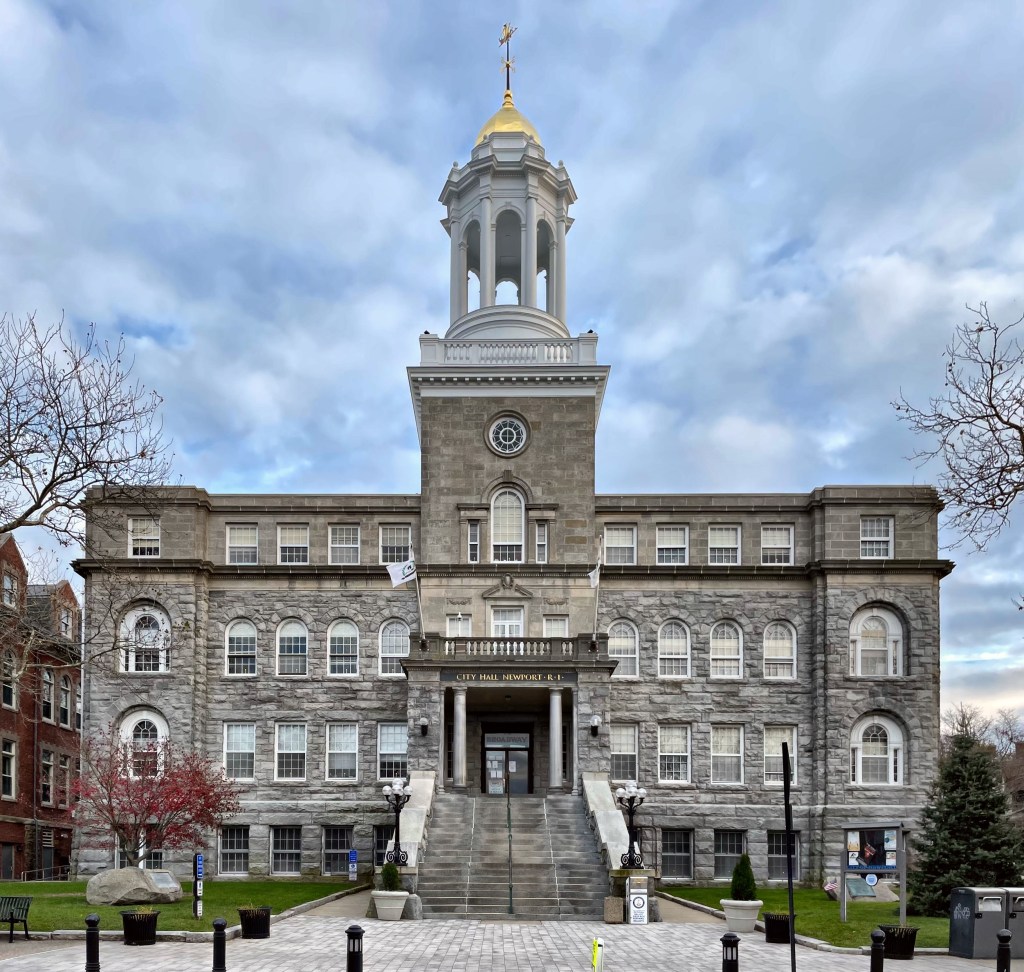
Newport City Hall // 1900

Newport, Rhode Island was settled in 1639 from colonists, who took land from the Narragansett people, who had lived on the land for generations. Newport eventually grew to be the largest of the original settlements that later became the Colony of Rhode Island and Providence Plantations. Newport served as the seat of Rhode Island’s government until the current Rhode Island State House in Providence was completed in 1904. Newport was a major center of the slave trade in colonial and early America, active in the “triangle trade” in which slave-produced sugar and molasses from the Caribbean were carried to Rhode Island and distilled into rum that was then carried to West Africa and exchanged for captives. In all, about 60% of slave-trading voyages launched from North America – in some years more than 90% departed from the tiny state, many of which left from Newport. Beginning in the mid-nineteenth century, wealthy southern planters seeking to escape the heat began to build summer cottages. By the end of the 19th century, a large number of America’s elite would build summer “cottages” in the town, transforming much of it to the Gilded Age splendor we see today. Stay tuned for a sampling of Newport buildings.

Newport City Hall was completed in 1900 from Newport-based architect and builder John Dixon Johnston. The massive Beaux-Arts style building was constructed of granite block and capped with a mansard roof with iron cresting. Tragically, a fire destroyed much of the interior and the roof in 1925, leading to a re-imagining of City Hall. In the 1920s, Colonial design prevailed in New England, and architect William Cornell Appleton envisioned the building with more Colonial features. Palladian windows and a boxed-off fourth floor were added, along with a towering cupola.

Hamilton House // 1896

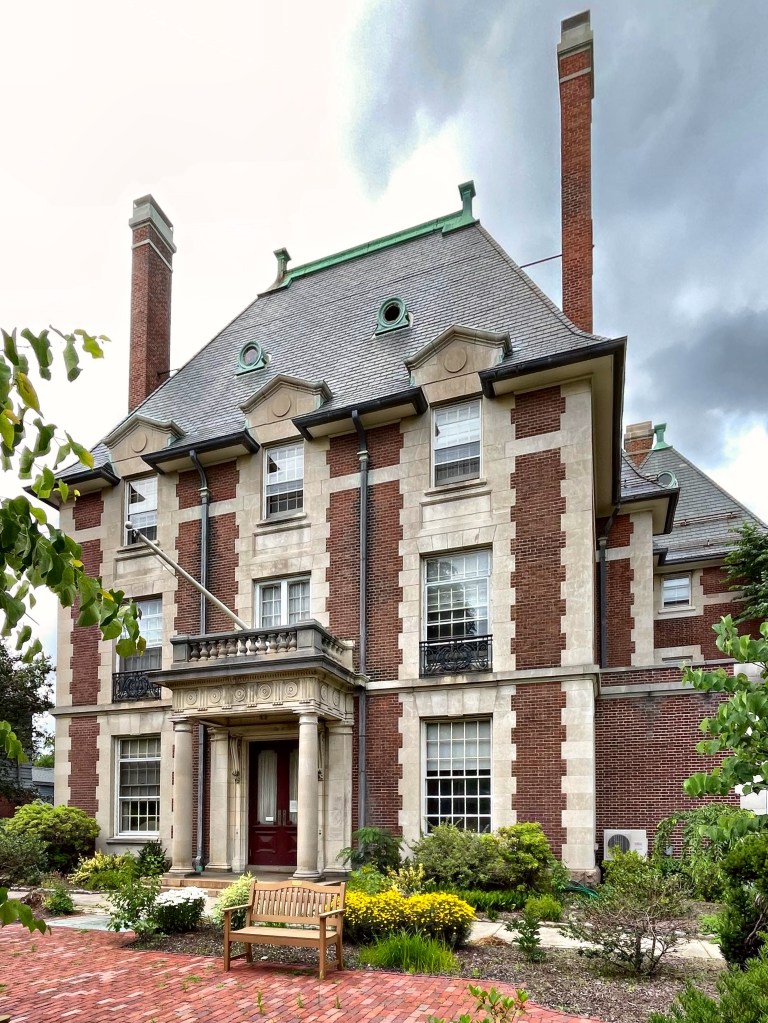
Providence is full of amazing residential architecture from all periods, but one house that stands out to me for being such a high style and unique mansion is the Hamilton House on Angell Street. The mansion was constructed in 1896 for local businessman, Francis W. Carpenter. From 1892 until his death, he was the president of Congdon & Carpenter Company, an iron and steel company which was founded in 1792, and operated in Providence into the 1980s. Carpenter was very influential as chairman of the committee on the construction of a new building for the Central Congregational Church (a previous post) in 1893. So pleased with how the church turned out, he hired the same architects, Carrère and Hastings of New York to design his own mansion which would sit next door to the church! Many in New England may not know how significant it was to have Carrere and Hastings design your house. To put it into perspective, while the firm was designing this house, they were designing the New York Public Library’s Main Branch building! The Carpenter Mansion was designed in the French Renaissance Revival style which was not too common in America, but always turns heads! The large hipped roof emulates the earlier French mansard roof forms, and the bold massing and use of limestone and brick makes the house look like a chateau or castle plucked from the French countryside. The house apparently was not finished until 1915, likely when the porte-cochere was added for the owner’s vehicles. The building is now occupied by The Hamilton House, a non-profit organization that serves as an adult learning exchange with programs from history classes to group fitness courses.

Robert Lippitt House // 1854

“Less is more” is a phrase adopted in 1947 by architect Ludwig Mies van der Rohe to describe his minimalist, Miesian glass box buildings. While he was referring to Modern architecture, the same phrase can be used in 19th century design, where massing, form, and materials are showcased in all their glory with little frills or additions. The Robert Lippitt House in Providence was constructed by 1854 for Robert Lincoln Lippitt (1823-1858), who worked with his brother Henry Lippitt in owning and managing textile mills. Henry would later build his own mansion nextdoor to his late brother’s house (see past post). Sadly, Robert died four years after this home was built, at the young age of 34. His widow, Louisa Gorden Hallet remained in the home and remarried within a year of her late husband’s death, to Charles Lippitt, possibly a cousin to Robert. Messy. The home was designed by architect Thomas A. Tefft, a promising and respected young architect who also died young, at the age of 33.

Peter Wanton Snow House // c.1830

This Greek Revival home with a one-story full-length porch was built in 1839 for Peter Wanton Snow, one of the unluckiest men in Providence. Born the son of a leading China trader and the son of a granddaughter of a former governor of Rhode Island, Peter W. Snow (1788-1843) was born into privilege and like many of such stature, could enter the family business with ease and make a lot of money. Peter first sailed for Canton (Guangzhou, China) with his father in 1803. Doubtless because of his father’s position and trading connections, young Snow became the partner of Edward Carrington who, within fewer than a dozen years, was to become one of the richest and best merchants dealing in Chinese goods in Rhode Island, if not in the entire country. Carrington wanted to retire and have Peter Snow take over his agency in China, but Peter did not seem to like it there and always wanted to go back home to the United States. He got the chance for a few years beginning in 1814, but upon returning home, he learned that his only son, Charles, had died a year earlier at the age of five years, and to compound his personal tragedy, Snow lost two baby daughters in the next three years. By 1816, he returned to China but never seemed to be able to get out of debt, while trying to provide for his last two remaining children. Tragedy struck again when his last living daughter died, while he was in China. Peter’s business partner and friend R. B. Forbes before letting Peter know the bad news wrote this.

Mr. Snow is now in as good health as he has been since his arrival in China, still he is weak in body, and a very little trouble or disappointment breaks him down and reduces him completely unable to do anything. Poor man, his countrymen here feel much sympathy for him, and fear the result of this news on him. This daughter has appeared to be the only thing which could induce Mr. Snow to make any exertion, and he often spoke of her with all the feelings of a Father who centered all his happiness, in this world, in making her comfortable and happy, and in the expectation of returning to America and of ending his days in her arms”

While in debt, he somehow had this home built in Providence, likely from assistance from family and colleagues. The land here was purchased by Peter’s wife Jeanette, and the home was likely built soon after. Peter died in 1843, virtually penniless.

Central Congregational Church, Providence // 1893

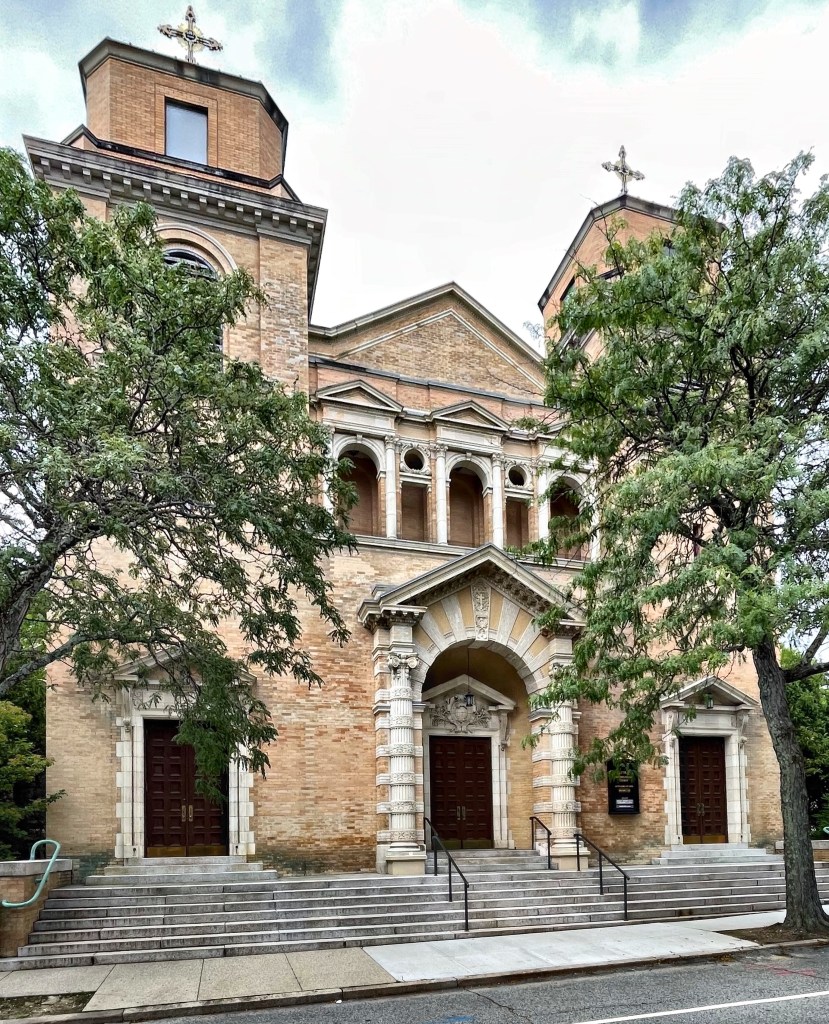
One of the best examples of Renaissance Revival architecture in Rhode Island is the Central Congregational Church of Providence. Constructed between 1891-1893, this building was the new home to a growing congregation, which outgrew its original Thomas Tefft-designed building on Benefit Street (which has since been occupied by RISD). Famed architect Thomas Hastings of the firm Carrère and Hastings of New York City, was hired to furnish plans, and worked closely with Reverend Edward C. Moore to make sure the building was fitting of the site. The church is cross-gabled in form and is constructed of yellow brick with terracotta trimmings, evocative of Spanish and Italian Renaissance styles. The facade has a detailed central pavilion which is flanked by two towers. These towers were originally surmounted by elaborate belfries, but these were damaged by a hurricane in the mid 20th century and replaced by the present brick caps. The dome and vaulting is of tiles by Rafael Guastavino, it is the first dome that he constructed in the U.S., making this building even more significant.

Governor Henry Lippitt Mansion // 1865

North (secondary) facade

New England is lucky to have so many diverse house museums where architecture and history nerds like me can tour old houses and envision what it was like to live in that era. The Governor Henry Lippitt mansion in Providence stands out as one of the most significant Victorian-era homes in Rhode Island, and contains one of the best-preserved Victorian interiors in America. The mansion was likely designed by local architect Russell Warren, and modified by Henry Lippitt (1818-1891), heir to one of Rhode Island’s leading textile manufacturing families, for his wife Mary Ann Balch (1823-1889) and their six children who survived to adulthood. While Henry was a prominent businessman, his wife Mary may have been even busier. Mary owned and managed rental properties in Providence, including this mansion, giving her husband Henry life tenancy. She oversaw day-to-day running of the mansion, supervising the servants while teaching her daughter Jeanie, who became deaf at age four due to complications from scarlet fever, to read lips and continue to develop her speech. The Lippitt Mansion is an early, and high-style example of an Italianate Villa/ Renaissance Revival design, which moved away from the more prescribed forms of architecture towards the more eclectic, Victorian-era mode. The home features two main facades, with the smaller, west (main) facade featuring a central pavilion with ornate foliate frieze and Corinthian columns, and the north (side) facade – my favorite – with a more commanding presence with a bold porte-cochere. The home remained in the Lippitt family for 114 years, and was later acquired by Preserve Rhode Island, who opened it to the public as a museum in 1993.

Linden Place // 1810

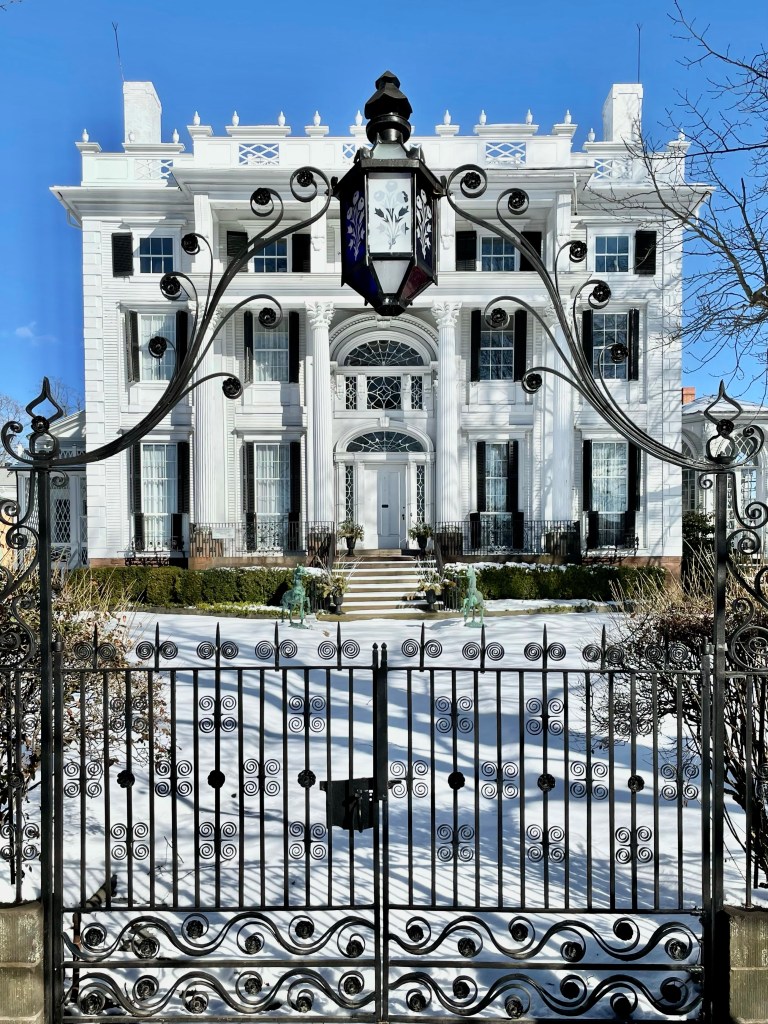
For the last post in this series on Bristol, Rhode Island, I am leaving you with a house that is architecturally stunning, but holds a dark history. Linden Place was built in 1810 by slave trader, merchant, privateer and ship owner George DeWolf and was designed by architect, Russell Warren. The DeWolfs of Bristol, who became the biggest slave-trading family in U.S. history, transported well over 11,000 Africans to the Americas between 1769 and 1820. The U.S. banned the slave trade in 1808, but the DeWolfs continued dealing in the slave trade until the 1840s by going through Cuba, where they had numerous plantations. They also got help from a DeWolf brother-in-law, who served as a customs inspector in Bristol — thus ensuring family slave ships continued to come and go. In 1825, George DeWolf suffered major financial hits and he and his family fled to his plantation in Cuba, where they’d be beyond reach of his creditors. Stories explain that with the possibility of legitimate payment out of the question, the townspeople sought compensation for George’s debts where they could, and they broke down the front door of Linden Place, and took everything, even peeling the silk wallpaper off the walls.

Following DeWolf’s bankruptcy, the house was bought by his uncle James DeWolf, who was alleged to have directed the murder of a female African slave in 1789 who was sick with smallpox on the slave ship Polly, which he commanded; she was bound to a chair and lowered overboard. James DeWolf was tried and effectively acquitted; which, sadly, should not surprise anyone based on historical precedent. In fact, James DeWolf financed another 25 slaving voyages, usually with other members of his family and was thought to be the second richest man in the United States upon his death in 1837. In later years the house passed to Samuel Pomeroy Colt, a grandson of George DeWolf (as well as the nephew of the inventor of the Colt revolver). His son Russell married actress Ethel Barrymore, who was the great-aunt of current actress Drew Barrymore, and lived in the home. Today, the grand estate is a house museum and event space.

Bradford-Norris House // 1792

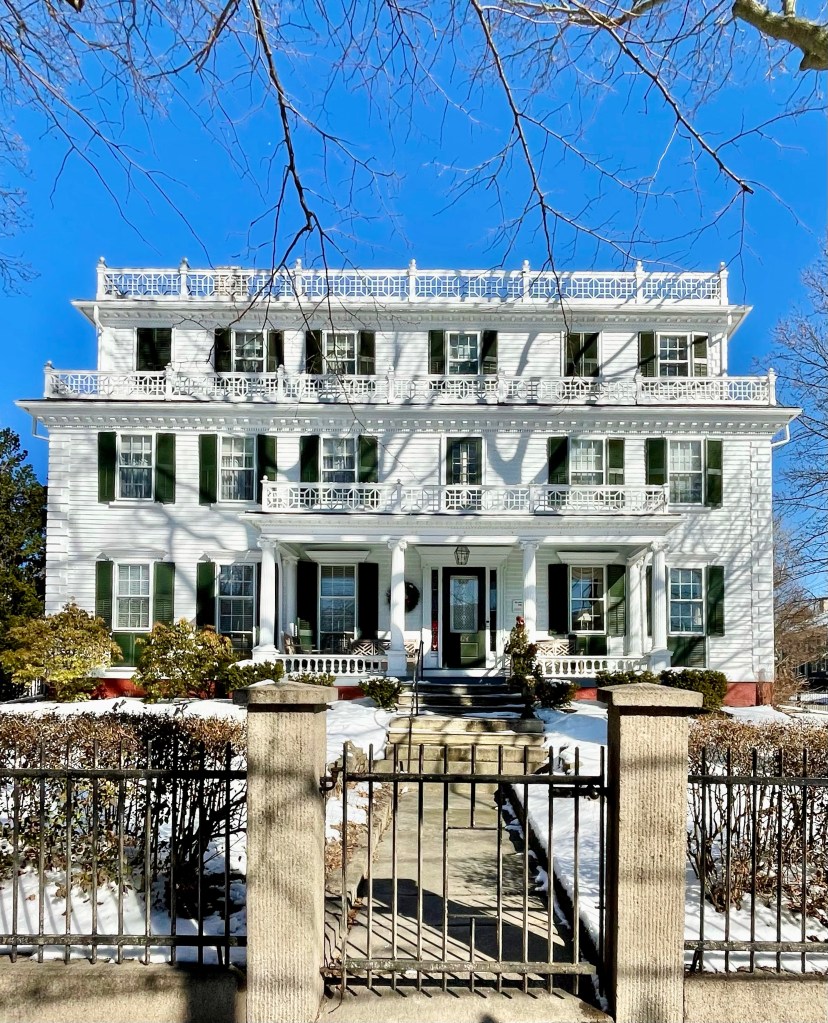
William Bradford (1729-1808), who would become Deputy Governor of Rhode Island from 1775 to 1778, came to Bristol to practice medicine by 1758. When he arrived, he rented Mount Hope Farm (featured before), before building a home in town. When the British Navy bombarded Bristol on October 7, 1775, his home was among the buildings destroyed. He afterward went aboard ship to negotiate a cease fire, saving what was left of the town. In 1792, he built a 2 1/2-story Federal style, boxy house on this lot, close to the street. The home was willed to his son Hersey, who resided there until the 1840s, when he mortgaged the house to Francis Dimond, who resided in a Greek Revival temple front home (also featured on here previously). He gifted the modest Federal home to his daughter, Isabella, possibly as a wedding gift upon her marriage to Samuel Norris, a sugar refiner. Mr. Norris and Isabella hired architect Russell Warren, who designed her father’s home nearby, to renovate the house in the spring of 1845, moving the house away from Hope Street. The house was given its third floor and additional bay, along with the ornate design which characterizes it to this day, including the Ionic porch and Chinese Chippendale balustrade. The house remained in the Norris family until 1942 and is now a B&B.