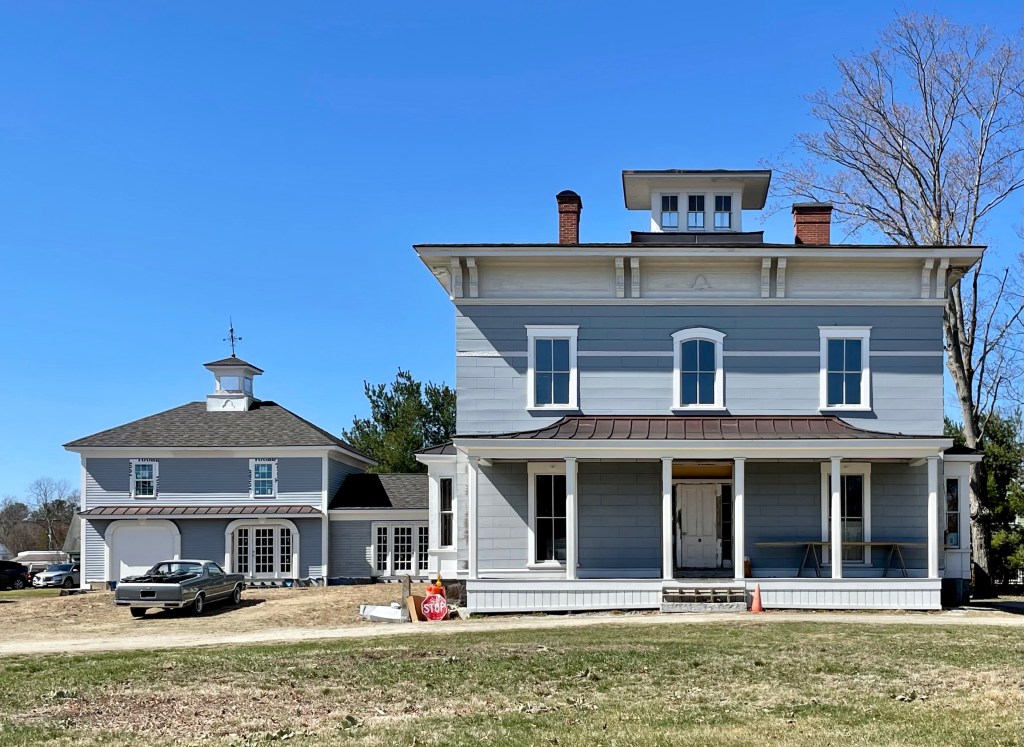
This Italianate mansion was built in the 1860s for George E. Lee, a tanner. Lee lived in this home for a few decades until his death, before which, we had a stable or carriage house built to house his horses and carriage. There is a belvedere at the roof which could have been used by George or his wife to oversee the tannery business just blocks away! The home was willed to his son William after his father’s death, who sold off land across the street for new development. Interestingly, land behind the house was sold off in the early 2000s for townhouse development, possibly to provide funding to restore the home, currently undergoing renovations. The street that the townhomes sit on… Preservation Lane.
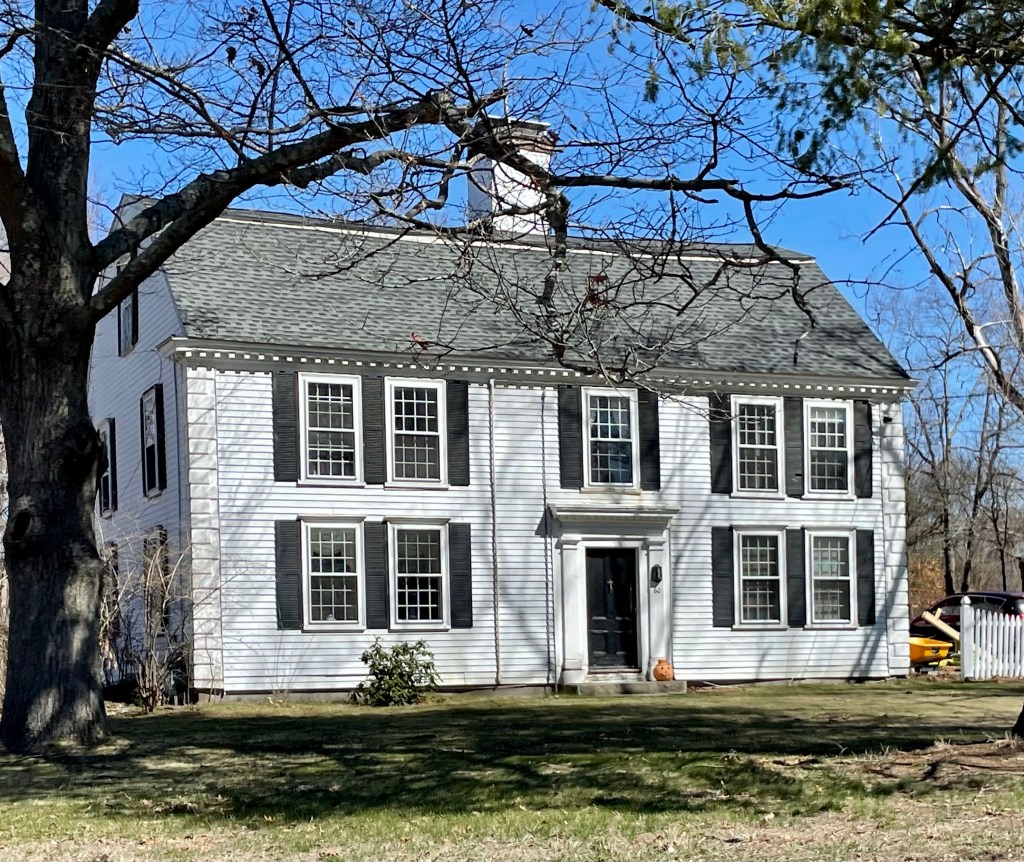
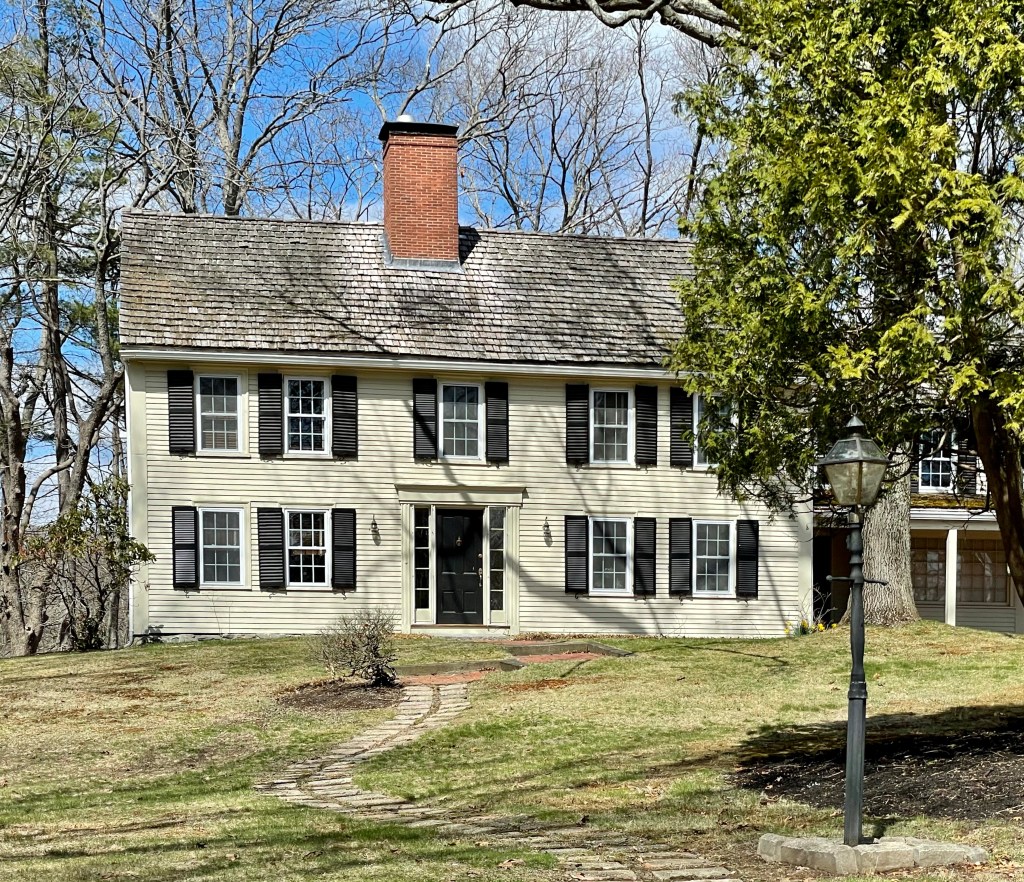
Sampson Spaulding (1711-1796) studied at Harvard University to become a minister. At the age of just 23, he was called to be the first minister at the new First Congregational Church in 1736. To entice the young minister to the rural new town of Tewksbury, this Georgian mansion was constructed, probably with help from his new congregation. He married Mehetable Hunt, a local woman, and they had six children. Rev. Spaulding was stricken with paralysis in 1791 in the middle of a church service, and he died five years later. He became one of the first burials in the new cemetery in town, now known as the Tewksbury Cemetery. The gambrel-roofed Georgian mansion stands today as one of the oldest homes in Tewksbury.
Reading Vermont’s public library building was built in 1899, by local resident Gilbert A. Davis (1835-1919). The building’s funds were furnished by Mr. Davis in his life, likely inspired by Andrew Carnegie’s fund which had libraries built in towns all over the United States. Gilbert Davis worked as a lawyer in Woodstock before moving back to Reading, Vermont to run his own practice. The library he funded is Neo-Classical in design in the form of a Greek Cross with intersecting gable roofs and with a monumental portico in the Ionic Order on the front facade. The charming library building is well-preseved and an excellent example of Vermonts beautiful small-town libraries.
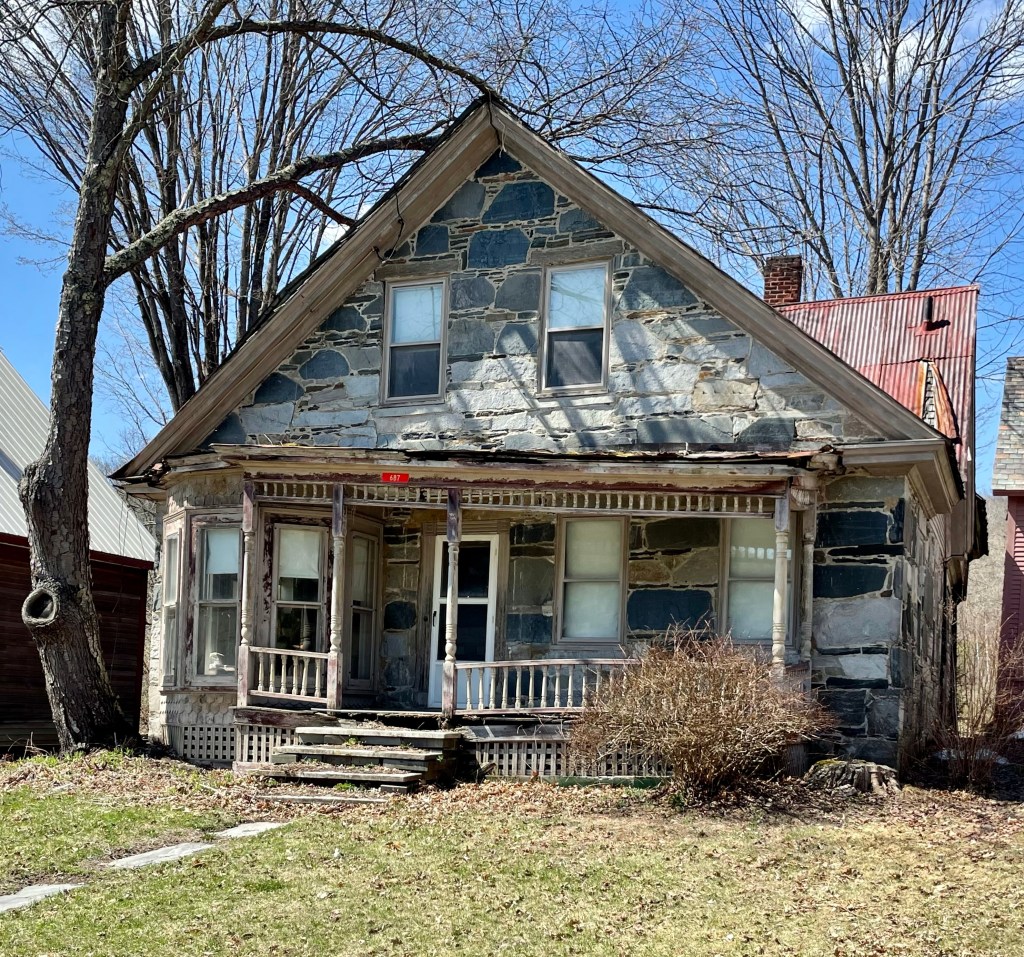
In the early 1830s, skilled masons from Scotland and Ireland came to central Vermont to work on building projects. A number of these workers, mainly from the Aberdeen area, and specialized in a specific building style in which plates of stone are affixed to a rubblestone wall. This method of bonding stonework is so prevalent in Scotland and Ireland it has been referred to in some journals as ‘Celtic Bond’, but in Vermont, it is known as “snecked ashlar”. The mixture of stone sizes and colors produces a strong bond and an attractive finish. This home is a rare example in the state, which is estimated to have about 50 of these homes left. I could not locate any information on the owners of the home, but the house has seen better days, with the wooden front porch shifting away from the main house. Also, if you look closely, you can see the original wood shingle roofing breathing under the sheet metal roof!
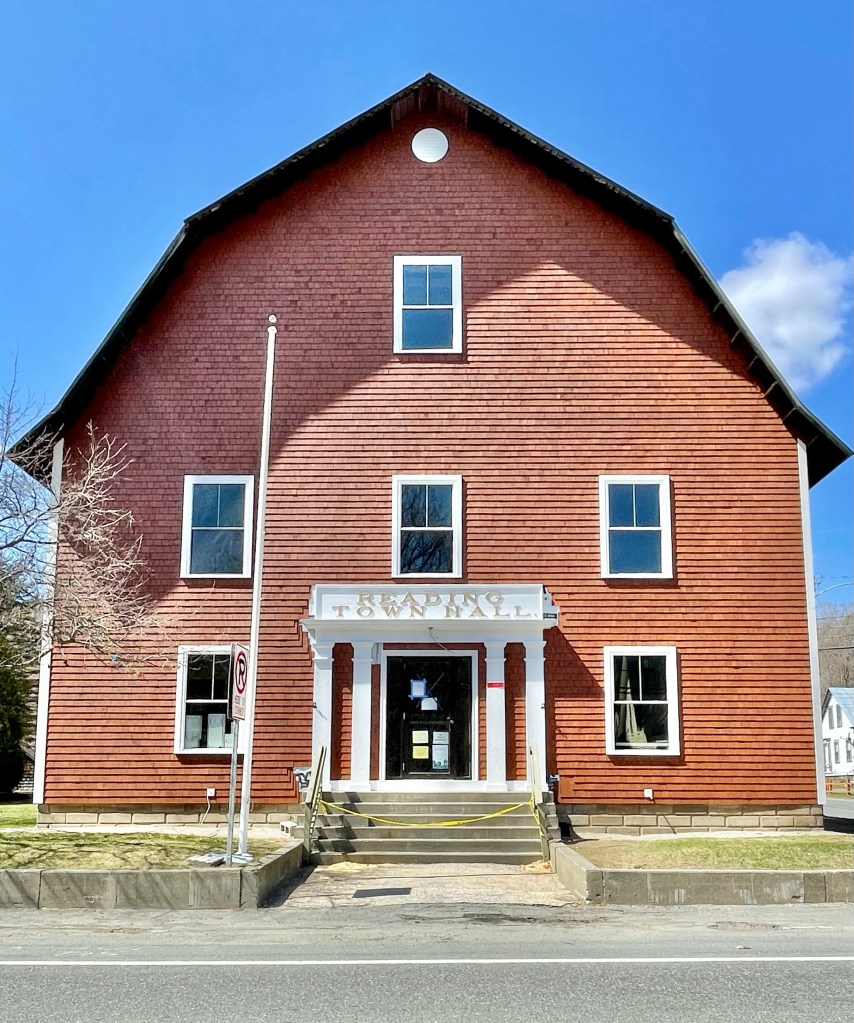
The Reading Town Hall in Reading, Vermont is an imposing shingle-clad, gambrel roof building which sits in the village of Felchville. The hall was built in 1911 as a gift to the citizens of Reading by Wallace F. Robinson. Wallace Robinson was born in Reading in 1832. He went to Boston as a young man and entered into the provisions (groceries) market, and became quite successful, expanding into the wholesale provisions business and meat packing. He was active in civic and business affairs of Boston, most notably as the President of the Boston Chamber of Commerce and as a State Representative in the Legislature for two terms. By around 1900, Robinson had retired and had taken up a life of philanthropy, spending much of his wealth on memorial buildings and to places that had a lasting impact on him, including Robinson Hall at Dartmouth College and renovations at UVM. The design for the Reading Town Hall is especially notable for the fact that it was designed to resemble historic gambrel roofed barns found in the state.
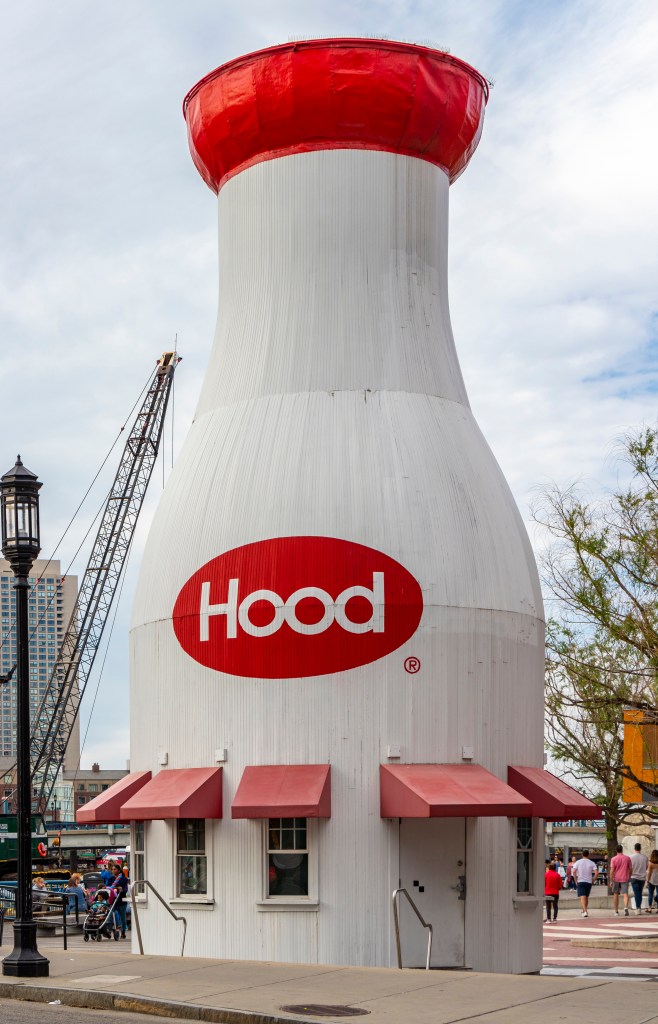
Boston’s iconic Hood Milk Bottle has been an iconic fixture in the city’s built environment for decades, but do you know about the history behind it? The architectural oddity was born in 1933-4 in Taunton, Massachusetts, the brainchild of Arthur Gagner who created it as roadside attraction in which he could sell his homemade ice cream. The Milk Bottle beckoned to local families with its impressive size (the structure is 40 feet tall, 18 feet wide, weighs 15,000 pounds, and would hold 58,620 gallons of milk, if it were a real milk bottle)! As car ownership became commonplace, giant donuts, coffee pots, hot dogs, and other surreal shapes rose up on roadsides across the country, enticing motorists to pull over from the busy, new freeways. Gagner peddled sweet treats from his whimsical wooden stand for a decade before selling the building to the Sankey family, who also used it to sell ice cream. But by 1967, the bottle had been abandoned. In 1974, photographer Walker Evans took a Polaroid of the forlorn building, which brought Hood Milk, native to Charlestown, to the table. With a quote of $25,000 to repair it, Hood agreed to cover that cost if the Bottle could be renamed The Hood Milk Bottle, and the structure was to be located on City Hall Plaza, until the architect of the plaza called the Mayor’s Office stating their displeasure with that idea. They then contacted the newly relocated Boston Children’s Museum, who agreed to locate the bottle on their property. The Hood Milk Bottle was delivered to the Museum in 1977 from Quincy (where the repairs were made) on a barge with two fire boats steaming alongside, on a voyage the Hood Company dubbed the “Great Bottle Sail”, where it has remained to this day. It recently underwent a $350,000 renovation, restoring it to its former glory. So no crying over spilled milk!
In the 1930s, America was in the throes of the Great Depression, and towns and cities struggled to provide services for the ever-growing populations, all the while suffering from lower tax revenues. The New Deal was enacted as a result, which provided a series of programs, public work projects, financial reforms, and regulations enacted by President Franklin D. Roosevelt between 1933 and 1939. One of these programs was the Public Works Administration (PWA), which funded and built large-scale public works projects such as dams, bridges, hospitals, and schools, to provide jobs and bolster local economies. In Newton, the developing Oak Hill Village required a new public school, and the town received funding for the Oak Hill Middle School in 1935. Architects Densmore, LeClear, and Robbins were hired to provide designs for a new school, and builders completed the building the next year. The Georgian Revival building is constructed with red brick with cast stone trim. The 16-over-16 windows and cupola also work to showcase the beauty of the design.
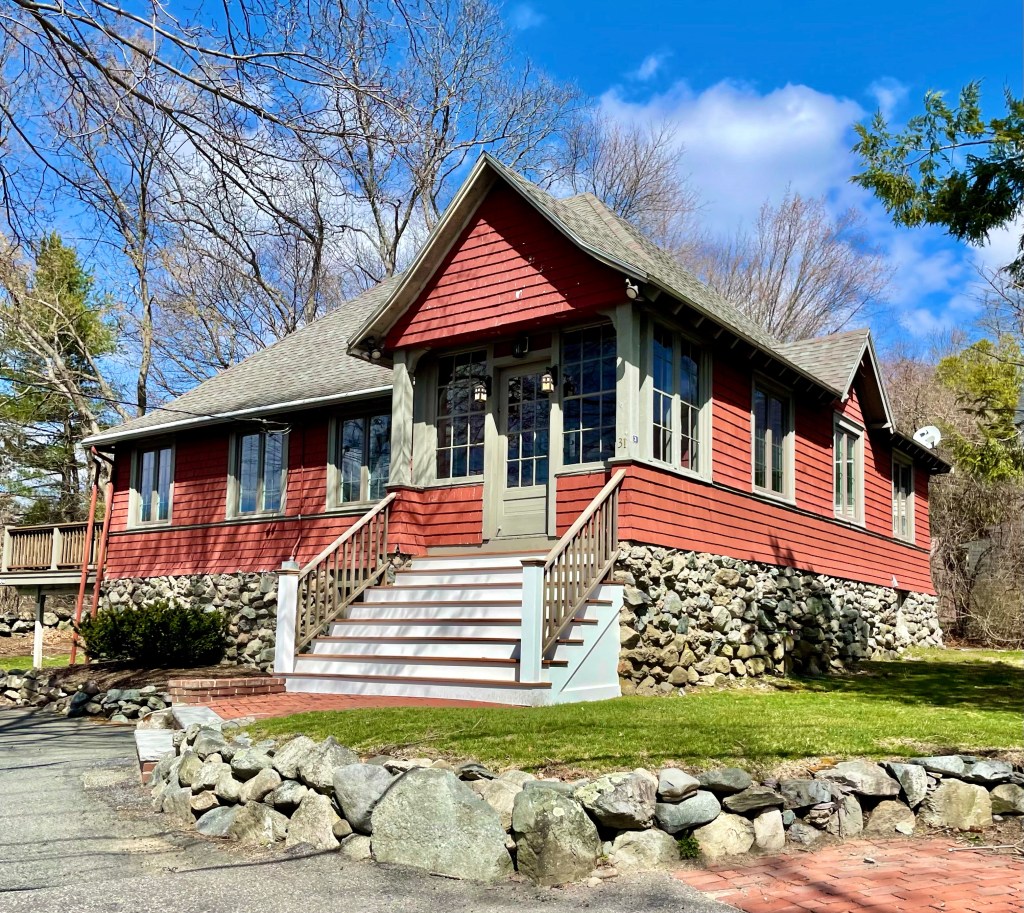
On a busy road in Oak Hill Village in Newton, Massachusetts, I saw this house which appeared as if it was built for a different use. After searching historic maps, I found it was originally home to the Oak Hill Evangelical Society, as a rural chapel. The chapel served as a local religious gathering place for the handful of families who lived around this section of Oak Hill and did not desire to travel to nearby villages to worship. The practitioners had money, and hired the Boston architectural firm of Cooper and Bailey, who designed many stunning civic and institutional buildings in New England. With the proliferation of the personal automobile, locals would later be able to travel to nearby churches easier, and this building was sold to a member, who converted it to residential use, which it has been used as to this day. The building is an excellent example of the Arts and Crafts architectural style with the raised rubblestone foundation, flared eaves with exposed rafters, and shingle siding which flares where it meets the foundation.
Another of Oak Hill Village’s pre-Revolution homes is this stunner! This home was built some years before 1718 and was eventually occupied by Robert Murdock (1663-1754) and wife Hannah Stedman. Murdock emigrated from Scotland to Plymouth, MA in 1688 with his brother, later settling in Roxbury. In 1703, Robert bought a house and 120-acres of land here, and worked as a housewright. Like the King House (last post), the house was likely rebuilt or modified substantially at this time. Robert also served as a selectman, Constable, Surveyor of Highways, and Assessor in town until his death; and his son, Robert Murdock Jr., took over the property. By the mid-18th century, the estate was purchased by Jeremiah Wiswall (1725-1807). Wiswall served as Captain of the militia at the battle at Concord and Dorchester Heights during the Revolution and held a number of positions in the community including Overseer of the Poor, Constable, Selectman and as a hogreeve (person charted with the prevention or appraising of damages by stray swine). He was very involved in the events leading up to the Revolution including the committee on the tea embargo and drilled with the militia. He also lent money to the town to hire soldiers and owned a house designated as a place to receive smallpox inoculations in 1777, though it is unclear if it was this house he used. The house was eventually slated for demolition in the 1960s, but was saved by Dr. Roy Carlson, President of nearby Mount Ida College (now owned by UMass. For $1, he purchased the home from a developer and paid for it to be moved from its original location at the corner of Brookline and Dedham streets a ¼ mile southwest to its current location, on Carlson Ave, and it served as the President’s House.
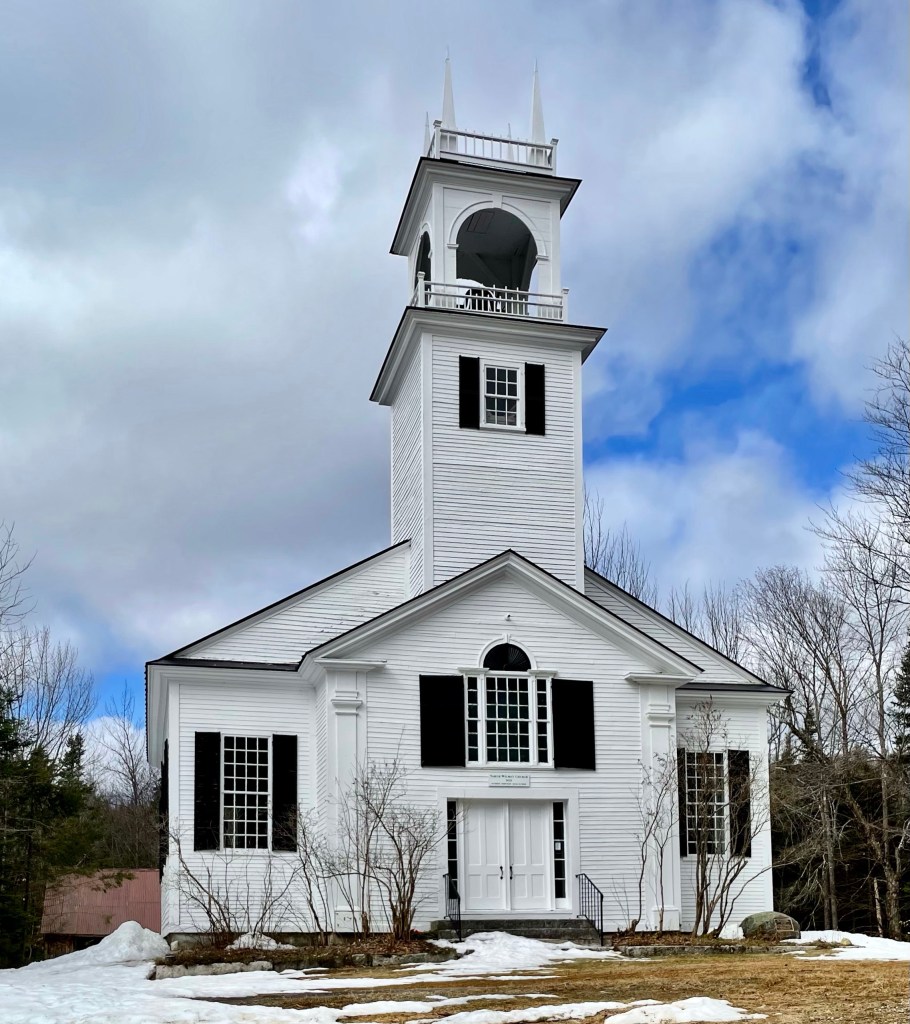
Off the beaten path (like much of the town of Wilmot, NH, you can find this stunning old New England meeting house. Erected in 1829, the North Wilmot Church stands as the oldest extant church in the small town. Five denominations—Congregational, Christian Baptist, Freewill Baptist, Universalist, and Methodist, together collaborated to build this structure then known as the North Union Meeting House. Each denomination held services at the church, as they were all too small separately to warrant their own buildings. Decades after it was built, it was determined that the church should be moved down the hill. In 1846, the church was lifted and placed on rollers (logs), and with the help of oxen, rolled down the hill. It is said that the builder of the church, Josiah Stearns, rode in the belfry. The Different congregations later built churches elsewhere and the building was under-utilized, and it was converted to a meeting space, but allowed a congregation to use the structure. In 1983, with the agreement of remaining North Wilmot Congregational Church members, the North Wilmot Union Meeting House Society was established to maintain the structure and arrange for services in July and August.


 Buildings of New England