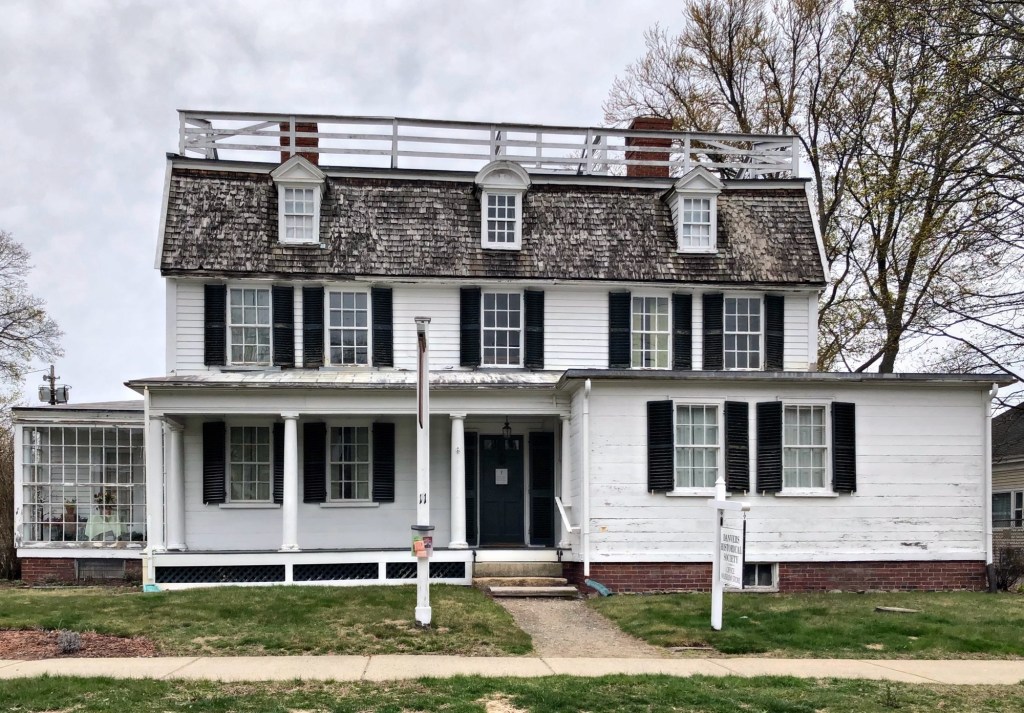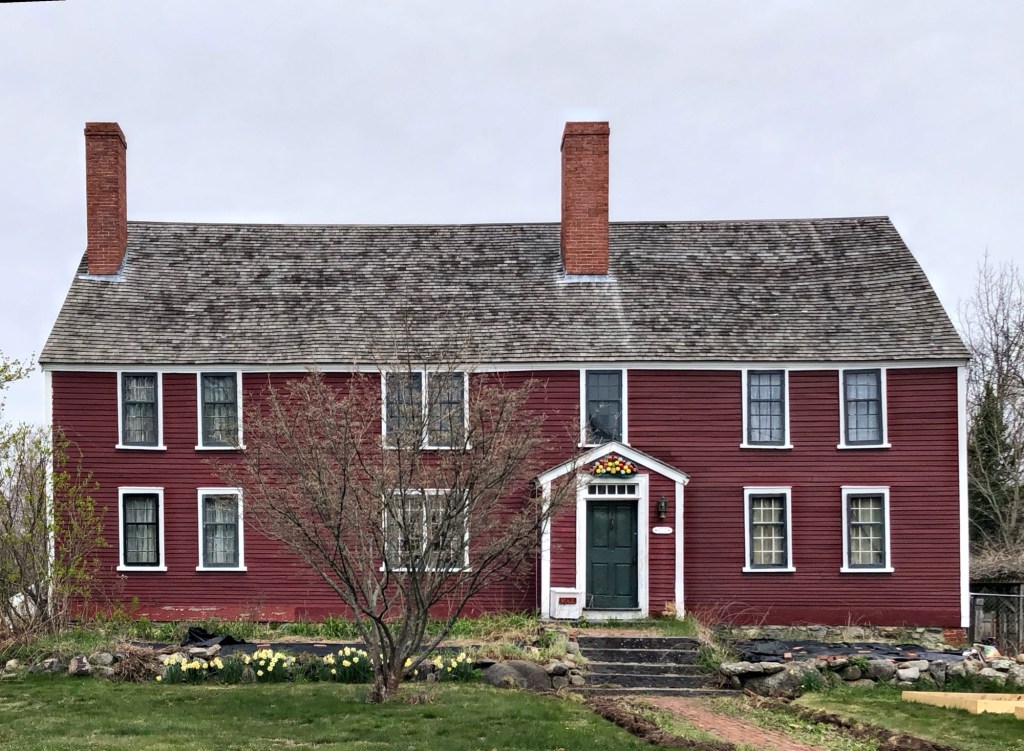
Darling-Prince House // c.1680

This large First Period house was built on the outskirts of Salem Village, now Danvers, Massachusetts, and moved to its present location in 1845. The residence was originally built around 1680 for John Darling (c.1637-1713), a mariner, who farmed the land here when he was not at sea or residing on the island of Monhegan in Maine (then a part of Massachusetts Bay Colony). John Darling (sometimes spelled Dollin or Dollen) died in 1713 and his estate went to his eldest son, Thomas, who farmed on the land there until the property was sold in 1734 to Dr. Jonathan Prince (c.1707-1753), one of the first resident physicians of Danvers, Massachusetts. Dr. Prince would practice medicine from his home and taught students the medical profession until he passed away at home in 1753. The home was later moved to its present site in 1845 by owner, John Hook, who likely expanded the home to its present configuration.

Mudge Family Cottage // 1852

Edwin Mudge (1818-1890) was a major shoe manufacturer and a representative to the Massachusetts General Court. In 1844, he married Lydia Nichols Bryant, and in 1852, the couple hired Edwin’s brother, a carpenter, to build this house at 108 Centre Street in Danvers, Massachusetts. A son, Francis was born October 4, 1846, and his sister Lydianna was born March 20, 1853. Tragically, both brother and sister died in 1855 of what was described as “brain fever” or “dropsy in the head.” Frank, one month shy of 10 years of age, passed away on September 8, 1855, followed by little two-year-old Lydianna exactly one month later. They are buried together in the local cemetery and a portrait of them is in the Danvers Historical Society collections. Edwin and Lydia would have one other child, Sarah Mudge (1857-1938), who grew up to be a prominent citizen and one of the founders of the Danvers Historical Society. The formerly simple Greek Revival style cottage was “Victorianized” in the Stick/Eastlake style with the addition of delicate bargeboards, a hood over the new double-door entry with iron balustrade, and side dormers.

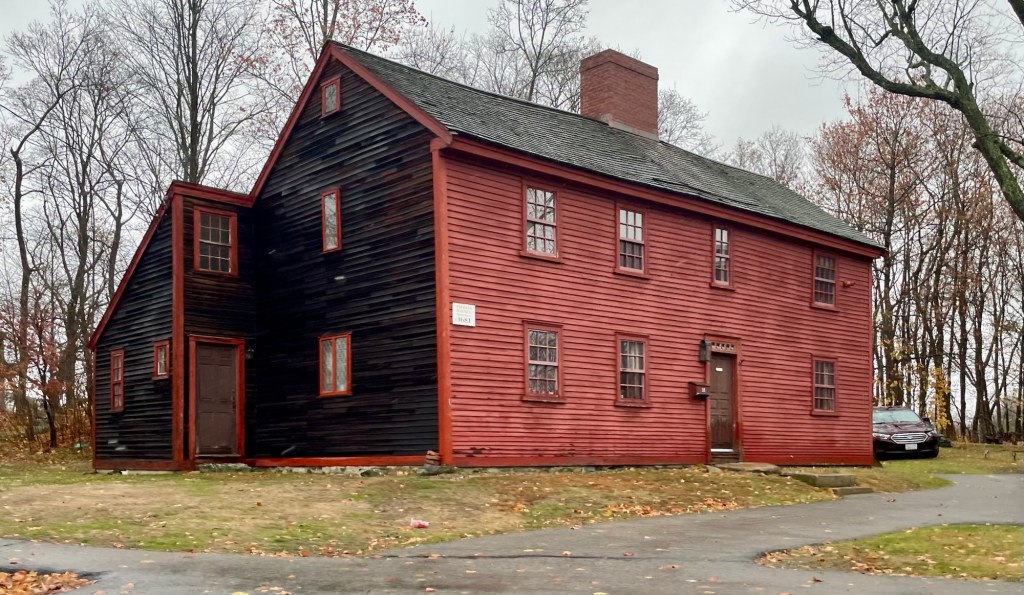
Thomas Haines House // 1681

There aren’t many extant buildings with direct ties to the Salem witch trials of the 1690s, but this First Period house on Centre Street in Danvers is one of them! This is the Thomas Haines House, built in 1681 for Thomas Haines. During the witchcraft hysteria of 1692, Thomas testified in the trials of Elizabeth Howe and John Willard, who were accused of witchcraft. Elizabeth would be executed by hanging on July 19, 1692 and John was hanged on August 19, 1692. Less than a year following the frenzy of the trials, Thomas received a license to keep a public house of entertainment & sell strong drink as an innholder. He remained here until 1703, when he sold his home and land to John Allen, a gunsmith, and removed to Salem, New Jersey. The First Period home with saltbox roof is in great condition and was restored to its historic appearance in the 20th century. The property is privately owned.

Tapley Memorial Hall // 1930

Years after the Danvers Historical Society acquired the Jeremiah Page House, saving and relocating it to its present location on Page Street, the society began planning for a new facility to house its collections. After a successful fundraising campaign, the society solicited plans from local architect, Lester S. Couch, a partner in the firm, Little & Browne, and member of the historical society, to design the new memorial building. Designed in 1930 and completed a year later, the Colonial Revival style building is constructed of fireproof brick walls with a hipped roof. Two entrances are located on the side elevation facing the Page House, with pedimented surrounds and blind fanlight transoms. The building is notable for the use of slightly recessed arched bays, common in Federal and Federal Revival buildings. The Tapley Memorial Hall is still maintained by the society and can be rented out for functions.

Jeremiah Page House // 1754

In 1754, a 32-year-old brickmaker Jeremiah Page built this large, gambrel-roofed Georgian house in Danvers, Massachusetts, for his young family. Jeremiah and his first wife, Sarah, raised nine children here and dreamed of liberty from England. Following the Tea Act, passed by British Parliament in 1773 that granted the British East India Company Tea a monopoly on tea sales in the American colonies, Page was said to have demanded that “none shall drink tea in my house.” One evening when her husband was out, Sarah Page is said to have invited several women from the neighborhood up to the porch atop the Page House’s gambrel roof to enjoy tea. Larcom quotes Page as telling her friends, “Upon a house is not within it,” thereby finding a loophole around her husband’s directive. This legend was enshrined in the poem “The Gambrel Roof” (1874) by Lucy Larcom, who knew Sarah Page’s granddaughter. Jeremiah Page would fight in the Revolution, serving as a Captain. The Page House remained in the family for two more generations, Sarah Page’s daughter in-law, Mary Page died in 1876 and her will put the property into a trust with the stipulation that once there were no longer any Page descendants to live there, the historic house was to be torn down. After Mary Page’s daughter Anne Lemist Page died in 1913, the trustee planned to demolish it according to her wishes. The Danvers Historical Society sprung into action and sued to oppose the will, fighting to preserve this significant home. They won, and relocated the home a block from Elm Street to its present site on Page Street, where it stands today. The Danvers Historical Society maintain the structure to this day, including the “porch” at the roof where the tea party once took place.

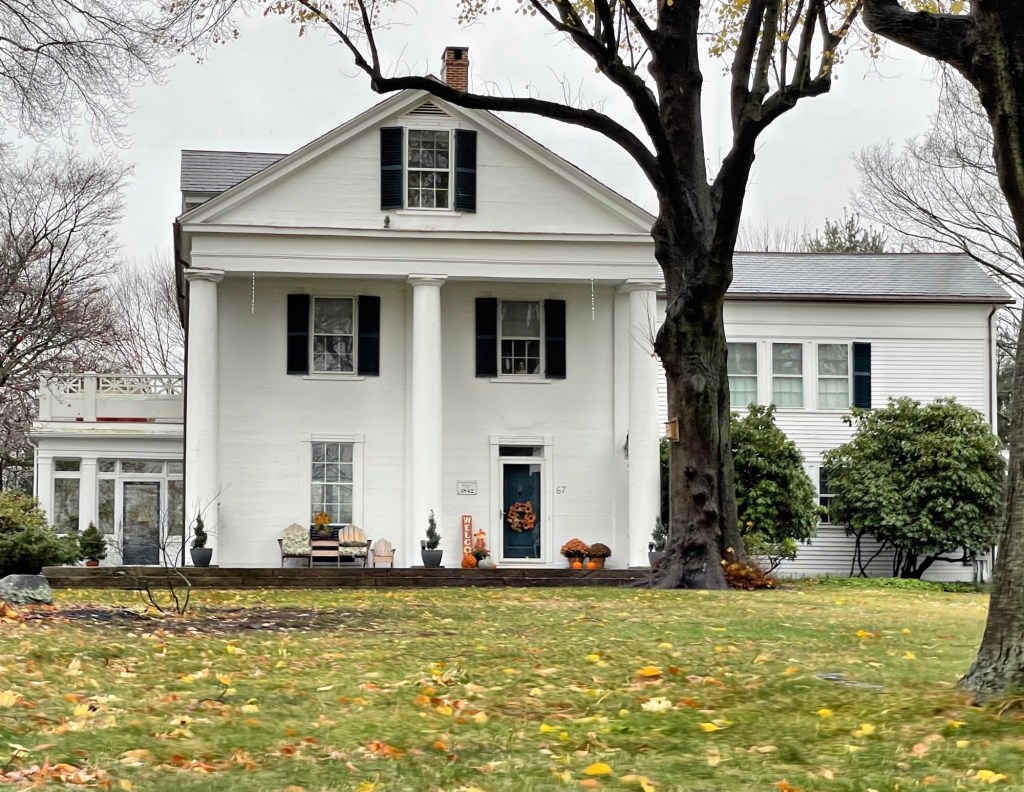
Overlook Mansion // 1842

In about 1842, a Salem merchant, Joseph Adams, built this stately Greek Revival style mansion on Pine Street in Danvers, Massachusetts. Named “Overlook”, the house is a simplified adaptation of the temple-front form with three columns supporting an entablature and closed pediment above. Joseph Adams was an instrumental force who brought an Episcopal church to Danvers, bankrolling the new building there himself. By 1862, the house was owned by Milton P. Braman (1799-1882), who had just retired as pastor for the First Church of Danvers. Of particular note, when news reached Danvers of the assassination of President Lincoln, a gang of men there captured two men who had said unkind words of the late president, and tar and feathered them. A number of the mob were said to have planned to also go to Rev. Braman’s house here to do the same to him, as he was said to have been a “copperhead” a democrat who opposed the American Civil War and wanted an immediate peace settlement with the Confederates. Reverend Braman got wind of the plans of the local mob and had men stationed in the windows with shotguns, with the order to shoot anyone who entered the property. Luckily for all involved, the mob never showed. He would later move to Brookline and Newton. Overlook remains a significant country estate and very well-preserved by the owners.

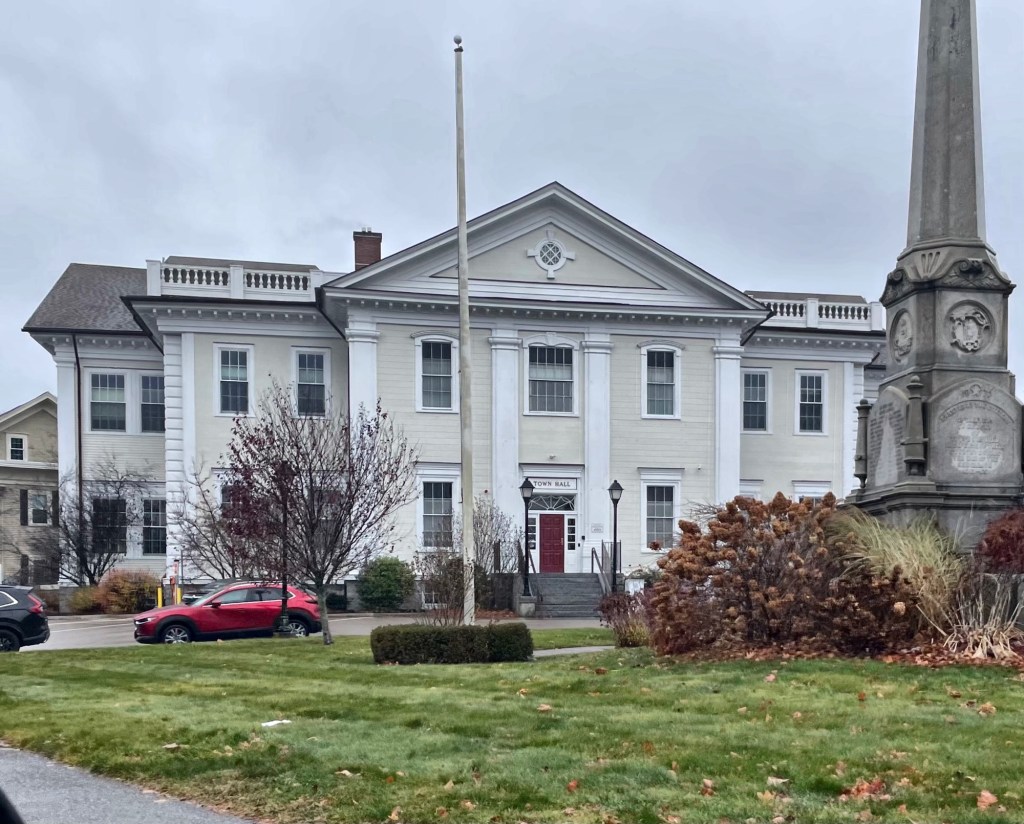
Danvers Town Hall // 1854

The land that is now Danvers, Massachusetts, was once owned by the Naumkeag branch of the Massachusett tribe. Permanent European settlement began in 1636, when present-day Danvers was known as Salem Village, a village of Salem. The historical event for which Danvers is best-known is the Salem witch trials of 1692, which began in the home of Rev. Samuel Parris, in Salem Village. Danvers officially separated from Salem in 1752 and is likely named after Sir Danvers Osborn, a Colonial Governor of New York. In 1757, Massachusetts incorporated Danvers as a town and, according to legend, King George II later vetoed this act of incorporation and returned his decree with the message, “The King Unwilling.” They simply ignored this royal veto, which was later included on the town’s seal! Danvers would eventually build a central town hall building , this structure, in 1854 which partially functioned as a high school as well. Plans were drawn by the Salem architectural firm of Emmerton & Foster in a pleasing blending of Greek Revival and Italianate styles. As the town grew, the building was expanded in 1883, and in the 1890s. When a new, purpose-built high-school was constructed elsewhere in town in the early 1930s, it was decided to renovate the town hall building. Due to financial constraints during the Great Depression, the town got a lifeline by the Federal government, who in 1934, appropriated $6,500 to the town for a renovated town hall as part of the New Deal. Additional funds from the WPA went to murals (many of which still adorn the walls inside). Architect Lester S. Couch of Danvers, a partner in the firm Little & Browne, oversaw the renovations in the Colonial Revival style.

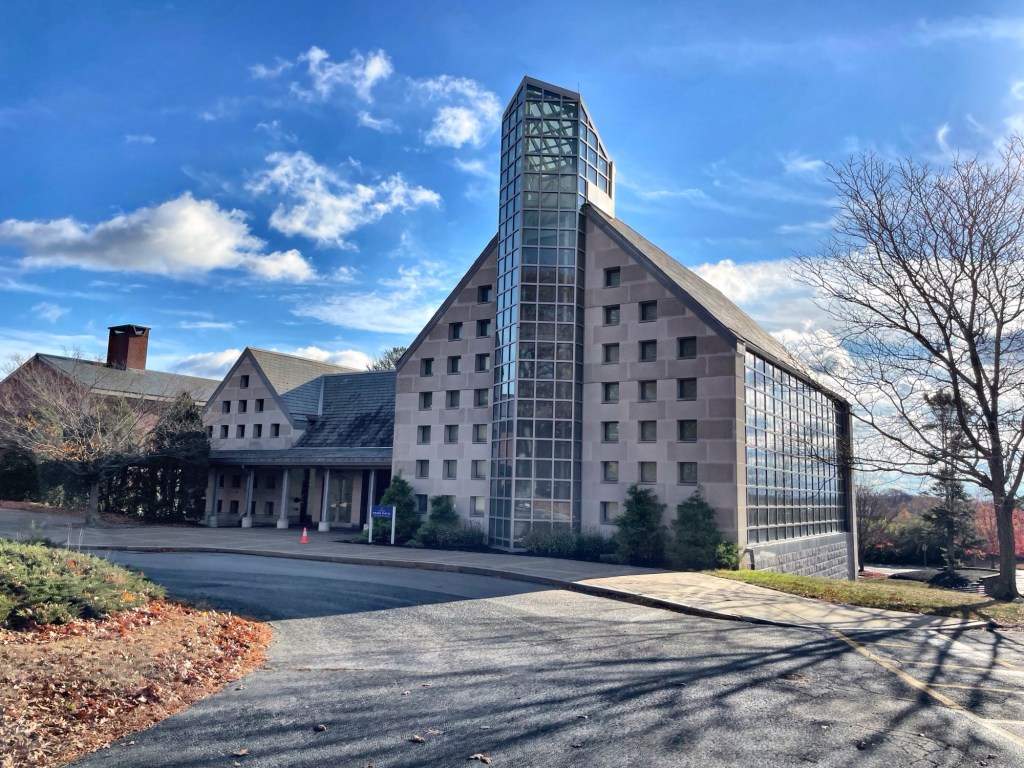
Wilson Chapel – Andover Newton Theological School // 2007

The last building constructed on the former Andover Newton Theological School in Newton, Massachusetts, was Wilson Chapel, located at the edge of the campus. The building is a modern interpretation of the traditional New England meetinghouse, and was completed in 2007 from plans by Context Architecture. The limestone building is punctuated by a grid of square punched windows and raised panels with the primary facade dominated by a glass tower, resembling the more traditional steeple. To me, the building does an excellent job at respecting the basic forms of a New England chapel, while utilizing contemporary materials and design elements to distinguish it as a 21st century structure.

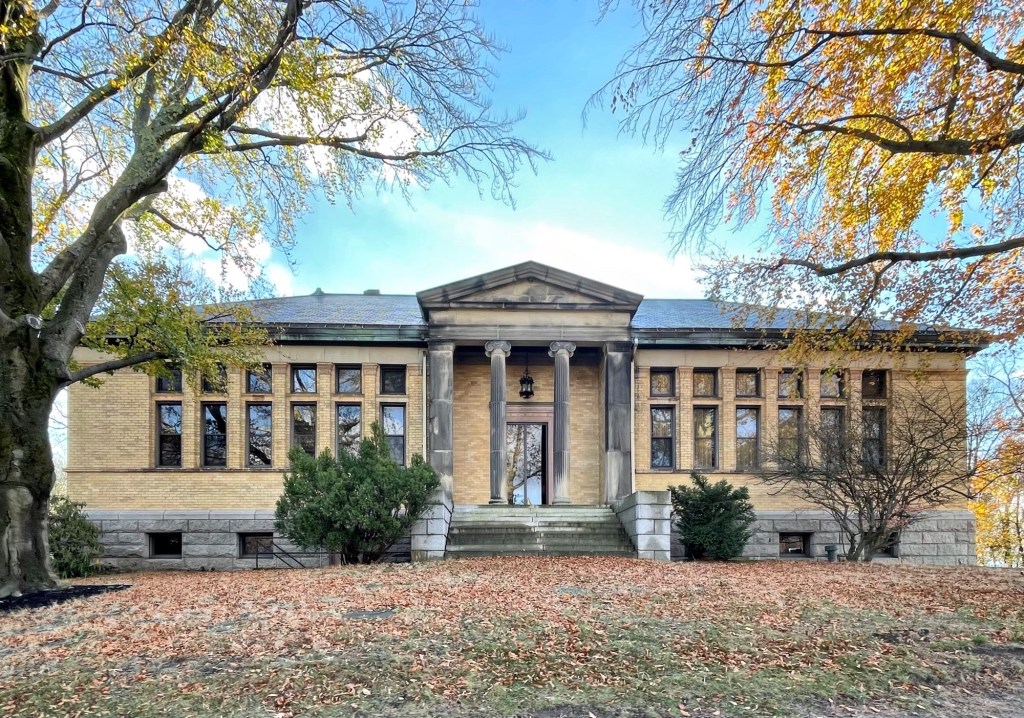
Hills Library – Andover Newton Theological School // 1895

The Hills Library is a formal building standing at the summit of Institution Hill, so-named as the home of the Newton Theological Institution (and most recently as the Andover Newton Theological School). The library was constructed in 1895 from plans by architects Henry H. Kendall and Edward F. Stevens of the firm, Kendall & Stevens. Designed in 1894 in the Neo-Classical style, the library has a stately portico in the Ionic order with a pediment above. The building is constructed of yellow brick with stone and terracotta trimmings with banks of vertical windows. The library would be added onto at the rear, with the main entrance later closed for an accessible entrance in a rear addition. The building is now known as the Hanns Sachs Memorial Library for the current owners and stewards, the Boston Psychoanalytic Society & Institute (BPSI).

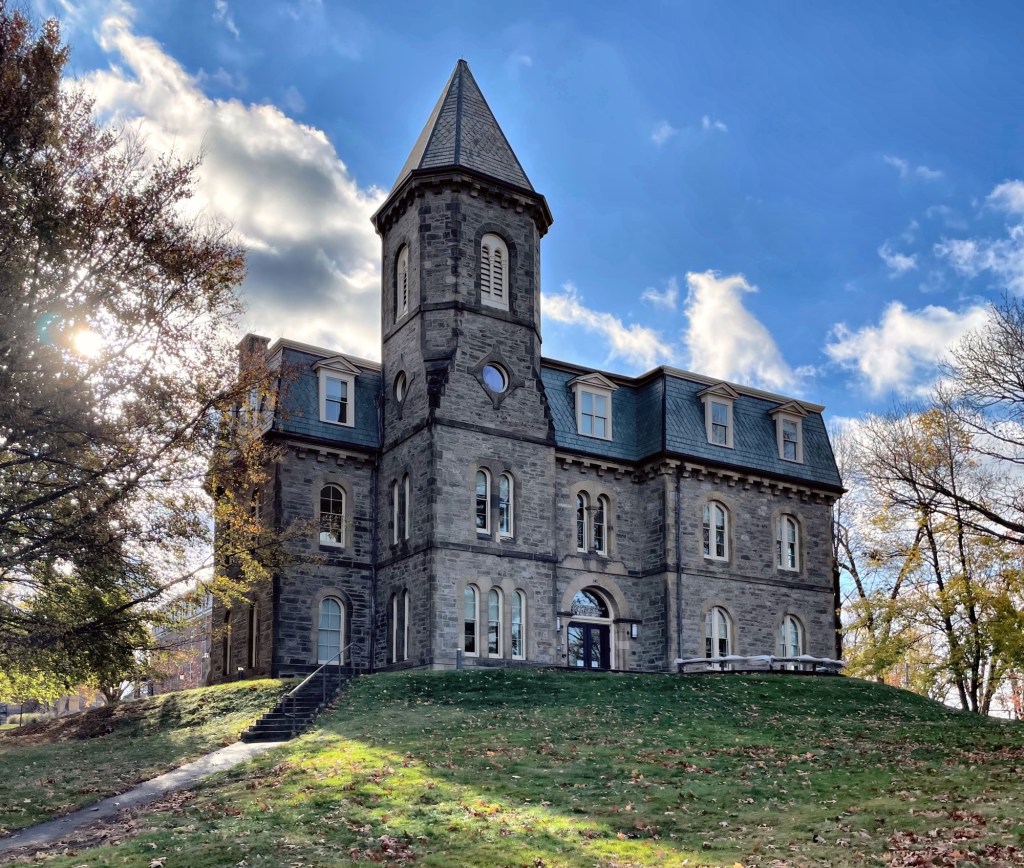
Colby Hall – Andover Newton Theological School // 1866

Colby Hall sits perched atop a hill overlooking Newton Centre, Newton, and is located in the Andover Newton Theological School campus. The building was constructed in 1886 for the Newton Theological Institution, which was founded on this site in 1825, and used for the a Baptist seminary, educating young students in theology. By the 1860s, the school had outgrown its space and following a donation from benefactor,  Gardner Colby (1810–1879), who was treasurer of the school (and was also the benefactor and namesake of Colby College in Maine) plans were drawn up for the new lecture spaces and chapel building. The unique building was designed by Alexander Rice Esty, a prominent architect at the time, and it blends Second Empire and Romanesque Revival styles under one roof. The three-story structure is of a light buff, rough cut stone with sandstone trim and features an imposing four-story tower at the eastern end. In November 2015, the school announced that it would sell its campus and become part of Yale Divinity School in New Haven, Connecticut. The Newton campus was purchased by the Windsor Park School with Colby Hall now occupied by the Boston Psychoanalytic Society & Institute.