East Congregational Society Chapel // 1881

I love exploring old industrial towns. In Ware, Massachusetts, the urban decay of some buildings provides opportunity and potential, but also so much negative thoughts for long-time residents as it reminds some of the town’s once thriving past. Just off Ware’s Main Street, I spotted this former chapel and had to learn more. This structure was built in 1881 as the second East Congregational Church chapel. The congregation was largely made up of immigrant laborers who worked in the town’s mills. This chapel replaced a Greek Revival building erected in 1857 on Water (Pulaski) Street that was later remodeled by the town into a fire station. That building was destroyed during the Hurricane of 1938. This Victorian Gothic chapel was designed by architect Eugene C. Gardner of Springfield, who was very busy in central/western Massachusetts. The chapel long was used by church members for spillover events and social gatherings. Later, the building became the office of the Ware River News.

Otis Company Mill #1 // 1845

This five-story granite mill building was one of the major catalysts for the 19th century population surge in Ware, Massachusetts. As New England’s fledgling textile industry of the era played a vanguard role in transforming the U.S. into an industrial nation, the significance of this type of mill can hardly be understated. The Otis Mill #1 in Ware is one of the last remaining granite textile mills of this early period in central/western Massachusetts. The mill was built in 1845 for the Otis Company, which initially manufactured woven cotton fabric, but later branched out into stockings, woolen shirts and drawers underwear. The company was Ware’s largest employer for about 100 years! The company prospered thru WWI employing over 2,500 people. During the 1920’s the business began a decline due to the southern state’s mills and lack of modernization. In the mid 30’s the Otis Co sold its property to the citizens of Ware, which they formed Ware Industries, Inc to continue the major employer in the town. Due to this Ware came to be known nation-wide as “The Town That Can’t Be Licked.” The mill is now home to local small businesses as a sort of incubator, providing jobs to local residents!

Manley-Lefevre House // c.1820

The last (but certainly not least) building in Dorset, Vermont I’ll be featuring is the Manley-Lefevre House aka. Marble House! This stunning Federal period home was built around 1820 by Martin Manley (1783-1856) on land originally owned by his father George. The house is constructed of ashlar marble that was quarried with hand tools from the lower quarry located approximately 200′ behind the site of the house with dressed marble finished in town and brought back for installation at the lintels, sills, and door surround. In 1907, Edwin Lefevre, Sr. (1871-1943) traveled by train from Bronxville, New York to Dorset at the suggestion of the artist Lorenzo Hatch, with the intention of locating a summer residence for his family. They purchased this home, which became known as “The Old Stone House” and hired Eugene J. Lang, a New York architect, to remodel the house, design a kitchen wing and remodel the barn into a garage (1909). While in Italy, Lefevre fell in love with the formal gardens there, and wanted something like this for his country estate. Upon his return, he retained garden designer Charles Downing Lay to design the gardens that surround the house. The country estate is now home to The Marble House Project, a multi-disciplinary artist residency program.

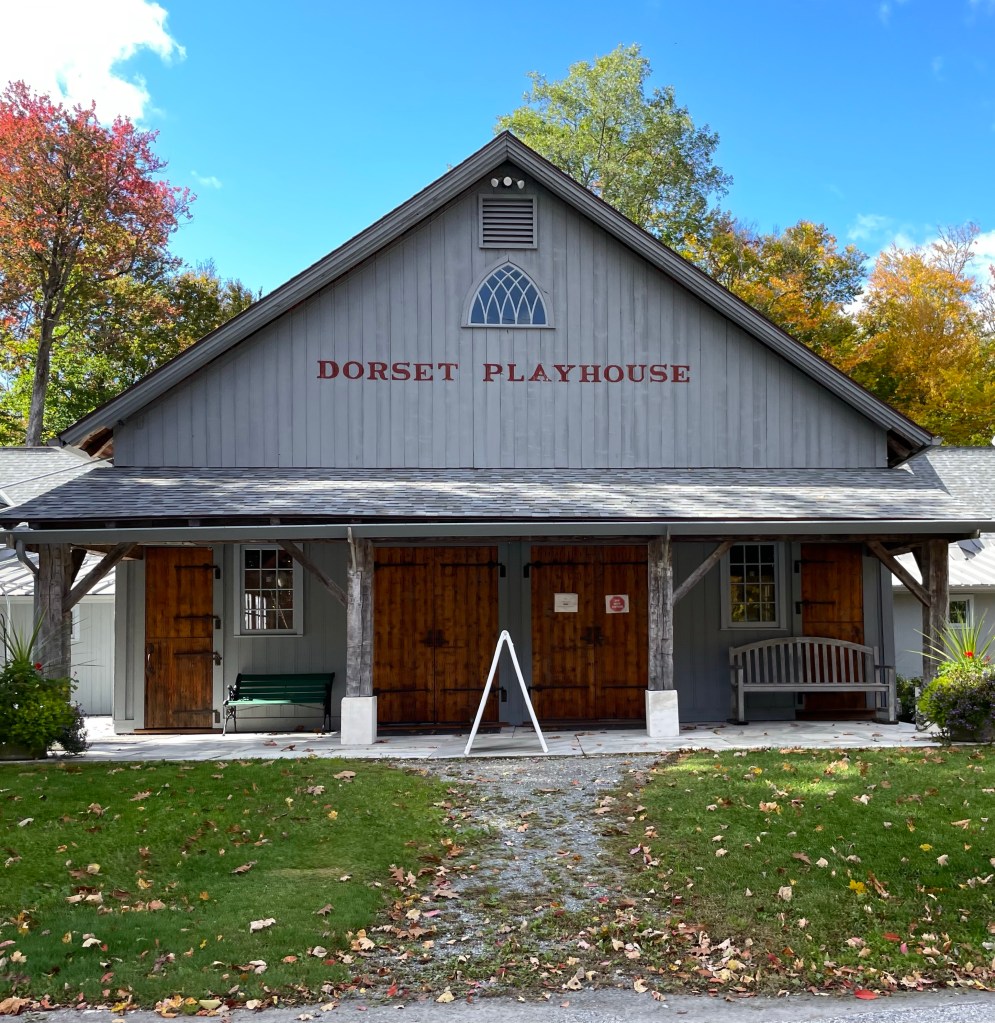
Dorset Playhouse // 1929

During the spring of 1927, Mr. and Mrs. Edward Goodman, devotees of the performing arts, were able to interest a number of Dorset residents in producing a play. In April 1927, a three-act play entitled ’39 East’ was presented in the Dorset Town Hall for the benefit of the PTA and was received with great enthusiasm. From this, a movement took off. Many summer residents and artists in town formed a group, the Dorset Players, who would continue performances for the town. They realized that the space in Town Hall was not suitable nor permanent enough for the goals of the group. May Goodman purchased land at the edge of the village and the group held two years of performances in nearby towns to gather funding to erect a playhouse. Ernest West, a member, offered two barns on his property in town and it, plus one more barn, were incorporated into the new playhouse. The auditorium was built so that the weathered sides of the barn boards were on the inside and hand hewn timbers 12 by 12 inches were used to achieve a rustic effect which draws many favorable comments from those visiting the Playhouse. It remains a cultural center of the town and greater region to this day.

Dorset Congregational Church // 1909

Arguably the most high-style building in the quaint village of Dorset, Vermont is the Congregational Church, which appropriately sits on Church Street. The original congregational church in Dorset was located in nearby Maple Hill Cemetery. When the wood structure burned in 1832, an new wooden church was built on this site. The second wooden building burned in 1907, and then this church was built, but of fireproof construction. Jordan Greene, an architect from New York, designed this Neo Gothic Revival style in the historic district. The church was constructed by the contracting firm of O. W. Norcross, partner in the Norcross-West Marble Company, which donated the building stone from its South Dorset quarry. The design is dominated by a massive square central tower that ascends its facade and is capped by pinnacles. Behind the tower, the gable-roofed church is built of rough-faced Dorset marble laid in patterned coursed ashlar and trimmed with dressed stone. How many other marble churches can you think of?

The Old Jail, Barnstable // c.1690

The Old Jail in Barnstable is a historic wooden jail, resembling a colonial domestic residence, which was built by order of the newly established Barnstable County, which separated from the Plymouth Colony on in 1685. It served as the Barnstable County jail from 1690 to 1820 and is the oldest extant wooden jail in the United States! By 1702, prisoners were being held in the jail while awaiting trial at the Court Sessions held in Barnstable. In 1716, the jail imprisoned Mehitable “Goody” Hallett, the lover of pirate Samuel Bellamy, later known as the Witch of Wellfleet, as well as the two survivors of Sam Bellamy’s flagship Whydah Gally which wrecked at Wellfleet, and the seven pirate survivors of his consort ship Mary Anne which wrecked ten miles south. The jail house is considered one of the most haunted in America, supposedly containing the spirits of these pirates and lost loves. The jail building was attached to a barn by the 19th century, when a new jail was constructed. This building was later removed from the barn and restored, and moved to the present site next to the old Customs House in 1968.

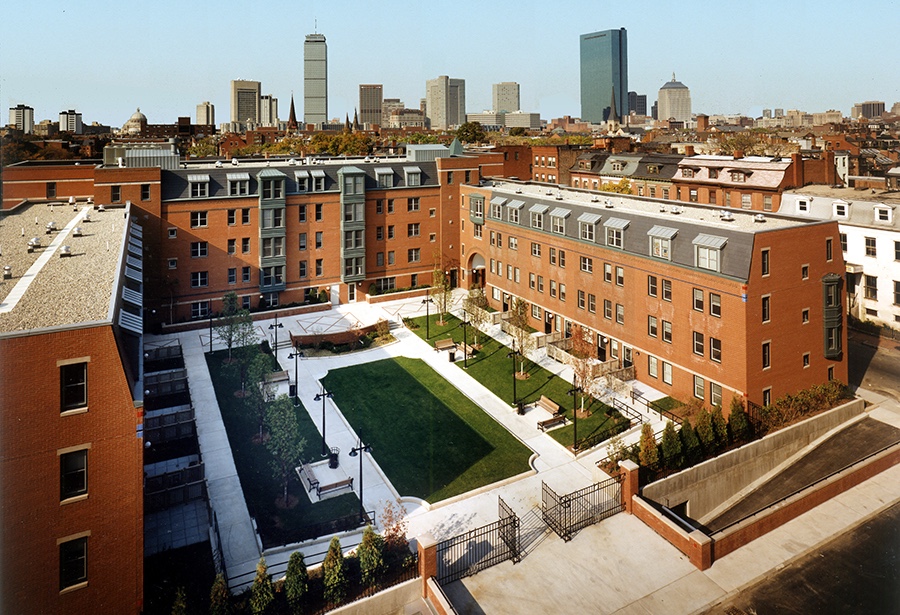
Langham Court // 1991

Image courtesy of Goody/Clancy

Appropriate infill construction can be a very difficult thing to accomplish, with some developments hitting the mark and others adversely impacting the historic neighborhoods where they were built. Boston is home to many examples of both occurrences, but I wanted to share a very successful infill project in the South End neighborhood, Langham Court. As the South End resurfaced as a desirable neighborhood, long-time residents were priced out, which led to the Boston Redevelopment Authority to fund projects to provide much-needed housing for the local community. This site which once housed over 20 townhouses, was razed by the 1960s in a period of urban renewal where existing housing was deemed unsafe and inadequate. The local design firm of Goody/Clancy was hired, and they masterfully designed a U-shaped complex of 84 mixed-income units that fits well within its surroundings. The design exhibits dormers, bays, arched and vaulted entries, a combination of mansard and flat roofs, stringer courses and textured brickwork, and a palette of well chosen materials all at a scale that blends in the 1990s building to its surroundings which came nearly 150 years prior. The complex remains as a testament to good-quality design even for affordable housing, which notoriously gets the short end of the stick design-wise.

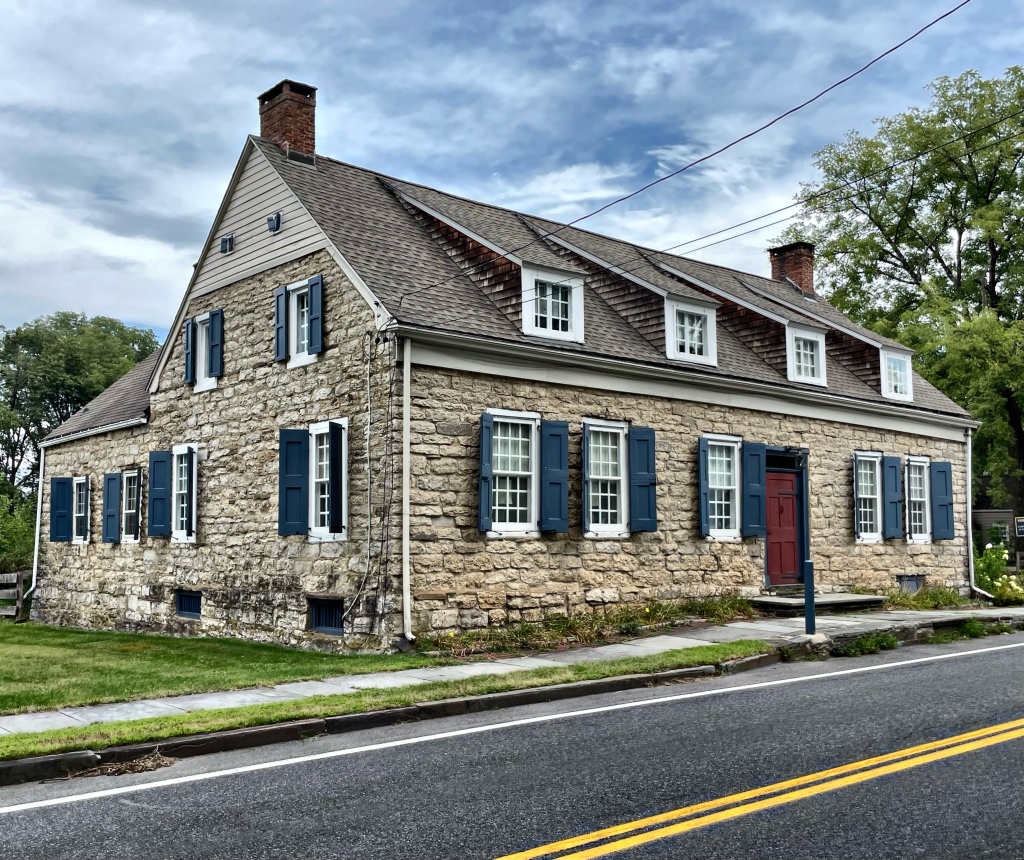
Roosa-Van Deusen House // 1744

For my last building feature in New York in this series, I feature the Roosa-Van Deusen House on Hurley’s Main Street village of old stone homes. This house dates to 1744 and was built upon land owned by Jan Alderts Roosa, who emigrated to New Netherland (New York) with his family on the Spotted Cow in 1660, when he was 14 years old. The house was likely built by Jan Van Deusen (Jan Roosa’s grandson), a blacksmith who worked in town. The Van Deusen House famously became the capital building of New York when in 1777, the newly formed New York state government moved here for two months while Kingston was being rebuilt after the British Army had burned it in retaliation for the creation of the state. It is thus the second of the state’s three capital cities, the present, Albany, being the third.

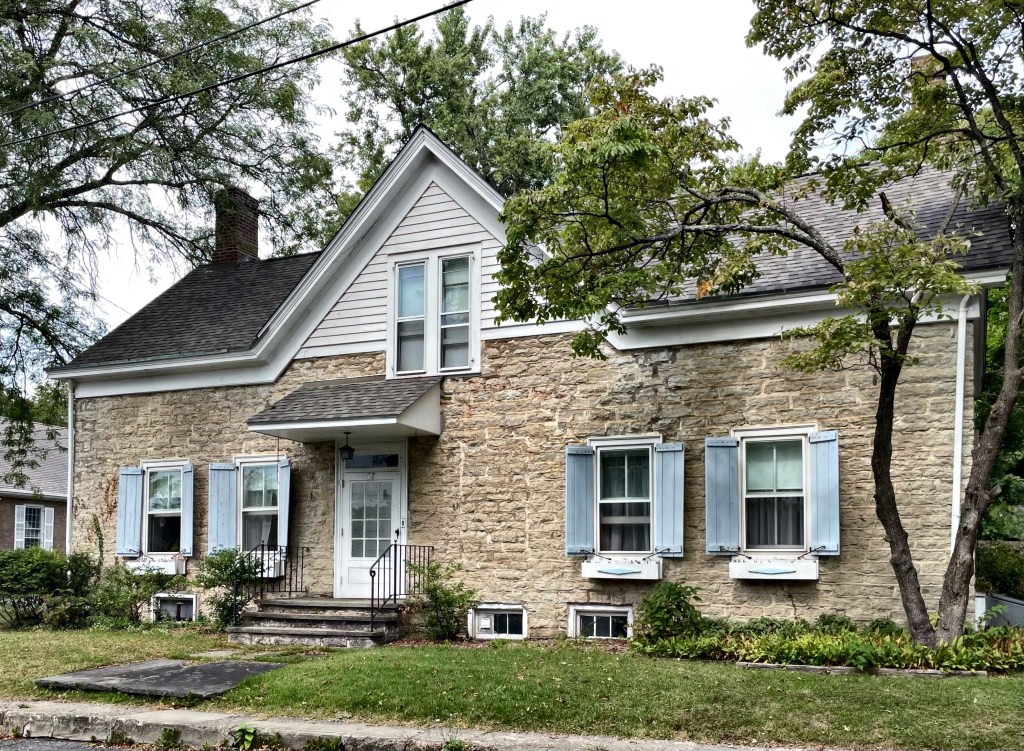
Petrus Crispell House // c.1725

Another of Hurley, New York’s beautiful old stone houses is this Georgian-era home, right on Main Street. The house is known as the Petrus Crispell House and dates to about 1725. Petrus Crispell must have purchased or inherited the house and occupied it for some years until it was acquired by the Dutch Reformed Church in the village to be used as a parsonage. It is 1 1/2 stories and is built of coursed and squared stone which continues into the gables. The facade, now 5 bays, was formerly 6, perhaps with two entrances. Nineteenth century alterations by the church include a large cross-gabled dormer and 2/2 sash.

Overlook Mountain House Ruins // 1923-

One of the most intriguing and historical hikes around is at Overlook Mountain in Woodstock, there is just something so mesmerising and enchanting about abandoned places. Overlook Mountain has long been a significant location in New York. In the boom years of New York City after the Civil War, more than 90 quarries in the Town of Woodstock (many around Mount Overlook) produced bluestone for sidewalks in Manhattan. By the end of the 19th century, the mountain and surrounding area became a tourist location for New Yorkers escaping the woes of city living, looking to breathe in the fresh mountain air up the Hudson. The current ruins Overlook Mountain House was actually the third hotel on the site. The first Overlook Mountain House was built in 1871 and accommodated 300 guests, before it was destroyed by fire in 1875. It was rebuilt in 1878 by the Kiersted Brothers of Saugerties. Overlook was used irregularly between 1887 and 1917, when Morris Newgold of Manhattan purchased the hotel. In 1921, it was the site of a secret organizational meeting of what was to become the Communist Labor Party of America. The second incarnation of the Overlook Mountain House was destroyed by fire in 1923. And Morris Newgold sought to rebuild with fireproof construction.

His architect used concrete to rebuild the hotel, which likely would have been covered with stucco. They also broke ground for a chapel, stables, and a standalone lodge for private housing for his family. Newgold’s shaky finances paired with the Great Depression made for slow progress, and portions of the resort were still “under construction” as late as 1939 (and the main hotel never being finished from what I could find). Morris Newgold died in 1940 and the property was either sold by his son or acquired via eminent domain by the New York State Conservation Department and made part of the Catskill Forest Preserve. You can now explore the old ruins of the Overlook Mountain House between views of the Catskill Mountains.

1928 House