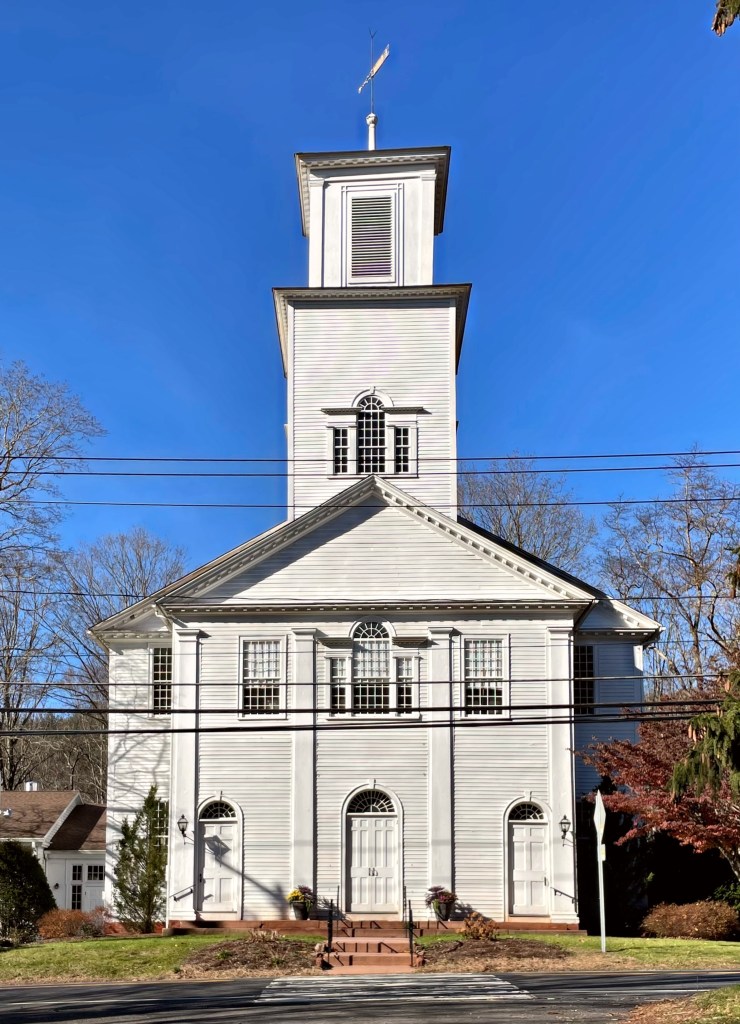
Collinsville Congregational Church // 1858

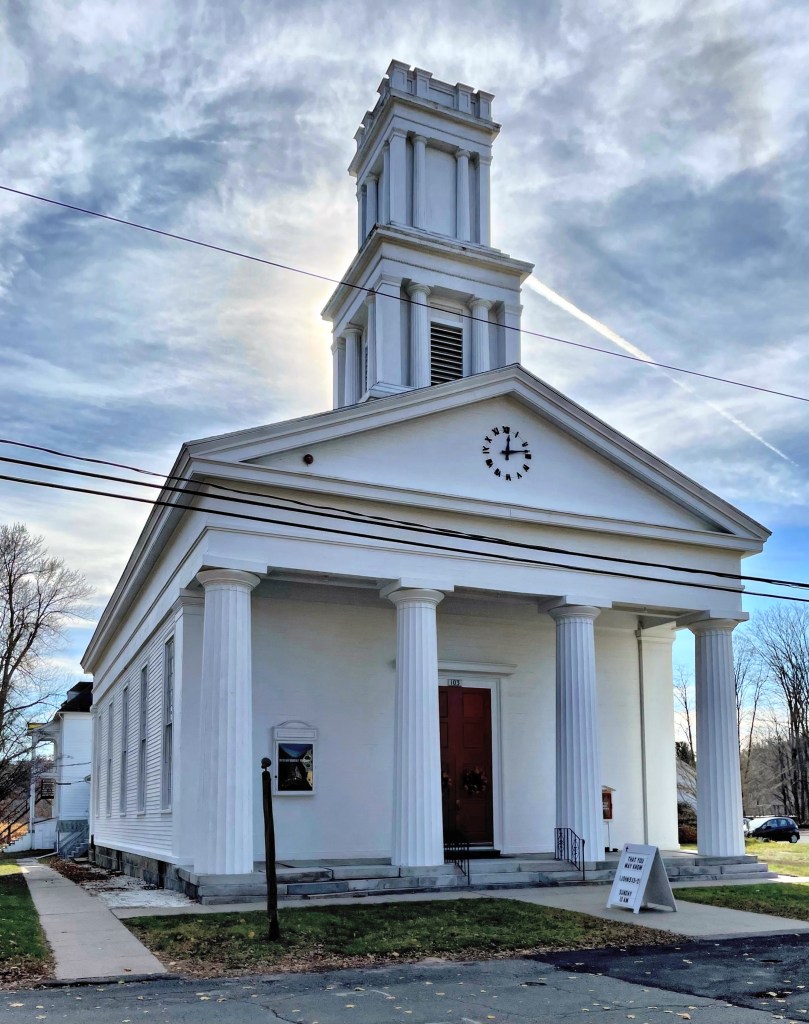
Shortly after Collins and Company was founded in 1826, religious services were held in various homes in the South Canton Village which came to be known as Collinsville. In 1830, the Collins Company erected its first office building on Front Street, and religious services were held there on the second floor. The first church building was erected on land bought by Collins and Company in 1826. By the mid-1850’s, the church membership was outgrowing the building. Although there may have been plans to enlarge the building, tragedy struck and in January 1857, and the church was consumed by fire, which started in the chimney, during a winter storm. The current building was erected almost immediately and dedicated on February 25, 1858. The present church is a grand Greek Revival style building, with a full pediment and large entablature supported by four monumental fluted columns. The two-tiered, square belfry has engaged columns as well. What a great example of a New England church!

Canton First Congregational Church // 1814

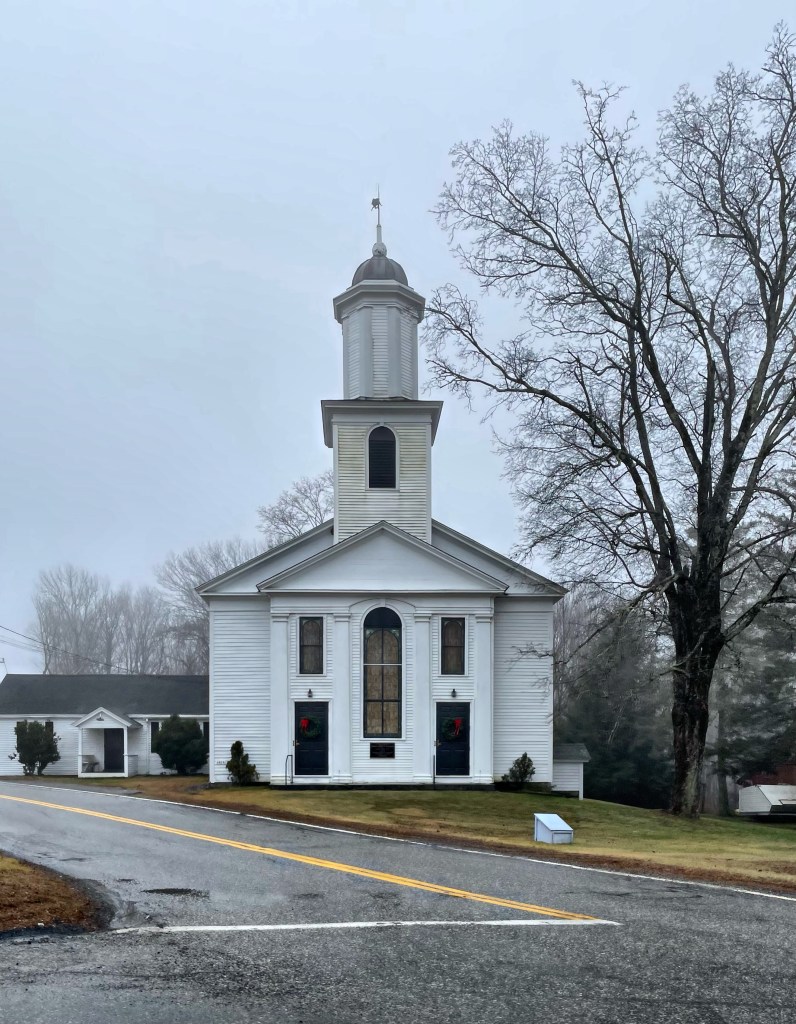
In 1750, a new parish church was established as The First Ecclesiastical Society of West Simsbury, with parishioners meeting in members’ homes. Then, Canton Connecticut was still a part of Simsbury. In 1763, the Parish constructed a meetinghouse with the building also used for town meetings and other public gatherings. In 1806, Canton separated from Simsbury and the congregation soon after decided that the nearly 50 year old primitive building needed replacement. A new building was proposed and materials were harvested. Stories report that the first tree felled for lumber for the new church killed a parishioner. The beautiful Federal style church edifice features Palladian windows, a hallmark of the style. The congregation is active to this day.

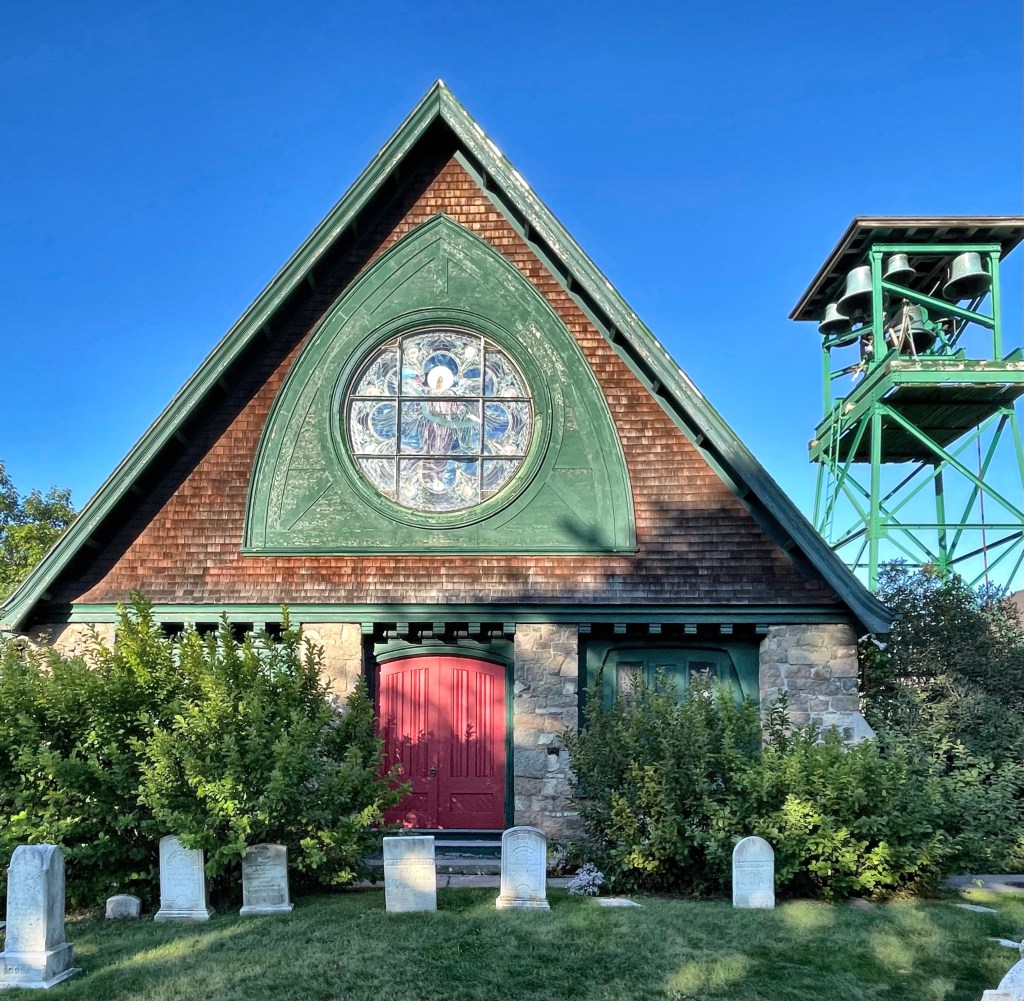
St. Saviour’s Episcopal Church // 1877

Initially erected in 1877 and enlarged several times thereafter, the St. Saviour’s Episcopal Church in Bar Harbor is an excellent example of ecclesiastical architecture in the state of Maine. The original church building had been erected in 1877-78 at a cost of about $7,000 from designs by the New York architect Charles C. Haight. Within eight years of its construction, space limitations caused the church to undertake a major expansion. Designed by the Boston architectural firm of Rotch and Tilden, this building campaign – carried out in 1885-86 – dramatically changed the church’s appearance by developing a cross shaped plan that made use of the original structure for transepts and added a larger nave, semi-circular apse, and an imposing crossing tower. The numerous building campaigns designed by both prominent and lesser known architects, have produced a rich eclectic architectural legacy that mirrors the development of Bar Harbor.

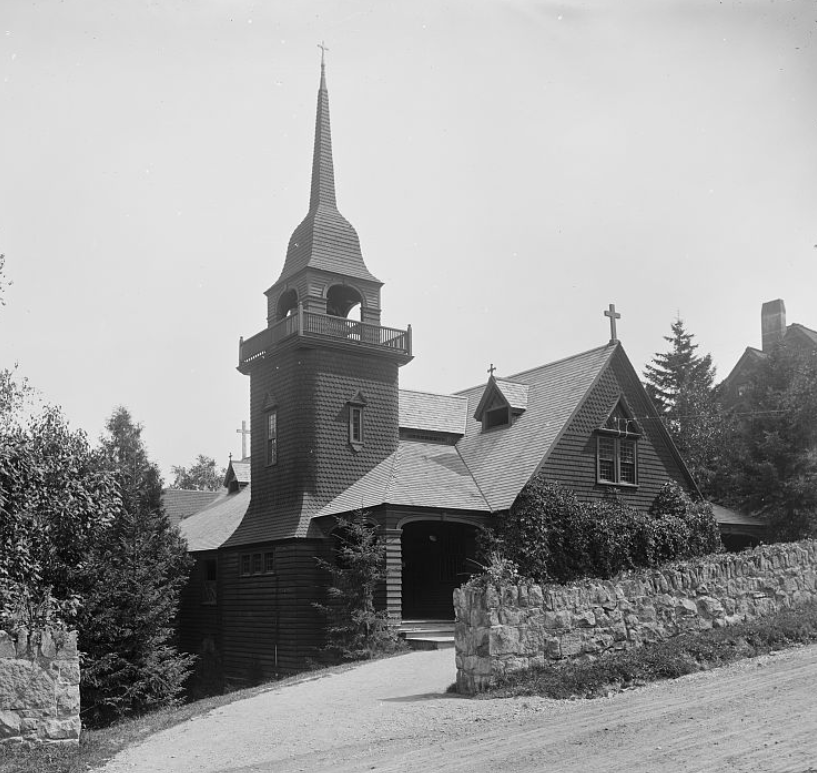
St. Sylvia’s Catholic Church // 1881-1909

Photo in Detroit Publishing Co. Collection.

As wealthy citizens from cities like Boston, Philadelphia and New York, began building summer cottages on Mount Desert Island in Maine, an influx of carpenters and tradespeople from Ireland followed to construct and work on them. Realizing this, cottager DeGrasse Fox along with Brooks White of Philadelphia, donated land for a new Catholic church building. Maine architect, William Ralph Emerson, donated plans for the church. A masterpiece of Shingle style design, the church, which seated 300 people, was deemed too small for the growing village’s summer congregation. A new, stone church was built closer to town (featured previously). The spire and belfry resemble another church Emerson designed in Beverly, MA, St. Margaret’s Catholic Church. Sadly, St. Sylvia’s burned down in 1909.

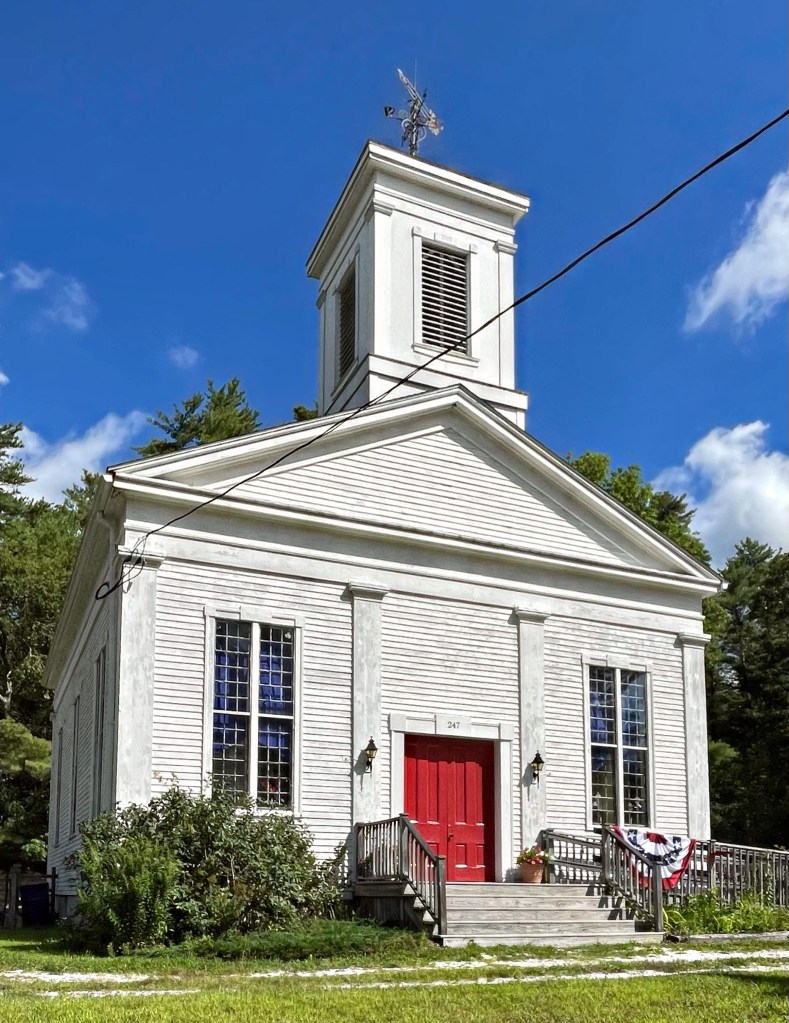
North Rochester Congregational Church // 1841

The North Rochester Congregational Church is located in a distinctly rural, area in the northwest corner of the largely pastoral town of Rochester, Massachusetts. This church, built 1841, is locally important to the development of religion and community in North Rochester. In Rochester as in other early New England towns, the building of a church symbolized the founding of a community. North Rochester’s first church was built in 1748, about 1 mile west of the present building, and was served by traveling ministers from other communities. The church congregation was formally organized in 1790, and a new church was built at that time, serving a larger area. The current church building was built in 1841 by Solomon K. Eaton, a noted regional builder whose credits include several other area churches. The church is of the Greek Revival style, which was frequented in the designs of hundreds of churches all over New England in the mid-19th century.

Rochester Congregational Church // 1837

Rochester’s First Congregational Church is the oldest extant building still standing on the Town Green in Rochester Center and is the fourth house of worship to occupy the site. Constructed in 1837 to the designs of architect, Solomon K. Eaton, the beautiful Gothic Revival church building is among the most beautiful in the state. Eaton was well-known for his ecclesiastical structures, but also designed other prominent civic buildings in Southeastern Massachusetts. A fun fact about Eaton is that at age 55, he volunteered for the Union Army during the Civil War and his unit saw action in North Carolina, he returned home after the war and lived out his final days. The church stands out to me for the quatrefoil windows on the bell tower, the pointed finials and comer posts, and large lancet windows. Swoon!

St. Luke’s Episcopal Church // 1871

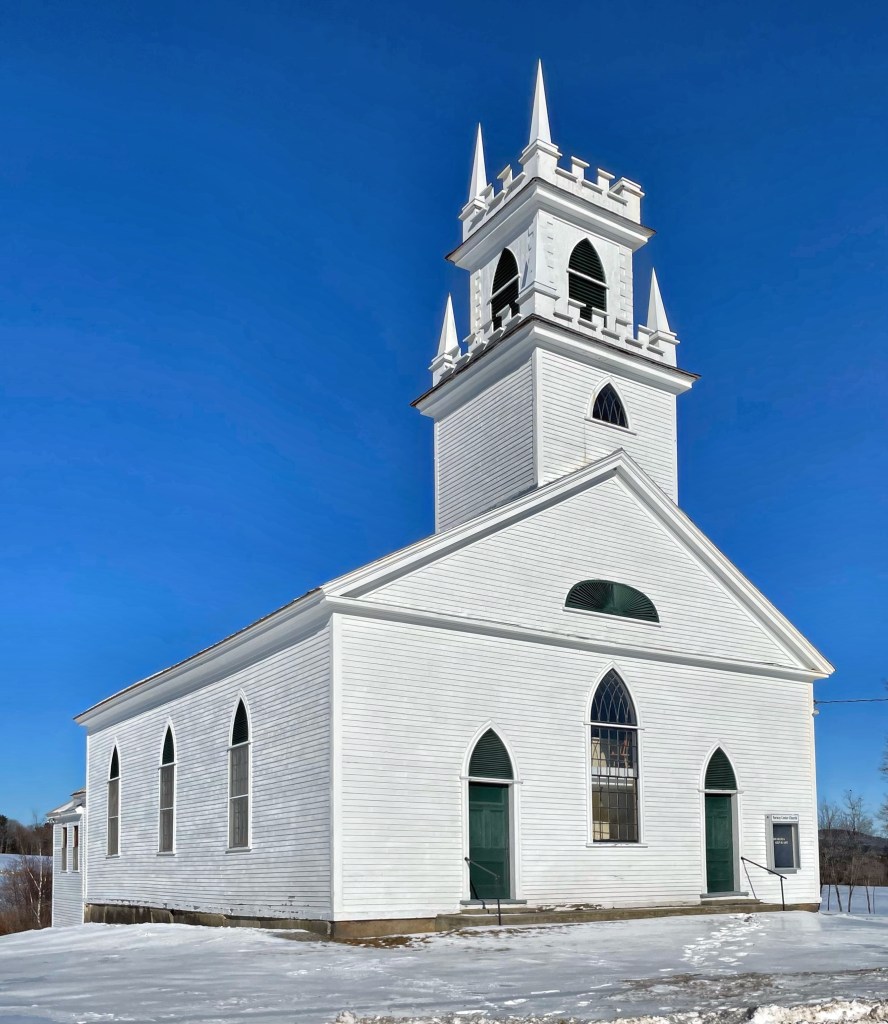
Next door to the Inn Victoria, the beautiful St. Luke’s Episcopal Church in Chester, VT, stands out as one of the only Gothic Revival buildings in the town. A small group of residents gathered in the 1860s to found a Episcopal church in the town, which already had a dominant Congregational church. They furnished money which was matched by the diocese, and Merrick Wentworth was named senior warden. Members of his family and that of Frederick Fullerton, his son-in-law, formed a large part of the congregation. Frederick and Philette Wentworth Fullerton donated a building site across the street from their home, and Mr. Wentworth’s nephew, Boston architect, William P. Wentworth, contributed plans for a Gothic-style frame church, which includes a tall corner belltower.

St. Rita’s Roman Catholic Church // 1916

A Roman Catholic parish was established in the South Coast/Cape Cod area by 1830 in Sandwich, where a large glass company employed a number of Irish immigrants. Over the course of the 19th century, several mission churches were established, and eventually a second parish, St. Patrick’s, was established in Wareham in 1911. Soon after, a mission was established in nearby Marion to serve the summertime Catholic community there. A parcel of land was acquired by the Roman Catholic Bishop of Fall River and they hired architect Matthew Sullivan to furnish plans for the small church. Matthew Sullivan (1868–1948) trained in the office of Edmund M. Wheelwright, Boston City Architect (1891-1894). Sullivan succeeded Wheelwright as City Architect and served in that position from 1895 to 1901, when he became a junior partner in the firm of Maginnis, Walsh and Sullivan, which was widely known for its ecclesiastical work, where he too specialized in religious buildings. St. Rita’s Roman Catholic Church is an example of an early 20th century chapel in the Craftsman style, characterized by eaves marked by long projecting rafter tails and a bold entry framed by Tuscan columns.

Central Congregational Church, Providence // 1893

One of the best examples of Renaissance Revival architecture in Rhode Island is the Central Congregational Church of Providence. Constructed between 1891-1893, this building was the new home to a growing congregation, which outgrew its original Thomas Tefft-designed building on Benefit Street (which has since been occupied by RISD). Famed architect Thomas Hastings of the firm Carrère and Hastings of New York City, was hired to furnish plans, and worked closely with Reverend Edward C. Moore to make sure the building was fitting of the site. The church is cross-gabled in form and is constructed of yellow brick with terracotta trimmings, evocative of Spanish and Italian Renaissance styles. The facade has a detailed central pavilion which is flanked by two towers. These towers were originally surmounted by elaborate belfries, but these were damaged by a hurricane in the mid 20th century and replaced by the present brick caps. The dome and vaulting is of tiles by Rafael Guastavino, it is the first dome that he constructed in the U.S., making this building even more significant.

Grace Church // 1835-1966

Grace Church was built in 1835 for a growing congregation in Beacon Hill. The absolutely stunning Gothic style church was designed by William Washburn (1808–1890), an architect and city councilor in Boston. The church was constructed of granite and had massive stained glass windows and soaring towers with decorative embellishments. Inside, a massive central window flooded the interior with natural light, and illuminated paintings from Mario Bragaldi, a Milan artist. In 1865, the building was sold to the Methodist Episcopal Society. 1873, it merged with Hanover Street, and took the name First Methodist. The church was variously referred to as First, Grace, or Temple Street, sometimes all at once! This church was occupied until 1962, when it merged with Copley to form First-Copley, which appears to have then occupied the Old West Church. The building was soon after acquired by Boston University and demolished for the building on the site today, a true loss to one of Boston’s most beautiful buildings.