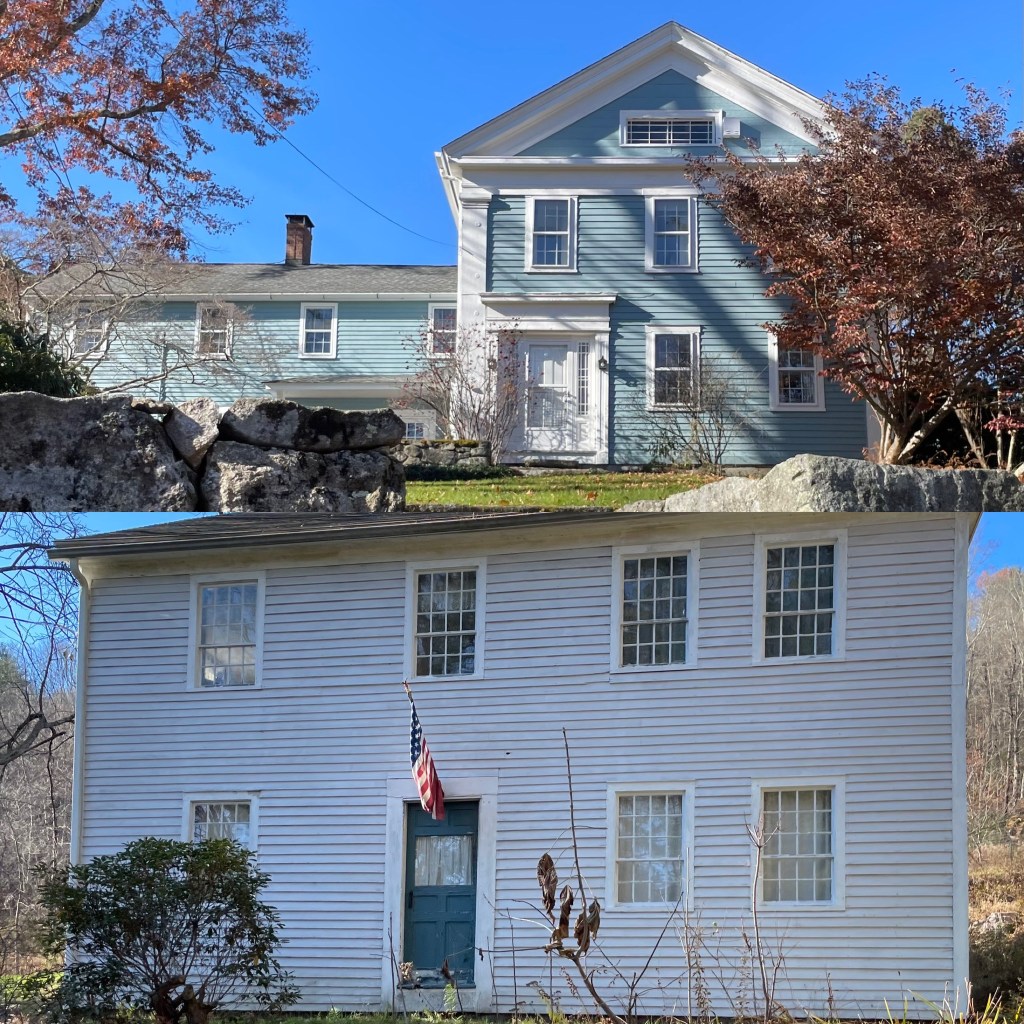
Alson and Sadosa Barbour (sometimes spelled Barber) grew up in North Canton, Connecticut and resided in these two homes, raising families and farming the land. The blue house was built in 1839 for Alson Barbour, who updated his earlier 1814 home which was gifted to him by his father as a wedding gift. The smaller home was outgrown by Alson, Hannah, and their 12 children (all living to adulthood) and he built this stately Greek Revival home on the quiet, meandering road. Not to be outdone by his brother, Sadosa too added onto his earlier home, also a wedding gift from his father. The 1803 house was enlarged in 1840 and given its present appearance, a modest Greek Revival home with a side-gable roof.
This old Georgian house in rural Canton, Connecticut was built before the Revolutionary War for David Adams (1742-1834). After David’s death, the home was willed to his family, and soon after became a local post office for the village, facilitated by the fact Oliver Adams became postmaster for the area. The family built an attached structure as a post office, but it was removed in the early 20th century. The post office was run out of the home by members of the family until the 1930s. Later owners restored the house and discovered that the home originally had a gambrel roof, which matched the office addition.
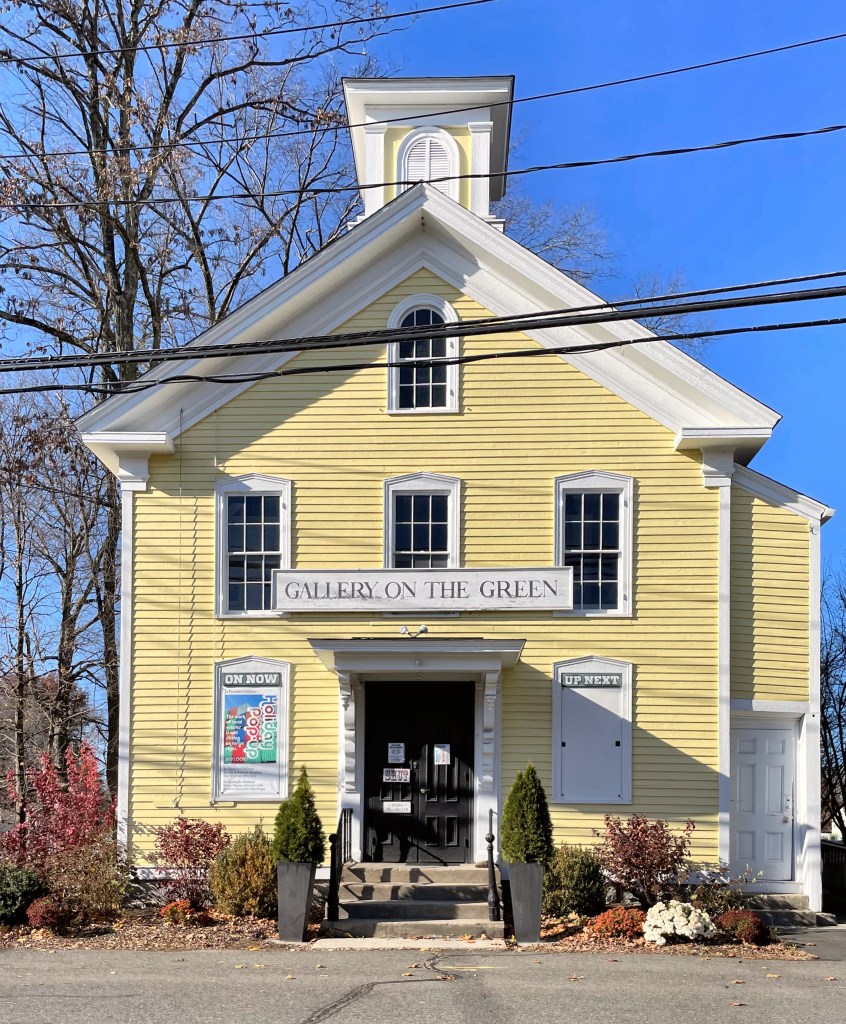
Canton, Connecticut, the only town in the state named after a city in China! The land which we now know as Canton had long been inhabited, specifically by the Wappingers, a group in the larger Algonquin speaking tribes. Canton was incorporated out of Simsbury in 1806, and named after the City of Canton in China (now known as Guangzhou), though I am not sure why. The town quickly developed two main villages. Collinsville sits on the Farmington River and its power was harvested for industry; while the center village grew differently as an agricultural village of farms. At the center of town sat a green for civic and town functions and gatherings. The town constructed a school here as far back as 1759, when the rural village was still a part of Simsbury. This is the fourth building on the green and it was built in 1872, and can be classified as Italianate in style. The building was occupied as a school until 1949, and it was used for other city uses until 1971, when the building was rented to the Canton Artist’s Guild and the building was renamed Gallery on the Green. The building remains community-focused and holds exhibits of local artists! Much of the rest of Canton Center lost all of its bucolic charm when the main road became commercialized, prioritizing speeding cars over a walkable village.
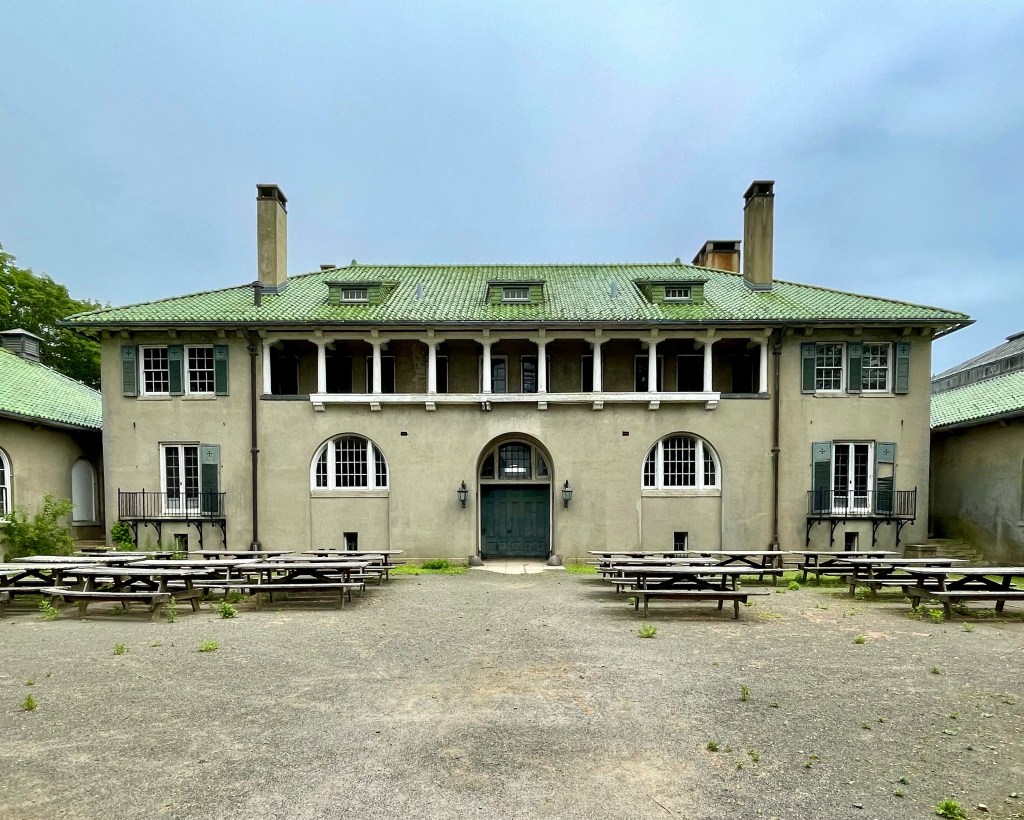
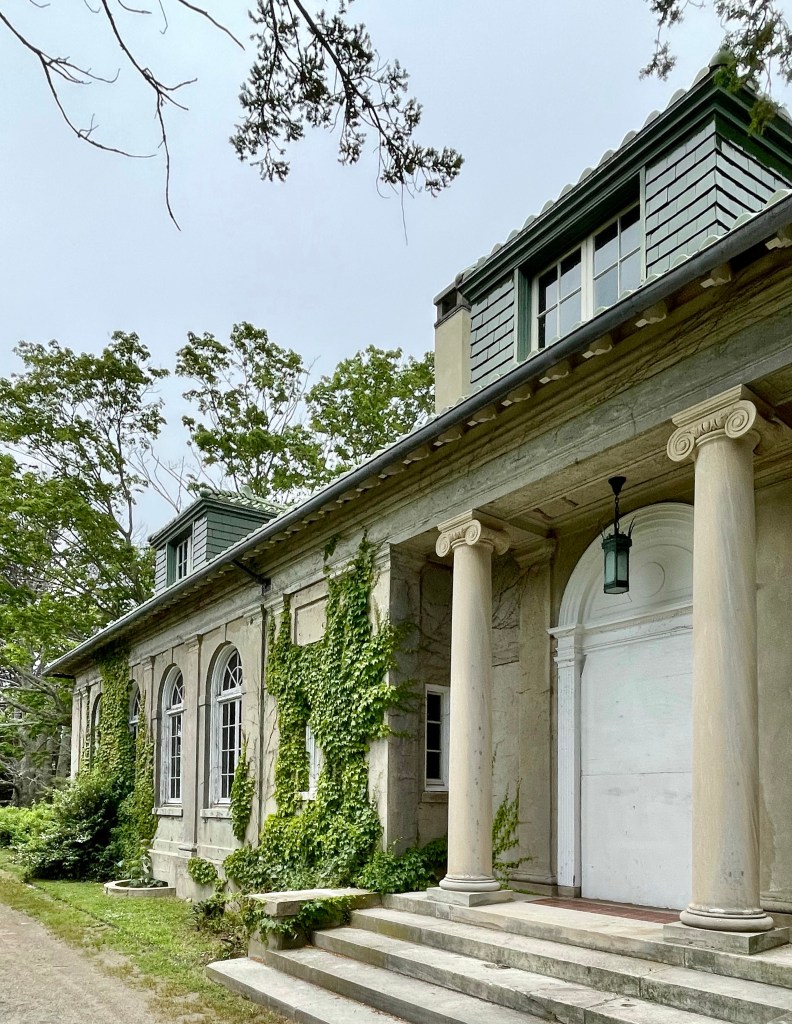
Another of the stunning buildings on the Harkness Estate is this massive all-purpose building that served a variety of functions, but I will call it the Carriage House. The building was constructed in 1908 and designed by James Gamble Rogers, mimicking the Renaissance Revival grandeur of the main home, Eolia. As previously mentioned, the large, U-shaped building was a multi-use support compound for the Harkness Family and their farm. The South Wing (right) of the building served as a clubhouse for Edward Harkness and his friends, with a billiards room, squash court, and two bowling lanes. This wing has large windows looking out towards the ocean and the large gardens on the property. The central block contained a garage with a turntable to facilitate the parking of limousines, a gas pump and a car wash for Mr. Harkness and his growing automobile collection. The North Wing (left) contained the horse stables, carriage area, tack room, smithy, and even a space dedicated to dog grooming. Upon close inspection you can see small rounded stones near the portals to allow the wheels to hit them rather than damage the building. Perhaps most importantly, the Carriage House was the location for the furnace room with its huge steam boiler. This boiler heated the Carriage House as well as the Mansion via an underground steam line. Apparently the building will soon be undergoing a restoration. Fingers crossed!
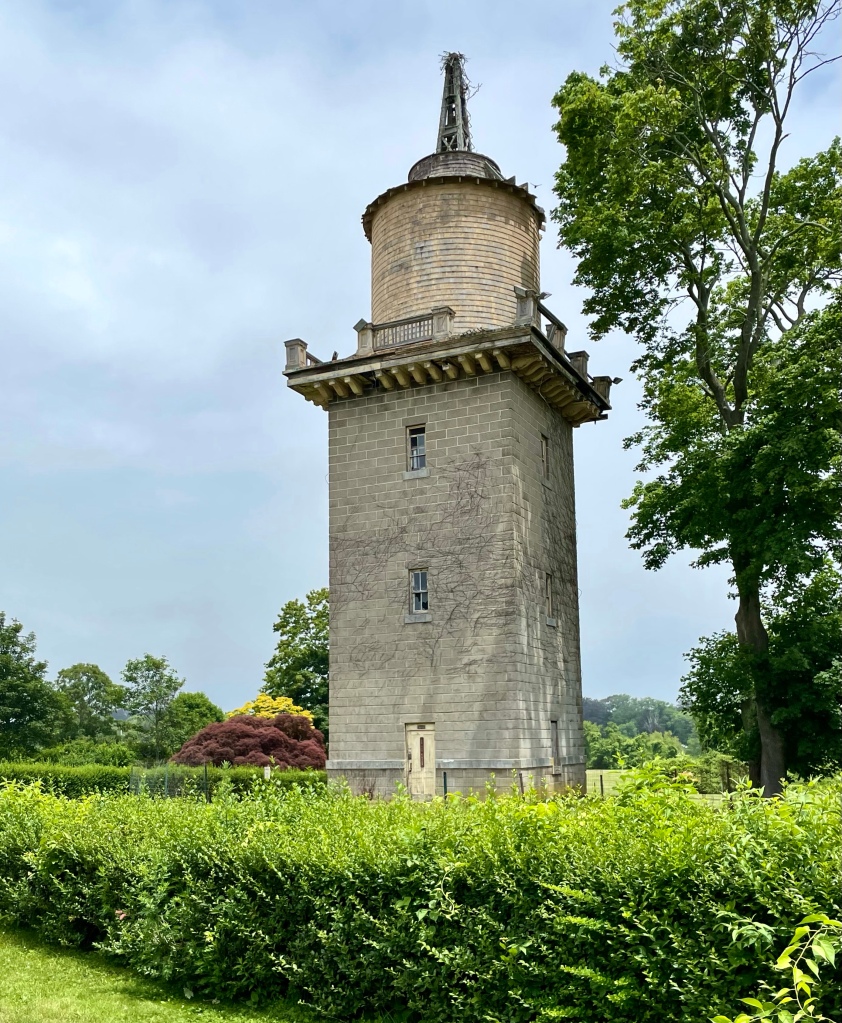
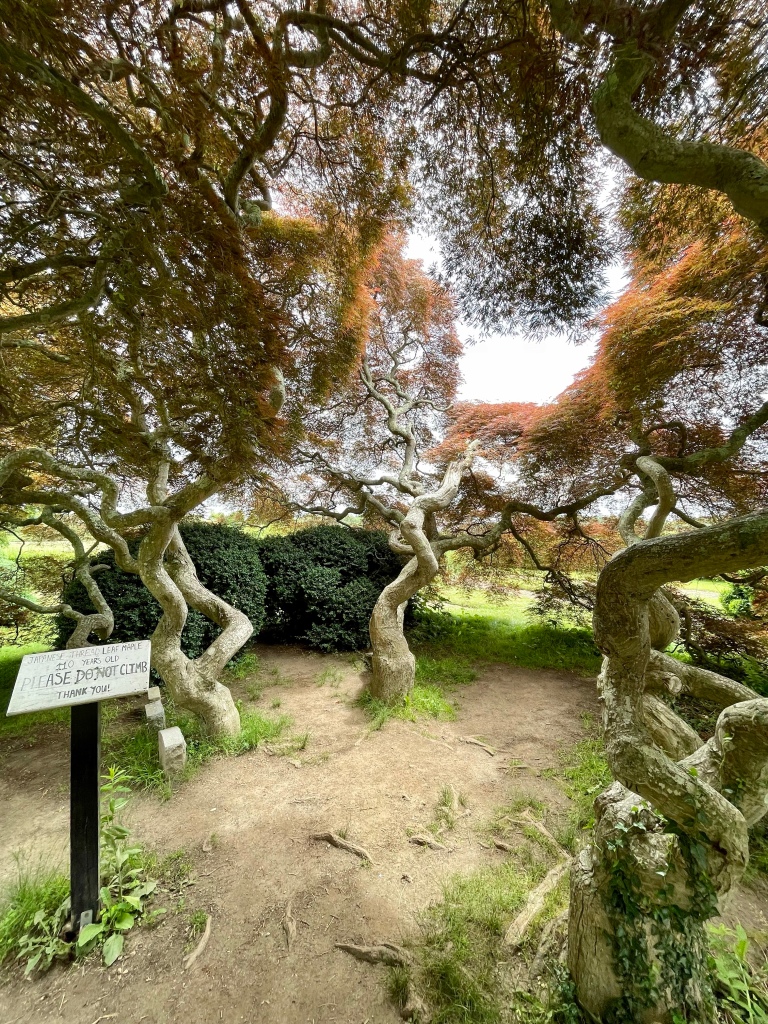
One of the most unique buildings on the grounds of the Harkness Estate has to be the most functional, the 1910 water tower. The structure was designed by architect James Gamble Rogers, a really under-appreciated architect who was commissioned by Edward and Mary Harkness to revamp their summer compound. The water tower features a skeletal frame with concrete block tower protecting it, surmounted by a shingled water tank which once had a functioning wind mill on it! Nearby the water tower, a garden designed by female landscape architect Beatrix Farrand frames the tower very well. In that garden sits a 110+ year old Japanese Thread Leaf Maple tree, which is probably the most beautiful tree I have ever seen.
Eolia, the Harkness Estate, sits on the shoreline of Waterford, Connecticut and is significant as one of the most complete grand-scale, seaside estates in Connecticut. Similar to Seaside Sanatorium (featured previously), the Harkness Estate is another Connecticut State Park in the coastal town, but is quite opposite as the buildings and grounds are in much better condition and get use! The property was developed as a formal seasonal retreat and working farm in the early 1900s for William Taylor and Jessie Stillman, until it was purchased by Jessie’s sister Mary and her husband Edward Harkness soon after. Edward S. Harkness (1874-1940) spent most of his life managing, with his older brother Charles, a tremendous fortune built up by their father Stephen Harkness, who had had the foresight in 1870 to become John D. Rockefeller’s business partner by investing in the Standard Oil Company. Edward Harkness married Mary Stillman, daughter of wealthy New York attorney Thomas E. Stillman, in 1904. Mary’s maternal grandfather was Thomas S. Greenman, a shipbuilder in Mystic, Connecticut, who co-founded George Greenman & Co shipyard (now part of the Mystic Seaport Museum). As the centerpiece of this summer estate, the premier NY architectural firm of Lord & Hewlett, designed this stunning Renaissance Revival mansion which holds a whopping 42-rooms. Mary hired female landscape architect Beatrix Farrand to design the absolutely stunning gardens on the grounds. In 1918, Edward Harkness was ranked the 6th-richest person in the United States, and the couple decided to give away much of their wealth, including selling off some of their property in Waterford for Camp Harkness for children with polio. Mary and Edward were very private people who avoided public attention and acclaim, unlike many of the rich of today. Mary Harkness’s final gift, was written in her will, that her beloved estate Eolia, would be gifted to the State of Connecticut.
Stay tuned for some more buildings on this stunning estate!
The Beebe-Phillips house in Waterford, CT, was built in the 1830s by Orrin Beebe (though some accounts say it was built for his wife Lydia after his death), and is an excellent example of a traditional full-cape house in Connecticut. The home is a vernacular example of the Federal style with no frills or expensive details. The house was originally located elsewhere in town but was moved to its current site on Jordan Green in 1974 by the Waterford Historical Society, next to the Jordan Schoolhouse.
The last stop we will see at the stunning Seaside Sanatorium campus in Waterford, Connecticut is the former Superintendent’s Residence. Built in 1936, the home is elegantly sited at the waterfront, which would have provided amazing views for the man in charge of running Seaside, the Tuberculosis hospital for children here. Like the Maher Building, Nurse’s Residence, and Duplex Residence previously featured, this building was designed in the Tudor Revival style and is also credited as a work of architect Cass Gilbert. The Superintendent’s Residence is interesting as it has two completely different facades. The campus-facing facade features an L-shape with a garage wing and projecting entry pavilion in stone. Above, a diamond-pane window would allow natural light into what may be the stairhall. At the waterfront, a large open porch (since boarded up) and large windows at the first floor, would provide natural light and air into the building, along with amazing views of Long Island Sound. Additionally, a catslide roof extends from the rightmost bay and covers a recessed porch with basketweave brickwork above. I would for sure live here, could you?
This gorgeous stone house was built circa 1877 by Phillip M. Powers (1814-1889), who served as President of the Millstone granite quarry in Waterford, Connecticut. The home is said to have been built off an earlier 1700s home, but all was constructed in ashlar granite to showcase Mr. Powers’ quality stone. It is said that Phillip went bankrupt not long after the construction of this home. In 1930, the house was purchased by Beatrice H. Rosenthal and her husband. Ms. Rosenthal served as both a delegate and as a committeewoman of the Democratic National party, and a staunch advocate for women’s rights. She was also active in women’s educational institutions around New England. The old home and barn are now available for rentals for events or overnight stays.
Waterford was once part of New London, but it separated in 1801 as the area desired its own town government which took agricultural interests more seriously. In the 19th century, much of the town’s economy was centered around agriculture, with many residents running sheep farms. During the 20th century, sheep farms were replaced by dairy farms. Between 1920 and 1960, there were about 100 dairy farms in Waterford. After WWII, suburbanization occurred and many wealthy residents of nearby New London moved to Waterford for more space. The oldest surviving public building in Waterford, Connecticut is this Colonial-era schoolhouse which was likely built in the 1730s. The Jordan Schoolhouse was built as a rural schoolhouse as farmers wanted their children to be taught writing, reading, arithmetic, and religion, even if they followed their parent’s footsteps in farming. The gambrel-roofed Georgian building was used as a school until the mid-19th century and it was converted to a private home for Asa and Eliza Gallup and their family. The schoolhouse was eventually moved to its current site on Jordan Green in 1972 and is operated as a museum space for the Waterford Historical Society.



 Buildings of New England