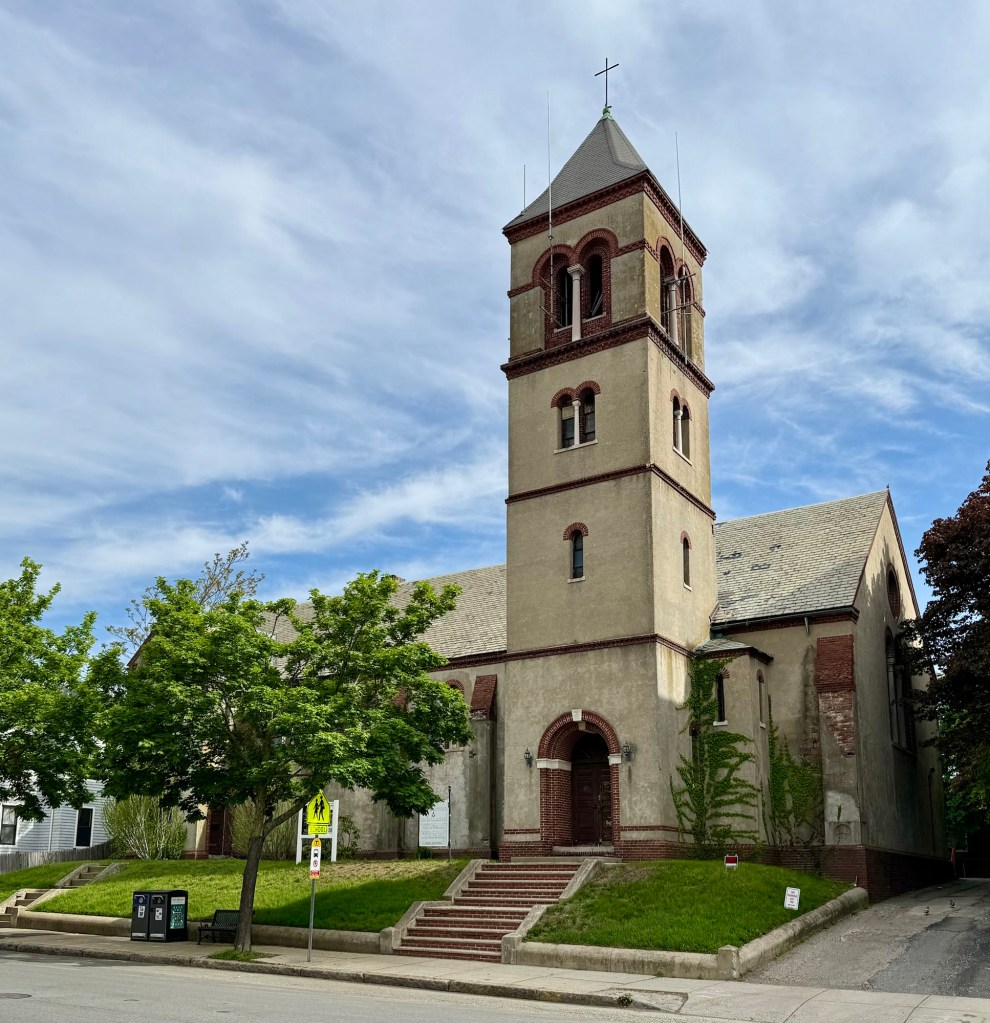
First Universalist Church of Somerville // 1917

The First Universalist Church of Somerville is located on the north side of Highland Avenue across from the First Unitarian Church of Somerville, in a completely different design. The congregation acquired this site in 1915, and the church was built from 1916 to 1923 to a design by the noted ecclesiastical architect Ralph Adams Cram, who produced a somewhat more Romanesque plan than the typical Gothical Revival work he is best known for. One of the key members of the building committee was Gilbert Henry Hood of the Hood Milk Company family. The new church was planned to house an “assembly room,” Sunday school classes, and a parish house. The church operated here for decades, but most recently was home to the Highland Masonic Building Association as the King Solomon’s Lodge. The lodge moved from the building and the property was purchased by a developer who hoped to demolish the building and erect a housing development. The building was deemed significant and “preferably preserved” by the Somerville Historical Commission, and landmark designation was initiated. The building was recently re-listed for sale, and would make a great adaptive reuse or even partial demolition for housing incorporated into the old church. Kudos to the Somerville Historical Commission for standing firm on this significant church by a nationally recognized architect.

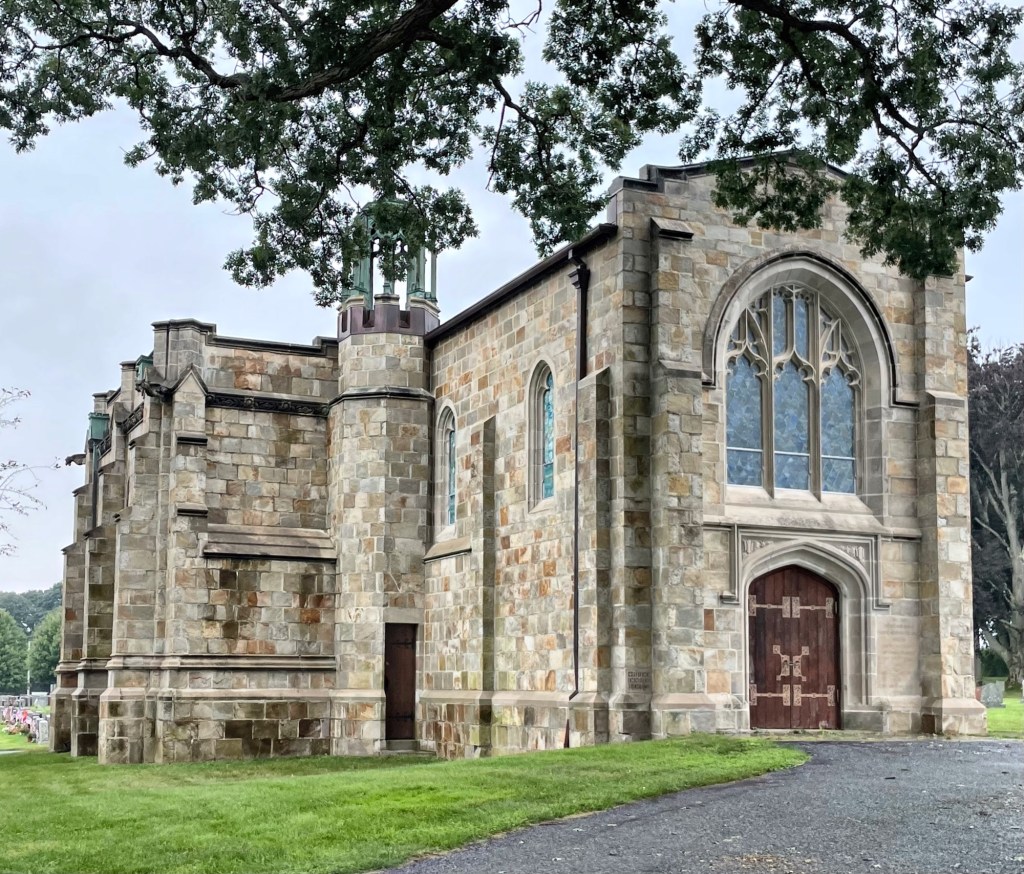
Highland Cemetery Chapel // 1903

Tucked away in Highland Cemetery, a typical looking cemetery in Norwood, Massachusetts, you will find a masterpiece chapel designed by one of the great architects of the Arts & Crafts movement. The Highland Cemetery was established in 1880 becoming the town’s second and primary burial ground. The town’s first burial ground was the Old Parish Cemetery which is located in the center of town on a 3/4-acre hill and because of its limited size and the difficult terrain; there was no room for growth. The rapidly developing town required a second cemetery and laid out Highland View on the outskirts of the village. In 1903, the Chapel of St. Gabriel the Archangel, also known as the Day Memorial Chapel, was erected at the center of the cemetery. The Chapel, which also acts as a mausoleum, was donated to the town by Lewis and Anna Smith Day in memory of their parents. Their only stipulation was that the chapel be available for use free of charge for any resident who desired to do so, no matter their religion or race. Esteemed architect Ralph Adams Cram designed the chapel in the Neo Gothic Revival style. Fred Holland Day, a renowned photographer and publisher, was the only child born to Lewis and Anna and he was a close friend of Ralph Adams Cram and Bertram Grosvenor Goodhue, likely leading to their commission here in Norwood. F. Holland Day lived in a Tudor mansion in town, modified from his childhood home. The Cemetery Chapel remains a seminal building for its genre and time.

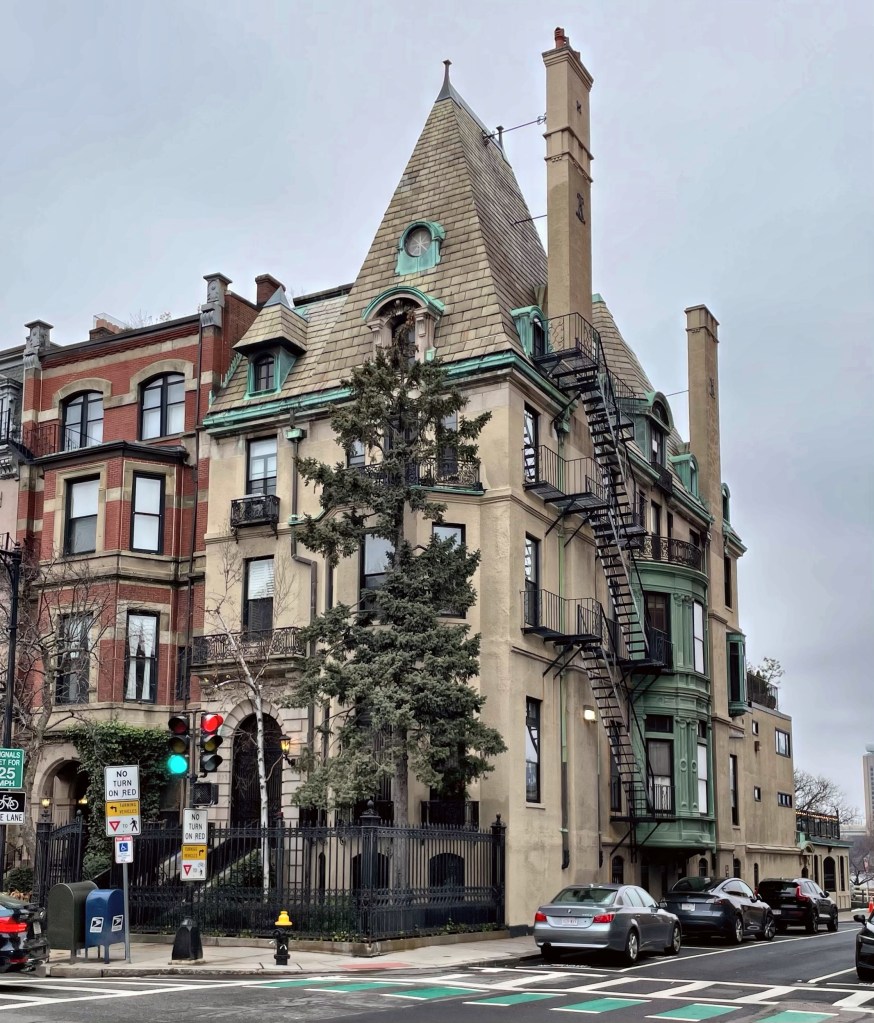
Pope-Barron Townhouse // 1871

Merry Christmas to those who celebrate! As there is no snow on the ground in Boston, I wanted to share a house with a prominent pine tree, which resembles an oversized urban Christmas tree on Beacon Street. This house at the corner of Beacon and Fairfield streets was built in 1871 by architect and builder Frederick B. Pope on speculation. It did not sell as quickly as he would have hoped, and it took two years for it to finally sell at public auction in 1873. The relatively modest brick Second Empire style house was bought and sold numerous times until March 1905, when the residence was purchased by Clarence Walker Barron, a prominent publisher and journalist. In 1903, he purchased Dow Jones & Company and from 1912 until his death in 1928, he was its president. During this period, he was also de facto manager of The Wall Street Journal, he expanded its daily circulation, modernized its printing press operations, and deepened its reporting capabilities. In 1921, he founded Barron’s National Financial Weekly, later renamed Barron’s Magazine. Barron pushed for the intense scrutiny of corporate financial records, and for this reason is considered by many to be the founder of modern financial journalism. In 1920, he investigated Charles Ponzi, inventor of the “Ponzi scheme”. His aggressive questioning and common-sense analysis helped lead to Ponzi’s arrest and conviction. For his Boston townhouse, Barron hired the firm of Cram, Goodhue & Ferguson to completely renovate the dwelling with an extra floor, limestone facades, and more bold roof design.