Wayland Railroad Depot // 1881

The Wayland Railroad depot in Wayland, Massachusetts, was built in 1881 by the Massachusetts Central Railroad, which was later absorbed as part of the Boston and Maine Railroad. The line operated both passenger and freight service, with this structure serving as the passenger station and freight at the nearby structure, also built in 1881. Regular train service helped develop Wayland Center into a more prosperous Boston suburb, but industry and larger developments did not occur like in other communities. In its heyday, the Wayland station was manned by an agent with a small office in the building. The station agent was responsible for nearly all aspects of the operations from selling tickets; handling mail, baggage, and freight; keeping financial and operating records; and even maintaining the grounds. After WWII, car ownership and highway expansion harmed the rail industry and trains ceased to run in Wayland. To save the building from eventual demolition, the Town of Wayland purchased the old depots, which since the 1980s, has been leased to “The Wayland Depot“, a charitable women’s consignment craft shop with retail space in the station. The former rail line has largely been converted to a rail trail for pedestrians and bicyclists to traverse the old railroad right-of-way.
Cornwall Bridge Railroad Station // 1886

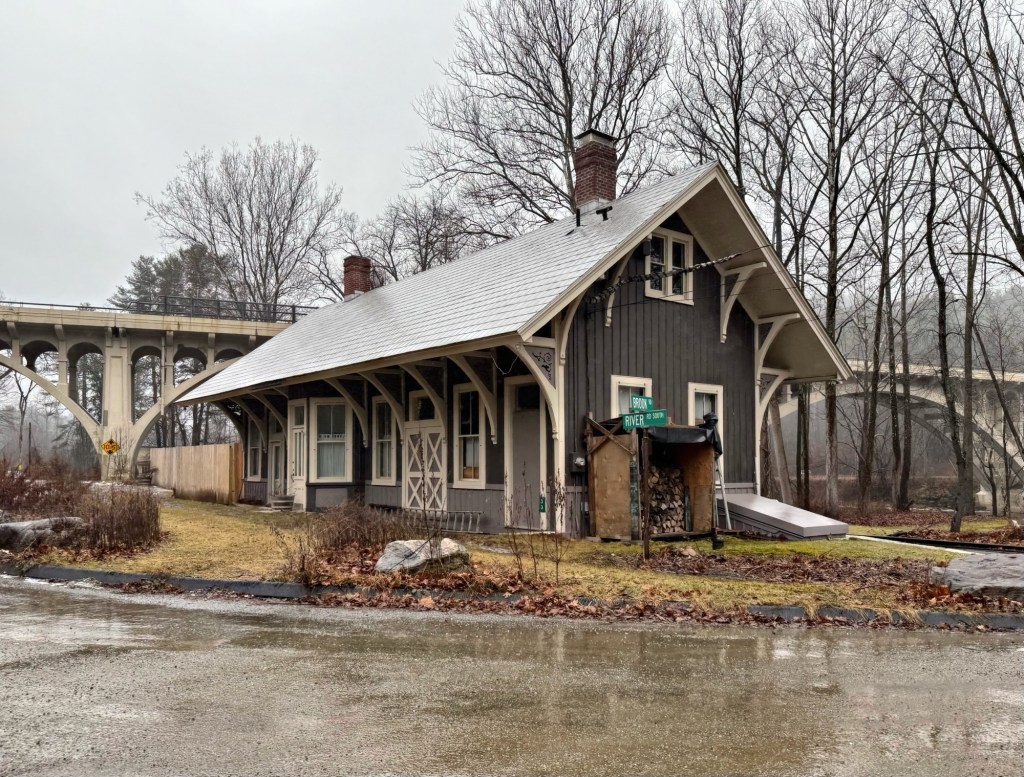
One of the most attractive railroad depots in Connecticut, the Cornwall Bridge Railroad Station exists in almost complete originality. Its siding is board and batten and its slate roof with a wide overhang supported by the original brackets, showcases the attention to detail railroad companies paid to design and appoint these important landmarks. Built in 1886, the building can be classified as Stick Style and is one of a few buildings in town of the style, adding to its significance. The station was built by the Housatonic Railroad to replace an earlier station on the site. The Housatonic line was acquired by the New York, New Haven and Hartford Railroad in 1892 and later by the Penn Central Railroad in 1969, which went bankrupt by 1970. This station was subsequently sold to private ownership and listed on the National Register of Historic Places as a tool to bring awareness to its significance and threatened status. Luckily, the building was preserved and has been converted to a private residence.

Former Boston & Lowell Railroad Depot // 1871-1927

Courtesy of Boston Public Library collections

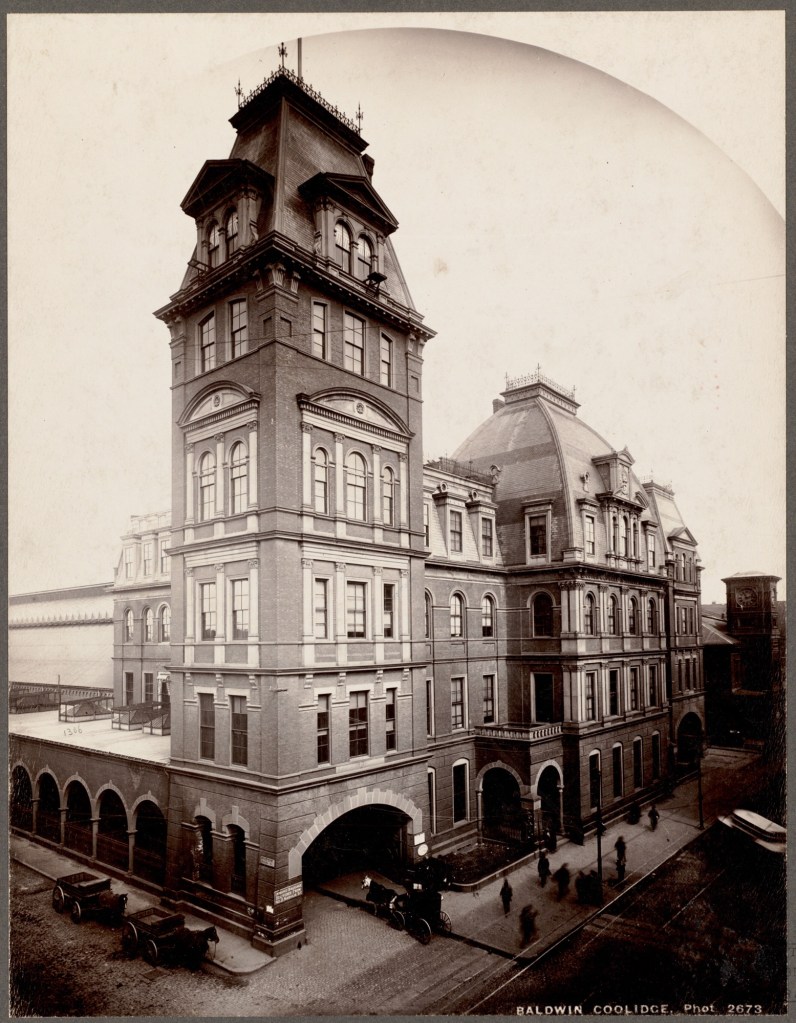
The Boston and Lowell Railroad was established in 1830 as one of the first rail lines in North America. The first track was completed in 1835, and freight service began immediately connecting Boston to the newly established town of Lowell, which had just 6,400 residents at the time (compared to Boston which had 10x that). The original Boston depot was a modest structure, but after the Civil War, it was decided that a new station connecting two of the most important industrial cities in Massachusetts, should be built. Architect Edgar Allen Poe Newcomb and his father’s firm, L. Newcomb & Son, was selected to design a new station on Causeway Street. The French Second Empire masterpiece was built between 1871-1878. Inside, the concourse was lined with oak walls and marble flooring. The depot was added onto in 1893 and incorporated into a Union Station of multiple former lines, and ultimately demolished in 1927 for the first North Station.

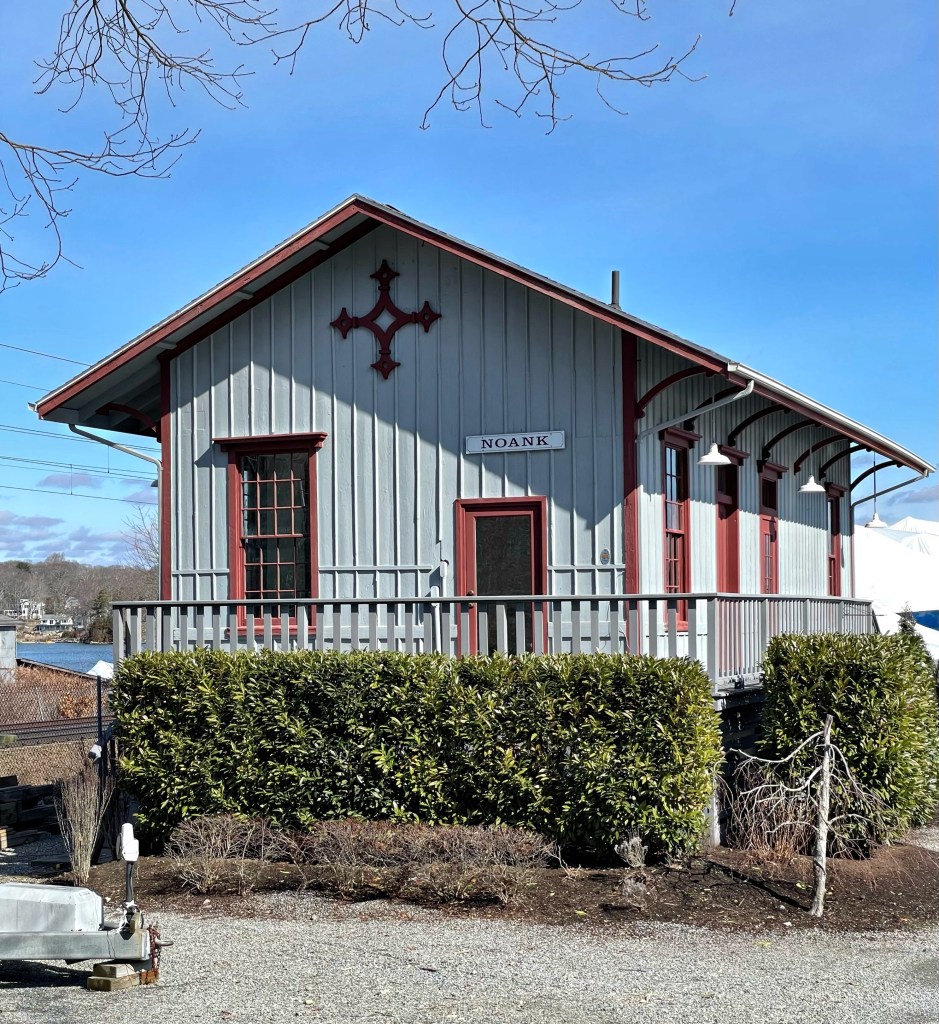
Noank Train Depot // 1858

Starting in 1848, rail service connecting New Haven and New London, Connecticut commenced to provide transit between two of the state’s economic centers. The New Haven and New London Railroad was completed in 1852 and almost immediately, work commenced on extending the line eastward as the New London and Stonington Railroad. This completed the “Shore Line” route between New York City and Boston through other lines and the span became re-organized and named the Shore Line Railway. One of the many village stops along the route was in Noank, in this 1858 rail depot. The small train station is covered in board-and-batten siding with an overhanging gable roof supported by brackets. In 1976, much of the shoreline track was purchased by Amtrak, which is now known as the Northeast Corridor. The Noank station was cancelled as a stop, and the building was sold from the holdings, it is now office space, seemingly for the Noank Village Boatyard.

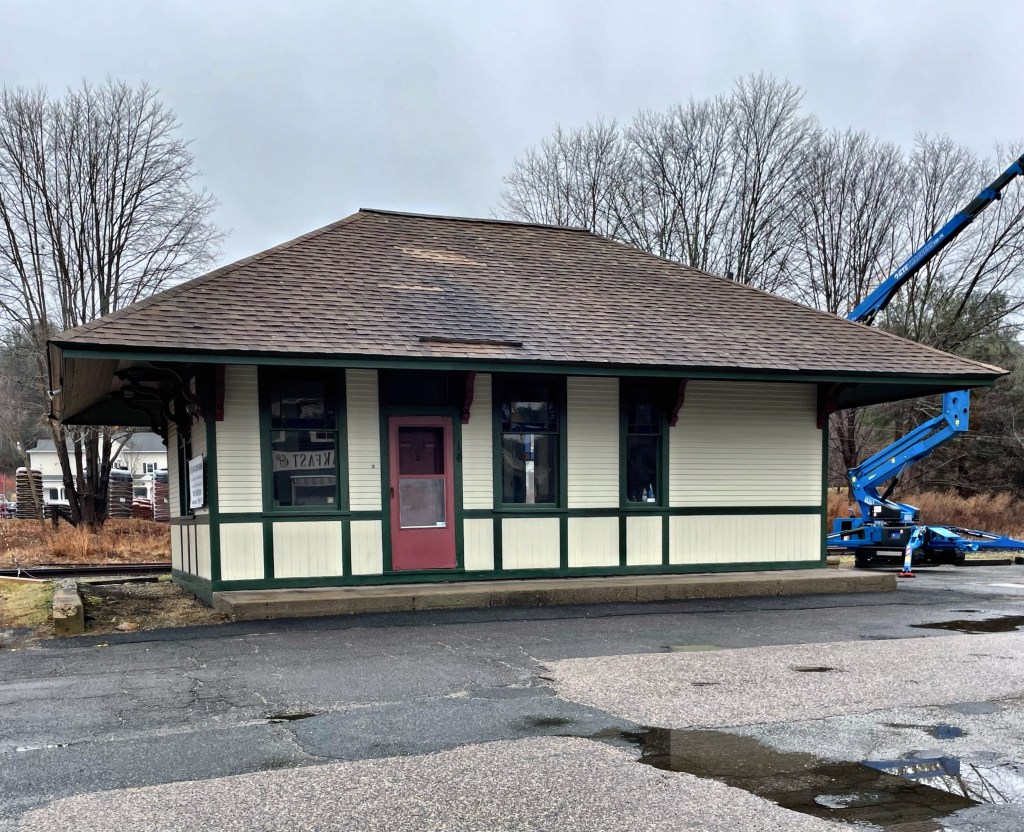
Willington Train Depot // 1895

TOOT TOOT! Next stop, Willington, Connecticut. Historically, all of central Connecticut was occupied by various Algonquin tribes which for thousands of years inhabited the region, the larger Pequot and Mohegan, and the smaller Nipmuck, Podunk, Shenipset and Skunkamaug all sharing a common-lineage, and language. In 1720, a party of eight men, originally from England, bought 16,000 acres of the region and called it Wellington after the town in England. Willington was incorporated in 1727. Like many early towns, Willington began as a farming community with modest industry until the 19th century, when the American Industrial Revolution saw mills and factories sprouting up all along the river towns in the region. Villages spouted up in town, mostly following their geographic location in relation to the town center (South Willington, West Willington, etc.) and each had their own industry and character. By the 20th century with industry in decline, many of the former mills and villages closed up and residents moved to “greener pastures”. The town is today mostly rural and serves as a suburb to larger towns nearby.

This train depot is located in West Willington just over the town line of Tolland. Due to this, the depot was originally named Tolland Station. Rail service began here in 1850, when the New London, Willimantic and Palmer Railroad Company built a freight and passenger station near this location. The rail line was later absorbed into the larger Central Vermont Railway in 1871. The original depot burned down in 1894, and was replaced that same year by this structure. The line, and this station, were in use for passenger service until 1947, when it closed. The depot has luckily been occupied by businesses ever-since, preserving this building typology in America that we are losing every year.

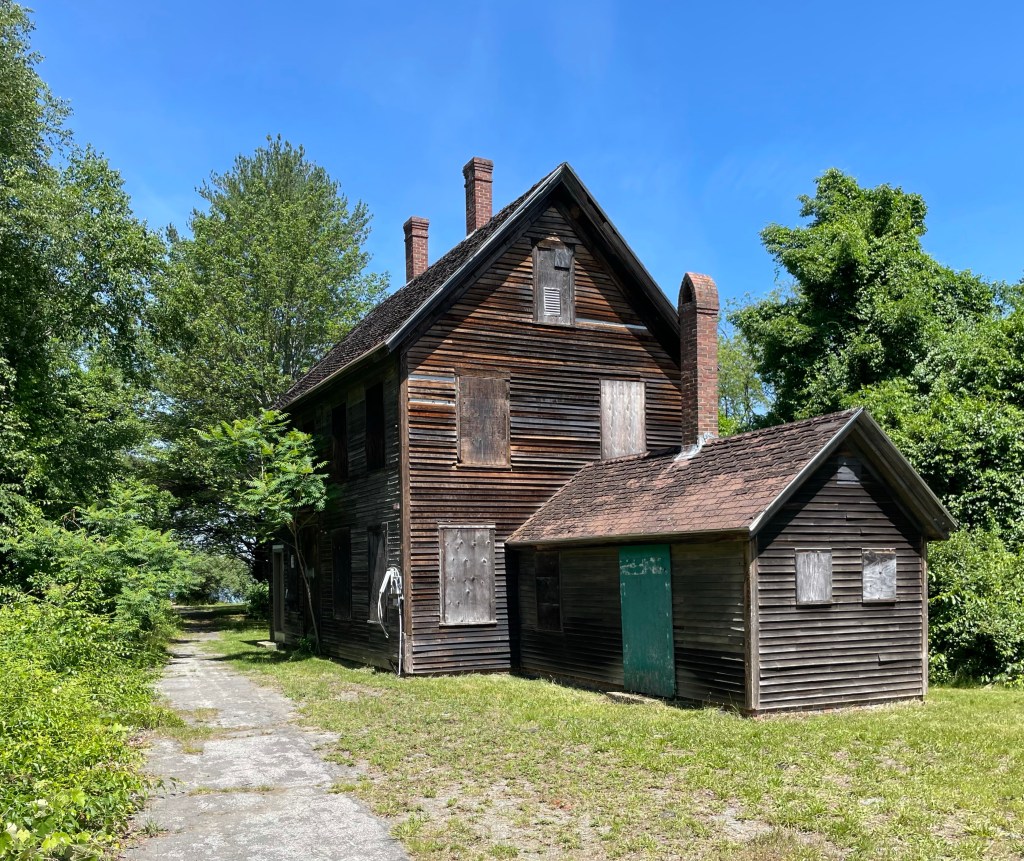
Newington Railroad Depot // 1873

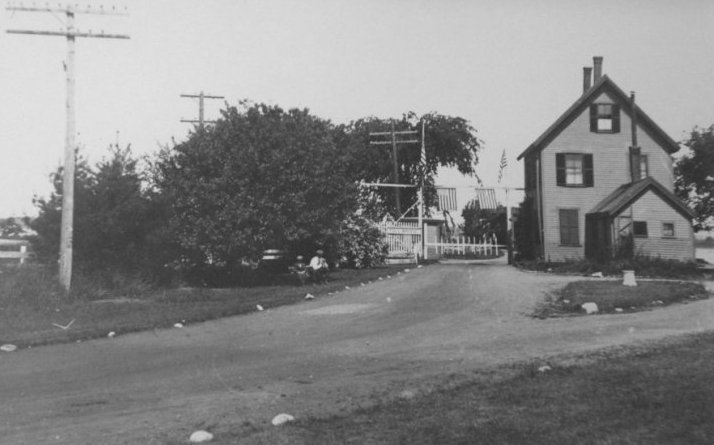
The Newington Railroad Depot was built in 1873 at the narrowest point at the Piscataqua River as part of the Portsmouth and Dover Railroad. The Portsmouth and Dover Railroad Company was chartered in 1866 in order to provide a link between the eastern and western divisions of the Boston and Maine Railroad and also included the means to cross Great Bay. The rail line was completed in 1874 and included this railroad depot which included a residence for the stationmaster while he collected tolls for pedestrians and carriages crossing the bridge nearby, and operated the swing section of the bridge to permit boat traffic to pass. By 1915, the one story wing was constructed which served as a 10’x20′ waiting room and ticket office. The offshoot rail line remained in service until the completion of the General Sullivan Bridge in 1934, due to the popularity of the automobile. The rail line was subsequently abandoned, and the nearby tracks were taken up in 1940. Elmer Brooks, the longtime stationkeeper was allowed to remain in the old depot, renting the building from the State of New Hampshire, who acquired the site in 1940. He lived here until his death in 1971. After which, the building has decayed. The State of New Hampshire should restore this valuable piece of history and has an amazing opportunity for a park in the surrounding area. Hopefully something is done to preserve the building!