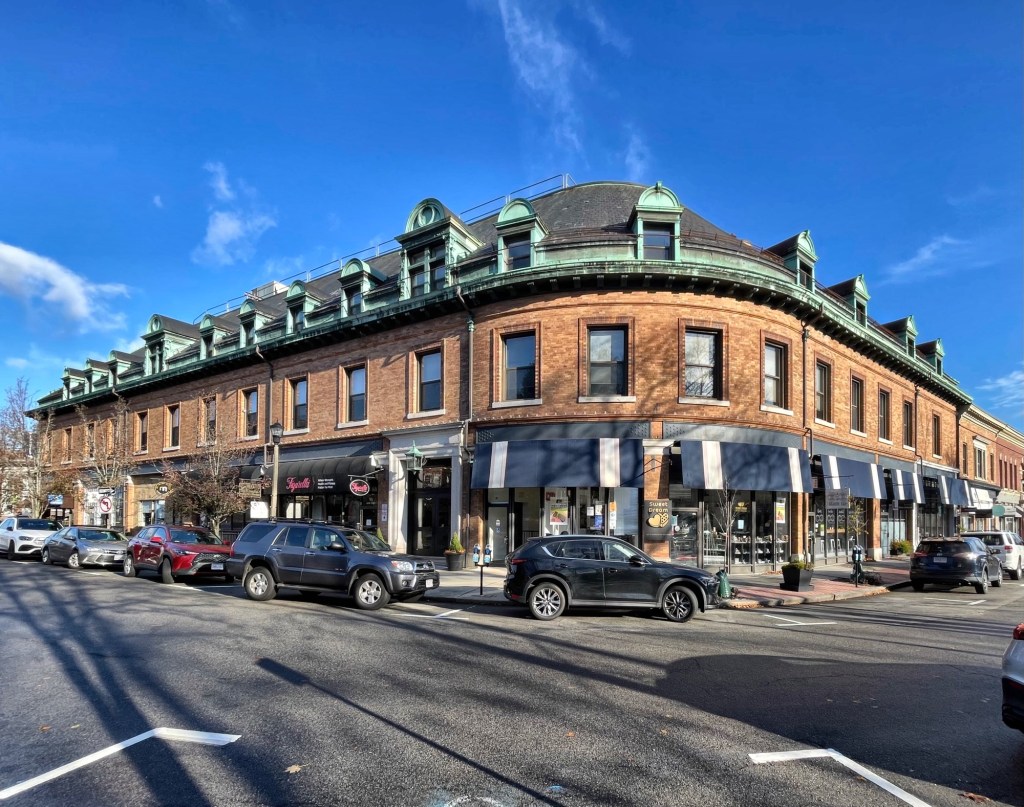
Bray’s Hall // 1893

As Newton Centre’s new railroad station and following development boom transformed the once sleepy village into the main commercial center for the city, landowners capitalized on the opportunity by developing commercial blocks to serve the community and line their own pockets. Mellen Newton Bray (1856-1946) became a major landholder in Newton Centre and would develop the areas directly surrounding the new train station there. On a curving site, he built Bray’s Hall, this three-story commercial block renting out spaces to local banks and stores with a large assembly hall and bowling alley in the building as well. Initially, Bray planned for an eight-story structure, having contracted a solid foundation that could support such a structure, pending the success of the initial construction. That is mixed use before it was “cool”. The building was designed by the firm of Kendall & Stevens, likely led by Henry H. Kendall, who resided in Newton Centre. Kendall would also design the apartment block across the street for Mr. Bray. The building is constructed of light Tuscan bricks and is notable for the bracketed cornice and dormers all in copper. The building was restored in the 1970s by owner David Zussman, and rebranded as Piccadilly Square, following his recent trip to London being impressed with by the atmosphere of Piccadilly Circus.

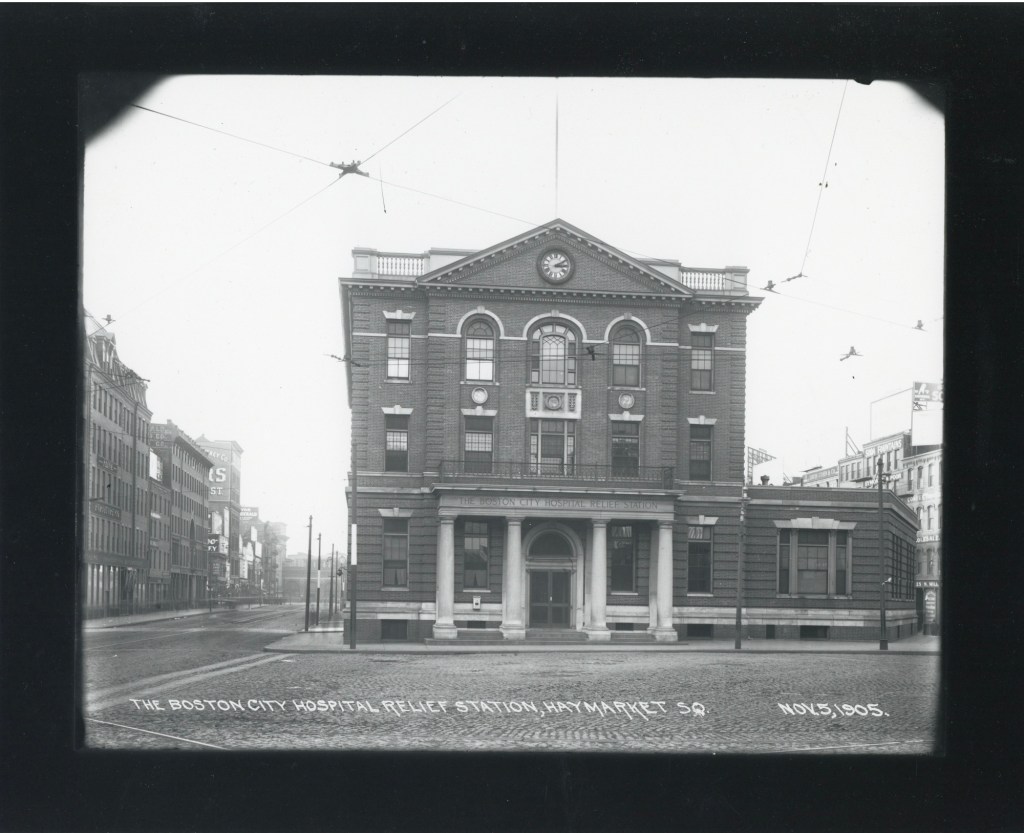
Boston City Hospital Relief Station, Haymarket // 1902-1960s

Image courtesy of City of Boston Archives

In 1858, as Boston began to see a massive influx of immigration into the city and rapid industrialization, the City of Boston authorized the creation of a new hospital whose purpose was the “reception of those sick and injured: citizens of Boston who, from any cause, were unable to otherwise obtain care and treatment,” especially in cases of “acute illness and for the victims of accident or injury.” This was the Boston City Hospital, which was established in the South End, and is now known as the Boston Medical Center. The hospital was thought to be too far away for victims of injury of illness to get to promptly, so a relief station was built in Haymarket Square, replacing the recently demolished Boston & Maine Railroad Station. The new, standalone hospital building was constructed of brick and stood three stories tall and opened in 1902. On its first day of operation, doctors and staff saved the life of a man who had attempted suicide by ingesting carbolic acid. A Boston Globe reporter speculated that had the patient been  transported to the more distant Massachusetts General or City Hospitals, he would have surely died. The Colonial Revival style building was designed by the firm of Kendall, Taylor & Stevens, who specialized in medical facilities and other institutional building designs. The structure was demolished by the 1960s, when much of the Government Center/West End areas were razed for urban renewal.