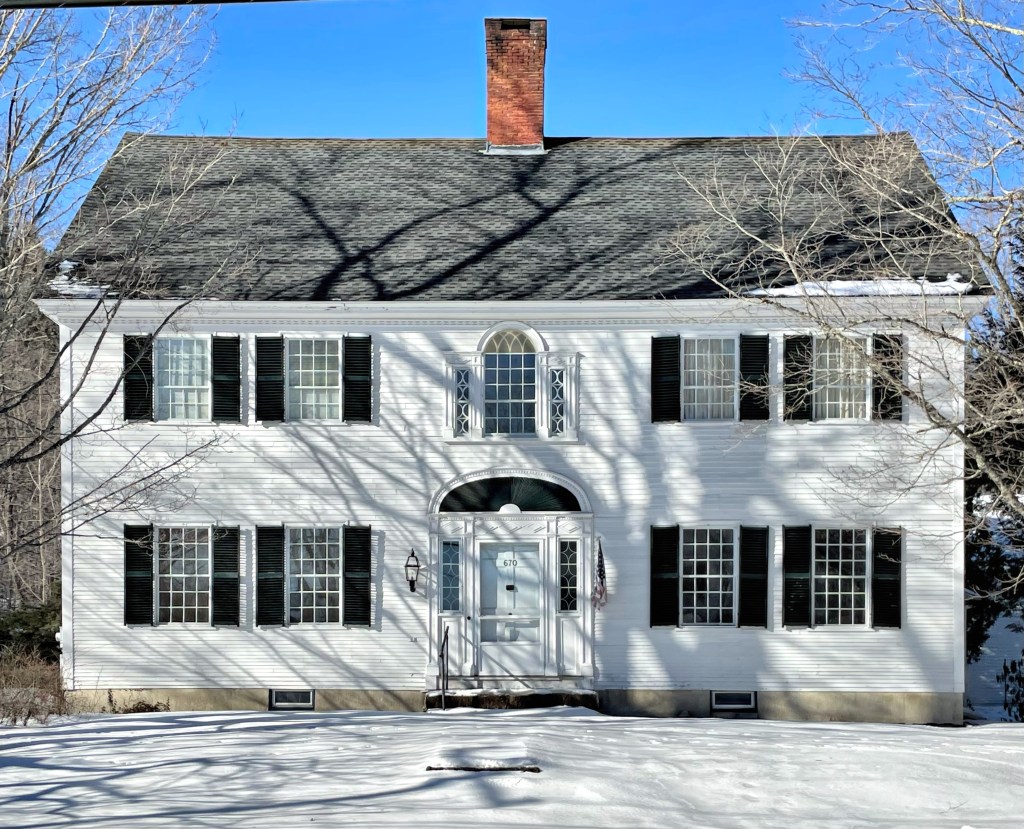
The most architecturally significant example of the Federal style in Waterford, Maine, is this c.1810 home built for Ambrose Knight, who operated a store in town. The high-style Federal home features a well-proportioned fanlight over the entrance with a Palladian window above, all with geometric moulding. The home was likely built by a housewright who employed designs from Asher Benjamin’s pattern books for builders, as the high-style features and Palladian windows are uncommon in this part of Maine.
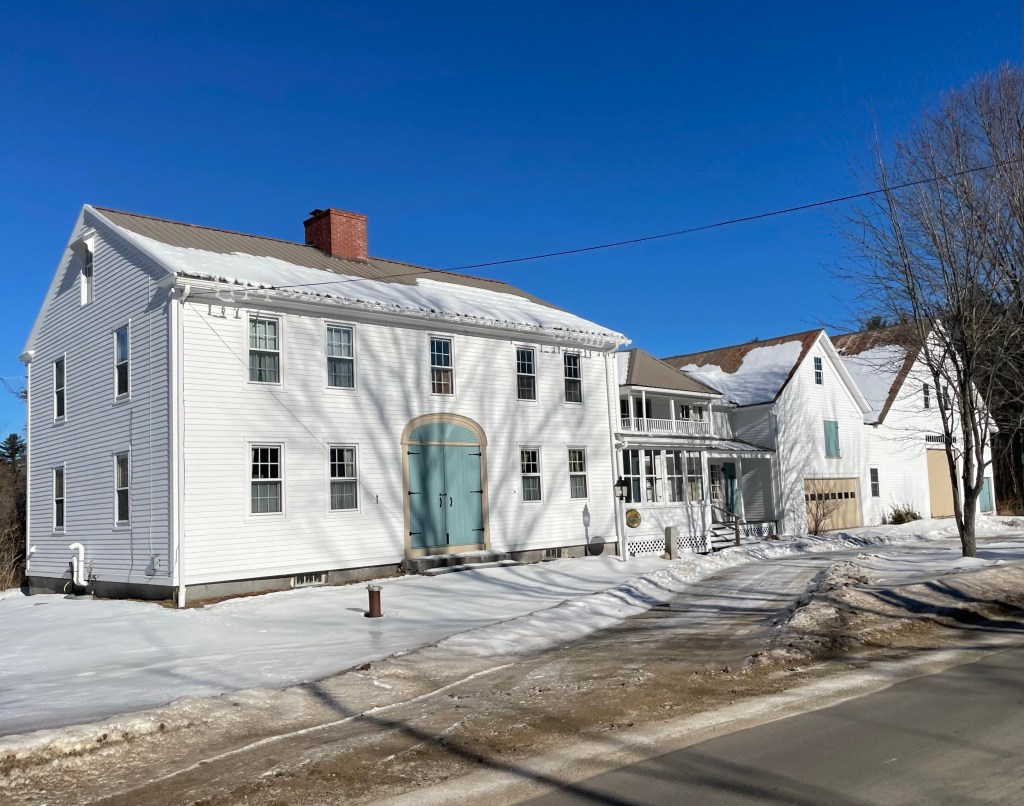
Dr. Leander Gage (1791-1842) came to Waterford from Bethel, Maine in 1817. He erected and lived in this Federal style house which overlooks much of the South Waterford village. Gage was a prominent medical practitioner in town and involved in local politics as a moderator at town meetings and as a school committee member until his death. The home has a Federal style stable and 1840s barn attached and had remained in the Gage family until at least the 1980s.
Built soon after a massive fire destroyed much of North Waterford Village in Maine, the Iocal order of Odd Fellows decided to rebuild, constructing this building for their members. Though active for several decades after the building was reopened, an aging and dwindling membership forced this chapter to merge with the Odd Fellows of nearby Norway, Maine. After, this building was occupied by the Daughters of Rebekah, an auxiliary group of the IOOF for women until 1973 when it was donated to the recently formed Waterford Historical Society. The society has since moved, and listed the building for sale in 2020 for just $10,000!!
One thing about Victorian-era houses that I love so much is the fact that it’s so rare to find two houses that are the same! The uniqueness and detail is just amazing and stalking these homes never gets old! This 1886 beauty was built as a double-house for Stephen Cummings of Norway, Maine. Cummings was a member of the family which built many of the grand homes in town as they ran a woodworking and carpentry company. Architect John B. Hazen designed the Stick style home with a octagonal bay at the facade, capped by a tower, giving the home a sort of pagoda effect.
The most iconic house in Norway, Maine has to be the Evans-Cummings House (also known locally as the Gingerbread House) on Main Street. The ornate Victorian era home was originally built in 1855 for Richard Evans, who was born in Portland in 1805 and after training as a carpenter, moved to Norway in 1833 for work. He and his wife, Mary Warren Hill, had eight children and they resided in the home until their death. In 1890, Charles B. Cummings bought the house in 1890 and hired local architect John B. Hazen to remodel the house. Hazen added the gingerbread adornments for which the house is now known colloquially. The home attracted a lot of attention in the region, and the later heirs continued that whimsical appeal. When the home was willed to Fred and Cora Cummings, they were said to have kept a stuffed peacock at the top of the stairs, which delighted children when they toured the home. The house eventually became used as storage by the owners of the local Advertiser Democrat newspaper, and its future was threatened. Since 2012, a local group, Friends of the Gingerbread House, have poured tens of thousands of dollars and an equal amount of time restoring the iconic home to her former glory! Preservation is important!
Last up on our tour of Scandinavia (Denmark, Sweden and now Norway) Maine, is Norway. The town of Norway centers around Pennessewasse Lake, which supported native people in the region for thousands of years. It wasn’t until after the American Revolution that European settlers established the town. By 1789, a sawmill and gristmill were established, the first road was built in 1796, and the town of Norway was officially incorporated on March 9, 1797. Before incorporation, the township adopted the name Rustfield, to recognize the contributions of prominent landowner Henry Rust of Salem, Mass and the community once petitioned the Massachusetts General Court to be named Norage, meaning “falls” in the native peoples’ language. Norway won the name, but the origin of the town’s name remains unknown. The town leaned more towards industry than Denmark and Sweden due to the stronger rivers, and its population increased as a result.
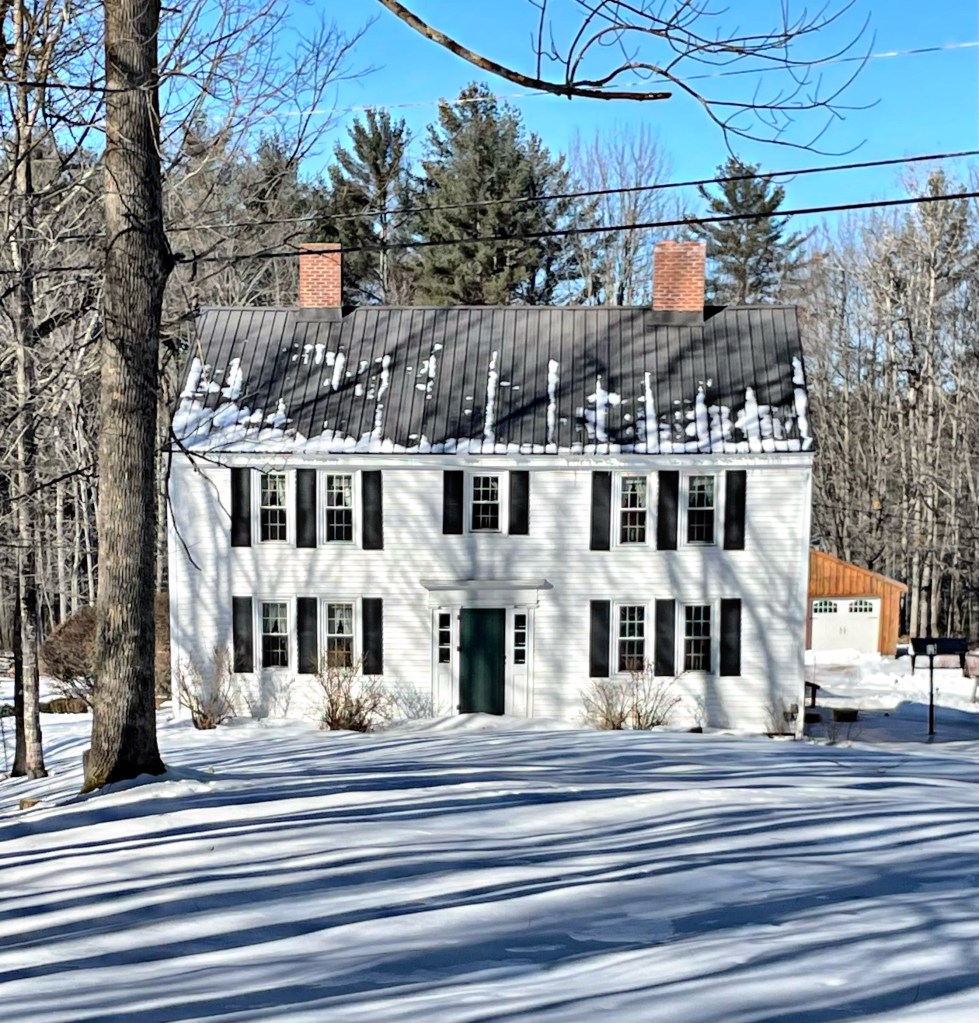
This historic farmhouse sits on the eastern edge of Pennessewasse Lake and is one of the oldest extant homes in town. It was built in 1792 just years after land here was purchased by Nathaniel Bennett in 1790. Nathaniel and Elizabeth Bennett resided in the home until they died, childless. The home was eventually purchased by Don Carlos Seitz, publisher of the New York World, who grew up and was educated in town. Seitz operated the property as a gentleman’s farm, and is responsible for naming the property “Cedarbrook Farm”. His estate sold the property to one of his hired hands in 1927. It remains very well preserved and was listed on the National Register of Historic Places in 1996 as the Nathaniel and Elizabeth Bennett House.
In 1820, just seven years after the incorporation of Sweden Maine, a homesteader, Amos Parker purchased fifty acres of land and began to erect a two-story, Federal house with a center chimney and a detached store beside it. Plagued by debt, Parker sold the unfinished house to Samuel Nevers circa 1833–1835, who purchased the property with the store for his recently married son, Benjamin. By 1860, Benjamin Nevers had a successful store and prospering farmstead. Benjamin died in 1883, and in the next two years, their daughter Charlotte, and her husband, Charles Bennett, dramatically remodeled and modernized the farmstead, adding a connected two-story ell building outward from the main house toward the old 1840 barn, connecting the entire property. I believe that the property remains in the Nevers-Bennett Family, as recently, Steve and Judy Bennett, recently negotiated an easement with the Maine Farmland Trust to protect their hay, beef, and maple sugaring acreage as farmland into the future.
While architecturally significant mansions, churches and civic buildings are great, the smaller wood-frame buildings such as this really tell the story of New England. When the town of Sweden, Maine was still in her infancy, the Nevers Family helped to establish the town and diversify its output from the typical agricultural village. Sweden supported an interesting variety of nineteenth century businesses including: general stores, saw mills, copper and cobbler shops, and a straw hat factory. The town of Sweden was distanced from major trade routes, railroads and navigable rivers, so it saw a period of decline from the late 19th to the 20th century. The town has since been a sort of “bedroom community” where people mostly live, but travel outside the town for commerce and work. This blacksmith shop shows us an example of a trade that has largely gone away, but it was a common structure and profession in early America.
Located near the base of Pleasant Mountain in Denmark, Maine, you’ll find this stunning Victorian house, possibly the best example of Queen Anne architecture in town. Down the dirt road, you can imagine how shocked I was to stumble upon this beauty set back off the road, overlooking the White Mountains in the distance. The house was built around 1882 for the Warren Family, descendants of one of the first settlers in the town. Caleb Warren Jr., is likely responsible for this house, which served as a base lodge for the hotel once located at the summit. In 1845, Caleb Sr. built the first guesthouse atop the 2,200′ mountain, which was purchased just years later by a Joseph A. Sargent. Sargent converted the old hotel into a bowling alley and built a new hotel at the summit. That structure burned to the ground, and was replaced in 1873. The buildings at the summit were eventually purchased and demolished by 1908 when the mountain was sold to the Appalachian Mountain Club. Mountain Aqua would have served as a base lodge for the mountaintop hotel, and was a place where visitors could depart by foot or wagon to the summit. Mountain Aqua appears to be a single-family home today.
This two-and-a-half-story building sits on Main Street in the small town of Denmark, Maine, and has contributed to the town’s cultural life since it was built in 1884. The Independent Order of Odd Fellows (IOOF) is a non-political and non-sectarian international fraternal group that promotes the ethic of reciprocity and charity. It was founded in 1819 by Thomas Wildey in Baltimore, Maryland, evolving from the Order of Odd Fellows founded in England during the 1700s. New buildings sprouted up all over the United States in the 19th century, in cities as large as New York City and towns as small as Denmark. This IOOF Hall is Italianate in style, with brackets at the cornice and hoods and round arched windows in the gable end; it also shows some Greek Revival details with corner pilasters and the pediment. When Raymond Hale, the last member of the IOOF Lodge passed away, the town purchased the old Odd Fellows Hall. The city could not maintain the property and had no good use for it. Residents in town voted in 1991 to sell the building rather than demolish it. Local residents bid on and won the building with the aim to convert it to a local arts center. In August 1994 the owners signed over the deed of the Odd Fellows Hall to the Denmark Arts Center, a non profit organization. From that time until present, the old building, now the Denmark Arts Center, has again served as a community focal point, providing cultural activities for the people of Denmark and surrounding towns.




 Buildings of New England