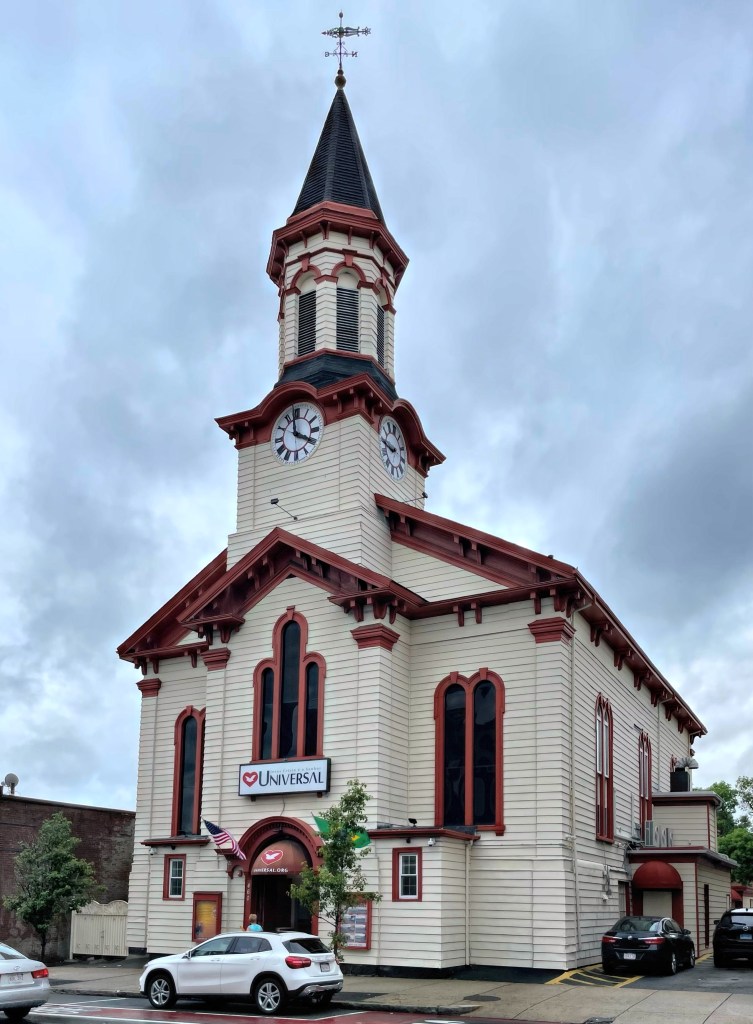
First Congregational Church, Everett // 1852

The oldest surviving church in Everett, Massachusetts is this one, the First Congregational Church, built in 1852 when the city was still a part of Malden. As in many other communities, this church was formed when the surrounding area of South Malden had grown and had the means to support its own religious society. Before this, residents had to travel to Malden Center for services. In 1848, it was voted to establish the church calling it the Winthrop Congregational Church, as at the time, it was thought that when South Malden would split away, the new town would be named “Winthrop”. When the town finally split in 1870, another town had already taken that name. Originally, the Italianate-style building was sheathed in wood clapboards and outlined by pilasters, both of which were covered or removed for the installation of aluminum siding, very common in the city after WWII. Remaining hallmarks of the Italianate style include the paired cornice brackets and the round-headed windows. The tower was originally capped by a taller steeple above an open octagonal arcaded belfry, but was replaced by the present spire in 1911. The church was possibly an early design by architect Thomas Silloway. Today, the church is occupied by Universal Church USA, a congregation that originated in Brazil, showing how the local community and demographics have shifted in Everett from 150 years ago.
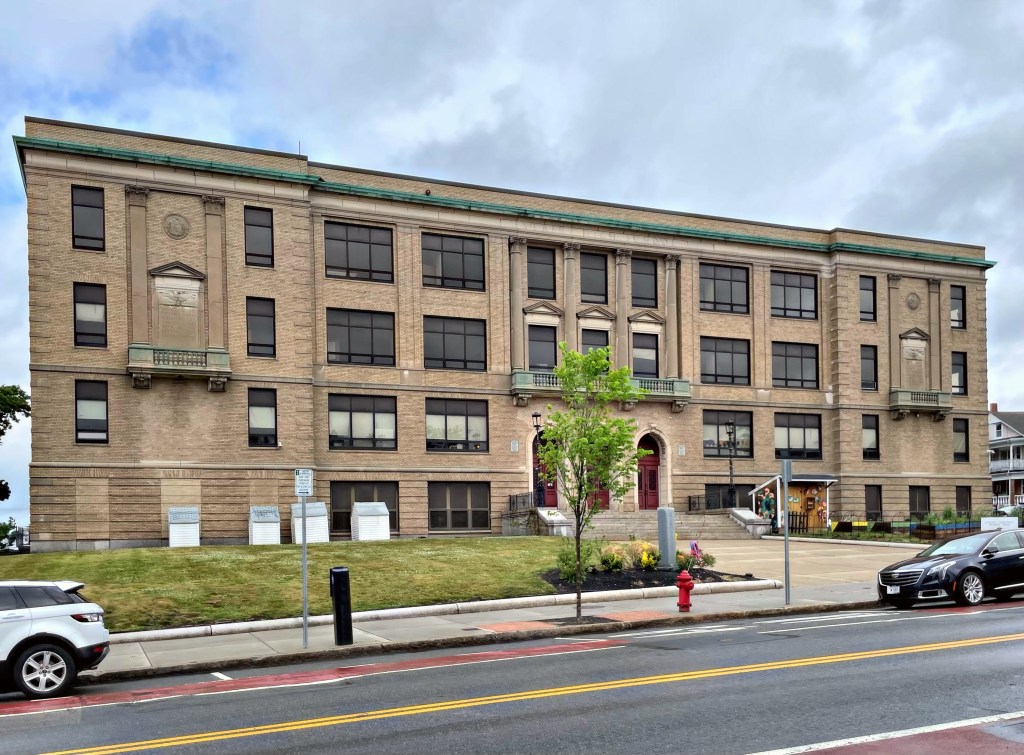
Second Everett High School // 1922

In 1892, the growing municipality of Everett, Massachusetts incorporated as a city. While Everett’s population had remained small compared to nearby towns throughout much of the nineteenth century, its close proximity to Boston resulted in dramatic population growth between 1885 and 1915. During this late industrial period Everett’s population was one of the fastest growing in the state, doubling between 1870 and 1880, nearly tripling from 1880 to 1890 and doubling again between 1890-1900. This massive population growth put a strain on public facilities, necessitating new housing construction, new public utilities, and schools. By 1889, planning for the first purpose-built high school had begun. The resulting first Everett High School, first known as the Home School, in 1893, the year after Everett’s incorporation as a city. That building was almost immediately outgrown and the city acquired a new site for a school that was large enough to educate the ever-growing town’s students. The City of Everett selected the architectural firm of Ritchie, Parsons, and Taylor for the construction of the new high school. The firm was led by Scottish-born James H. Ritchie, who designed the Classical Revival building. In the early 2000s, the building was again deemed inadequate and a third high school was built about a mile away. The building is now occupied by the Everett Community Health and Wellness Center and the Webster School Extension.

Everett Masonic Hall // 1910

Further up Broadway from Everett City Hall, you’ll find the town’s Masonic Hall, a now-vacant institutional building which contributes to the diverse streetscape and character of Everett’s built environment. The local Palestine Lodge of the Masons in Everett originally met in its original lodge, built in 1870. A corporation known as the Everett Associates, which included only Masons, subsequently constructed the original Masonic Building. The property burned in a fire in 1908, leading to a new building campaign by members. A site was acquired further up Broadway, and the groundbreaking was held on June 11, 1910, led by Everett Mayor Charles Bruce, a past master of the Palestine Lodge. Mayor Bruce also served as the chair of the Building Committee. In his remarks at the groundbreaking, Bruce noted the membership of the lodge as over 500 men! Inside the cornerstone, members placed: original papers from the former Masonic Building, a history of the Palestine Lodge, a list of lodge members, photographs, news articles, and other ephemera. The Boston architectural firm Loring and Phipps was responsible for the design of the building, which is constructed of water-struck brick and is of the Classical Revival style. After WWII, membership declined sharply, and the organization sold the building in the 1980s. From the mid-1990s to 2019 the building was owned by the Islamic Association of Massachusetts, and suffered from deferred maintenance. The red “X” on the building is for firefighters not to enter the building in case of fire or emergency. Luckily, the building was purchased and the new owner hopes to convert the building into housing, preserving the structure and using Historic Preservation Tax Credits. Fingers crossed!!

Hovey House // 1897

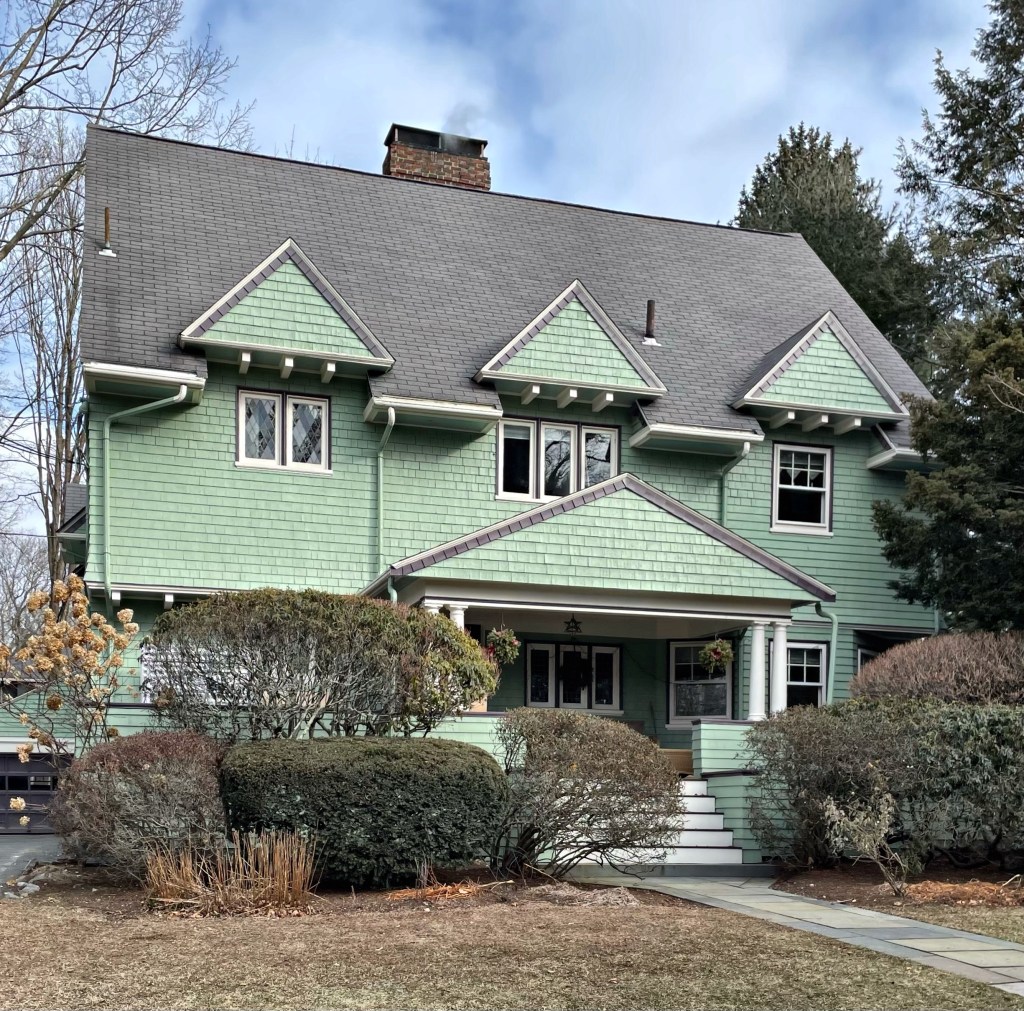
In 1897, tailor Charles L. Hovey and his wife Bertha, had this house in Waban built for their family. The architecture really stands out as an eclectic blending of styles, common at the end of the 19th century, when architects and builders would design homes to exhibit architectural details from multiple styles, all under one roof. The shingled house has a steep gable roof and three gabled dormers, which reflects Queen Anne theme. The diamond-pane windows and the technique of cantilevered dormers and the second floor overhanging the first, is First Period-Medieval in style, a unique interpretation of American architecture. What do you think of this home?

Hall-Balcom House // 1810

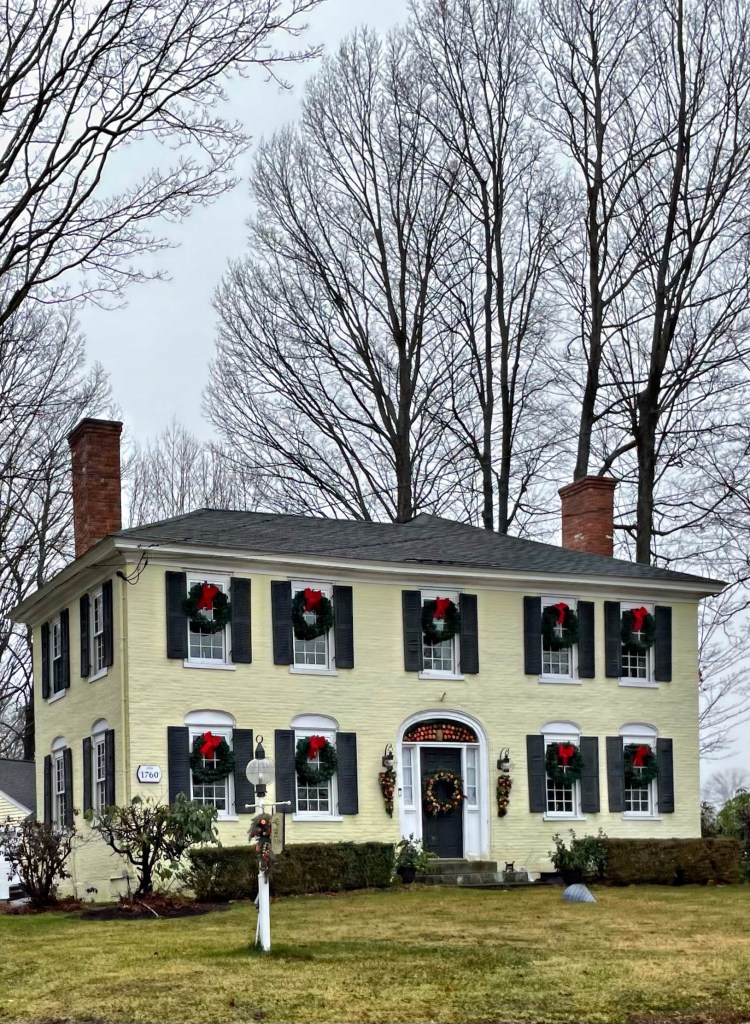
This historic house in West Millbury, Massachusetts, began in the end of the 18th century as a one-and-a-half-story wood-frame farmhouse. By 1810, the home was rotated 90 degrees and a more substantial, two-story brick house was constructed facing the street. The Federal style home was owned by Thaddeus Hall (1779-1855), and after his death, it was owned by his son, Orson Eddy Hall, who possibly rented the property for income while he resided in New Orleans and ran the iconic St. Charles Hotel there. The property was later acquired by Willard Balcom and remained in the family. Oh what I wouldn’t do to see the paint come off this old brick house!!

Longley Farmhouse // 1819

Backroads in New England are just amazing! When driving through Millbury on my way to visit one of the finest examples of Federal style architecture in the state, I stumbled upon this gorgeous rural Federal style farmhouse, and had to snap a picture! Millbury is best-known as a mill town (hence the name), but you can find dozens of rural farms dispersed between the mill villages in the township. The Blackstone River cuts through the town, and during the Industrial Revolution, it provided much of the water power to the town’s many textile mills and factories. Like many former mill towns, the shifting of the economy away from manufacturing towards the service sector, harmed the economy of Millbury in the 20th century. Many mills were abandoned and demolished, others adaptively reused. Before we get to some industrial history, I wanted to share this charming farmhouse. This home was built for Nymphas Longley upon the time of his 1819 marriage to the love of his life, Nancy Bond. They ran a farm on over 80 acres, with Nymphas also serving as a town selectman, an overseer of the poor, and led recruitment efforts in town at the start of the Civil War. Like many farms, this one saw suburban development take some of the former land, but this home still sits on over 9 acres, not bad for being so close to Worcester!

Unity Church Parsonage // 1878

Architects William Robert Ware and Henry Van Brunt designed this parsonage in Easton, Massachusetts for the Unity Church in town (featured previously). The Victorian Gothic house is constructed of polychromatic stone, wood trim, slate and copper roof surfaces, and terracotta finials. The architecture is very well-developed and stands toe-to-toe with the other architectural landmarks in town, just a short walk away.

Oakes Ames Shooting Lodge // c.1905

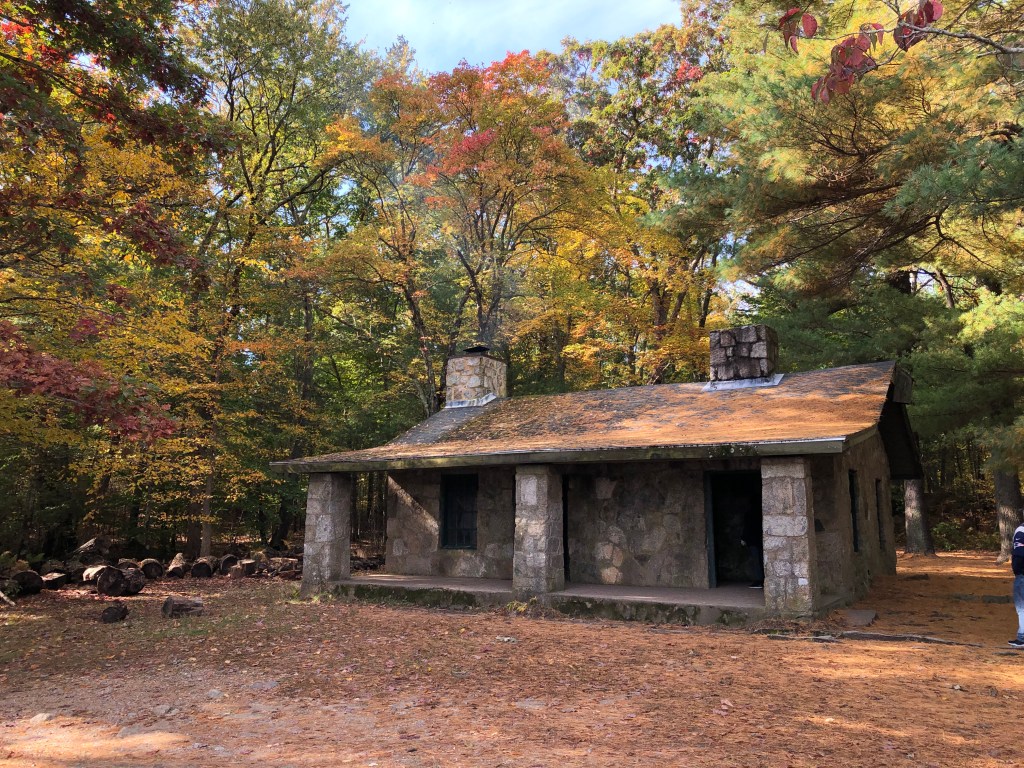
Located near the banks of Leach Pond in Borderlands State Park, this handsome stone structure set the style for one of the most iconic and beautiful buildings in Easton, the Ames Mansion. The one-story concrete and stone structure was designed and constructed under the supervision of Blanche Ames, and may have been a prototype for the construction technique used in the Ames Mansion, built just years later. Blanche was an amazing woman. She was an artist, political activist, inventor, writer, and prominent supporter of women’s suffrage and birth control. In 1900, she married Harvard University botany professor Oakes Ames (no relation). She took the married name Blanche Ames Ames. She illustrated her husband’s botanical research on orchids, and later got involved in designing the family’s country retreat. Originally designed as a warming hut during hunting season, this lodge was originally minimally designed with exposed stone walls. In the 1930s, the lodge was renovated to contain a living space, a kitchen, and a bedroom. When the Commonwealth of Massachusetts acquired the Ames Estate in the 1970s for a state park, the Lodge was restored to its original condition. The hunting lodge is open to the elements and the public, who can warm themselves in one of the two six-foot fireplaces.

Old Brick Tavern // 1804

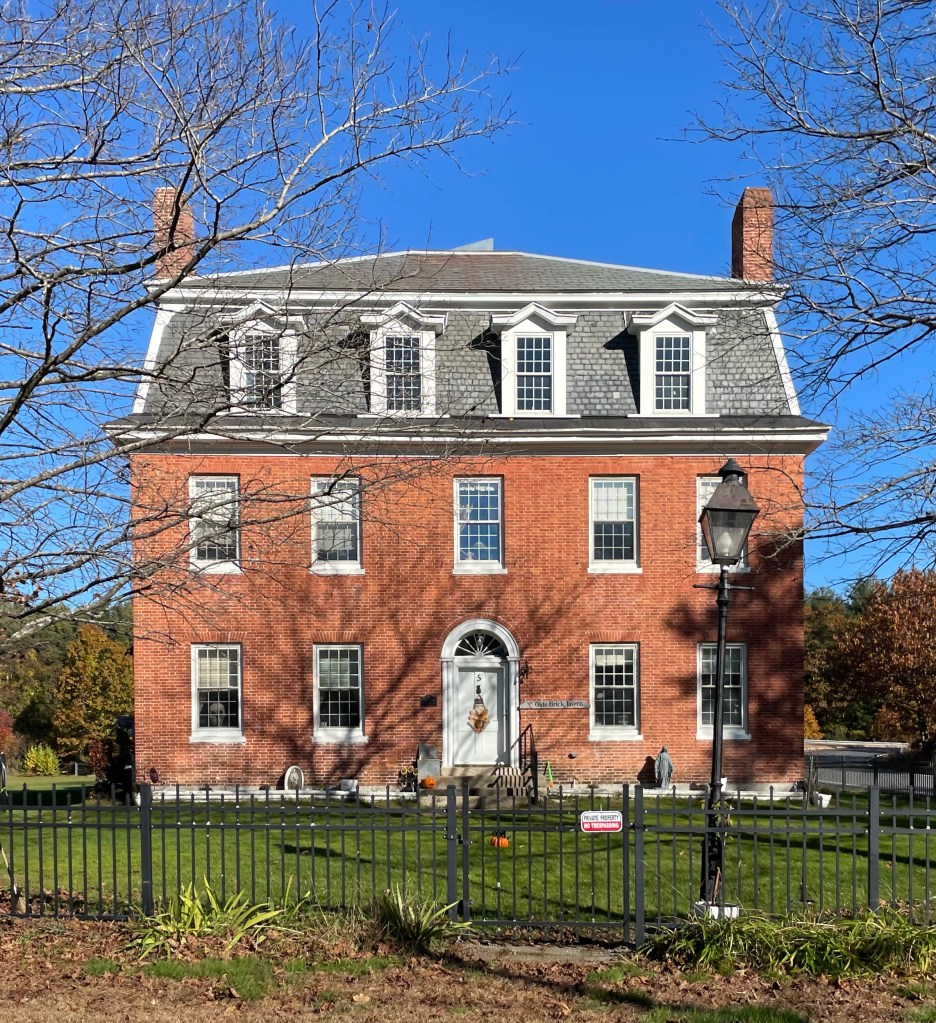
The Brick Tavern was an important stopping point on the old Union Turnpike, and the original two-story brick structure was completed about the time of the turnpike construction by Paul Willard, who with his heirs, operated the inn for 25 years. In the first years of the 1800s, the Union Turnpike Company planned and built a road providing a link for travel from Boston to Albany. Realizing the possibility for an inn along the first leg of the route, Willard financed this substantial brick building for travellers to stop, eat and spend the night. The tollroad was later made free, and less people stayed at the inn. After subsequent ownership, the building started to suffer from deferred maintenance and it was sold to a local Quaker group. The Quakers modernized the building by constructing the mansard roof and updating the interior. They never occupied it, but rented it to tenants for income. After, it was a hospital, boarding house, and in WWII, as a barracks of sorts for soldiers training nearby at a military base. The building is now a house!

Carter House and Publishing Company Building // 1820

Here is a two-for-one post! These two absolutely gorgeous Federal style buildings on Main Street in Lancaster were built in 1820 for George Carter and his brothers who ran a publishing company in the sleepy town. The Carter family was very active in the Swedenborgianism, a very small church in the general realm of Christianity, and they helped create a small enclave of worshippers in town. The brick, Carter and Andrews Publishing Company building (on the other side of a dead end street from this house) was built at the same time as the Carter home. The company was extremely popular in publishing children’s books, textbooks, and maps. One of my favorite publications the company made was “Peter Piper’s Practical Principles of Plain and Perfect Pronunciation”, now say that three times fast!