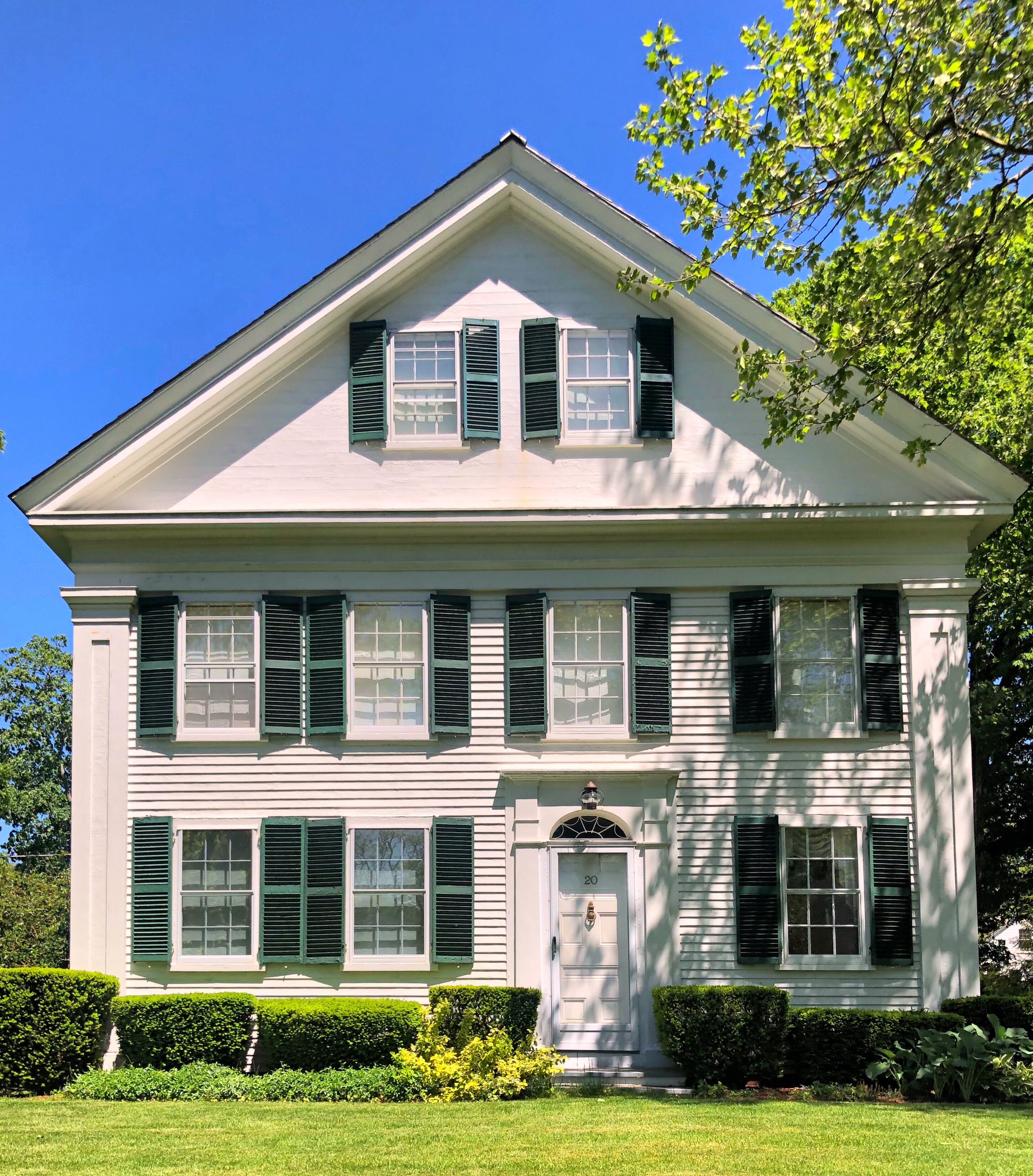
The gorgeous Reuben Nickerson House on Bridge Road in Eastham is an excellent example of a transitional Greek Revival home with hold-over features of the Federal style. Reuben Nickerson was born in 1814 on Cape Cod and worked as a farmer and saltmaker, he later served as a senator, school committee member, and representative. He was married twice; first to Elizabeth Doane who died in 1849, and he remarried Elizabeth’s sister Sarah Doane just a year later. By the 20th century, the home was operated by descendants of Reuben as a funeral home and residence. After WWII, the home was a bed and breakfast and has since been reverted to a single family home. Detail on the home includes: wide, paneled pilasters, boxed, molded cornice, a pedimented gable, a 2-part wide frieze, and a fanlight at the entrance.
Built in 1793, the Eastham Windmill on the old Town Green is the oldest workable gristmill on Cape Cod. Typical of Cape Cod, Eastham’s windmill is an octagonal , “hat and smock” or Flemish design in which the revolving top or hat can be rotated to direct the sails into the wind. Local historians contend that Thomas Paine, a noted early millwright and resident of Eastham, most likely built the Eastham Windmill in the late eighteenth century. Some sources state that the windmill was likely built in Plymouth and later moved to Truro and eventually to Eastham in 1793. In 1895, the women of the Village Improvement Society raised money to purchase the windmill and two adjoining properties from private ownership for $ 113.50. Around the turn of the twentieth century, the windmill became a local tourist attraction and the subject of postcards and souvenirs. The windmill is now the main attraction of the annual Eastham Windmill Weekend.
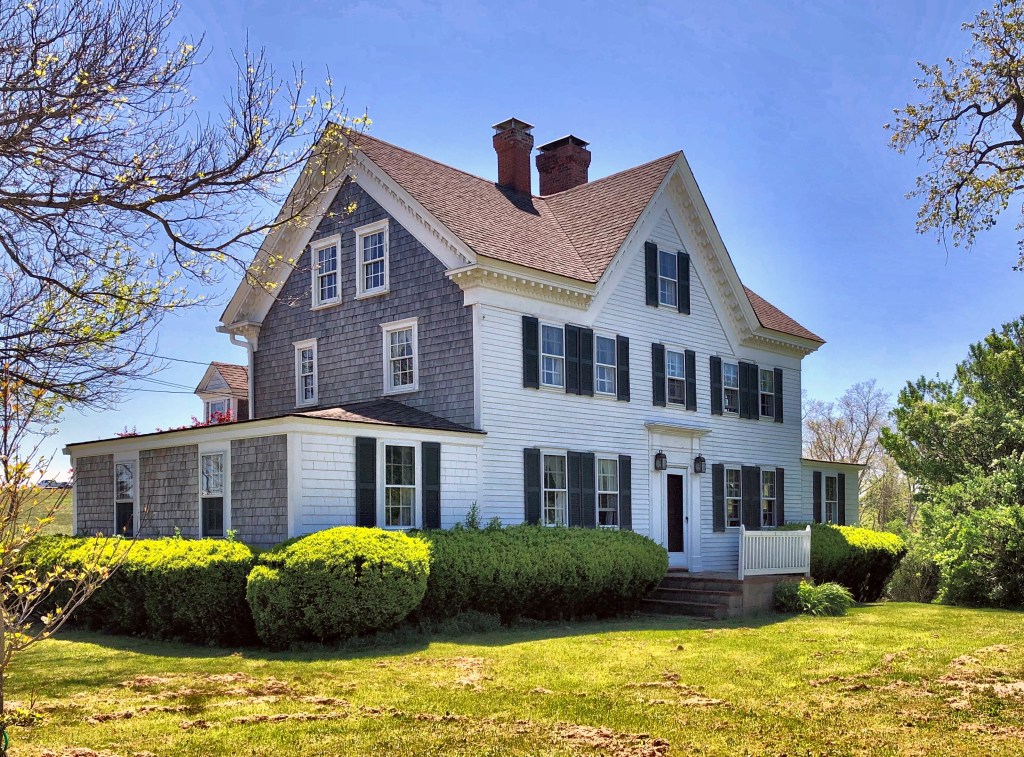
Located just a stones throw from the Penniman House, the c. 1780 Knowles House stands at the historic end point of Fort Hill Road. Accounts differ on its history. Some sources explain the home was built in c.1790 by Seth Knowles (who died in 1787) a prominent citizen of Charlestown, Mass., and one of the original members of the Bunker Hill Monument Association and of its board of directors. From my research, the home appears to have been built for Thomas Knowles, Seth’s son, and was later willed to his son, also named Thomas. Thomas Knowles Jr., was born in 1803, in Eastham, and in early life settled at New Bedford, engaging in the whale fishery industry. Deed research would be required to find out more. The gorgeous Federal home features a large, center cross gable with dentils at the cornice.
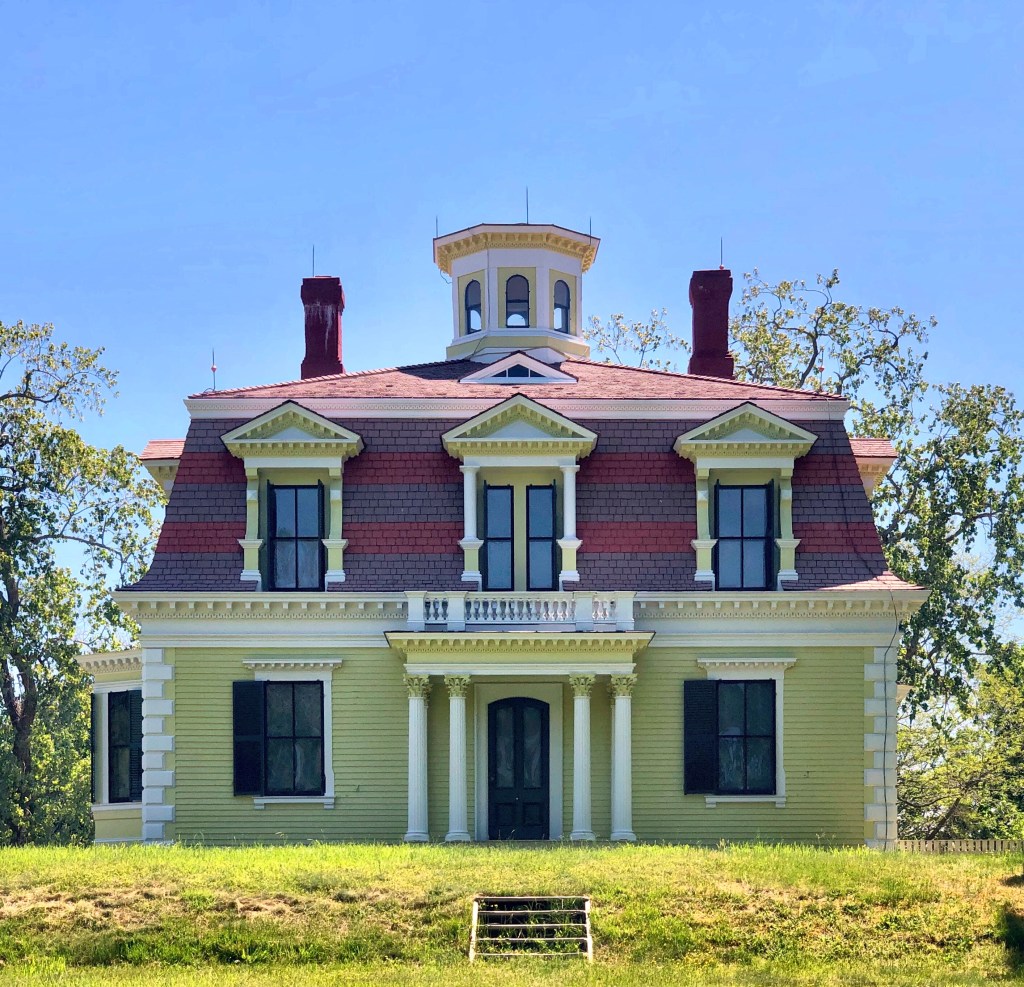
The Edward Penniman House is the finest example of Second Empire style in Eastham, and is one of the finest examples of this architectural style on Cape Cod. The grand home was designed and occupied in 1868 for Edward Penniman (1831-1913), one of the most successful whaling captains in New England.
Born in 1831 in Eastham, Edward Penniman set sail for the first time at age 11. The voyage was to the dangerous and unpredictable waters of the Grand Banks, a rich fishing ground off the coast of Canada’s Newfoundland. Nantucket had a flourishing whaling industry as early as the late 1600s, but it was New Bedford with its deep water harbor and railway system that would become New England’s whaling capital. In 1852 at the age of 21, Penniman would journey to New Bedford and sign on to his first whaling expedition. Later when Penniman became a captain he would select New Bedford as his home port setting sail seven times to hunt whales.
With whale over-harvested in the Atlantic along the shores of New England, whalers were forced to go further and further from home to hunt. Whaling expeditions often spanned three or four years, and it was not uncommon for wives and families of ship captains to go along on the trip. Penniman’s wife, Betsy Augusta Penniman, called “Gustie” by her husband, went on three such voyages often assisting with navigation and other shipboard matters. In addition, each of the three Penniman children accompanied their parents on various journeys with eldest son Eugene eventually becoming a whaling captain himself.
After the Captain’s death in 1913, Mrs. Penniman and their daughter, Betsey, continued to live in the home. Mrs. Penniman’s died in 1921. Betsey Penniman, who never married, stayed around and raised her niece, Irma. Upon Betsey’s death in 1957, the home was left to Irma Penniman Broun. Irma and her husband sold the house with twelve acres to the National Park Service in 1963 when the Cape Cod National Seashore was formed.
The Chapel in the Pines church had its origins in the growing desire by many late-19th century New Englanders to move away from the strictures of fundamentalist religion. A Universalist Society was formed in Eastham on the Cape for the erection of a new place of worship. Local families and esteemed citizens pooled resources and constructed the building themselves over five months, under the direction of an Elkany Hopkins (though sources state he died in 1885). The Victorian Gothic church has a certain flair with the turned posts at the entry, bell tower, and roof cresting. After serving various congregations and uses (including as the First Encounter Coffeehouse a renowned venue for folk and acoustic music since 1974), the building was purchased by the Nauset Fellowship. In 2017 and 2018, the Chapel underwent a renovation with money raised from the community along with two grants from the Town of Eastham’s Community Preservation Act funds.
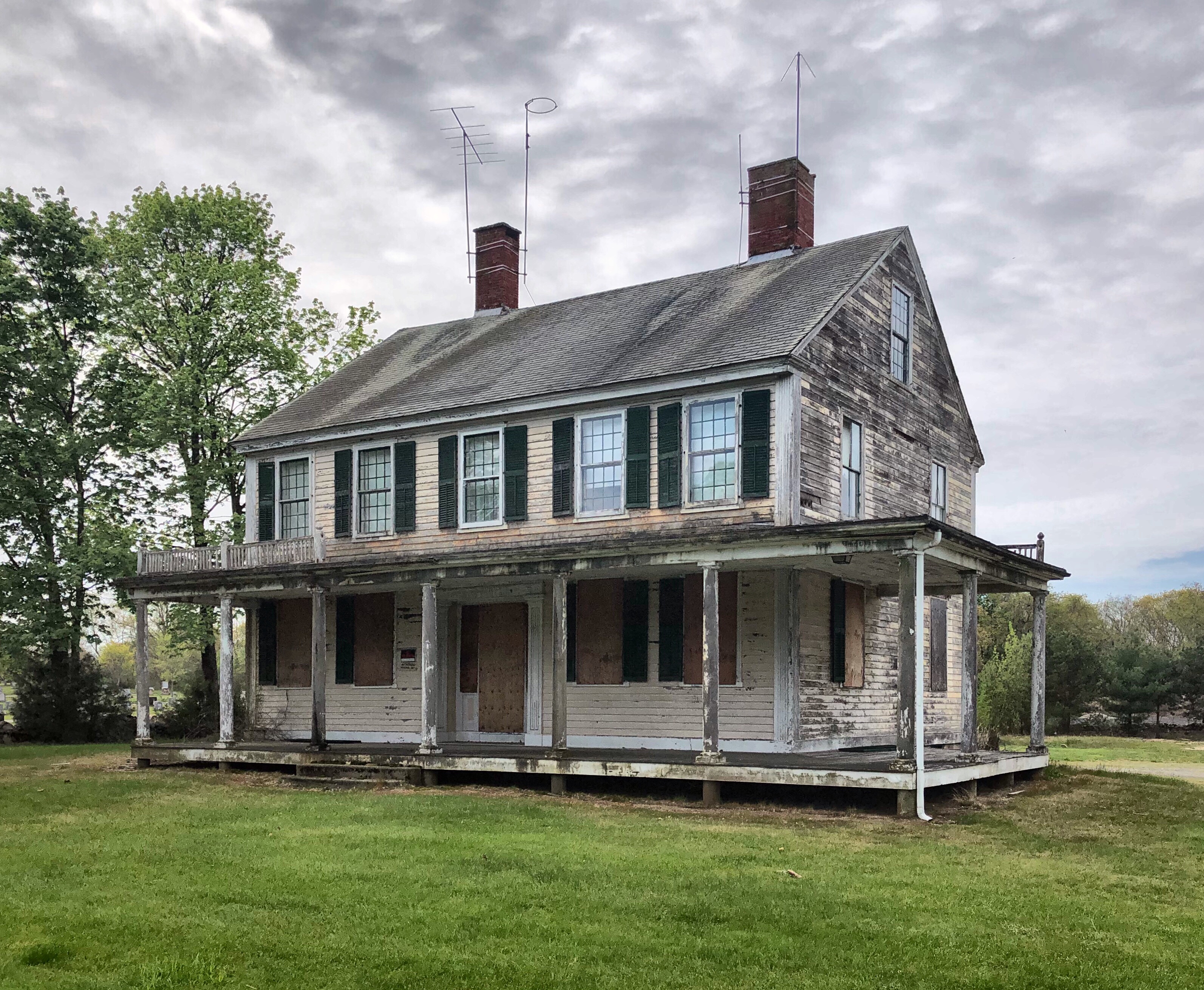
This old farmhouse in Swansea, MA, was built by 1820 for Preserved Gardner (1795-1873), one of five sons of Peleg Gardner, who owned much of Gardners Point. Preserved lived in the home until his death in 1873, and the home and acres of farmland were willed to his only son to live past childhood, Ira Gardner (1836-1901). Ira donated a large tract of land adjacent to the farmhouse to the town in 1882 for a cemetery, in which his father was buried. Later, the farm was purchased by Thomas D. Covel a bank president of Fall River who operated it as a gentleman’s farm and made the house his summer home. A ‘gentleman farmer‘ utilized their farms for pleasure rather than for sustenance or profit. After WWII, the land was purchased by the town to be used as a park and the property is still owned by the town. The Federal home with its veranda that wraps around the side has been neglected by the town for decades while the parks adjacent are maintained adequately.
The town has weighed various options for the home ranging from demolishing it, to preserving the front facade and converting it to a garage and storage shed (with a small museum on the second floor). I hate that idea personally. This seems like an ideal candidate for the town to allow a private individual or developer to move the home and restore it back to its original grandeur. Thoughts?
The Hotel Touraine at the corner of Boylston and Tremont Streets in Boston was built in 1897 as one of the most luxurious hotels in the city. Designed by the local firm of Winslow and Wetherell, the Jacobean Revival style building commands the well-trafficked corner opposite the Boston Common. Early articles described the hotel as “a large and sumptuously equipped house, with internal decorations in the style of the Chateau de Blois (a French chateau). Winslow and Wetherell appeared to have been inspired by the Louis XII wing of the Chateau, as many design elements of the hotel closely resemble it. The hotel was advertised as having 350 rooms valued at $2 a night up to $3 a night for a room with a private bath. Separate men and women’s parlors, a library, and elevator service made the hotel desirable for the upper-class Bostonians and visitors to the bustling Downtown area. The hotel’s rich clientele eventually began frequenting the larger hotels near Copley Square and the stature of the Touraine slipped with a changing Downtown character. By the 1960s, the hotel closed and was converted to apartments.



 Buildings of New England
