Ryder Windmill House // c.1899

Preservation and New England ingenuity at its finest can be found at this quirky residence on Spring Street in the charming community of Marion, Massachusetts. The unique home seen here was originally built around 1899 as a water tower and windmill on the estate of William H. H. Ryder (1841-1921), which generated power from the wind to pump water from a well below ground, providing a continuous supply of water to his residence. The structure was in use until 1907 when municipally supplied water became available in town. When William Ryder, who never married or fathered children died in 1921, the property was inherited by his niece, Harriet C. Ryder (1869-1943), who lived with her uncle and kept house for him. Financial struggles forced Harriet to sell the main house and convert the windmill into a small cottage in 1926. The structure was originally used as a summer cottage but was later expanded and made a year-round residence, with later owners maintaining the unique charm and form of this iconic local landmark.

Old Mill – Newport Tower // c.1670

No structure in Newport is as hotly debated than the “Newport Tower” located in Touro Park. The old stone, cylindrical tower stands like an ancient relic of ancient Europe, just dropped in downtown Newport. For centuries, people have debated the structure’s history and use. Some say this structure was built by Viking masons who visited North America 1,000 years ago, while other theories (more rooted in fact) share another story. The tower was located at the upper end of the plot behind the now-demolished mansion built by Benedict Arnold, the first colonial governor of Rhode Island (his grandson was the infamous Benedict Arnold, the traitor who switched sides to fight with the British. In 1677, Arnold mentions “my stone built Wind Mill” in his will is evidence that the tower was once used as a windmill. However, some state that there is no reference to Arnold ever having the structure built, with some stating that he simply repurposed the building to be used as the base of a windmill. In 1837, Danish archaeologist Carl Christian Rafn proposed a Viking origin for the tower in his book Antiquitates Americanæ. This hypothesis is predicated on the uncertainty of the southward extent of the early Norse explorations of North America, particularly in regard to the actual location of Vinland, where Leif Erikson is believed to have first landed around 1000 CE, nearly five centuries before the voyages of Christopher Columbus and John Cabot.. Rafn’s popularization of the theory led to a flurry of interest and “proofs” of Norse settlement in the area. Mortar tests completed in the 20th century basically prove this theory to be false, and date the structure to the middle of the 1600s, but it is fun to imagine it is much older!

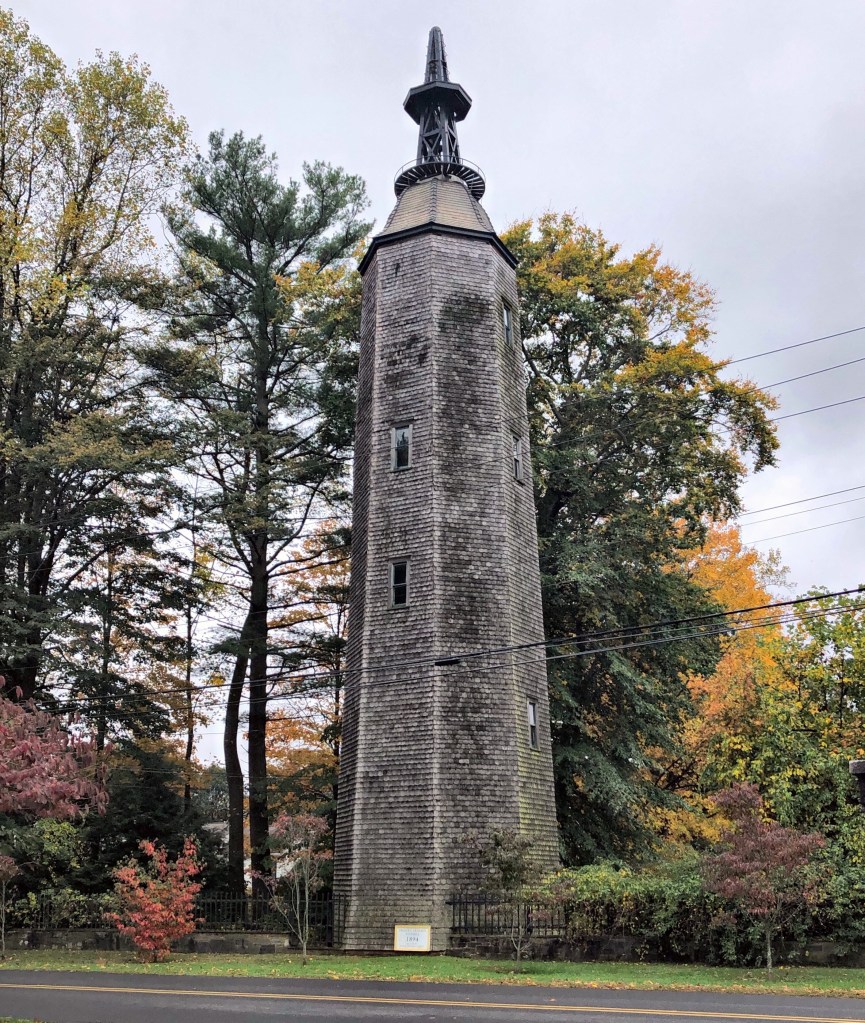
Bronson Windmill // 1894

Located in a more rural part of Fairfield, Connecticut, I drove past this massive tower just off the road. Intrigued, I doubled back to find out what it was, and learned it was once a windmill! The over eighty-foot tall shingled tower was constructed in 1894 as part of a large country estate. Frederic Bronson (1851-1900) was a prominent, gilded age lawyer in New York City. He accumulated massive wealth representing many elite families, eventually becoming a member of the “Four Hundred”, a list of the 400 most powerful (rich and connected) people of New York society. In the early 1890s, Bronson constructed a summer estate in Fairfield, CT, known as Verna Farm. A part of this estate the windmill which pumped water from a well 75 feet below ground into a 7,500-gallon wooden storage tank inside the tower. The estate eventually became the Fairfield Country Day School, and the windmill (no longer in use) was gifted to the town. Eventually, it was leased by Sprint, and the telecommunications firm restored the windmill and installed a cellphone tower in its interior.