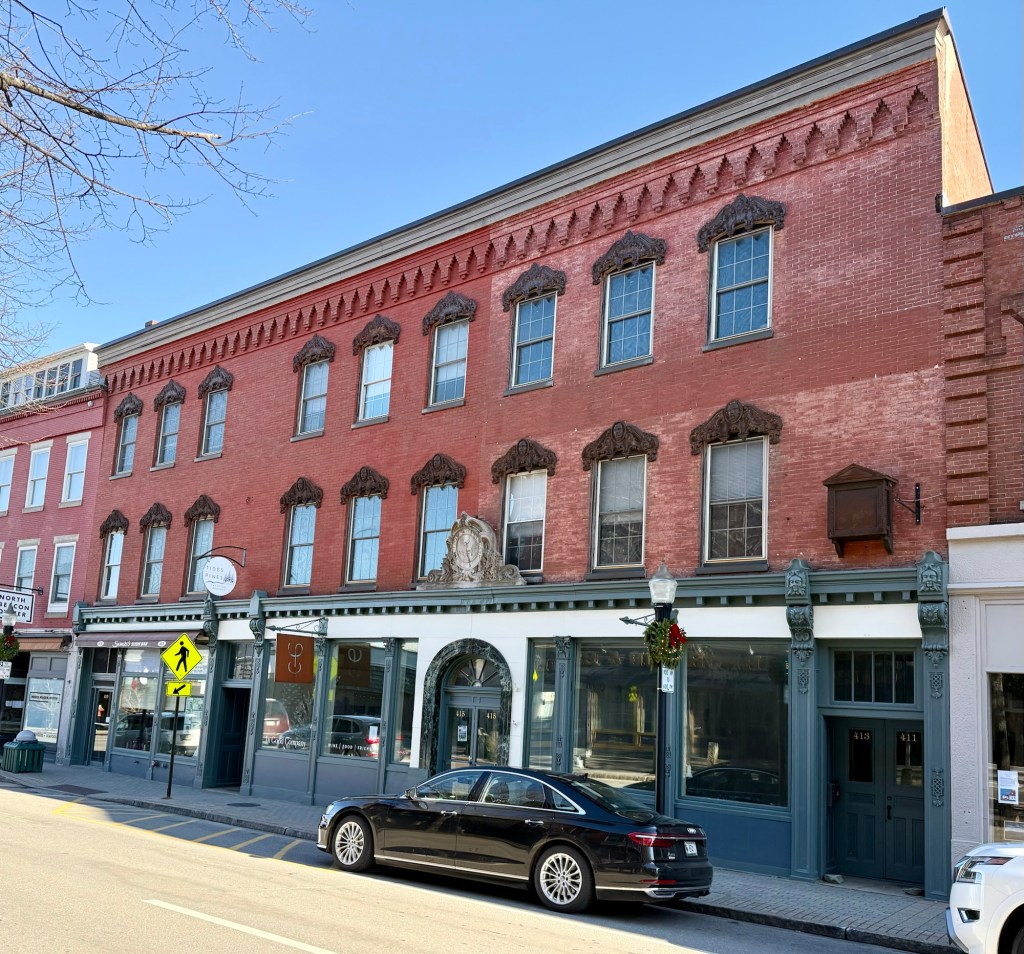
Custom House Block // 1853

This stately commercial block is found on Main Street in Rockland, Maine. The block originally housed the local custom house (before a larger, purpose-built custom house was erected nearby in 1873) with other retail and commercial spaces at the ground floor with offices and meeting space above. The block is a great example of the Italianate style with an intricate brick corbeled cornice and cast iron and marble storefronts. The commercial space occupied by the First National Bank also exhibits a stone medallion with deer set within a wreath over the entrance. The detail that stood out to me most was the cast iron lintels over the windows, with the second floor lintels including a man’s face! The building is well preserved and is today occupied by local businesses.

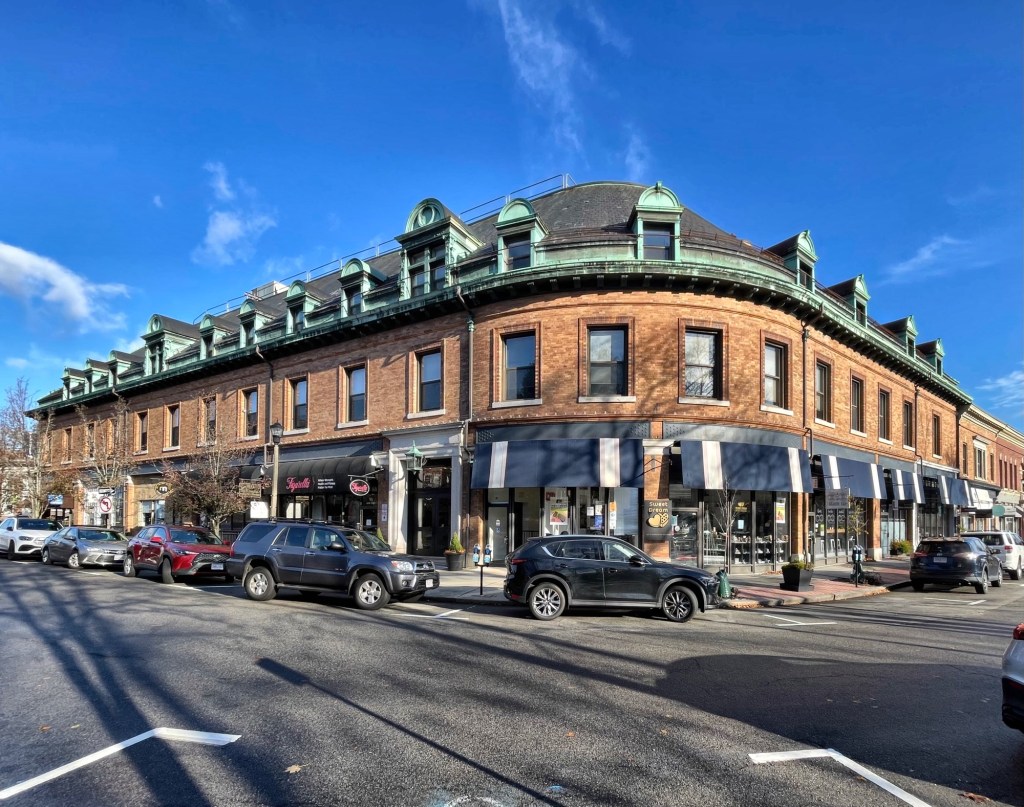
Bray’s Hall // 1893

As Newton Centre’s new railroad station and following development boom transformed the once sleepy village into the main commercial center for the city, landowners capitalized on the opportunity by developing commercial blocks to serve the community and line their own pockets. Mellen Newton Bray (1856-1946) became a major landholder in Newton Centre and would develop the areas directly surrounding the new train station there. On a curving site, he built Bray’s Hall, this three-story commercial block renting out spaces to local banks and stores with a large assembly hall and bowling alley in the building as well. Initially, Bray planned for an eight-story structure, having contracted a solid foundation that could support such a structure, pending the success of the initial construction. That is mixed use before it was “cool”. The building was designed by the firm of Kendall & Stevens, likely led by Henry H. Kendall, who resided in Newton Centre. Kendall would also design the apartment block across the street for Mr. Bray. The building is constructed of light Tuscan bricks and is notable for the bracketed cornice and dormers all in copper. The building was restored in the 1970s by owner David Zussman, and rebranded as Piccadilly Square, following his recent trip to London being impressed with by the atmosphere of Piccadilly Circus.

Hall’s Block // c.1883

This diminutive commercial block sits on Water Street in Warren, Rhode Island while small in size, packs an architectural punch! The late-Italianate style wooden block exhibits its original wooden storefronts, second floor round arched windows with stained glass, and ornate detailing including the brackets, parapet and period-appropriate paint colors which allow those details to pop. The shop was owned in its early days by the Hall family, who sold drygoods. Later, the building was used as an antiques shop on the ground floor with a studio for author and illustrator, David Macaulay on the second floor. These types of smaller-scale commercial spaces are some last remaining (relatively) affordable spaces for small businesses to operate. So lets make sure we

Wheaton-Clapper House and Shop // c.1760

Built before the Revolutionary War, this early example of mixed-use building is what we need more of in our cities and towns in New England. This charmer is located on Water Street in Warren, Rhode Island, and dates to around 1760. The house was occupied by D. B. Wheaton and later by a James Capper, through the 19th century. James’ wife Ann, worked as a dressmaker and the couple sold goods out of their property. As Water Street continued to proliferate with small businesses, a brick store was inserted into half of the ground floor with plate glass storefronts. This evolution of a Colonial-era residence happened all over New England, and it is great to see that the building is still occupied by a small business today!