One of the later mill buildings constructed in the mid-19th century for the Otis Companyis this brick building which contributes to the rich industrial heritage of the town. Built in at least three stages, this long industrial building probably grew from a middle section dating 1856, expanded in both directions over the next several decades and but was largely completed by 1869. The building was a major manufacturer, supplying thousands of jobs for the town until it closed after WWII. In 1945, the top two stories of this building along with their towers were removed in 1945, which echoes the history of many similar mills all over New England (but hey, at least this one is occupied today!)
This five-story granite mill building was one of the major catalysts for the 19th century population surge in Ware, Massachusetts. As New England’s fledgling textile industry of the era played a vanguard role in transforming the U.S. into an industrial nation, the significance of this type of mill can hardly be understated. The Otis Mill #1 in Ware is one of the last remaining granite textile mills of this early period in central/western Massachusetts. The mill was built in 1845 for the Otis Company, which initially manufactured woven cotton fabric, but later branched out into stockings, woolen shirts and drawers underwear. The company was Ware’s largest employer for about 100 years! The company prospered thru WWI employing over 2,500 people. During the 1920’s the business began a decline due to the southern state’s mills and lack of modernization. In the mid 30’s the Otis Co sold its property to the citizens of Ware, which they formed Ware Industries, Inc to continue the major employer in the town. Due to this Ware came to be known nation-wide as “The Town That Can’t Be Licked.” The mill is now home to local small businesses as a sort of incubator, providing jobs to local residents!
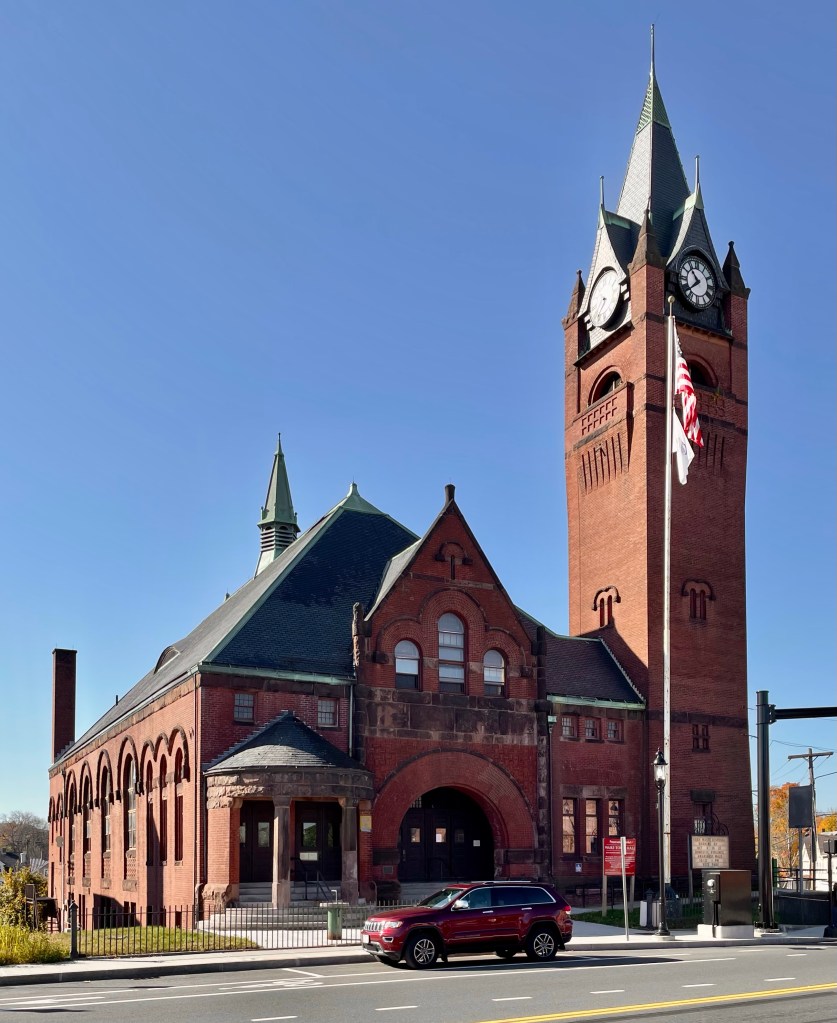
After learning a little about some of the buildings in Dorset, Vermont, which were saved and relocated to the town from land flooded for the Quabbin Reservoir, I wanted to visit one of the surviving towns there to see it for myself. I found myself in Ware, Massachusetts, a town with a history that parallels many in central and northern Massachusetts. The town was first settled by white European colonists by 1717, and incorporated in 1775. The town was named after the English town of Ware in Hertfordshire. The Town of Ware began as a sleepy farming town with inns and taverns dotting the landscape until industrial sites were developed on the banks of the Weir River. The post Civil War era (1860s–1900s) brought a new prosperity to the now established textile mill town. “Ware Factory Village” sprang up overnight and formed the basis for new growth and development, to the east of the former town center. From this, a new Town Hall was needed, and where better to locate it, than the economic and population center of town?! The Ware Town Hall was built in 1885-1886 from plans by the prominent Boston firm of Hartwell & Richardson. Sadly, a fire gutted much of the building in 1935, but the shell remains (though needing much repair). The town, like many former industrial centers, has struggled to re-invent itself, but a growing population is a great indicator of good things to come!
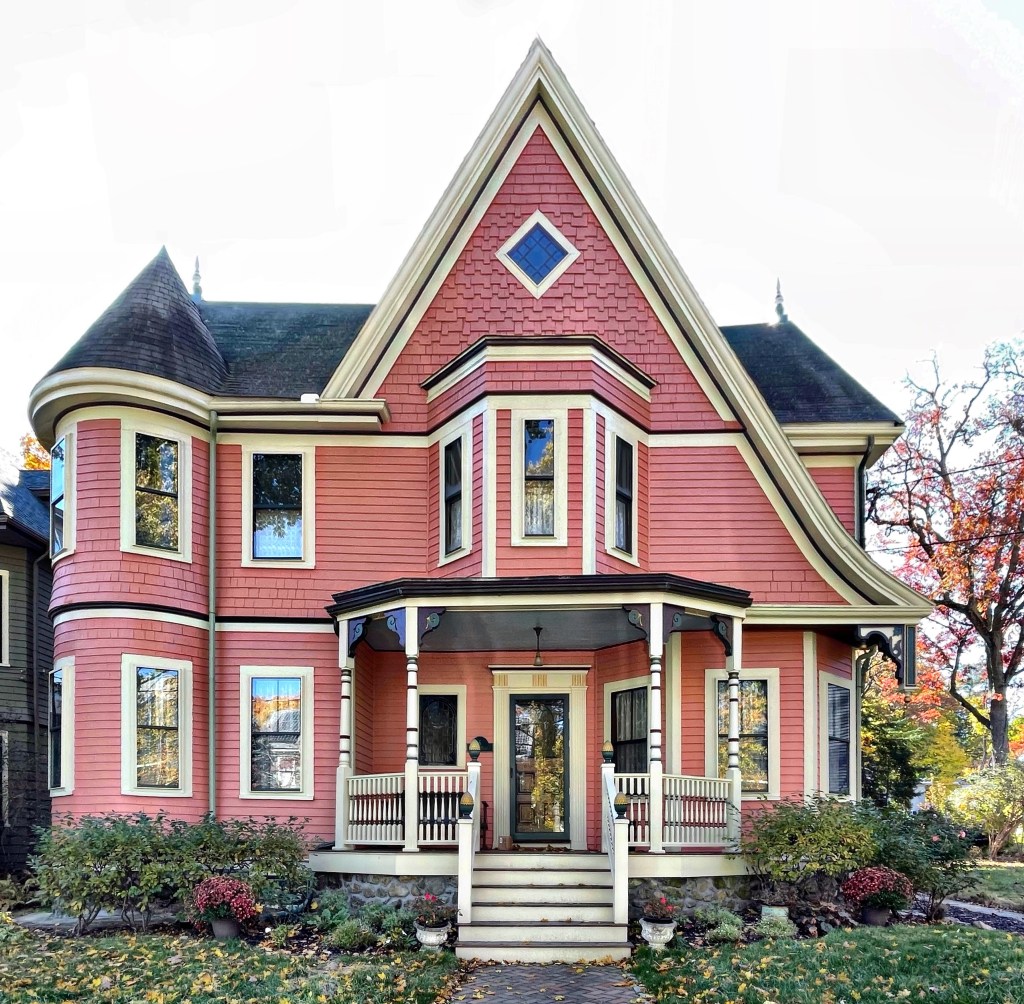
In 1852, Beacon Street in Newton was extended westward from Chestnut Hill through Newton Centre. The village’s suburban development accelerated through the activities of real estate developers as the city became connected to Downtown Boston by roadways and rail. This home was built in 1893 for Andrew and Ann Kistler. Andrew Kistler worked as a leather dealer in Boston, and commuted into the city daily. The Kistler House is an excellent example of Colonial Revival with some added oomph.
At the end of the 19th century, much of Boston’s suburban communities saw rapid development where country estates and farmhouses were razed and their properties laid out for residential development. This house in Newton was built around 1898 as a late Queen Anne and it has so many details and intricacies. The earliest known owner was Grace M. Weston who was mentioned often in local newspapers as an expert on antiques.
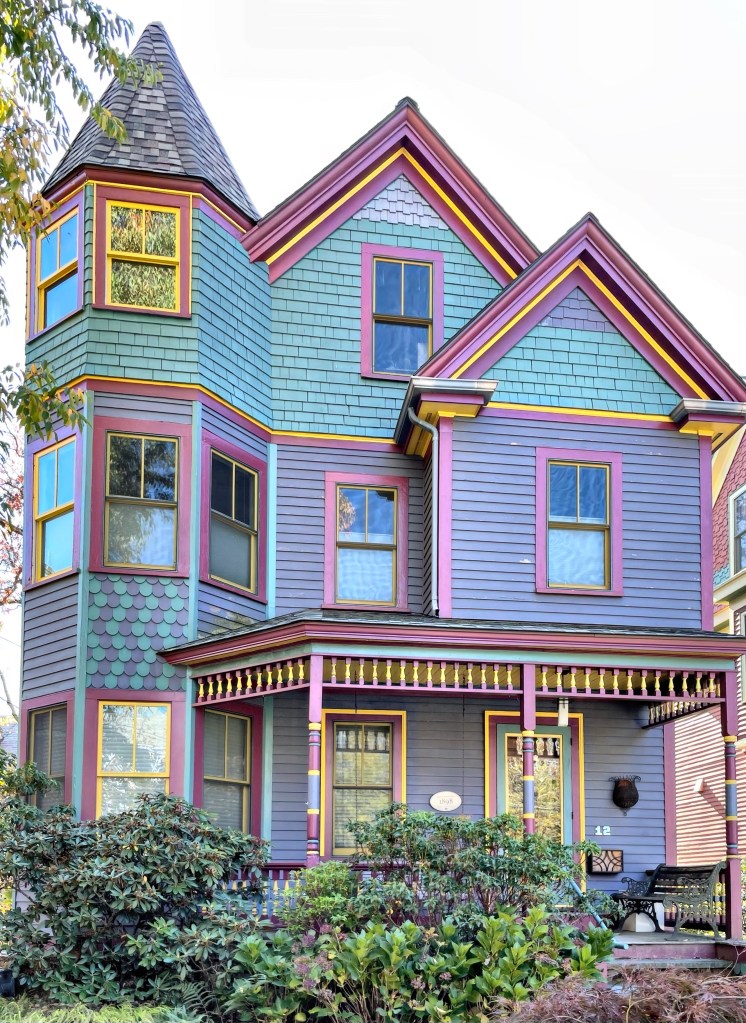
Behold this Queen Anne painted lady in all her glory! This home was constructed in 1898 as a late Victorian addition to Newton’s built landscape. The home’s earliest known owner was a T. C. Sullivan, who left the property to his family upon his death. The house is painted some pretty bold colors, which does an effective job at highlighting the many architectural details and intricacies in the design, but the home would have never been painted like this historically. A little history lesson: the “painted lady” trend took off in San Francisco when after WWII, disinvestment in the urban core led many Victorian homes there to be demolished, altered and covered with siding, and many were painted gray with war-surplus Navy paint (battleship gray). In 1963, San Francisco artist Butch Kardum began combining intense blues and greens on the exterior of his Italianate-style Victorian house. His house was criticized by some, but other neighbors began to copy the bright colors on their own houses. Kardum became a color designer, and he and other artists / colorists began to transform dozens of gray houses into Painted Ladies. By the 1970s, the colorist movement, as it was called, had changed entire streets and neighborhoods. This process continues to this day. The trend took off all over the United States as urban centers saw re-investment and gentrification. While not historically appropriate, the Painted Ladies can really make people happy and show pride in ownership.
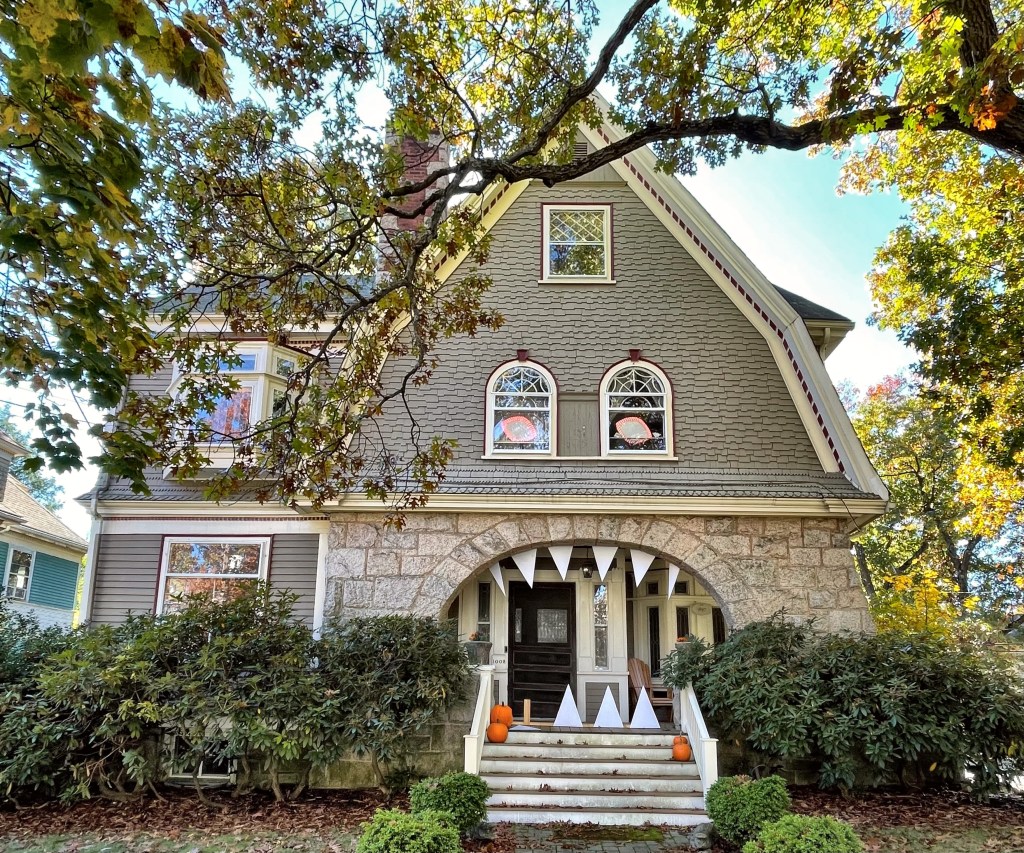
Happy Halloween! To celebrate I wanted to feature one of the more creatively decorated houses in the Boston area, which blends spookiness with architecture! This is the Barrows-Goddard House, so named after its first two owners. The house is located in Newton and was built in 1898 as an eclectic Queen Anne/Shingle style home. The original owner was Joseph Barrows, who developed the property and sold it within a year, relocating to a new home on a less busy street. The property was owned next by Christopher Goddard, an insurance agent with offices in Boston. Architecturally, the gable roof of the main block is intersected by an over-scaled gambrel cross-gable clad in patterned cut wood shingles. The focal point of the design is the Syrian-arched entrance porch of coursed, dressed fieldstone which this time of year, eats trick-o-treaters!
The last (but certainly not least) building in Dorset, Vermont I’ll be featuring is the Manley-Lefevre House aka. Marble House! This stunning Federal period home was built around 1820 by Martin Manley (1783-1856) on land originally owned by his father George. The house is constructed of ashlar marble that was quarried with hand tools from the lower quarry located approximately 200′ behind the site of the house with dressed marble finished in town and brought back for installation at the lintels, sills, and door surround. In 1907, Edwin Lefevre, Sr. (1871-1943) traveled by train from Bronxville, New York to Dorset at the suggestion of the artist Lorenzo Hatch, with the intention of locating a summer residence for his family. They purchased this home, which became known as “The Old Stone House” and hired Eugene J. Lang, a New York architect, to remodel the house, design a kitchen wing and remodel the barn into a garage (1909). While in Italy, Lefevre fell in love with the formal gardens there, and wanted something like this for his country estate. Upon his return, he retained garden designer Charles Downing Lay to design the gardens that surround the house. The country estate is now home to The Marble House Project, a multi-disciplinary artist residency program.
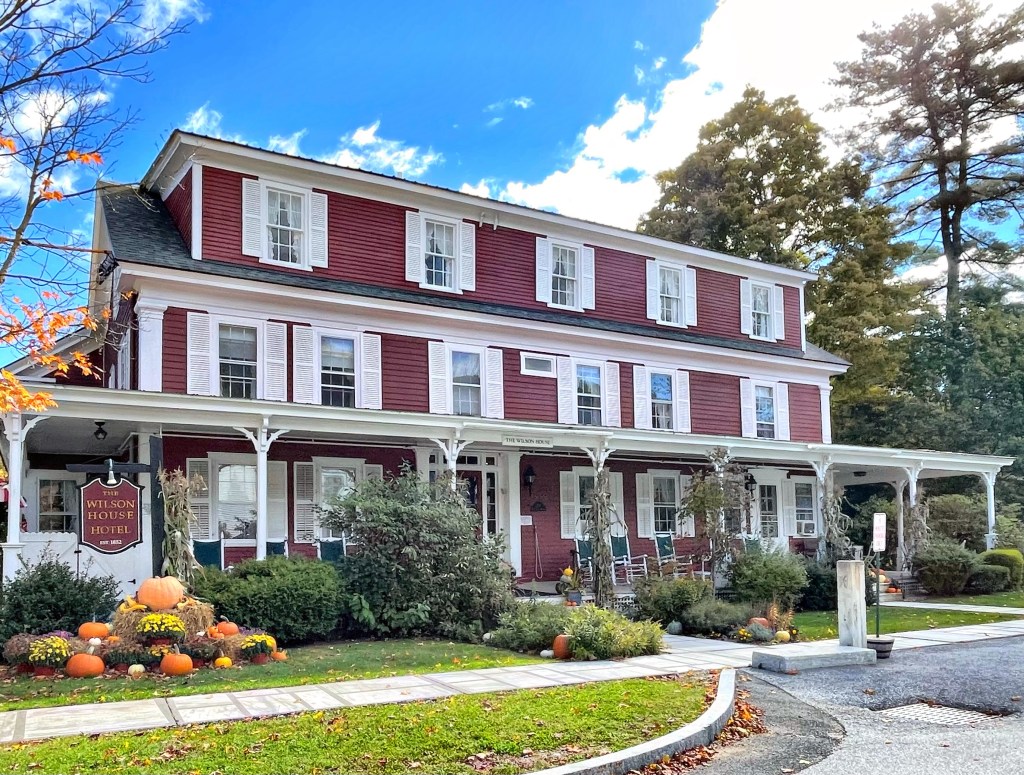
This building, the largest building in East Dorset Village, was constructed and opened as a hotel in 1852 and has ties to one of the most influential organizations in America. Entrepreneur Ira Cochran built this hotel the same year the railroad came to town, capitalizing on the influx of business and new laborers travelling to the once sleepy town now dominated by the marble industry. By the end of the 19th century, the building was owned by the Griffith family. On November 26, 1895, William (Bill) Griffith Wilson was born here, behind the bar of the hotel during a snowstorm. As a child, he moved away until the age of 11, when he returned to East Dorset to live with their maternal grandparents, the Griffiths. Bill would later go on to become the co-founder of Alcoholics Anonymous. The building would eventually sit vacant and dilapidated until Albert “Ozzie” Lepper, Wilson’s friend, purchased the property in the late 1980s and made it into a living memorial to Bill Wilson, renovating The Wilson House with the help of volunteers’ time and talent. The hotel reopened in 1998 under the historic name. The Wilson House was later established as a nonprofit organization to ensure that Wilson’s memory, spirit, and purpose in life continues on for decades to come. Today, visitors come to the Wilson House from all corners of the world. Many of them are in recovery themselves, while others are history buffs who simply want to visit the homestead, which was added to the National Register of Historic Places in 1995.
This absolutely charming vernacular Greek Revival home was built in the mid-19th century in East Dorset Village. By the end of the 19th century, it was converted to a cheese factory a model in adaptive reuse and historic preservation. In the late 1930s, as Dorset became a popular summer colony for artists and upper-middle class residents of New York and the Mid-Atlantic, the cheese factory was purchased by artists Norman and Silvia Wright. The artists relocated the small building to the Kent Hill neighborhood of town, restoring the home and adding wings onto it. I also love the chocolate color paint!





 Buildings of New England