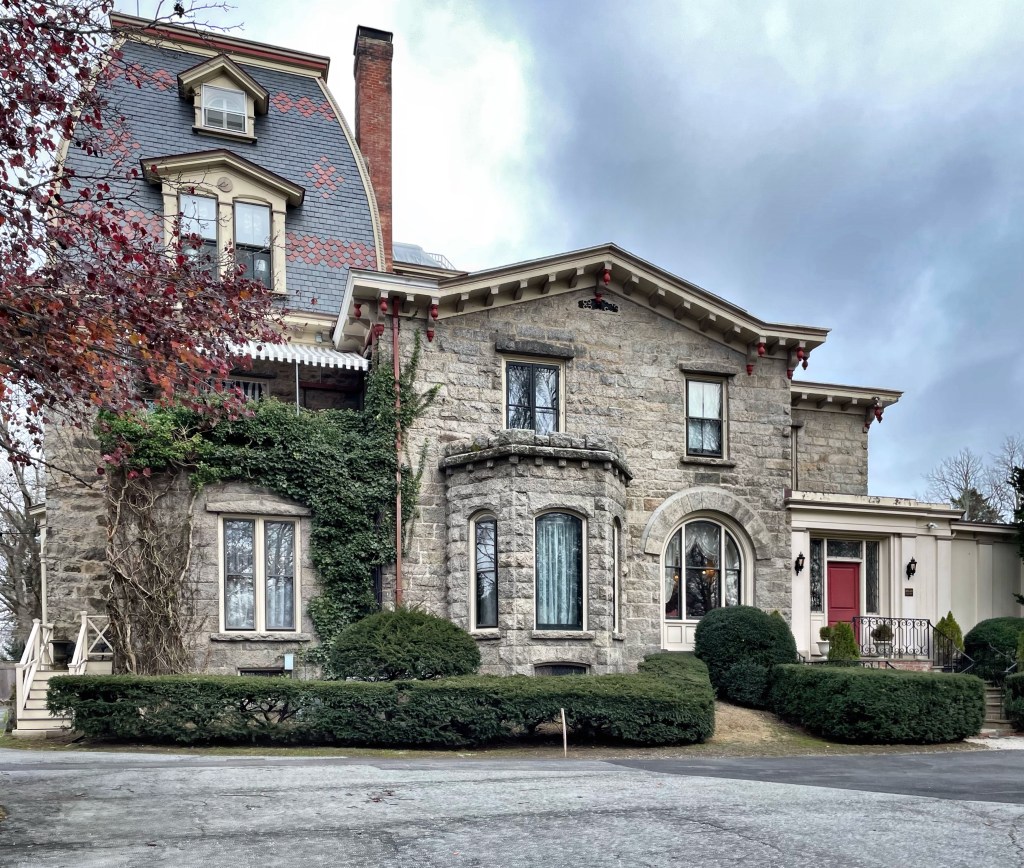
One of the most stunning summer “cottages” in Newport, Rhode Island is this stone behemoth named “Belair”. The house is set back way off the street and was one of the first summer estates built in this section of Newport. Belair was built in 1850 for New York oil baron H. Allen Wright in the Italianate style and constructed of roughly dressed stone and was originally about half of the size of the current footprint. The mansion was designed by architect Seth C. Bradford, who is also credited as architect of the similarly designed Chateau-sur-Mer, built one year later. Wright sold this house to George H. Norman two years after its completion. Norman (1827-1900), founded the Newport Daily News in 1848 and made his fortune as an engineer, first establishing gas works and later water works systems across New England, New York, and the Midwest. Norman made a fortune, and renovated and expanded his mansion in 1870 from plans by Newport architect Dudley Newton, with grand Second Empire additions, including the high convex-mansard corner tower. The original four acre Belair property has been extensively subdivided, and this house now occupies a lot of about an acre; with the original outbuildings sold off, and Belair is now 11 condominium units!
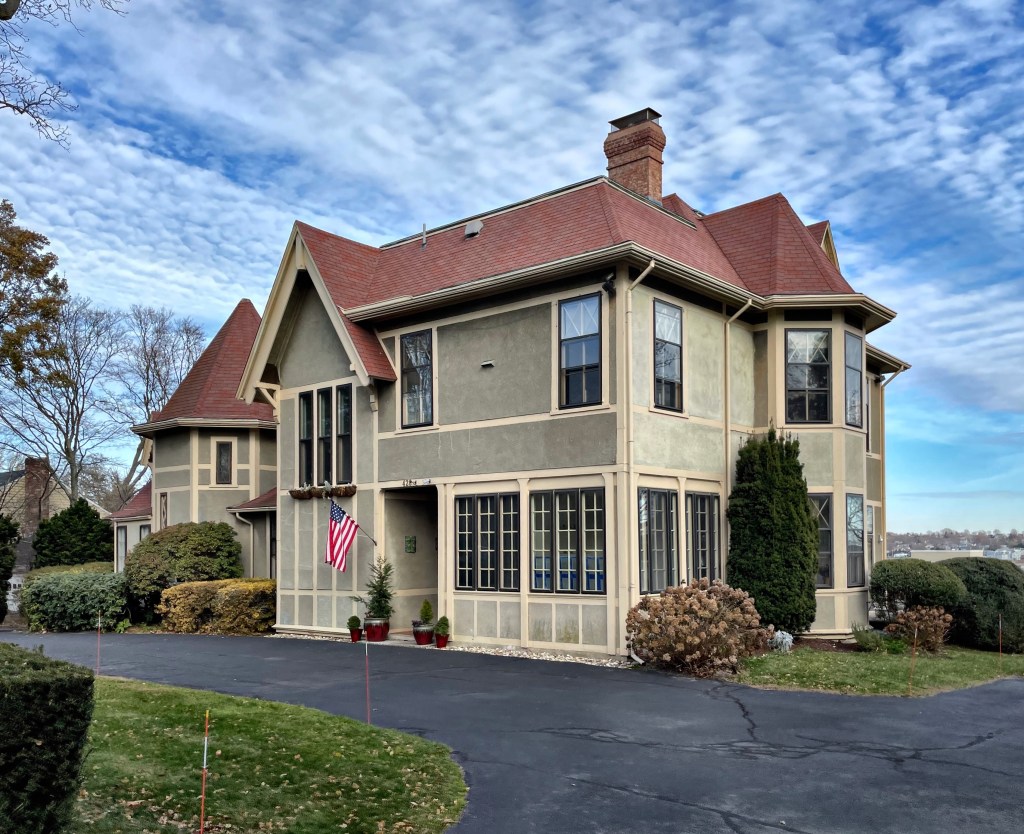
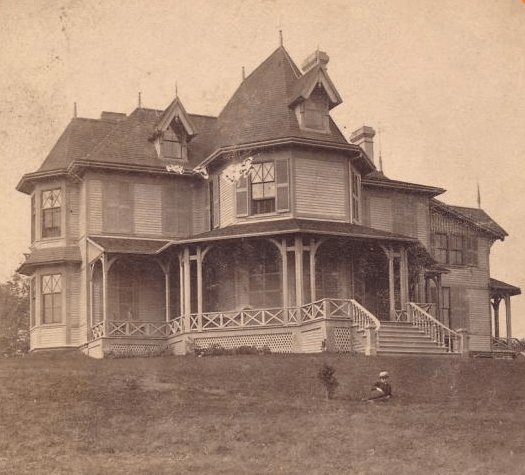
While many of the summer cottages in Newport retain much of their architectural and historical integrity, it is not always the case. This cottage, named “Morningside” barely resembles its original 1873 design. The summer home was built for William Barton Rogers (1804-1882), a scientist, educator, and best-known as founder of the Massachusetts Institute of Technology. He sought a place of rest and leisure, away from the stresses of Boston and running a new college, so he hired the Boston firm of Cabot & Chandler to design a Stick style cottage for him to spend the summer months at. In his diary for October 11, 1872, Mr. Rogers wrote, “Removed [from Cliff House Cottage] to our new home on Gibbs Avenue, at 4.30 o’clock. I have decided to name the place ‘Morningside.'” The house was his respite from stresses and he loved to spend time here with his family. President Rogers died after collapsing during a speech at MIT’s 1882 commencement exercises. His last words were “bituminous coal.” After the property sold out of the Rogers estate, the house was remodeled with stucco siding and much of the original Stick detailing was removed or covered. Morningside is now divided into condominiums.
This charming Victorian cottage in Newport was built in 1878 for Henrietta and Dr. Stephen Cambreleng Powell as their summer cottage. The well-connected couple hired New Haven architect David R. Brown to design the residence, which is an excellent example of the Queen Anne and Stick/Eastlake architecture styles. David Brown, the architect, apprenticed under the famed Henry Austin for years in New Haven, Connecticut before becoming a partner of the firm. As any good summer cottage needs a fun name, the couple named their cottage “The Anchorage”. The cottage is now known as the Old Beach Inn, and is among Newports many charming old inns.
One of the most eccentric and over-the-top houses in Newport (a town full of over-the top houses) is this home on Cottage Street. The original house was built around 1850, likely as an Italianate style residence with a flat roof. Early owner Elbert J. Anderson (1800-1888) who was born and raised in New York City. In Manhattan, Anderson was a director of The Manhattan Fire Insurance Company; the Farmers’ Loan & Trust Company; and The Phoenix Bank. He married Martha Maria Ellery, the eldest daughter of the late Abraham Redwood Ellery. In 1847, his wife inherited the Redwood Farm at Portsmouth, six miles from Newport, and they eventually moved there permanently. They maintained this summer cottage in Newport to remain close to high-society. The home was sold to George and Annie Collins, who likely modernized the residence with the bays, porches, and frilly details. By the early 20th century, the property was owned by Gustave and Amanda Muenchinger, who ran a hotel at the corner of Bellevue and Catherine streets.
This Greek Revival house in Newport was built in 1845 for the Tew Brothers. The home was likely a double-house with two doors for each family, as the current entry looks to be of a more recent vintage. The house features a full-length columned porch which has small brackets in the eave, an early nod to the emerging Italianate style. The property was recently renovated and sold for just over $1 Million. Talk about a steal!
This large frame house in Newport, Rhode Island was built for Tillinghast Tompkins in 1854. The house is a formal example of the Italianate style of architecture, of which many great examples can be found in the coastal town. Character-defining features of the style on this house include the elaborate round-arch bargeboard with acorn pendants, tripartite round-arch windows in façade’s attic, and the important wide cornice with large triple-arch paired brackets with acorn pendants. The house was occupied by Tillinghast for just a few years until his death in 1860. His widow, Charlotte owned the property until her death in 1899, upon which time it was inherited by their son, Hamilton Bullock Tompkins, a historian and author.
Built at the tail-end of the Gilded Age in Newport, this turn-of-the-century mansion evokes feelings of country estates in England. “Clarendon Court” was built in 1904 for Edward Collings Knight, Jr. (1863-1936) and his first wife, Clara W. Dwight (1862-1910). Edward C. Knight was a railroad executive and amateur artist who “exhibited more talent at spending money than making it”, which was evident from his architectural taste and timing for building such an expensive home in Newport, which was beginning to wane in popularity at the time. Clarendon Court was actually designed in the 18th century by Colen Campbell, a renowned Scottish architect. The country estate was never built, but Gilded Age architect Horace Trumbauer, found the design in one of Campbell’s old books, and except for removing the cupolas over the wings either side of the central block, he reproduced a perfect copy. Trumbauer had just a year before designed a townhouse for the couple in Philadelphia. Edward Knight originally named the mansion “Claradon Court” after his wife Clara. In 1930, Claradon Court was purchased by Maisie Caldwell (1878-1956) and her third husband, Colonel William Hayward (1877-1944), legendary commander of the “Harlem Hellfighters” during World War One. Maisie had inherited a fortune of $50 million from her second husband, Morton Freeman Plant, a railroad and steamship magnate. The couple renamed the mansion Clarendon Court, a more traditional name.
Clarendon Court was later purchased by Claus von Bülow and Martha Sharp Crawford, who was known as “Sunny von Bülow”. Sunny was worth over $75 million and updated the mansion and grounds to exceptionally elegant conditions. It was known that Sunny and Claus had a rough marriage, but it came to a head when on December 26, 1979, after the family had come together for Christmas at their mansion, she was found unresponsive and was rushed to the hospital where she slipped into coma but was revived. After days of testing, doctors determined the coma was the result of low blood sugar and diagnosed her as hypoglycemic, warning her against overindulging on sweets or going too long without eating. No foul play was suspected at the time. One year later, on the evening of December 21, 1980, while celebrating Christmas with her family at their mansion, she again displayed confusion. She was put to bed by her family, but in the morning she was discovered unconscious on the bathroom floor. She was taken to the hospital where it became clear that this time she had suffered severe enough brain injury to produce a persistent vegetative state. A hypodermic needle was found in a black bag in Bulow’s study and coupled with their maid’s testimony he was subsequently charged with her murder, accused of injecting his wife with insulin so he could live at Clarendon on her money with his mistress. His mistress was the actress Alexandra (Moltke) Isles, better known as “Victoria Winters” in Dark Shadows. In 1982, in a sensational case that gripped the country, Bülow was convicted. But, he appealed in 1985 and was acquitted. His stepchildren then filed a $56 million law suit against him, which was dropped two years later: Bülow agreed to divorce his comatose wife, relinquish all rights to her fortune, leave the country and never to profit from the story. Bülow moved to London where he kept a low profile for the rest of his life while Sunny remained in a vegetative state in New York until she eventually passed away in 2008.
Completed in 1880, the Newport Casino building is one of the best examples of Shingle style architecture in the world, and despite its name, it was never a gambling facility. Planning for the casino began a year earlier in August, 1879. Per legend, James Gordon Bennett, Jr., the influential publisher of the New York Herald and a summer resident of Newport, bet his polo partner, Captain Henry Augustus Candy, a retired officer of the Queen’s 9th Royal Lancers and skillful British polo player, to ride his horse onto the front porch of the exclusive gentlemen’s-only club, the Newport Reading Room. Candy took the dare one step further and rode straight through the clubrooms, which disturbed the members. After Candy’s guest membership was revoked, Bennett purchased the land across the street from his home, on Bellevue Avenue, and sought to build his own social club. Within a year, Bennett hired the newly formed architectural firm of McKim, Mead & White, who designed the U-shaped building for the new club. The Newport Casino was the firm’s first major commission and helped to establish MMW’s national reputation. The building included tennis courts, facilities for other games such as squash and lawn bowling, club rooms for reading, socializing, cards, and billiards, shops, and a convertible theater and ballroom. In the 20th century, the casino was threatened with demolition as Newport began to fall out of fashion as a summer resort. Saviors Candy and Jimmy Van Alen took over operating the club, and by 1954, had established the International Tennis Hall of Fame in the Newport Casino. The combination of prominent headliners at the tennis matches and the museum allowed the building to be saved. The building remains a National Landmark for its connections with gilded age society and possibly the first commission by McKim, Mead and White, who became one of the most prominent architectural firms in American history.
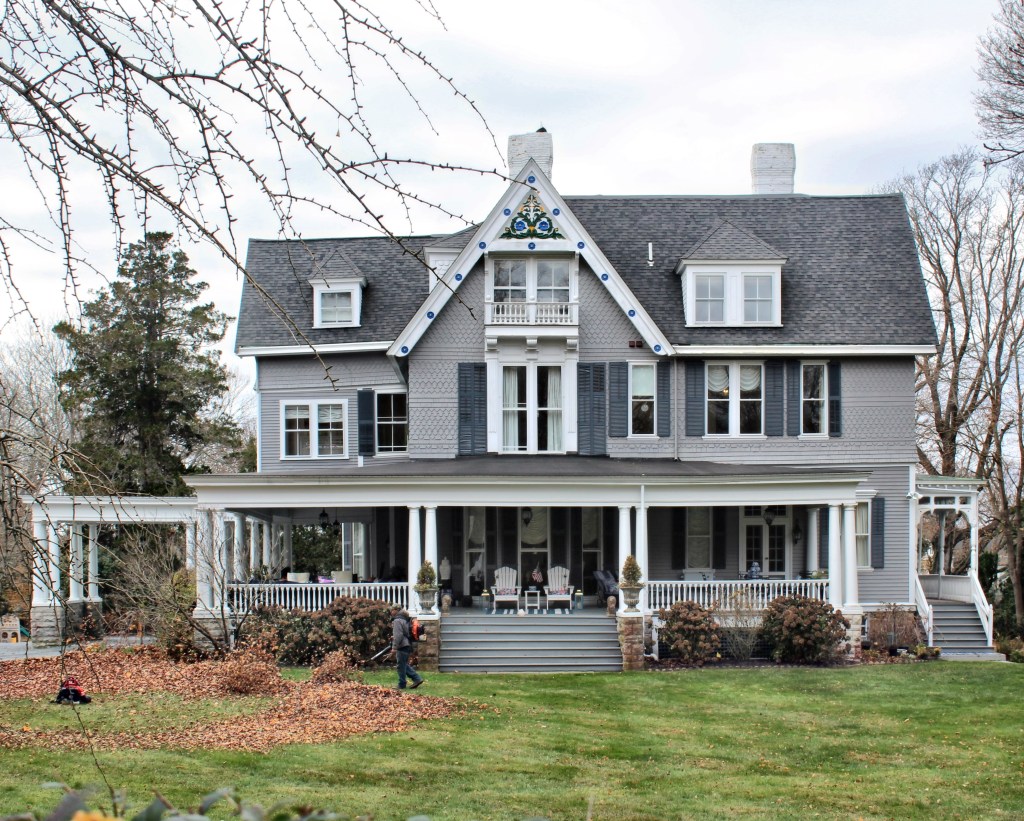
One of the best Queen Anne style summer cottages in Newport is this gem, named Sunnylea. The house was built in 1881 for Charles F. Chickering, who ran the Chickering & Sons Piano Company in Boston. Chickering hired local architect Dudley Newton, who had previously apprenticed under George Champlin Mason, a builder of many Newport summer houses. Sunnylea was the first independent commission that Newton designed with his own firm. The house was later owned by Luther Kountze, a New York banker and his wife Annie. After WWII, the home was converted away from single-family use, and was occupied as a prep school, before being converted to condos late in the 20th century. It recently sold, and wow, the interior is just as beautiful as the exterior!
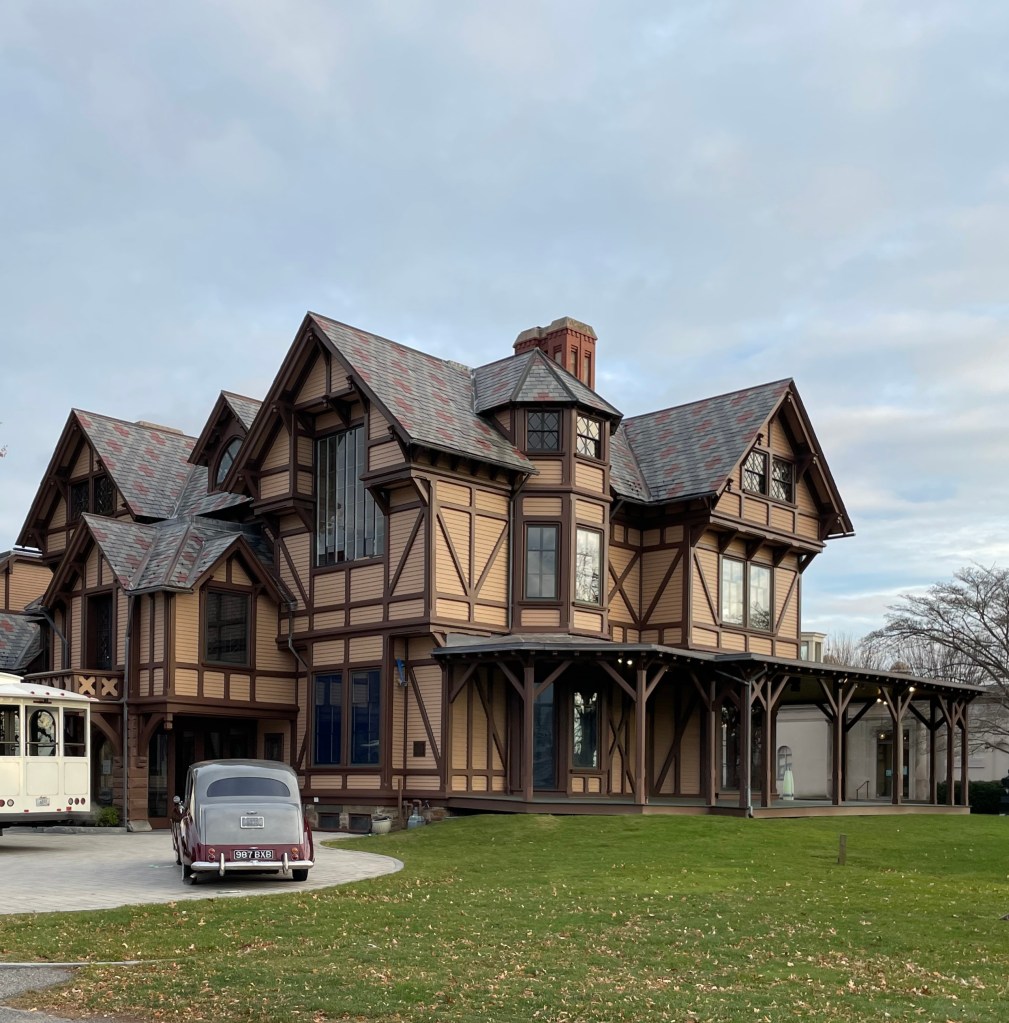
John Noble Alsop Griswold (1822-1909) was born into wealth, with his family business involved in land speculation in New York as well as the N. L. & G. Griswold Company, which imported sugar and rum from the Caribbean on clipper ships. In his 20s, John traveled to China for a trade and within a year of that trip, was appointed United States consul at Shanghai, serving in that role until 1854. Upon his return to America, he helped develop several prominent railroads, serving as president of the Illinois Central Railroad and chairman of the board of directors of the Chicago, Burlington and Quincy Railroad. He eventually settled in Newport and helped shape the sleepy town into a summer resort town for high-society. His statement-piece in town was his own mansion on Bellevue Avenue, built in 1863 from designs by Richard Morris Hunt, and completed that next year. It was the first of Hunt’s many notable works in Newport, and is considered a prototype work of the Stick style of architecture in America. Hunt would go on to design Ochre Court, The Breakers, and other Gilded Age mansions in Newport and all over the northeast. Griswold died in the house in 1909; it remained vacant until 1915, when it was acquired by the Art Association of Newport, which now uses it as a museum gallery. I really want to see the inside of this beauty!


 Buildings of New England