The Tower Cottage // 1880

Tower Cottage was built in 1880 and is one of the best examples of Queen Anne architecture in the town of Ridgefield, CT. The home was designed and built by Charles Betts Northrup, a carpenter and builder who grew up in town. The home was eventually occupied as a summer retreat for Maude Bouvier Davis, who would spend some summers at the house away from the big city. In Ridgefield, Maude was sometimes visited by her niece, Jackie Bouvier, later known as Jackie Kennedy Onassis, First Lady to President John F. Kennedy. Maude owned the property until 1972 and the home has been lovingly preserved since.

Rockwell House // c.1850

Built in 1850, likely as a late-Greek Revival or Italianate style home, this property on Main Street in Ridgefield was completely “modernized” in the 1880s in the Queen Anne style popular at the time. The home was originally built for Francis Asbury Rockwell (1818-1881), a tin-smith, wine-maker and inventor who married Mary Lee Everest, who also had deep roots in the community and was a daughter of a local Revolutionary War captain. The couple built a home on Main Street and raised their children there until Francis and Mary died in 1881 and 1883 respectively. The family home was inherited by their eldest son, Charles Lee Rockwell, who became the director of the First National Bank in town. Charles updated the house to give it the Queen Anne Victorian flair we see today.

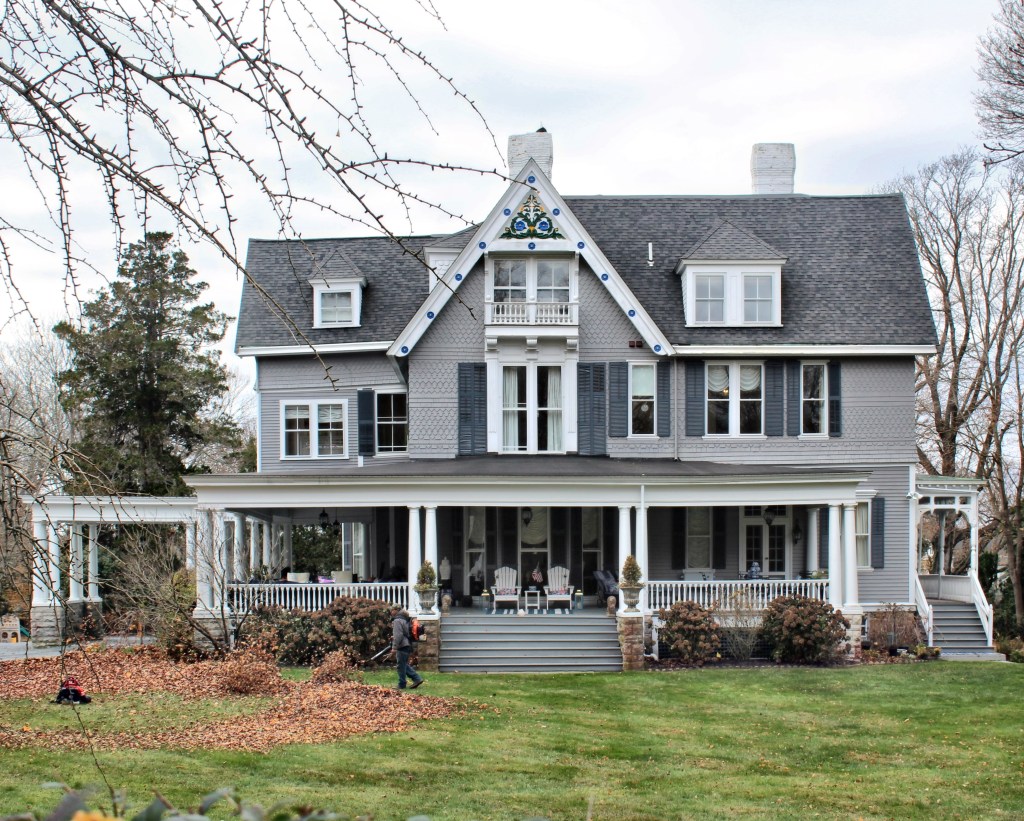
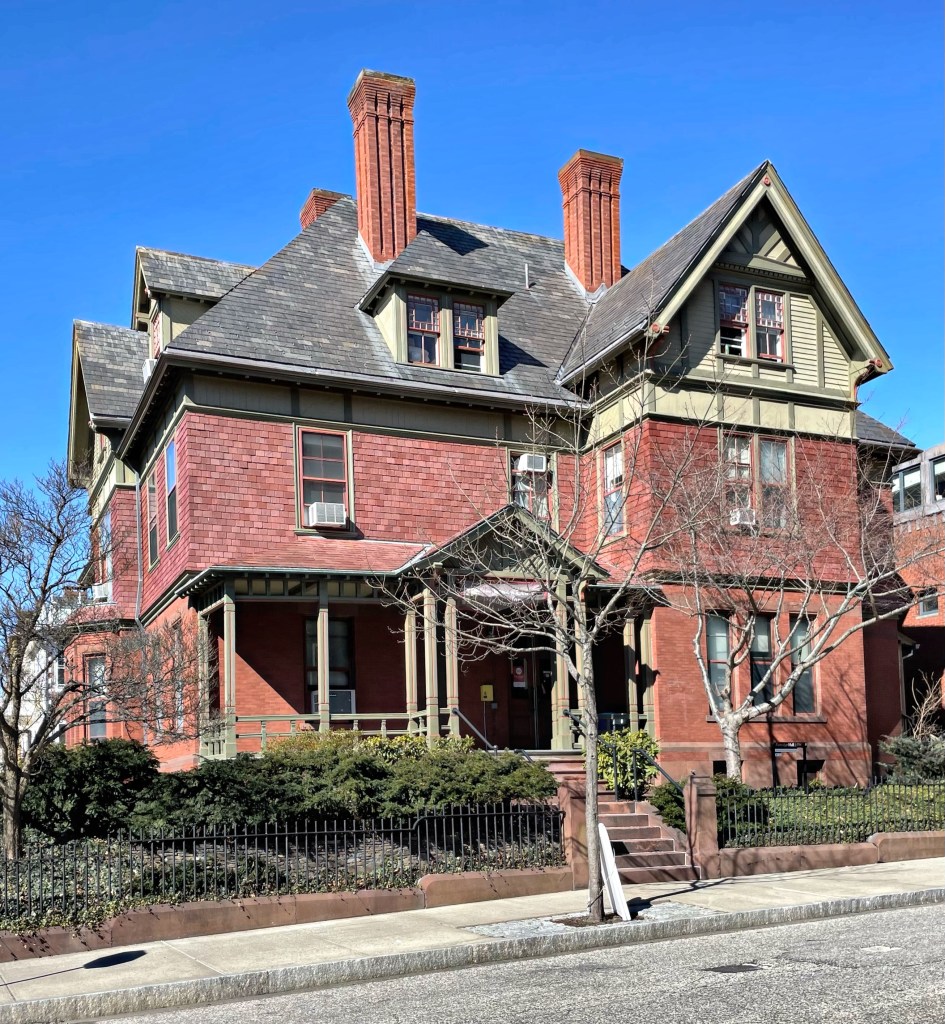
Beckwith House – Partridge Hall // 1882

Henry Truman Beckwith (1808-1893) was born in Providence and (of course) enrolled at Brown University. He left school after two years and wished to see the world. He began to work as a cargo clerk aboard ships for a cotton merchant of Macon, Georgia. He traveled between Boston and Calcutta at least twice, bringing aboard novels from American and British authors, spending much of his time reading. Being well-read and without a family of his own (he never married), he devoted much of his time to clubs and organizations including: the Providence Athenaeum, Rhode Island Historical Society, and the Rhode Island Horticultural Society. In the later years of his life, Henry had this Queen Anne style home built in College Hill, on the same block as the Historical Society where he was a member. The Beckwith House was eventually acquired by Brown University and has since been known as Partridge Hall. The building is now home to the Brown Center for Students of Color, an organization that was established after a series of student protests in 1968 and 1975. Amid the civil rights movement of the late 1960s and 1970s, a group of Black students walked out of Brown University in December 1968 in protest of fierce racism on campus. The mission of the Brown Center for Students of Color has evolved over the years, but its current mission statement reads “Visualize. Vocalize. Mobilize”, they remain an integral piece of the campus and provide much-needed space for students of color to build a sense of community on campus.

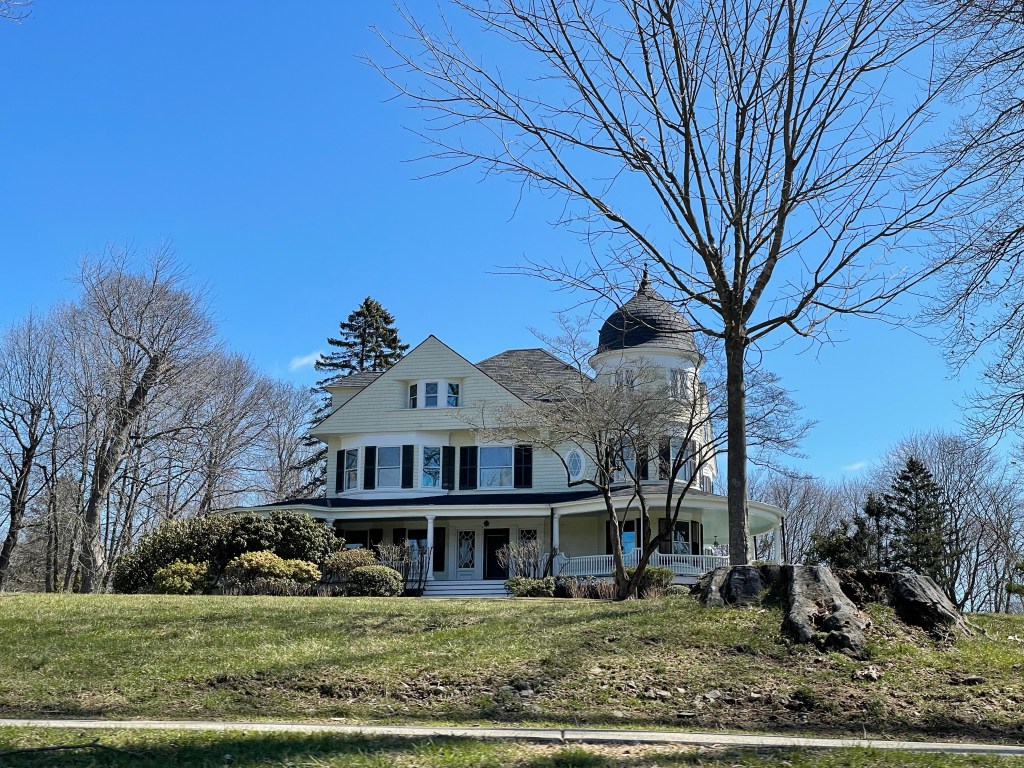
Stetson House // 1897

Waban is full of eclectic homes from the end of the 19th century, and this example is probably my favorite! The Herbert and Georgia Stetson House was built in 1897 and demonstrates how elements of the Colonial Revival style were incorporated into a less rigid Queen Anne style plan. Herbert was a lumber dealer, and likely used his own product in his home. The mixture of ornament includes Colonial
Revival style pedimented dormers, a Palladian motif window, oval windows, and a modillion cornice in combination with bays, oriels, a dramatically overshot gable roof, and a swept dormer reminiscent of the Queen Anne style. Together, the composition is perfection, and really makes you stop and analyze all the details!

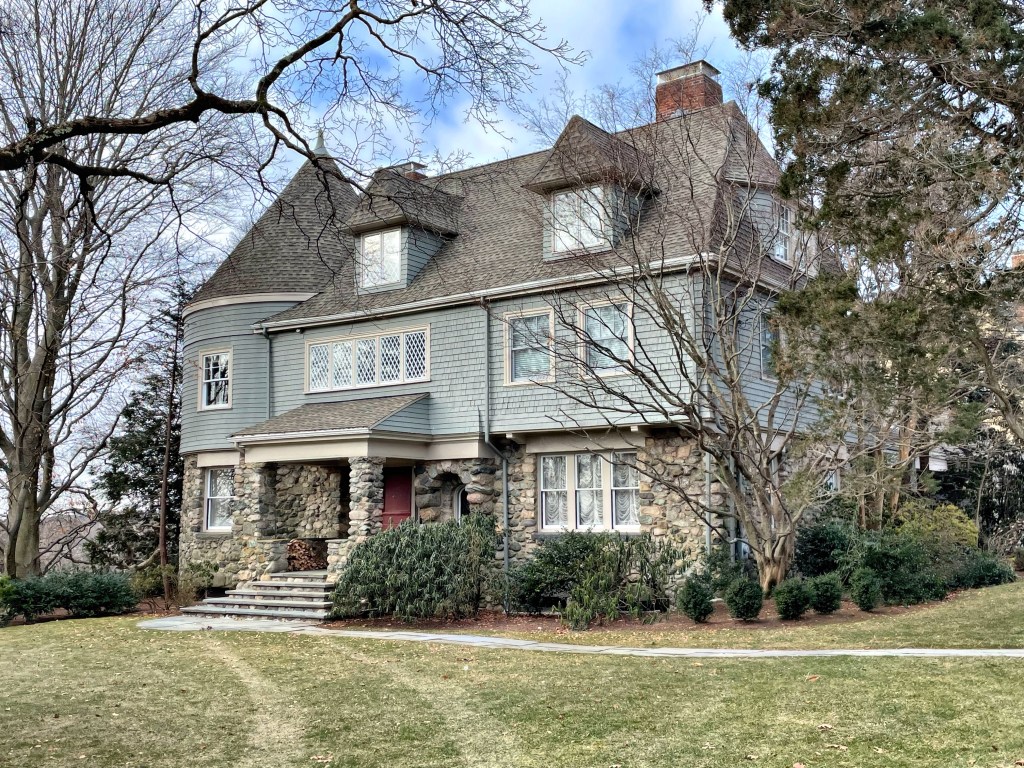
Louis K. Harlow House // 1888

One of the best houses in Waban Village in Newton is this absolutely stunning Shingle style/Queen Anne home perched high on Moffat Hill. This house was built in 1888 for Louis K. Harlow, who began his career as a professional artist in 1880 and traveled Europe to study the work of prominent painters. Back in the Boston area, Harlow painted nature and landscapes and produced etchings that were shown in the Boston Art Club and sold worldwide. He later got into poetry and published multiple works. Harlow hired the firm of Longfellow, Alden, and Harlow, to design this country retreat. I assume there is a relation between Louis K. and the architect Alfred Branch Harlow, but I would love to find out the connection! The design is quintessentially Queen Anne, with the asymmetry, complex roof form, varied siding types, and diamond window sashes. The shingled second floor overhangs the fieldstone first floor which to me, evokes the Shingle style where the house seems to have grown out from the earth. I can only imagine how spectacular the interior is!

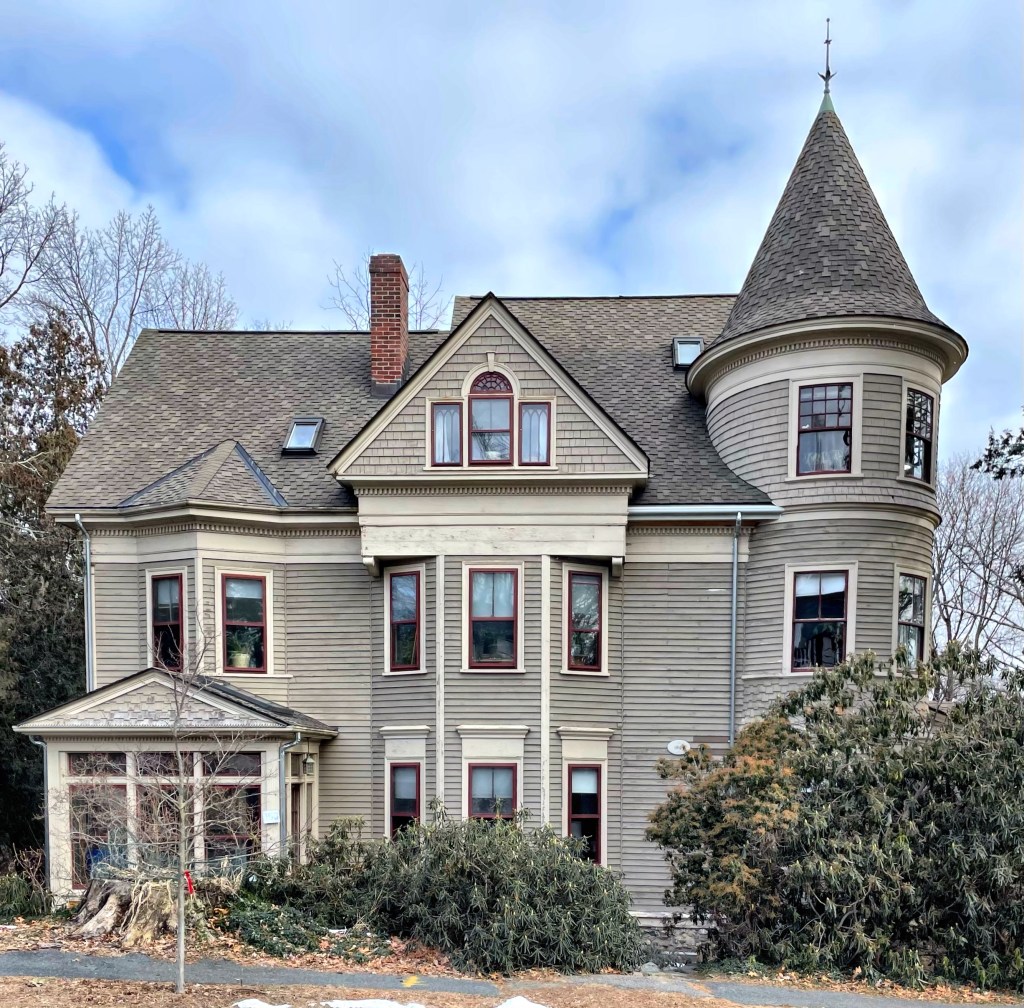
Winfield S. Carr House // 1896

In 1895, Winfield S. Carr (1849-1911) purchased land on Windsor Road for a residence from William S. Strong, a horticulturist and developer of Waban Village. The lot is located at the peak of Moffat Hill, and provided sweeping views of undeveloped farm and marshland and possibly Boston in the distance. As a young man, Carr moved to Fall River from Maine, and was employed in the dry goods business. He eventually moved to Boston and opened up a toy shop, which clearly became a large success. The firm sold fireworks and children’s toys from the downtown location. The Queen Anne style home was occupied by Carr and his wife (they don’t appear to have had children) for less than a decade, when the couple downsized and moved to an apartment on Comm. Ave. in Allston.

‘Mountain Aqua’ // c.1882

Located near the base of Pleasant Mountain in Denmark, Maine, you’ll find this stunning Victorian house, possibly the best example of Queen Anne architecture in town. Down the dirt road, you can imagine how shocked I was to stumble upon this beauty set back off the road, overlooking the White Mountains in the distance. The house was built around 1882 for the Warren Family, descendants of one of the first settlers in the town. Caleb Warren Jr., is likely responsible for this house, which served as a base lodge for the hotel once located at the summit. In 1845, Caleb Sr. built the first guesthouse atop the 2,200′ mountain, which was purchased just years later by a Joseph A. Sargent. Sargent converted the old hotel into a bowling alley and built a new hotel at the summit. That structure burned to the ground, and was replaced in 1873. The buildings at the summit were eventually purchased and demolished by 1908 when the mountain was sold to the Appalachian Mountain Club. Mountain Aqua would have served as a base lodge for the mountaintop hotel, and was a place where visitors could depart by foot or wagon to the summit. Mountain Aqua appears to be a single-family home today.

Sunnylea // 1881

One of the best Queen Anne style summer cottages in Newport is this gem, named Sunnylea. The house was built in 1881 for Charles F. Chickering, who ran the Chickering & Sons Piano Company in Boston. Chickering hired local architect Dudley Newton, who had previously apprenticed under George Champlin Mason, a builder of many Newport summer houses. Sunnylea was the first independent commission that Newton designed with his own firm. The house was later owned by Luther Kountze, a New York banker and his wife Annie. After WWII, the home was converted away from single-family use, and was occupied as a prep school, before being converted to condos late in the 20th century. It recently sold, and wow, the interior is just as beautiful as the exterior!

The Old Breakers Mansion // 1878-1892

For my last post on this series on The Breakers in Newport, I wanted to highlight the original Breakers mansion. Built in 1878, the original Breakers was equally as significant, but a completely different style architecturally. The Breakers was constructed for Pierre Lorillard IV (1833-1901), a tobacco manufacturer and thoroughbred race horse owner from New York. In 1760, his great-grandfather, and namesake of the family company, founded P. Lorillard and Company in New York City to process tobacco, cigars, and snuff. The ‘cottage’ would serve as a summer retreat for Lorillard and his family for the summer months. The home was designed by one of the premier architectural firms in the country at the time, Peabody & Stearns, who specialized in high-style country estates. In 1885, Lorrilard used his family land in Orange County, New York, to lay out a new residential colony as a playground for New York’s wealthiest residents during the summer months. The colony is known as Tuxedo Park. He sold The Breakers to Cornelius Vanderbilt II in 1885 and the family would summer in the massive Queen Anne style estate for just seven years until a fire destroyed the home. The detached children’s cottage (also designed in 1878 by Peabody & Stearns) survived the fire and remains on the site. The Vanderbilt’s decided to erect a fireproof house immediately, and the result is the massive limestone mansion we can tour today.

The Breakers – Children’s Cottage // 1878

While the Breakers Mansion in Newport is one of the most opulent buildings in the United States, a tiny cottage on the grounds always gives me feelings of whimsy. Predating the larger mansion by two decades, this cottage was constructed on the grounds of the original Breakers House, owned by Cornelius Vanderbilt, which was destroyed by fire in 1893. The cottage was built as a children’s playhouse around the time the original Breakers mansion was built in 1878. The Boston architectural firm of Peabody and Stearns built the mansion and adjacent cottage for Pierre Lorillard IV, a New York cigar manufacturer and millionaire. The Queen Anne Revival style elements, including the half-timbering and shingles and asymmetry, were in keeping with the style of the original Breakers, and complimented it well. My favorite part of the cottage is the open porch facing the ocean, which has four wooden posts, carved in the shape of figures from Dutch folklore, a sort of caryatid, supporting the roof. The house contains a living room and kitchen separated by a huge red brick chimney, which would be maintained by servants for the children while they play.