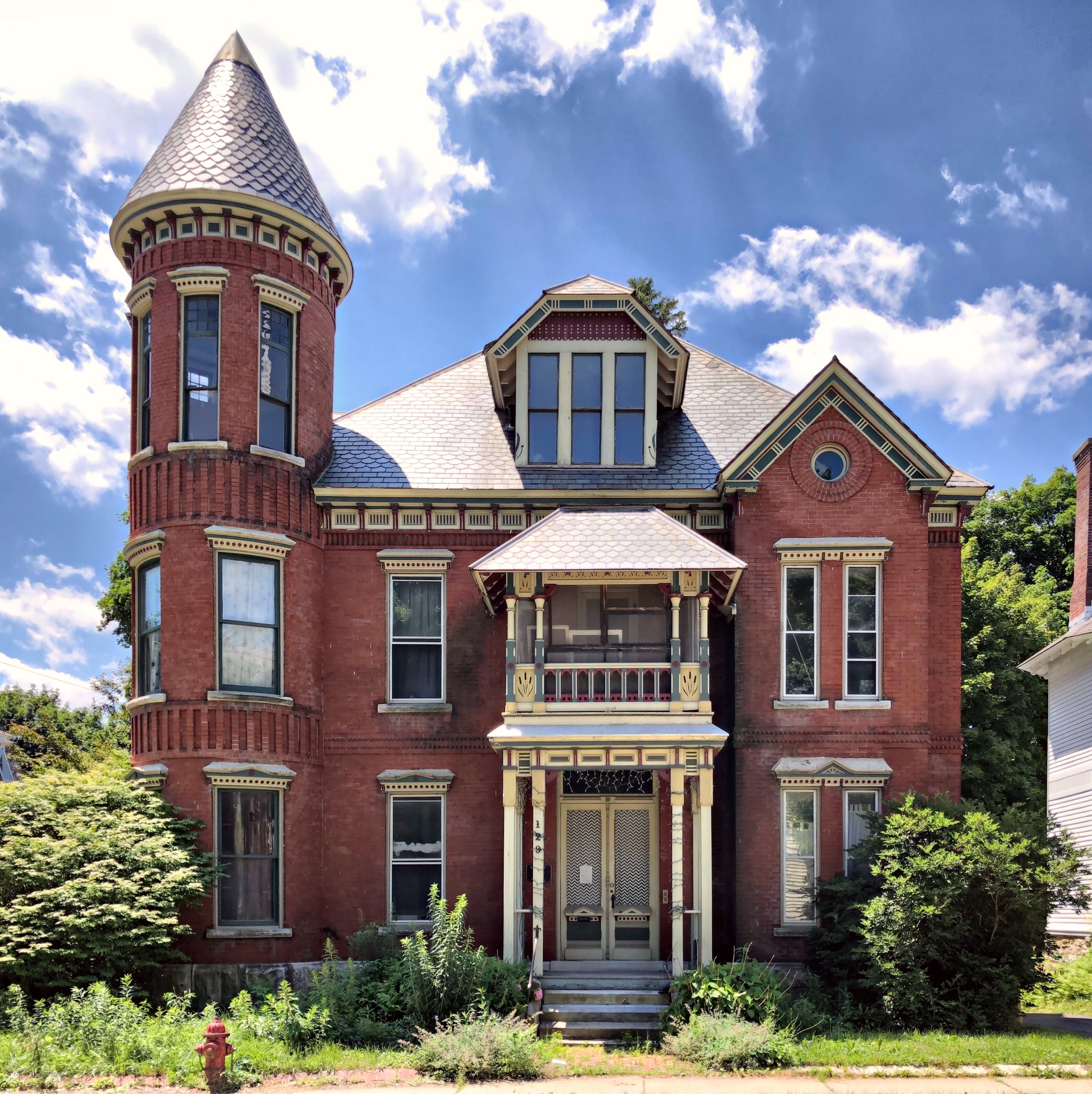
Marblehead, Massachusetts is better known for its Colonial-era homes, but there are definitely some amazing old Victorians interspersed in the warren of narrow streets and alleys. This Queen Anne style house was built in the 1890s for Thomas D. Hamson, who was listed in directories as a shoe manufacturer. Queen Anne style Victorians typically exhibit asymmetrical plans, varied projecting and receding planes, varied siding materials and forms, turned posts and porches, and towers and turrets. This house has it all!
In 1891, the Baptist Society of Stoneham, Massachusetts unveiled that it had acquired funding and approved the plans for its first purpose-built church building in town. The organization met in a shared chapel in town since its founding in 1870. The new church would be unique in the Boston suburb as the only in town to be of the Queen Anne/Shingle style. A prominent site on South Main Street was acquired and work began in 1892 to erect the new house of worship. The design of the church is credited to the firm of L.B. Volk & Sons, a firm who specialized in church buildings with commissions all over the country. The church is complex in plan and combines brick and shingle siding in its construction with a prominent two-story tower with rounded corners and stained glass rondels (round windows).
Built nextdoor to his business partner’s summer cottage (last post), Wilhelm (William) J. D. Keuffel, a German immigrant from Saxony, erected this summer cottage in the fashionable German-developed summer colony Elka Park in upstate New York. Keuffel & Esser Company (K&E) was founded by German immigrants Wilhelm J. D. Keuffel and Hermann Esser and manufactured high-quality surveying, drafting, and calculating tools for architects, engineers, surveyors, and building contractors in Hoboken, New Jersey with a sales office in Manhattan. By the early twentieth century, it was one of the largest manufacturers of scientific instruments in the world. Keuffel made good money, and summered in Elka Park for years until his death in 1908. The Queen Anne style Victorian “cottage” features the typical asymmetrical plan, corner towers, varied siding and detailing, and many porches to provide the residents with sweeping views of the distant mountains.
Roswell Burrows Fitch (1833-1908) was born in the seaside village of Noank to parents Elisha and Mary P. Fitch. At twelve years of age he commenced to be self-supporting, and from then until he was fourteen, occupied a clerkship in a general store in town. In his teens, summers were spent aboard ships fishing for a livelihood, and his winters attending school. Upon completing his education, he became clerk in a store, and was afterwards engaged to assume the management of a union store which was erected for the special purpose of being placed under his charge. The store, located on Main Street in Noank, was eventually fully purchased by Fitch, and he did well financially. He may have had this house built or merely bought it years after it was built in the mid-19th century. When he sold his business in 1890, he “Victorianized” the classically designed Greek Revival style house with Queen Anne embellishments. The renovations in 1890 included an octagonal tower, an elaborate porch, a two-door entry likely replaced the sidelights and transom, brackets and applied decoration at the gable and cornice, and a Palladian window which was a Colonial-inspired addition. Hodge-podge or eclectic houses are some of the most fun!
In 1880, Jonas Gerlusha Smith (1817-1893) received a permit to erect a multi-family apartment building on Warren Avenue in present-day South End. The lot was close to his personal residence at 13 Warren Avenue and would have been easy to maintain and oversee tenants in the building. Mr. Smith hired 26-year-old architect Arthur H. Vinal, who furnished the plans for the handsome Queen Anne building. Vinal would later become the City Architect of Boston from 1884 to 1887, designing the High Service Building at the Chestnut Hill Reservoir just seven years after this building. By the late 1880s, the building was known as The Carlisle and it remained in the Smith family holdings under Walter Edward Clifton Smith until the 1930s. Walter attended the Cambridge Episcopal Theological School and later worked at various churches in the Boston area, serving as pastor in his later years. He lived on Follen Street in Cambridge while he held the Carlisle for additional income. Under new ownership in 1950, a retail storefront was added to the first floor which was occupied as a florist for some years. In 1979, after years of deferred maintenance, the property was purchased by Louis G. Manzo and his son David W. Manzo, who meticulously restored the building over time into the time-capsule that it is today!
I think I found it… My favorite street in Roxbury. Harrishof Street is a surviving streetscape that shows the beauty and potential of the Washington Park district of Roxbury, a surviving span of houses that dodged the wrecking ball during a period of Urban Renewal. This section of the street runs a stone’s throw from the ruins of the 1857 Horatio Harris Villa (featured previously) and was laid out by Horatio’s heirs who developed the former sprawling estate into multi-family housing, to cash in on suburbanization caused at the turn of the 20th century thanks to electric trolley lines in the neighborhood. The development is credited to Alexander Colin Chisholm (1868-1941), a Canadian-born architect and developer who grew up in Roxbury. He specialized in small residential enclaves of similar houses, including these houses on Harrishof Street, and later on Elm Hill Park. The two-family houses blend Queen Anne and Colonial Revival styles in such a fun way that pushes the boundaries of academic architecture. The houses on the street are all slightly different and have had varied alterations over time, but this is a great candidate for a historic district!
One of the most well-designed and least-pretentious summer cottages in Newport is this charming dwelling on a dead end street. The Samuel P. Tilton Cottage was designed in 1880 by the prestigious firm of McKim, Mead & White as an idiosyncratic blending of Queen Anne and Shingle architectural styles. Mr. Tilton was a milliner (maker and seller of women’s hats) with stores in Boston and Paris, France. He had this cottage built to summer close to the nation’s wealthiest, likely marketing some hats at elaborate Gilded Age events. The facade is assertively Queen Anne with its massing and decorative panels, with shingled side elevation seemingly sprouting from the earth. The architectural terminology for these unique decorative panels is “sgraffito” where here, cement or plaster siding is set and adorned with shells, pebbles, colored glass, and pieces of coal into a cartouche design. The house is one of the finest in Newport, and shows that bigger isn’t always better!
One of the finest Queen Anne style residences New England is this 1877 summer cottage, named “Snug Harbor”. The mansion was designed by architects William Appleton Potter and Robert Henderson Robertson for Charles H. Baldwin, a prominent admiral in the United States Navy. The design utilizes a brick first floor with shingle siding above, a high cross-gabled roof, panels and half-timbering, asymmetrical form, and a porte cochere at the entry. Later owner Arakel Bozyan, painted the entire exterior a deep red color and renamed the house “Gamir Doon”, Armenian for “Red House”. The house was restored back to a traditional color scheme and sold in 2020. The interiors are STUNNING!
This charming Victorian cottage in Newport was built in 1878 for Henrietta and Dr. Stephen Cambreleng Powell as their summer cottage. The well-connected couple hired New Haven architect David R. Brown to design the residence, which is an excellent example of the Queen Anne and Stick/Eastlake architecture styles. David Brown, the architect, apprenticed under the famed Henry Austin for years in New Haven, Connecticut before becoming a partner of the firm. As any good summer cottage needs a fun name, the couple named their cottage “The Anchorage”. The cottage is now known as the Old Beach Inn, and is among Newports many charming old inns.
South of the Ware River in Ware’s Industrial Village, you will find this absolutely charming former manufacturing office on the side of the road. The building was constructed in 1885 for the George H. Gilbert Co., a textile manufacturer, as the company offices. The building’s architect could not be readily located, but the building appears to have been the work of a skilled designer. When the Gilbert Company relocated north to a new industrial village of Gilbertville, the Joseph T. Wood Shoe Company moved in. The building now appears to be owned by the present occupant of the mill building nextdoor, American Athletic Shoe Company. The former Gilbert Co. Office is one of the more high-style buildings in the town of Ware and exhibits the best in Queen Anne and Romanesque Revival architecture.