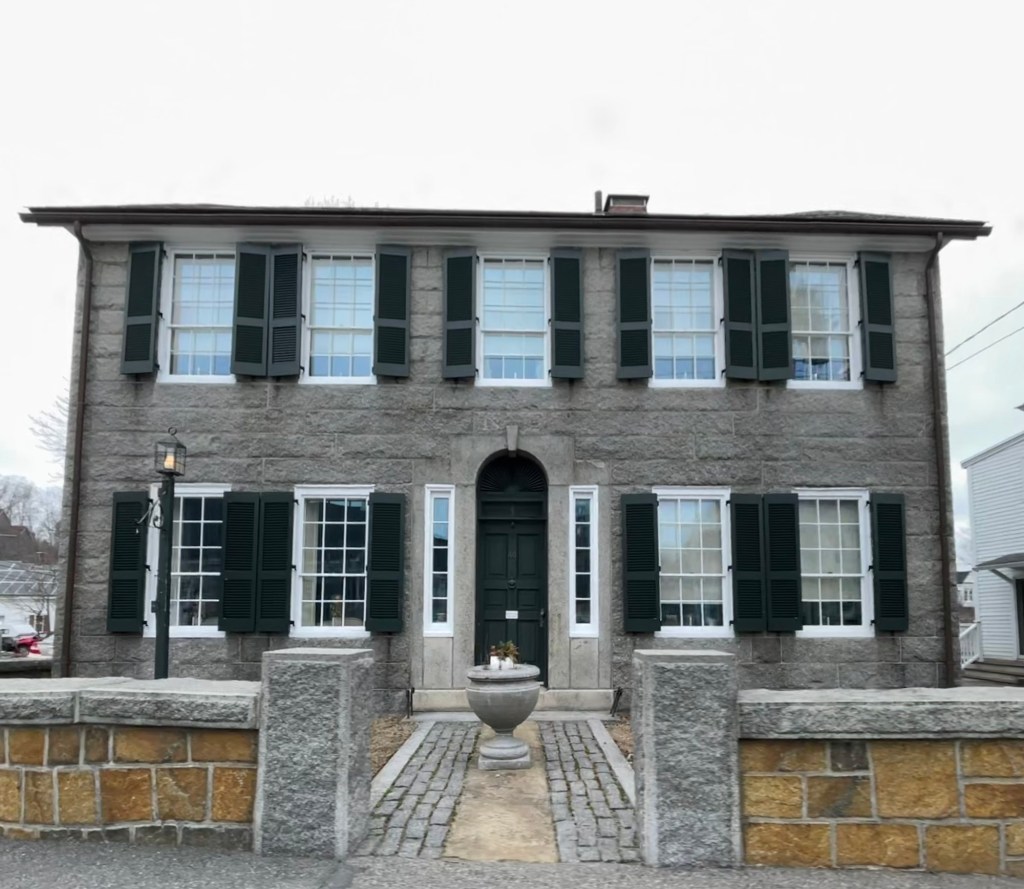
Dow-Starr House // c.1858

A big departure from the plain, yet classically proportioned Federal period homes in Warren, this Gothic Revival on Main Street turns heads when people pass by. A quintessential Gothic “cottage,” the facade of the Dow-Starr House in Warren has also been graced by a three-sectioned Gothic Revival porch as illustrated in Alexander Jackson Downing’s plan books from the 1840s. As completed, this house followed almost exactly Andrew Jackson Downing’s Design II as illustrated in Cottage Residences 1842 ; it differed only in its use of speckled fieldstone over coursed ashlar. The house was later acquired by and used as a convent for the St. Jean Baptiste Church in Warren, who also built a school building behind. The house has seen some alterations, but remains an important architectural landmark of the town.

Hutchings-Pfaff Gatehouse // c.1884

Once located at the entrance to the Hutchings-Pfaff Mansion, this small stone gatehouse is all that remains of a great Roxbury estate. Built of locally quarried Roxbury Puddingstone decades after the main house was completed, the Victorian Gothic style cottage surprisingly survived the subdividing of the large property and was sold as a private home in the early 20th century. It is uncommon to see these types of outbuildings survive into the 21st century, so I hope to see this charming cottage survive another 150 years!

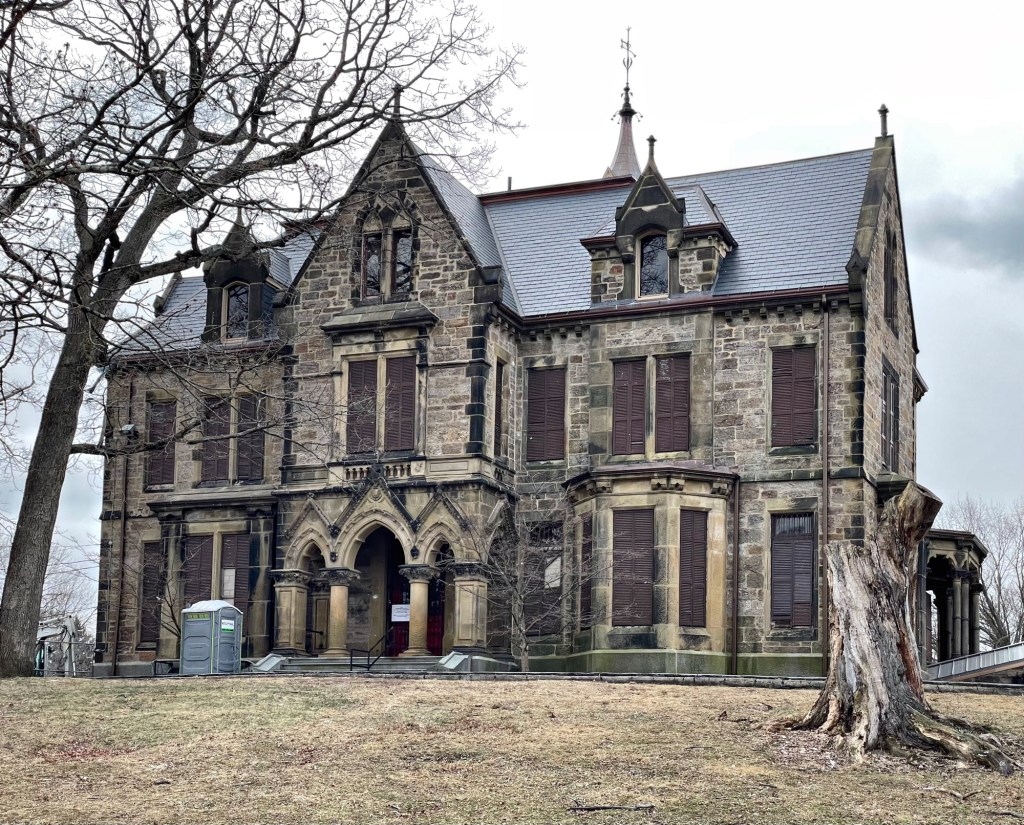
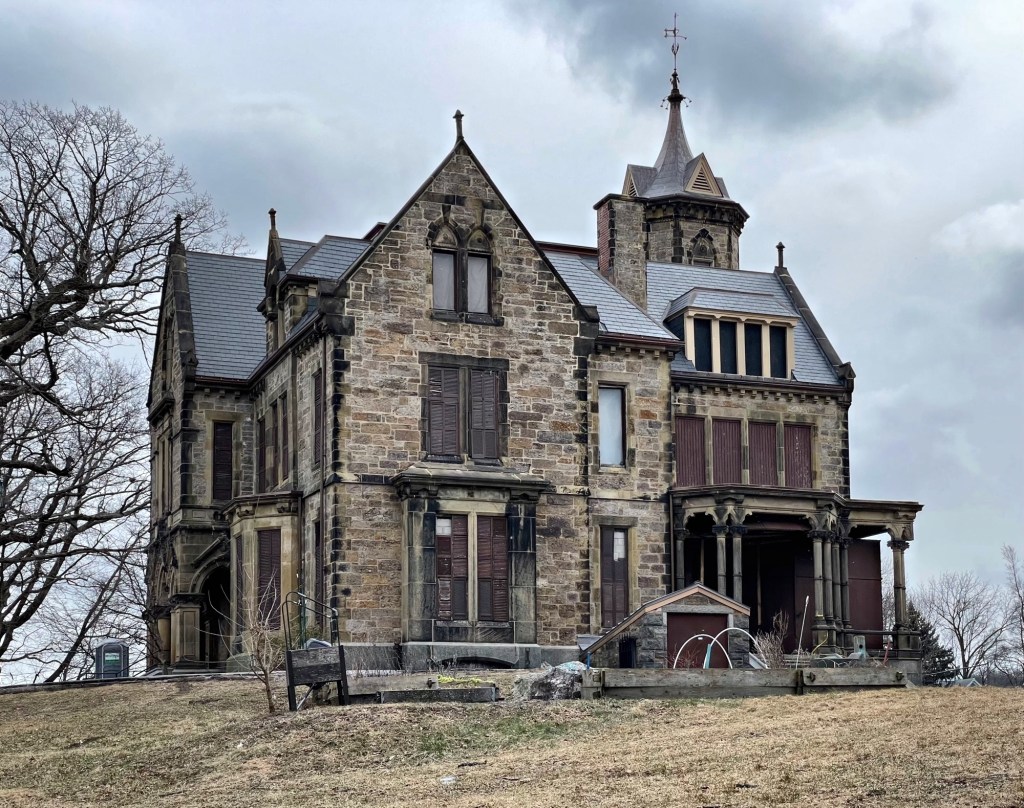
Abbotsford Mansion // 1872

The Abbotsford Mansion in the Roxbury neighborhood of Boston was designed in the High Victorian Gothic style and was built of Roxbury puddingstone, which was quarried locally. Abbotsford, originally named “Oakbend”, was built in 1872 as the residence of Aaron Davis Williams, Jr., (1821-1899) an industrialist and son of the founder of the Roxbury Institution for Savings. Roxbury-based architect Alden Frink designed the country estate and it is his most notable work. When Davis lost his fortune, James M. Smith, a brewer who had a passion for Sir Walter Scott, acquired the estate and renamed the house Abbotsford after Sir Walter Scott’s ancestral keep of the same name. The house continued to serve as a private residence until 1924, when the City of Boston acquired it for use as an elementary school and a disciplinary school for boys. The parcel was subdivided and the David A. Ellis School was built on the former grounds. After the building slipped into decline in the 1970s, the National Center for Afro-American Artists purchased the property, filling in the windows to create exhibit space. They have maintained the building to this day.

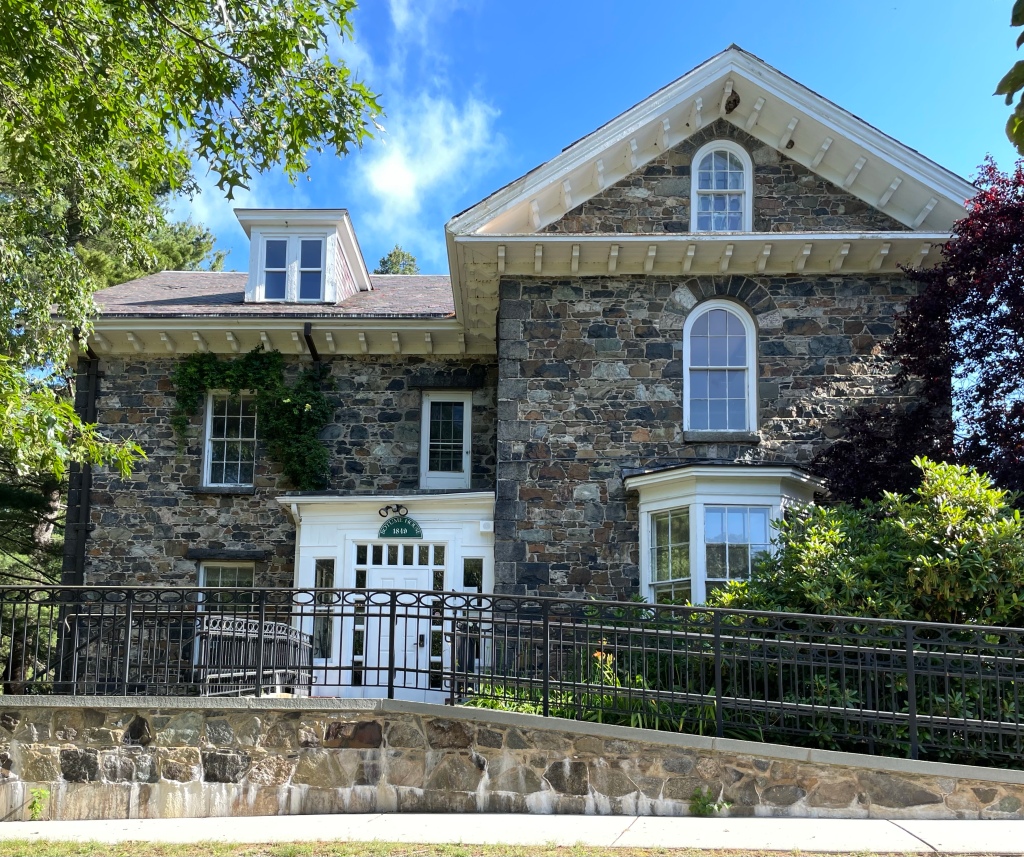
John Bottume House // c.1858

The John Bottume House in Stoneham, Massachusetts was built c.1858, this stone house was one of several built along the shore of Spot Pond by a Boston businessman as a retreat, and is the only one to survive. The coursed granite residence is an excellent and high-style example of the Italianate architecture style. It is owned today by the Massachusetts Department of Conservation and Recreation, and houses the visitors center for the Middlesex Fells Reservation.

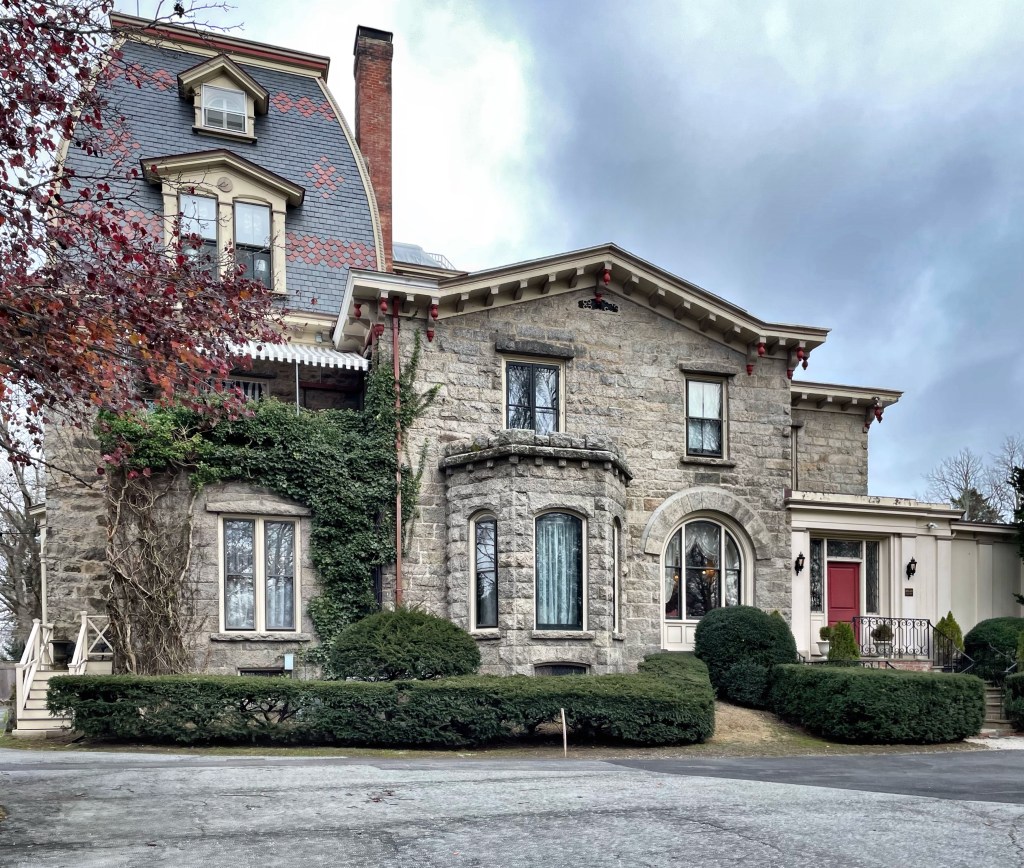
Belair Mansion // 1850

One of the most stunning summer “cottages” in Newport, Rhode Island is this stone behemoth named “Belair”. The house is set back way off the street and was one of the first summer estates built in this section of Newport. Belair was built in 1850 for New York oil baron H. Allen Wright in the Italianate style and constructed of roughly dressed stone and was originally about half of the size of the current footprint. The mansion was designed by architect Seth C. Bradford, who is also credited as architect of the similarly designed Chateau-sur-Mer, built one year later. Wright sold this house to George H. Norman two years after its completion. Norman (1827-1900), founded the Newport Daily News in 1848 and made his fortune as an engineer, first establishing gas works and later water works systems across New England, New York, and the Midwest. Norman made a fortune, and renovated and expanded his mansion in 1870 from plans by Newport architect Dudley Newton, with grand Second Empire additions, including the high convex-mansard corner tower. The original four acre Belair property has been extensively subdivided, and this house now occupies a lot of about an acre; with the original outbuildings sold off, and Belair is now 11 condominium units!

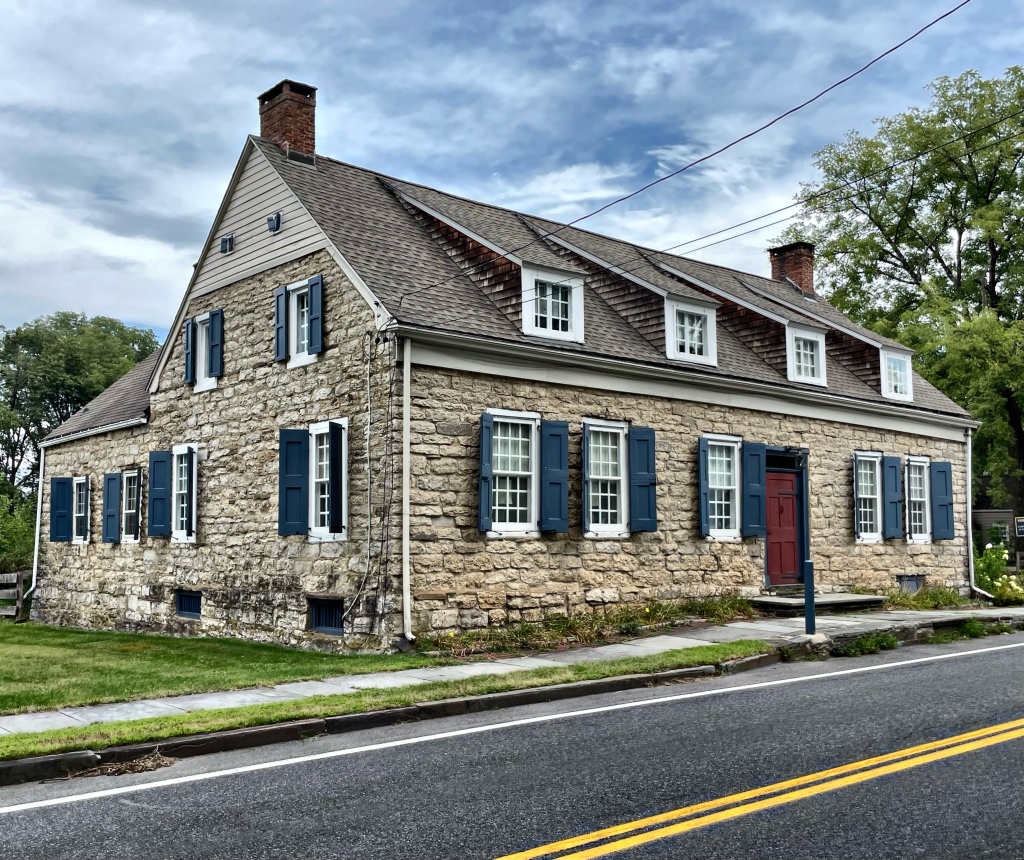
Roosa-Van Deusen House // 1744

For my last building feature in New York in this series, I feature the Roosa-Van Deusen House on Hurley’s Main Street village of old stone homes. This house dates to 1744 and was built upon land owned by Jan Alderts Roosa, who emigrated to New Netherland (New York) with his family on the Spotted Cow in 1660, when he was 14 years old. The house was likely built by Jan Van Deusen (Jan Roosa’s grandson), a blacksmith who worked in town. The Van Deusen House famously became the capital building of New York when in 1777, the newly formed New York state government moved here for two months while Kingston was being rebuilt after the British Army had burned it in retaliation for the creation of the state. It is thus the second of the state’s three capital cities, the present, Albany, being the third.

Elmendorf House // c.1780

Built circa 1780, this old stone house is fairly new compared to some of its neighbors (it was built after the Revolution). The land upon which the house sits was originally owned by Anthony de Hooges and his wife Eva. It was purchased by Conrad Elmendorf, who likely built the home after the War. and handed down to his great-grandson Col. Jonathan Elmendorf who served in the War of 1812. The property is now home to the Hurley Historical Society, which host an Old Stone House Tour every year.

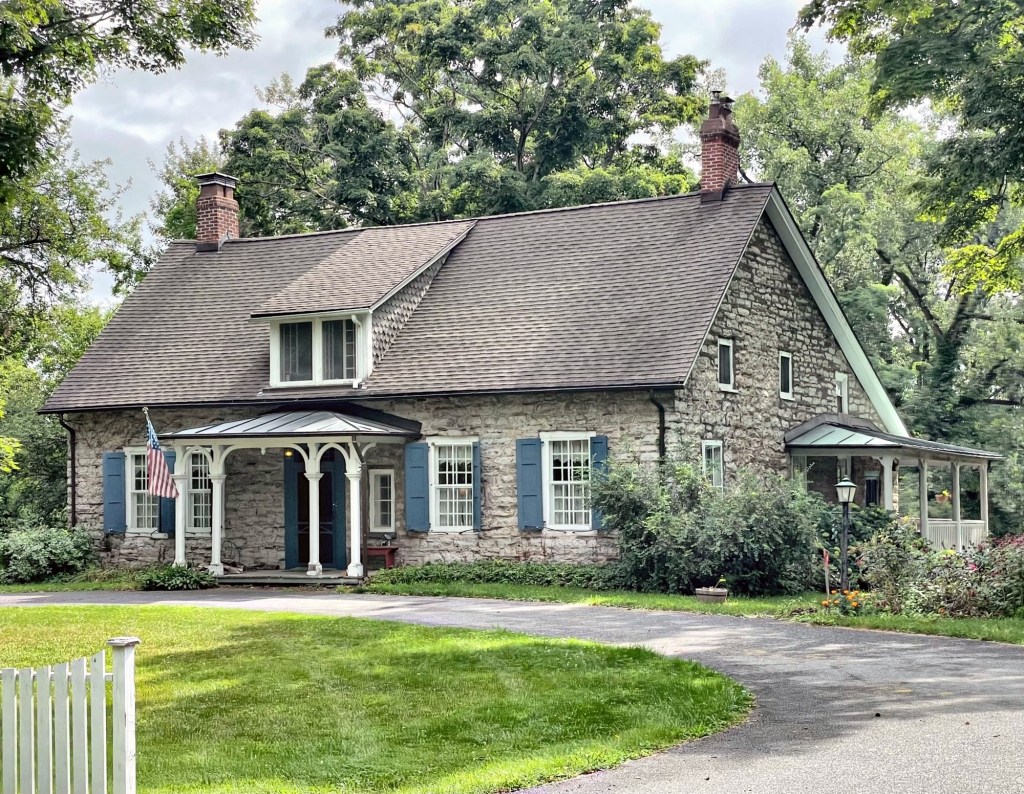
Van Etten-Dumond “Spy” House // c.1726

One of my favorite houses in Hurley is the Dumond House (also known as the “Spy House”), a pre-Revolutionary stone cottage built in Dutch traditions. The house is one and one-half stories high, and is built of limestone. The limestone walls are of various thickness, from a nearby quarry, with the square ends laid up in mortar made of clay, and pointed with lime mortar outside. The house was built by Jacobus Van Etten (1696-1779) and used as a Guard House during the American Revolution. In 1777, it was famous for housing the convicted British spy, Lt. Daniel Taylor after he was caught carrying a message between British Generals Henry Clinton and John Burgoyne. Lt. Taylor was arrested as a British spy, convicted in court of spying and held in the basement of the Du Mond House as a prisoner. He was hung on October 18, 1777 from a nearby tree. American soldiers encamped in the area were paraded by the body as a warning to any potential British sympathizers. The home was later owned by the Dumond Family. It has been owned by the Kent family since 1933.

Polly Crispell Cottage // c.1700

Another of Hurley’s stone houses is this beauty, known as the Polly Crispel Cottage. The house was built before the American Revolution c.1700 by an Anthony Crispell, a cordwainer. The home was likely a half cape in form with the door and two windows to its right. The other half was added at a lower level later on with the floors uneven, likely in 1735 where a construction date plaque read. The home also features a dutch door, which I wish we had more of in New England.

Abram Elmendorf House // c.1789

As the Elmendorf family put its roots down in Hurley, Ulster County, New York, the descendants built stone houses as a nod to their ancestors of Dutch heritage, following those building traditions. This five-bay stone house was built around 1789 and is a vernacular Federal home with Dutch and English building influence. The property exhibits shed dormers and a Colonial Revival portico, but exudes 18th century charm.