Saunders Cottage // c.1900

Charles Saunders, a carpenter, and his wife Annie Saunders, seemingly built and lived in this Shingle style cottage in the Ocean View summer colony of Rockport. The couple shows up in census records as living here in 1910 while in their 50s. The house likely dates to the 1890s and is a great example of the Shingle style for a middle-class residence. The house features a corner tower and a wrap-around porch with continuous shingle siding and columns. The property was deeded to a Lawrence Regester in 1924 when Annie sold the property after Charles’ death. The shingled cottage has remained in a great state of preservation for its existence!

Haven Avenue Cottages // c.1877

When Andrews Point in northern Rockport, Massachusetts, was opened for development by speculators Eben B. Phillips and George Babson, they envisioned the colony, “Ocean View” as a rival to other nearby summer colonies of Beverly Farms, Gloucester, and Magnolia. Roads were laid out and house lots were plotted with larger lots for big summer cottages along the coast and smaller cottage lots at the interior of the development. The rocky coast and more limited access compared to its rivals, caused Ocean View to lack in sales, but there are still some great remaining cottages to be found here. These two early cottages are great surviving examples of the modest, middle-class homes for summer residents. These two charming Victorian cottages sit side-by-side and were owned by an L. Brigham and Benjamin Lewis and both are in a great state of preservation 150 years later.

Oak Knoll Cottage // c.1877

One of the earlier cottages built in the Oceanview summer colony of Rockport, Massachusetts is this charming example of a late-Italianate style residence on Phillips Avenue. Local lore states that the cottage was owned by Lucy Canney, the wife of Edwin Canney, who operated multiple granite quarries in town. Oak Knoll was possibly used as a boarding house for visiting guests of the quarries to stay at when inspecting the quality of the granite. The Canney’s sold off much of their property in the area by the end of the 19th century, and the cottage was later owned or occupied by Dr. Helen Morton (1834-1916), a Boston-based obstetrician and one of the early generation of women physicians practicing in Boston in the nineteenth century. Dr. Morton spent most of her time in a townhouse on Marlborough Street in Boston’s Back Bay with her possible partner, another obstetrician, Mary Forrester Hobart, but likely escaped to this cottage for some rest and relaxation for the summers.

Eben Phillips Cottage // c.1877

In the mid-1800s, Rockport, Massachusetts was best-known as one of the main ports for the quarrying and shipping of fine granite up and down the east coast of the United States. While the rocky coastline made granite a prime industry, the natural scenery also made the coastal areas desirable for residential development. While many of the coastal developments here never took-off as they did in nearby Gloucester, Magnolia, and Beverly, there are some notable summer colonies that sprouted up! In 1855, Eben B. Phillips an oil dealer in Boston, purchased undeveloped wooded lots and pastures, and slowly began to lay out roads and survey for developable lots for summer cottages on a peninsula near Pigeon Cove. The development was named “Oceanview” and it was marketed as the extreme point of Cape Ann. Development was very slow to materialize, and started in earnest in the 1870s. Eben Phillips built this summer cottage before 1877 (possibly as early as 1850), where he would spend summers until his death in 1879. The cottage retains much of its original character and is a rare survivor of the rustic style cottages which were built before the phase of larger Shingle and Queen Anne residences were built in later decades.

“Park Gate” Cottage // 1879

“Park Gate” Cottage sits on Bellevue Avenue near Touro Park in Newport, Rhode Island and is one of many summer “cottages” for wealthy summer residents. The home replaced the Atlantic House, a large summer hotel formerly on the site. The wood-frame dwelling was designed by Newport architect George Champlin Mason for Seth Bunker Stitt of Philadelphia and constructed in 1879. Mason’s design for “Park Gate” includes many features typical of the Queen Anne style including the asymmetrical facades, wrap-around front porch, tower, and even the small details like dentils, spindle work and balustrades. The house was later purchased by Newport Lodge #104 of the Benevolent and Protective Order of the Elks in 1920, who own the building to this day.

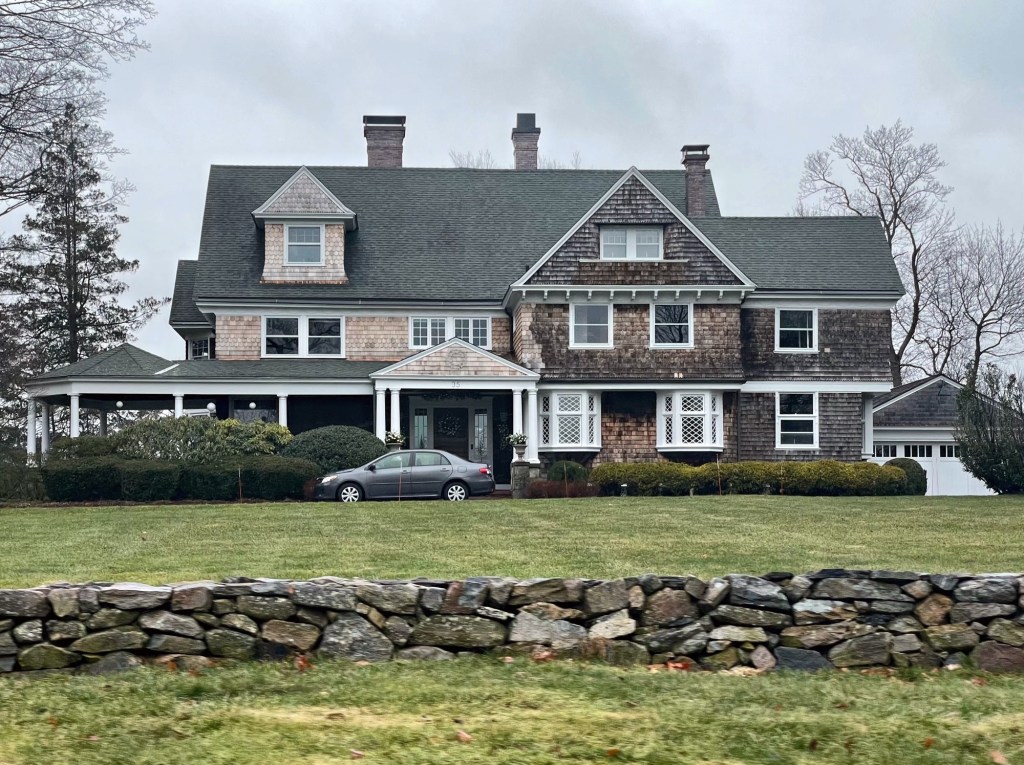
High Ridge Manor // 1893

Edward Payson Dutton (1831–1923) was a prominent American book publisher who founded the E. P. Dutton bookselling company in 1852 in Boston, Massachusetts. The business sold fiction and non-fiction, and within a short time expanded into the selling of children’s literature. In 1864, he opened a branch office to sell books in New York City and in 1869 moved his company’s headquarters there and entered the book publishing business. The company did very well, allowing Edward and his wife, Julia the means to build this large summer “cottage” in Ridgefield, Connecticut to escape the rustle and bustle of New York City. The couple purchased the lot in 1893 and appear to have built it soon after. High Ridge Manor is a stunning example of the Queen Anne and Shingle styles of architecture with its asymmetrical plan, continuous shingle siding with rubblestone foundation and chimney, gambrel roof, and towers.

Overlook Mansion // 1882

Raised in an intellectual home of his widowed father, William Allen Jenner (1844-1915) graduated from Middlebury College as the youngest in his class with highest honors. He would go on to graduate from Columbia Law School and be admitted to the New York Bar in 1867, becoming a partner in a prestigious New York City law firm. Outside of practicing law, William Jenner studied and authored textbooks on the Latin language and was an avid horticulturalist. His landscape architecture passion was fulfilled when he purchased a large house lot on High Ridge Road in Ridgefield Connecticut, and built this home in 1882, named “Overlook”, where he and his family would spend their summers outside of the city. Mr. Jenner and his wife, Josephine Curtis Jenner, raised three daughters between New York and Ridgefield. One of their daughters, Anna, would marry Sterling Foote, a New York City cotton broker. The Foote’s would inherit Overlook and spend their summers here until their death. The Queen Anne/Shingle style mansion showcases the shift of Ridgefield from sleepy farming town to summer destination for wealthy New York residents, a trend which continues to this day.

“Good Cheer Estate” // c.1820

Originally built as a Federal period farmhouse, this gorgeous estate is the epitome of what happened to Ridgefield… city money! By the end of the 19th century, wealthy New Yorkers were flocking to small towns every summer for clean air, rest, and relaxation. Ridgefield, Connecticut became an obvious option for its close proximity to New York and bucolic setting of farmlands bounded by old stone and rolling hills. As a result, wealthy summer residents purchased older estates and either demolished or renovated the homes there. Aaron Lockwood Northrop was raised in Ridgefield and was educated in its private schools before moving to New York as a young man, being awarded an apprenticeship as a dentist. Dr. Northrop went on to establish a prominent dental practice and would serve as President of the American Dental Association. As a wealthy adult, he acquired a circa 1820 house on this lot and renovated it, doubling its size and giving the residence its current Victorian flair. The summer house was affectionately named “Good Cheer”. Aaron died unexpectedly in 1908 while overseas in Paris, France. His widow, Caroline, resided at Good Cheer until her own death in 1927.

Maynard Estate // 1901

One of the largest summer estates in Ridgefield is this Neoclassical residence on Peaceable Street, which was built in 1901 for Effingham Maynard and his wife Helen. Maynard was a partner in Clark & Maynard, a New York publishing house. Local lore states that the Maynard Family hired New York architect Stanford White, to design this property, but no definitive proof could be located to substantiate that rumor. The Olmsted Brothers landscape architecture firm designed the grounds which were elaborate with gardens and outbuildings. The two unmarried Maynard daughters, Mary and Helen spent their summers here every year until their deaths in the 1950s.

Whelen Cottage // c.1891

For the last cottage on Grindstone Neck, I present the stunning Whelen Cottage. Charles S. Whelen (1850-1910), a banker and philanthropist who served as one of the directors of the Gouldsboro Land Improvement Company and as one of several of its stock agents in Philadelphia, purchased a house lot for him and his wife Migonette Violett. The couple did not hire Lindley Johnson, like so many other cottage-holders did, but they worked with esteemed architect Wilson Eyre to design the home. The Whelens were typical of the type of person who chose to summer on Grindstone. While comfortably well off, they were not in a financial position to commission the sort of cottages built on an ever increasing scale in Bar Harbor. The property left the Whelen’s ownership in 1897, and the house was altered and enlarged in 1900. The large porte cochere, porch, and additional rooms added at this time by William Winthrop Kent, an alumni of H. H. Richardson’s office.