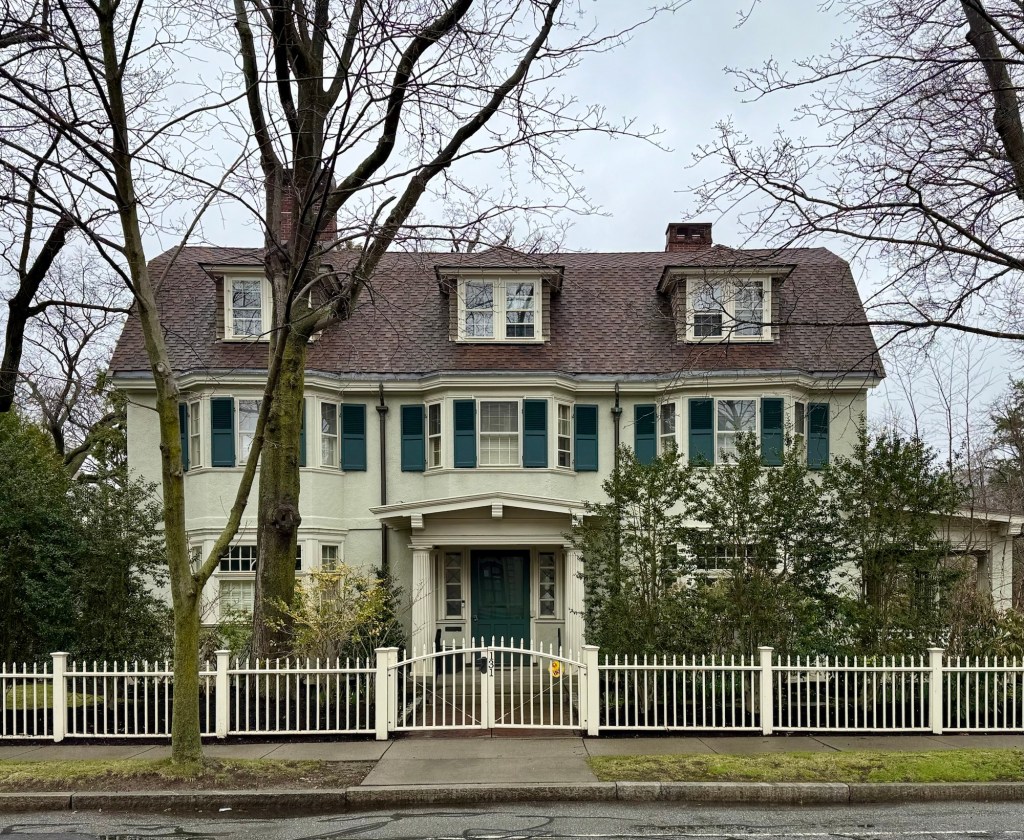
In 1902, Francis Bryden Dana (1865-1917) began construction on his home here in the Cottage Farm neighborhood of Brookline, Massachusetts. Francis was a member of the wealthy Dana Family and as a young man, attended the Boston Latin School and Harvard College. He became the president of the Dana Hardware Company of Boston. For his Brookline residence, Dana hired the exclusive architect, William Gibbons Rantoul to design the house which blends Arts and Crafts and Colonial Revival styles. The use of stucco siding, shed dormers, and portico with low sloped roof revealing exposed rafters falls squarely within the Arts and Crafts style; while the symmetrical facade, gambrel roof, and projecting octagonal bays are reminiscent of the more traditional New England Colonial Revival style.
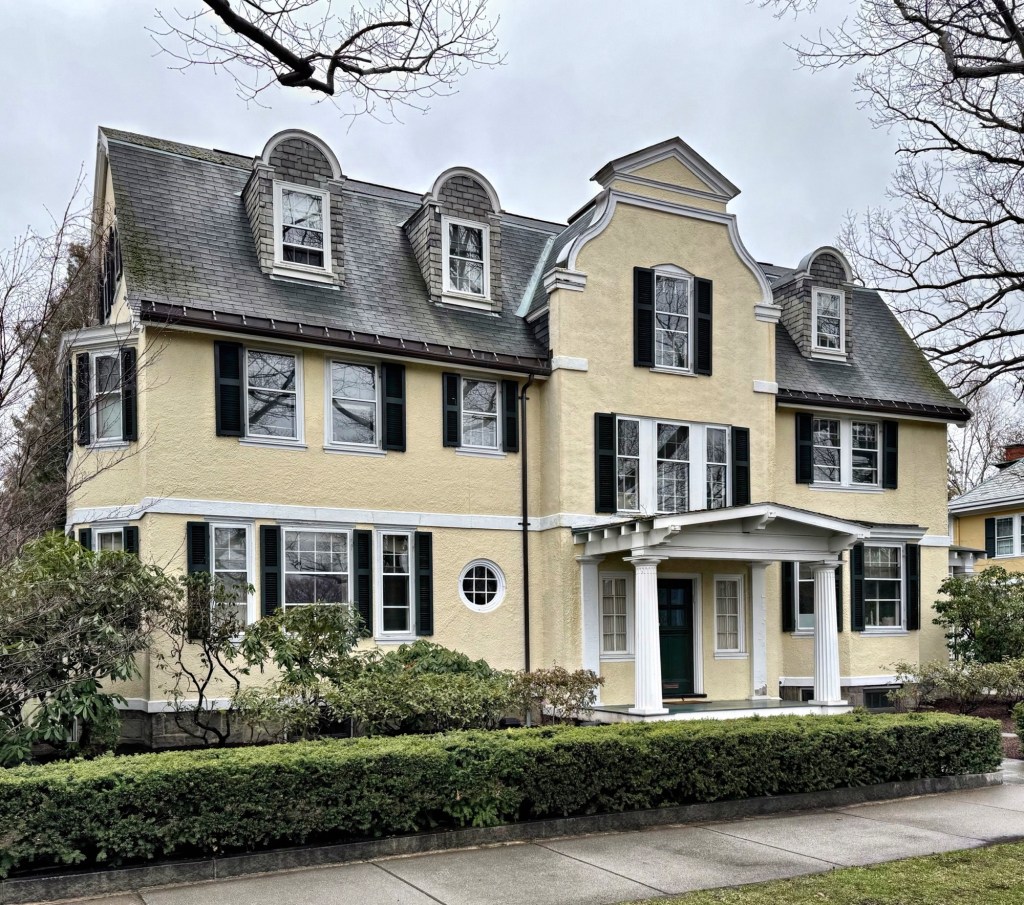
In 1905, George H. Cotton and his wife, Cora S. Cotton, purchased a house lot on Amory Street in Brookline and hired famed architect, William Gibbons Rantoul, to design this home for their son and daughter-in-law. George Cotton was a manufacturer of brass tubing and also the founder of the Belmont Springs Water Company and maintained homes in the Back Bay of Boston and in Belmont. His son, Harry W. Cotton, also worked for the American Tube Works and lived in this home with his family. The Cotton House is an architectural blending of Dutch Renaissance Revival and Arts & Crafts styles. The stucco siding and entry portico are in the Craftsman style, while the prominent Flemish gable on the central pavilion and round arched pediments for the dormers are in the Flemish mode.
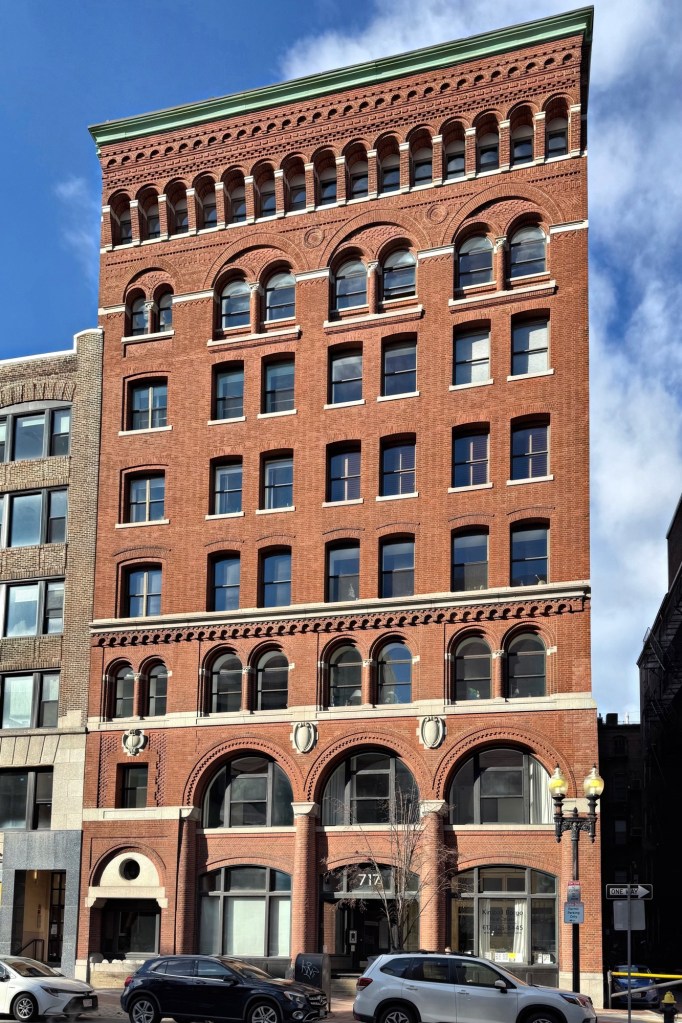
As far back as Colonial days, the boot and shoe industry was one of the State’s leading industries. Buyers came suburban towns to purchase supplies, and in the early 1800s, the larger manufacturers began to open offices and stores in Boston. Soon, most of the leading merchants had established places of business in Boston, by the late 19th century, many were located in the South Cove area, which became known as the Leather District. The Leather District is characterized today by large, brick structures with flat roofs and feature continuous floor levels, band courses, and cornice lines. This handsome brick building on Atlantic Avenue was built in 1901 for Charles G. Rice and the Heirs of Nehemiah W. Rice as a warehouse for the U.S. Leather Company. The building was designed by William Gibbons Rantoul, who studied architecture at Harvard, and apprenticed with Henry Hobson Richardson as a draftsman in the 1880’s before opening his own practice. In 1946, the subject property was purchased by Frank Einis, and the new tenants, Fur Merchants Cold Storage, Inc., used the building for the storage of skins and furs for manufacturing into soft goods. Architecturally, the building showcases the lasting influence of Richardson on architects and industrial buildings in Boston from the late 19th century into the early 20th century. The building can be classified as Romanesque Revival in style with its use of arches in the façade both structural and decorative, the Venetian arches at the 7th floor, as well as its arcaded corbelling over the 3rd level and at the cornice. I especially love the tall, engaged brick columns at the storefront, they are very unique!
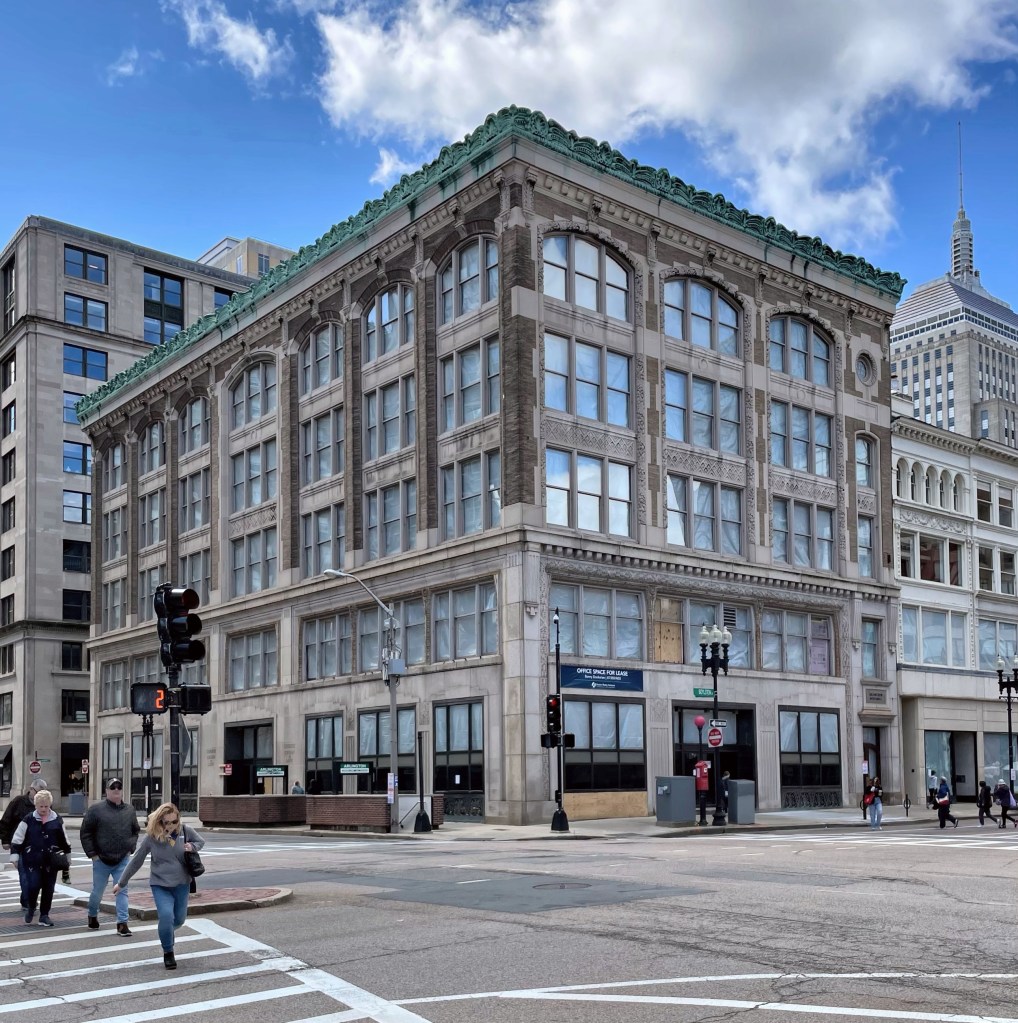
This one took me a while to write about because it still pains me to see it was demolished… The Arlington Building was constructed in 1904 as a mid-block building on Boylston Street, across from the Public Garden for the Bryant and Stratton Commercial School. It was designed by architect William Gibbons Rantoul of the firm Andrews, Jacques & Rantoul in the Beaux Arts style. The school building was significantly altered when Arlington Street was extended southward through Boylston Street, making this building suddenly a corner landmark. The new Arlington Street elevation was modeled after the Boylston Street facade. By 1929, Shreve, Crump & Low, established in 1796, the oldest purveyor of luxury goods in North America, moved into the building. The next year, they hired architect William T. Aldrich to add Art Deco embellishments and storefront designs, along with interior renovations to modernize the structure. The luxury company had downsized and moved out of the building, and its prominent site was threatened when owner/developer Druker Co. submitted for a demolition permit to raze the building (and others on the block) to erect a modern office/commercial building. After years of fighting between local preservationists and business interests and developers, the latter won and the building was demolished by late 2022. The new building, 350 Boylston Street, is presently undergoing construction, and in my opinion, is a poor attempt to fit into the surrounding context and is neither as unique or inspiring as the former building.
 Buildings of New England