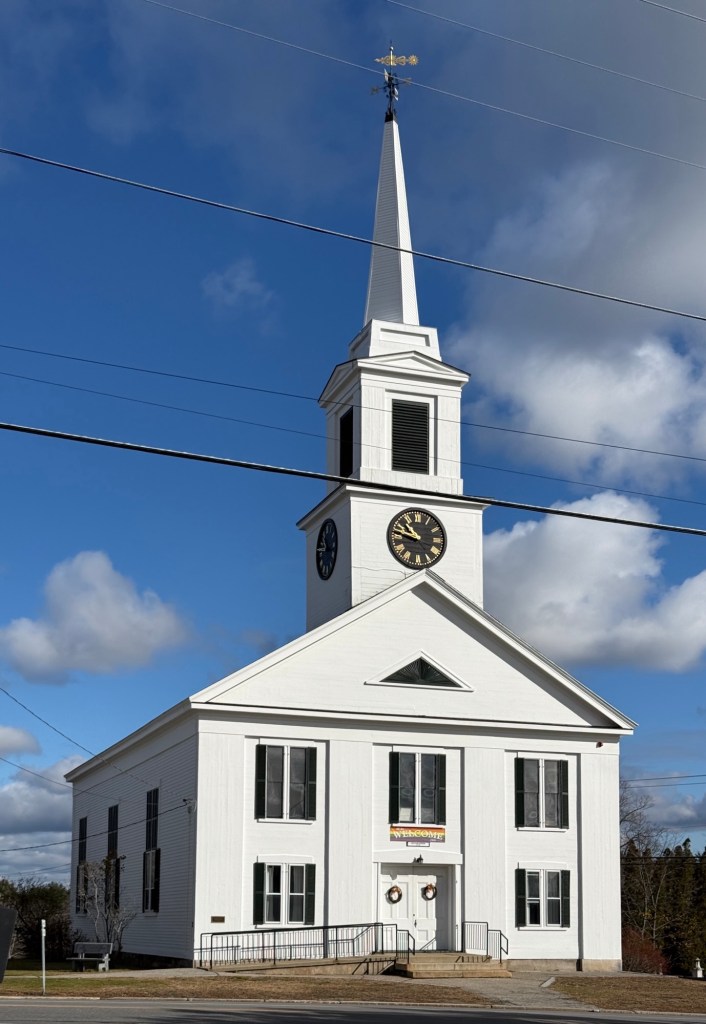
In October 1729, just seven years after incorporation, the town of Chester, New Hampshire, voted to erect its first meeting house. The two-story building was completed in 1732 and stood roughly where the town’s Civil War Memorial is today. In the period prior to the Revolutionary War, parts of the original town land were partitioned off and incorporated as separate towns. Following this, a new, Second Meetinghouse was constructed in 1773, to show the stability of the town. The meetinghouse served as the town’s Congregational Church and site for town meetings until Toleration Act of 1819, effectively created a separation of church and state for towns in New Hampshire, making an end to mandatory public taxation to support churches and ministers. The Town utilized a former academy building as the town hall, and the 1773 Second Meetinghouse was incorporated into a new church. It is said that the framing of the 1773 structure was turned and substantially altered in the Greek Revival style in 1840. The present Congregational Church of Chester features a flushboard facade with flat pilasters dividing the three bays, a pediment with louvered triangle, and a three-stage tower that rises from the front ridge, adorned by clocks added in 1881.

