Littlefield-Van Zandt House // 1836

In the late 1830s, Captain Augustus Littlefield (1803-1878) purchased a house lot on Pelham Street in Newport, Rhode Island and commissioned housewright John Ladd to design and build his new residence. Littlefield reportedly asked his Ladd to design an “authentic copy of an Italian Villa” he had seen during a trip in southern Italy. The result is a more traditional Greek Revival, temple-front house with a portico supported by four monumental columns with capitals that combine Corinthian and Egyptian lotus motifs. The minimal Italian Villa detail can be seen in the bracketed cornice and in the pediment. Built around 1836, the house remained in Littlefield’s possession until his death in 1878. The property was purchased by Charles C. Van Zandt, attorney and later the 34th Governor of Rhode Island. Gov. Van Zandt died in 1894 and was interred at Island Cemetery in Newport. The Littlefield-Van Zandt House remains a significant early, high-style Greek Revival house in the state and one with a great state of preservation.

Levi Starbuck House // 1838

One of the more unique Greek Revival style houses I have yet seen in New England is the Levi Starbuck House on Orange Street on Nantucket. The house was built in 1838 by housewright William M. Andrews who sold the completed property that year to Levi Starbuck, a wealthy sea captain for $5,000. When he bought the house, Levi Starbuck (1769-1849) was 69-years-old. Levi Starbuck is credited by some as inspiration for the character Starbuck in “Moby Dick.” He would spend the last ten years of his life in this opulent new house on Orange Street. Architecturally, the house is clad with flush siding with projecting paneled pilasters with fret patterns on the top and bottom breaking up the bays of the house.

Weir Farmhouse // c.1780

Impressionist painter, Julian Alden Weir was looking to build a home in New York’s Adirondack Mountains when Erwin Davis, an art dealer, offered him a farm in Ridgefield, Connecticut, for a painting he owned plus ten dollars. After a visit in 1882, Weir agreed and acquired the 153-acre farm. The old farmhouse, which dates to the 1780s, and was modified in the Greek Revival style before Weir’s ownership and expanded and renovated again during its time as an artist’s retreat. The house was often filled with family and friends as a popular artistic retreat for Weir’s closest friends, including: Childe Hassam, Albert Pinkham Ryder, John Singer Sargent, and John Twachtman. Weir’s daughter Dorothy Weir, a noted artist in her own right, took over management of the property following her father’s death in 1919. Sculptor Mahonri Young would build a second studio at Weir Farm after the couple married in 1931. The Weir Farm site was designated as a National Historic Site in 1990, but prior to its permanent protection, Weir Farm had been subdivided for housing development in the late 1980s. The Trust for Public Land worked to reacquire the divided land through close to 2 dozen transactions, preserving the site for generations to come.

Robinson Homestead // c.1835

Located in the Head of Tide village of Alna Maine, this large Greek Revival was once the home of prolific poet, Edwin Arlington Robinson. The home was built around 1835, likely by Edwin’s grandfather, Edward Robinson. The home was inherited by Edward’s second-born son, Edward Jr. Edward Jr. and his wife, Mary Elizabeth Palmer had two sons before their third pregnancy. Their third child was Edwin, but his parents did not name him until he was six months old, as it was said that they wished for a daughter. On a vacation, other vacationers decided that their six-month-old son should have a name, and selected the name “Edwin” from a hat containing a random set of boy’s names. The man who drew the name was from Arlington, Massachusetts, so “Arlington” was used for his middle name. Edwin described his childhood as “stark and unhappy” and his young adult years were plagued with tragedy with the death of a brother from a drug overdose and with his older brother marrying the woman that he was in love with. He would defy the odds and was accepted to Harvard. He became engaged in writing, specifically poetry, with his early struggles leading many of his poems to have a dark pessimism and his stories to deal with “an American dream gone awry.” He would go on to be awarded the Pulitzer Prize in Poetry three times in the 1920s. While he would likely not want to ever see this house again, it is significant both architecturally and as the home in his formative years in Alna.

Head Tide Church // 1838

In the early 19th century, Head Tide was a bustling village within the Town of Alna, Maine, supported by mills at the dam, agriculture and apple orchards, boat building, fishing and forestry. As Head Tide grew in population, village leaders determined to build their own Congregational church so they would not have to travel the three miles to the 1789 Meeting House in Alna Center. The Head Tide Church in Alna, Maine was dedicated in November 1838 and sits on a hill overlooking the village. The Head Tide Church is a handsome rural Maine house of worship which exhibits a combination of Federal style, Greek Revival, and Gothic Revival elements in its design. The facade displays the outline of a Grecian temple front with its six pilasters and strongly accented triangular pediment. The Federal fan motif appears above the two facade windows as well as in the center of the pediment and the Gothic Revival influence is felt in the two pointed arch windows on either side of the church and in the simple pinnacle at the top of each corner of the belfry. The church is a high-style building for the rural Maine village and is kept very well by the community. The congregation disbanded, but the church remains an important part of the town and is rented for memorial services, events, weddings.

St. Denis Catholic Church // 1838

Believe it or not, this church in rural Whitefield, Maine is the second oldest Catholic Church in New England! As Irish and French Canadian families settled in this part of Maine in the early 19th century, Catholic churches were needed to provide worship space for those families. The church community of St. Denis began in 1818 when Father Dennis Patrick Ryan, an Irish immigrant serving at St. Patrick Church in Newcastle (the oldest Catholic Church in New England), moved to Whitefield to serve the influx of Irish Catholics and soon founded the church. Fr. Ryan oversaw the construction on a wood-frame structure built on this site. As more Catholic families settled here, a more permanent building was needed, and between 1833 and 1838, the main portion of the present brick church building was constructed around that original church. The tower was added in 1861, and the stained glass windows also date from later in the 19th century following the growth and prosperity of the church and its members. The St. Denis Parish House was constructed across the street in 1871 and is a lovely Romanesque style building.

Joseph Cottrell House // 1843

The Joseph Cottrell House on Spring Street in Newport is a handsome, two-story, Greek Revival style house with flushboard siding and a traditional pilastered recessed center entry. What really stands out about this home is the two-story rounded corner bay which is finished with columned porches (since enclosed) which were likely added in the second half of the 19th century. Cottrell worked as a ship-builder in Newport, likely constructing the house and later addition himself. Developers today would never!

Town-Sheffield Mansion // c.1836-1957

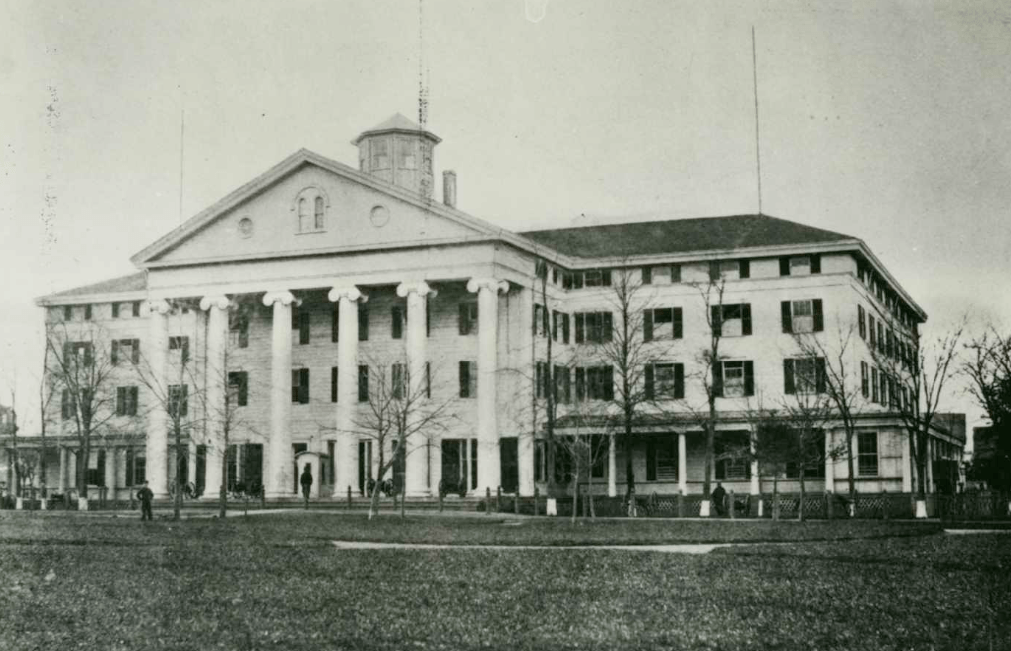
One of the biggest architectural losses in New Haven was the 1957 demolition of the Town-Sheffield Mansion, formerly on Hillhouse Avenue. The mansion was built around 1836 by esteemed American architect and civil engineer Ithiel Town (1784-1844) as his own home on Hillhouse Avenue in the Greek Revival style; here he kept what was then an extraordinary architectural library, which was said to have been larger than any other personal collection anywhere at the time, including that of Sir John Soane in London. After Town’s death, the house was bought by Joseph Earl Sheffield in 1859, benefactor of the Sheffield Scientific School at Yale, and modified by local architect, Henry Austin in the Italianate Villa style. Alterations included two large asymmetrical towers, a new porch, and symmetrical side wings with large bay windows. After Sheffield’s death in 1889, the building was used for laboratory space for the school. Although the house was one of Austin’s most important works, it was demolished in 1957 by Yale to make way for Dunham Laboratory.

North Weare Schoolhouse // 1856

The Town of Weare, New Hampshire was first divided into thirteen school districts in 1805 as a result of a state law to divide each town into school districts to service all students equally. Over the years the number of school districts fluctuated and were periodically redefined based on population distribution and class sizes. The North Weare Schoolhouse was built in 1856 and was operated as a one-room school until 1952 when a consolidated school was built in town. Architecturally, the building blends multiple styles, most notably the Greek Revival and Italianate styles. The property was later occupied as a Grange Hall with a 1960s addition to the rear. It was purchased in 1985 by new owners who had spent years restoring the building as a residence before they sold it more recently. Today, the former schoolhouse has modern additions and windows, but maintains its charm and uniqueness.

Amos Chase House and Mill // 1836

The Amos Chase House and Mill are located in Weare, New Hampshire, on the banks of the Piscataquog River. The house is oriented facing the road, while the mill is behind it, on the bank of the river. The mill is the only surviving 19th-century mill building in Weare. The house was built about 1836 by Amos Chase, as was a mill. That mill burned in 1844; the present mill was built by Chase as a replacement a few years later. This mill was the only one in the town to survive the New England Hurricane of 1938, although its waterwheel was washed away. Amos Chase was a tool manufacturer and one of several members of a locally prominent family operating small mills in the town. His son later used the mill in the manufacture of baskets. The large Greek Revival style home has all the hallmarks of the style, from the pediment facing the street, to the pilasters at the entrance and corners.