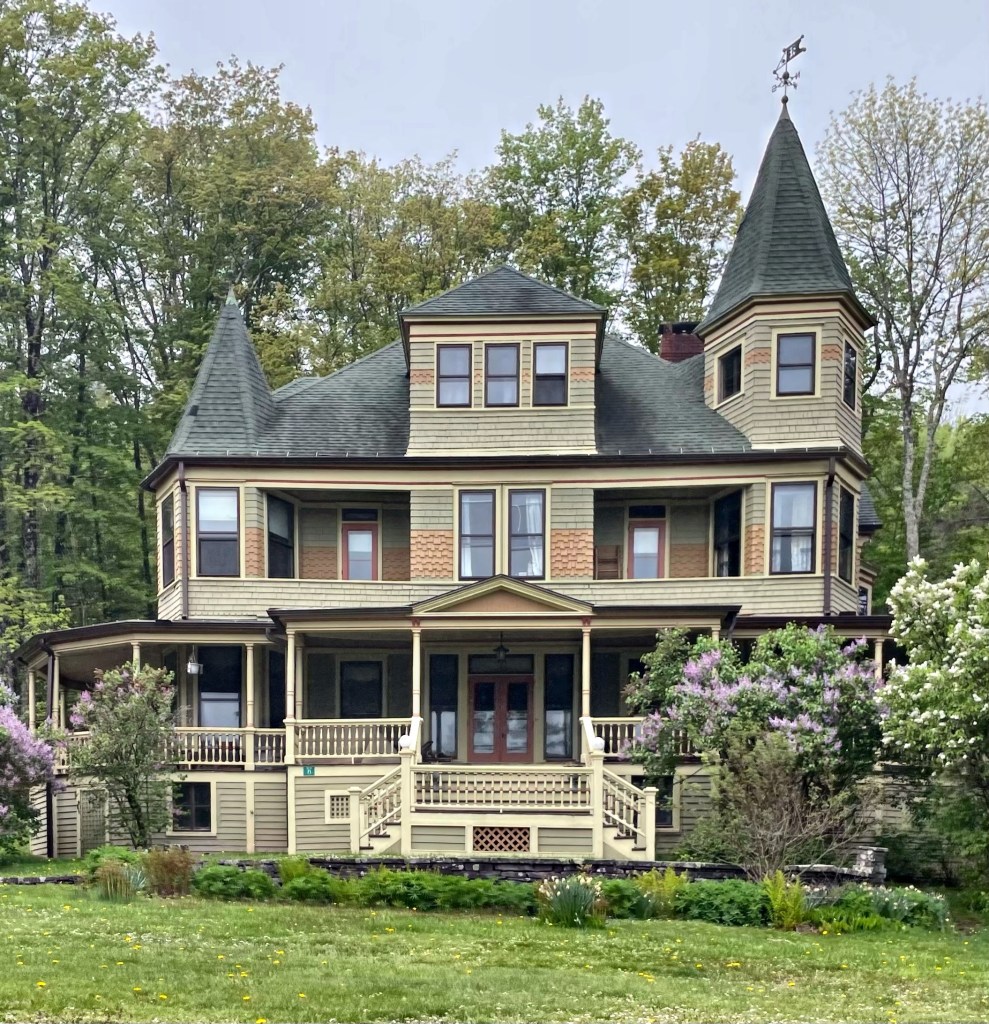
Arthur Blanchard House // 1892

I do not feature enough Queen Anne style buildings on my account, as penance, I present this beautiful example of the style with a painted lady color scheme! Located on Windsor Avenue in West Acton, Massachusetts, this house was built in 1892 and has all the hallmarks of the Queen Anne style. The use of varied siding materials and forms, asymmetrical form, applied ornament, and large five-sided tower capped by a conical slate roof with weathervane. The home was built for Arthur F. Blanchard, a local businessman who operated an apple farm and marketing business opened by his father. Mr. Blanchard was a philanthropist in town and used his wealth to enhance his hometown by funding the Blanchard Auditorium at the Acton High School (1925) and was a benefactor of the West Acton Women’s Club in 1925. He and his son, Webster, also founded the Blanchard Foundation in town in 1946, an organization which funded and sponsored educational projects for the community.

Sawyer Mansion // 1863 & 1914

Originally built in the Carpenter Gothic style in 1863, the Sawyer-Gillett Mansion in Whitingham, Vermont, is the highest-style house in town today. Indistinguishable from its Civil War-era original construction, the house was greatly expanded and altered into an elaborate take on Queen Anne / Shingle styles in 1914. The house was originally constructed by John W. Sawyer, but it was his son, Lincoln H. Sawyer who renovated the house and etched his name “L.H. Sawyer” on the glass of the new front door. The updated house style reflects a nostalgic Victorian preference by the owner, who sawed all the trim and materials on site at the family sawmill. It was recently sold and is now a B&B!

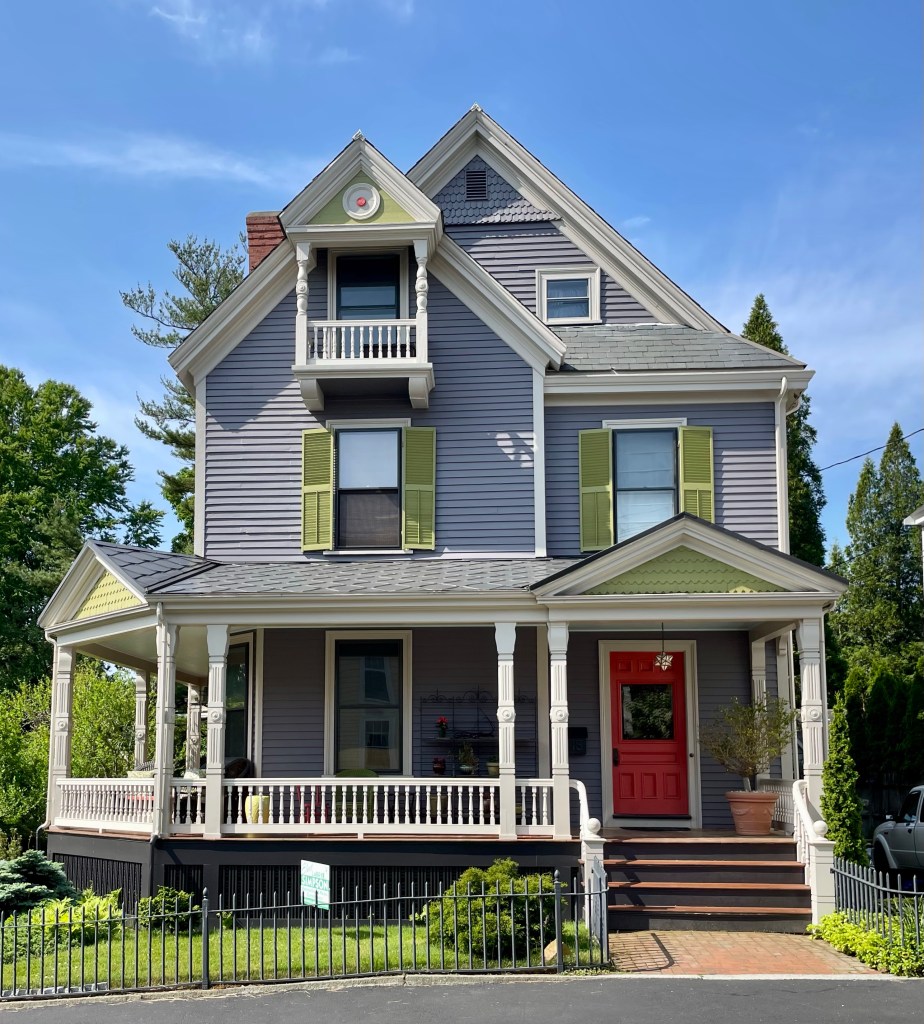
Thomas D. Hamson House // c.1895

Marblehead, Massachusetts is better known for its Colonial-era homes, but there are definitely some amazing old Victorians interspersed in the warren of narrow streets and alleys. This Queen Anne style house was built in the 1890s for Thomas D. Hamson, who was listed in directories as a shoe manufacturer. Queen Anne style Victorians typically exhibit asymmetrical plans, varied projecting and receding planes, varied siding materials and forms, turned posts and porches, and towers and turrets. This house has it all!

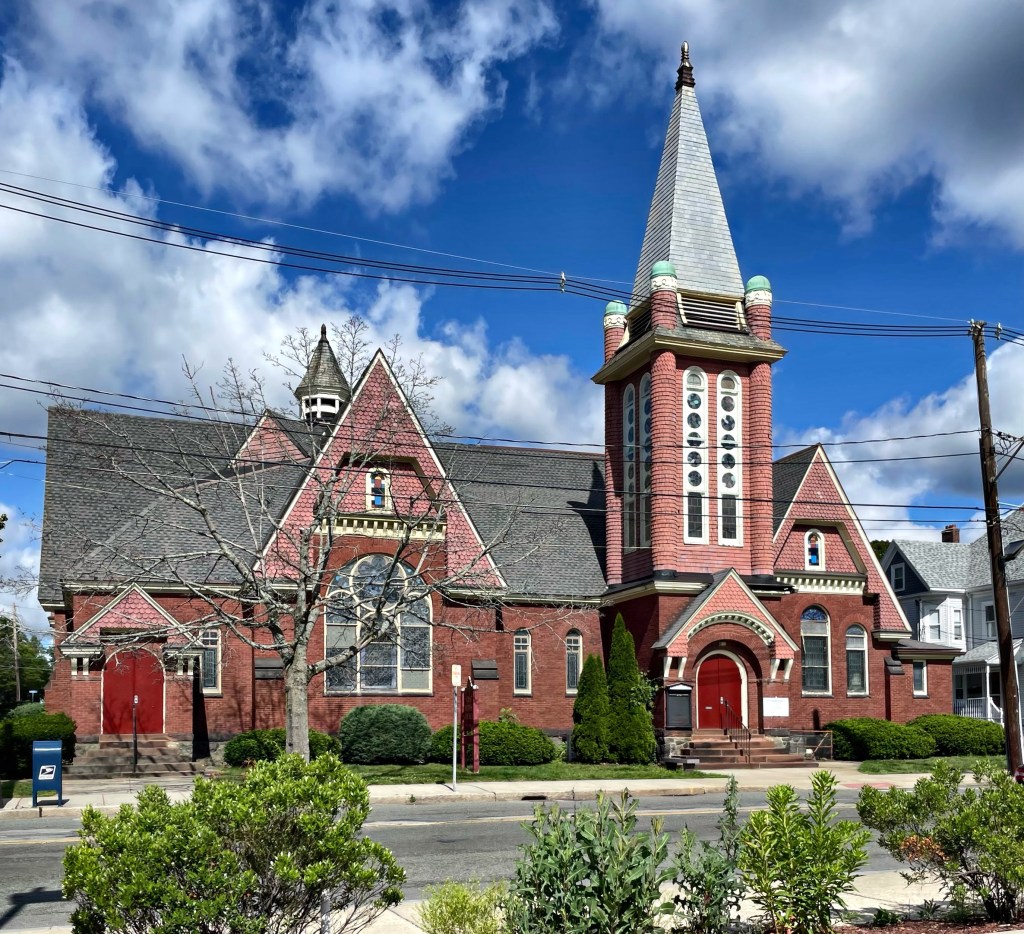
First Baptist Church of Stoneham // 1892

In 1891, the Baptist Society of Stoneham, Massachusetts unveiled that it had acquired funding and approved the plans for its first purpose-built church building in town. The organization met in a shared chapel in town since its founding in 1870. The new church would be unique in the Boston suburb as the only in town to be of the Queen Anne/Shingle style. A prominent site on South Main Street was acquired and work began in 1892 to erect the new house of worship. The design of the church is credited to the firm of L.B. Volk & Sons, a firm who specialized in church buildings with commissions all over the country. The church is complex in plan and combines brick and shingle siding in its construction with a prominent two-story tower with rounded corners and stained glass rondels (round windows).

Charles Copeland House // c.1875

Spot Pond, now encompassed by the Middlesex Fells Reservation, became a site of country retreats for Boston businessmen in the mid-late 19th century. One of the property owners was Charles Copeland, a confectioner and ice cream dealer, had ice houses on Spot Pond where he harvested ice for production into ice cream in Boston area shops. Copeland’s main house was located near the ice houses at the eastern shores of the pond, but this home was also owned by him in the 1870s. This residence was possibly rented out by Copeland or occupied by one of his many children. It remains a great example of the Stick and Shingle styles of architecture. The residence is maintained as part of the Massachusetts Department of Conservation and Recreation’s property in the Fells Reservation park.

Keuffel Cottage // 1893

Built nextdoor to his business partner’s summer cottage (last post), Wilhelm (William) J. D. Keuffel, a German immigrant from Saxony, erected this summer cottage in the fashionable German-developed summer colony Elka Park in upstate New York. Keuffel & Esser Company (K&E) was founded by German immigrants Wilhelm J. D. Keuffel and Hermann Esser and manufactured high-quality surveying, drafting, and calculating tools for architects, engineers, surveyors, and building contractors in Hoboken, New Jersey with a sales office in Manhattan. By the early twentieth century, it was one of the largest manufacturers of scientific instruments in the world. Keuffel made good money, and summered in Elka Park for years until his death in 1908. The Queen Anne style Victorian “cottage” features the typical asymmetrical plan, corner towers, varied siding and detailing, and many porches to provide the residents with sweeping views of the distant mountains.

Juniper Ledge Cottage // 1889

Ellen Kemble (Bartol) Brazier was born in New York City in 1844, the eldest of four children of Barnabas and Emma Bartol. Her father had many business interests in sugar refining and the family was able to travel the world from his wealth and success. The family spent most of their time in Philadelphia, but like many of the city’s wealthy residents, they often summered elsewhere. Ellen Bartol married Joseph Harrison Brazier in 1866 and they had two children. When her father Barnabas died, Ellen inherited some of his remaining fortune and as a part of high society, she had a summer cottage in Kennebunkport built. Working with Maine architect John Calvin Stevens, she oversaw the designs of Juniper Ledge, this gorgeous, eclectic shingled residence in the Cape Arundel summer colony. Ellen would summer at the cottage until her death in 1925, but before she died, she joined her daughter in the 1910s and 1920s at Women’s Suffrage events and fundraisers, helping to pass the 19th Amendment, allowing women the right to vote in the United States. Ellen is buried in the West Laurel Hill Cemetery in Philadelphia next to her husband, not far from her parents.

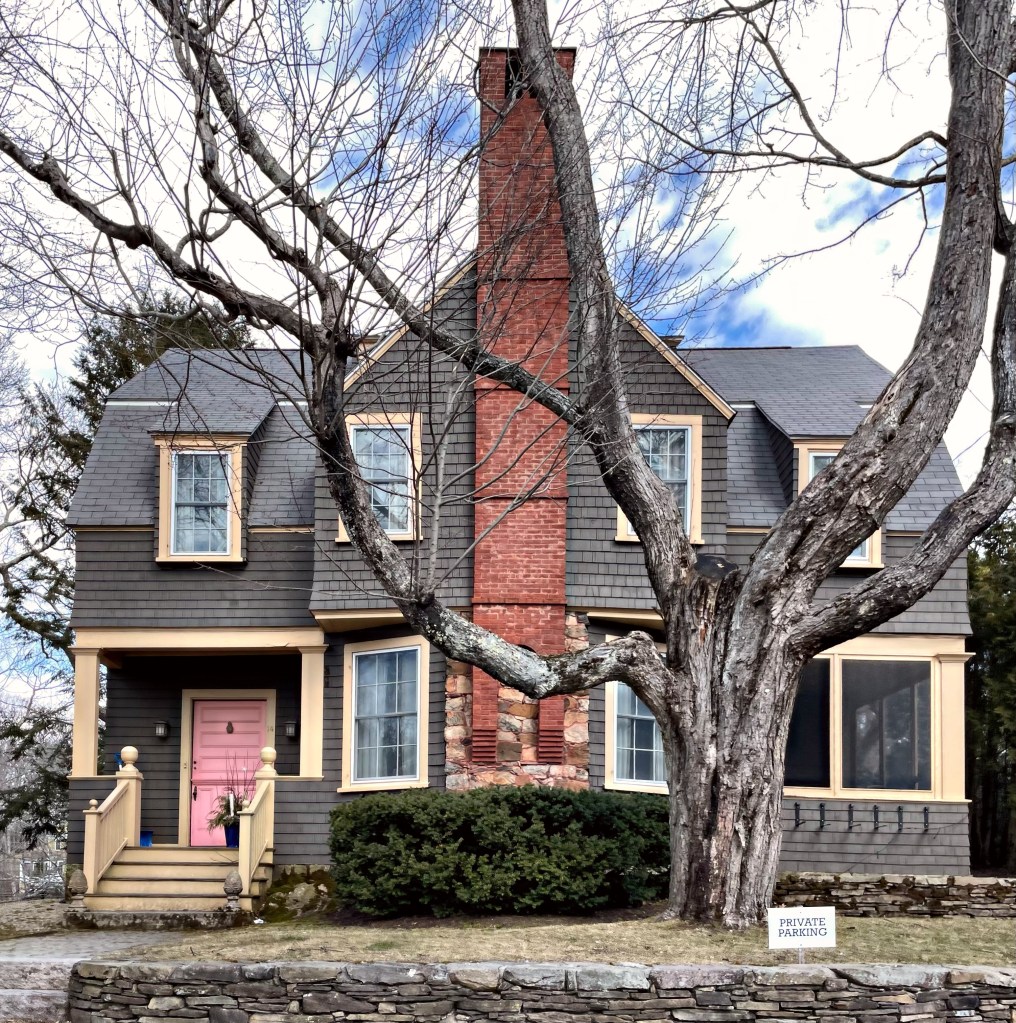
“The Dory” Cottage // 1888

Before Miss Gerrard purchased the Glen Cottage (last post) in 1900 in Kennebunkport, Maine, she had already summered in her own summer cottage nextdoor for over a decade. In 1888, she hired an architect from New Jersey to furnish plans for this charming shingle and stone cottage as her summer retreat. The cottage features a prominent brick and rubble stone chimney facing the street with a gambrel roof. The entrance is tucked away under a recessed porch and looks to be the original dutch-door. I can’t imagine how amazing summers in this house would be!

Nesmith-Kent Cottage // 1891

One of the most iconic summer “cottages” in Kennebunkport’s late 19th-early 20th century summer colony is the Nesmith-Kent Cottage, located next door to the often photographed St. Ann’s-by-the-Sea summer chapel. The cottage was built for Julia and Mary Nesmith, the daughters of John Nesmith a wealthy industrialist and textile manufacturer from Lowell MA. The sisters named the cottage “The Pebbles”, and spent their first night there on July 24, 1891. The half-timbered shingled house stood at the edge of the ocean near a former War of 1812 fortification. The sisters sold the property in 1910 to Arthur Atwater Kent, prominent radio manufacturer based in Philadelphia, who invented the modern form of the automobile ignition coil. Kent renovated the cottage extensively, increasing its size, and renamed “The Pebbles”, “At Water’s Edge” in a cheeky play on his last name. In 1919, he expanded again, purchasing a lot adjacent to his mansion which was the old fort constructed to protect the ships moored in the harbor during the War of 1812. In early 1919, workmen uncovered a few bones of what was calculated to be a seven-foot-tall man and two skulls of white men that had clearly met their end at the hands of Native people; one pierced by an arrow and the other scalped. The Kennebunkport Historical Society has one of these skulls in their collections. Today, the Nesmith-Kent Cottage is owned by the St. Ann’s-by-the-Sea congregation as their rectory.

Former Vermont State Hospital // 1890

The former Vermont State Hospital campus in Waterbury, Vermont, is a 36.3-acre campus of institutional buildings that have been converted for use as state government offices. A sprawling array of more than 17 structures, the hospital, which historically treated mental disorders, was first funded by the Vermont State Legislature in 1888. Construction began on the plans by the Boston architectural firm of Rand & Taylor in 1890. The architects designed the landmark main administration and auditorium building at the core, which is built of brick on a rusticated stone foundation and under a steep hipped slate roof. The building is connected by single-story links to two-and-a-half-story wings, which are attached to clustered two-story cylindrical wards. In planning the hospital, Rand & Taylor stressed the isolation of patients and stressed the importance of light and air in each room and restricted height of the building to facilitate egress from upper floors in the event of fire or emergency. The asylum has a dark history in that Dr. Eugene A. Stanley, the Superintendent from 1918–1936, was an advocate of eugenics and espoused forced sterilization and advised the Eugenics Society based on his patients records. From this, the word, “Waterbury,” became used in a derogatory sense, and did harm to the town for years. The hospital was closed in 2011 due to flooding in the aftermath of Tropical Storm Irene, and after a thorough renovation by architects Freeman French Freeman and Goody Clancy, the complex re-opened in 2015 as State Offices with renovated historic assets and modern, contextual new buildings.