Located on stunning West Broadway in Bangor, Maine, the Smith-Miller House stands out as a beautiful blending of the Shingle and Queen Anne styles. Built in 1893 from the designs of Connecticut architectural firm Cook, Hapgood, and Company, the home was featured in The American Architect and Building News journal for its design success. The home is clad with continuous cedar shingle siding, with a prominent corner tower, wrap-around porch, and porte-cochere, all together provide complexity and intrigue on the street of large homes. What do you think of this home?
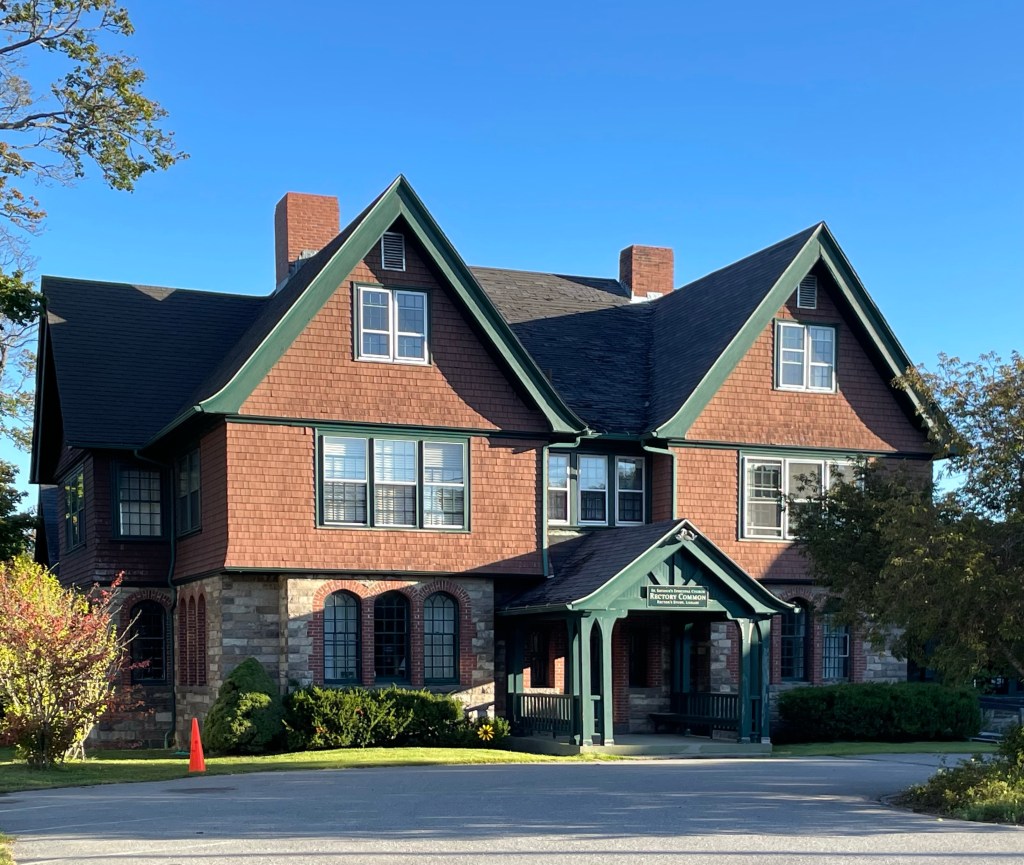
Standing adjacent to the beautiful St. Saviour’s Episcopal Church in Bar Harbor (last post), the church’s Rectory building fits very well into the landscape here. Built in 1898, the rectory is a two-and-a-half-story stone and frame home with a projecting entrance porch at the facade framed by a pair of steeply pitched gables. The Rectory was designed by Westray Ladd who grew up in the area, and worked in the office of Wheelwright & Haven in Boston, Massachusetts as well as with William Emerson and Peabody & Stearns before opening up a firm in Pennsylvania.
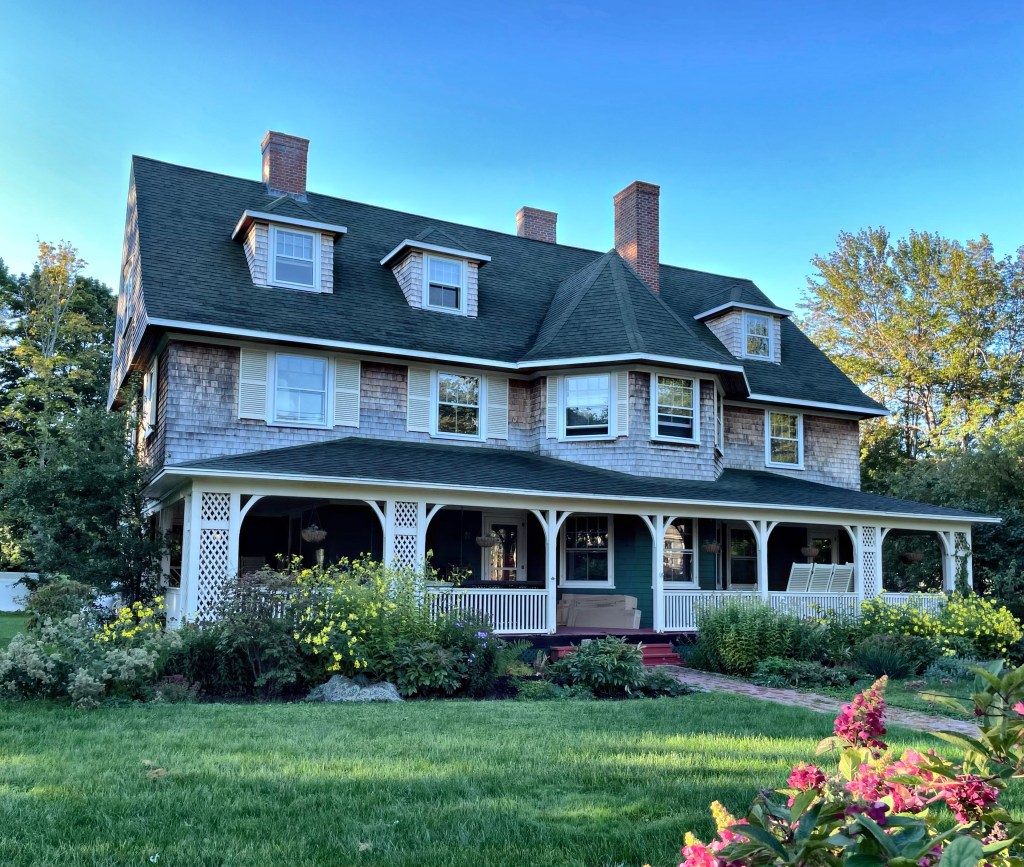
Built in 1901, “The Crossways” is one of Bar Harbor’s most stunning summer cottages built in the 20th century. The home was designed by the illustrious Boston architectural firm of Andrews, Jaques and Rantoul, possibly as part of the of the William B. Rice estate. The home appears to have been rented in early years until it was occupied by Edward and Esther Mears. Edward ran a hotel in town during the summer months before getting involved in real estate, where he made much more money. The home blends together the best of architectural styles of the time from Queen Anne to Shingle Style, and remains in an excellent state of preservation.
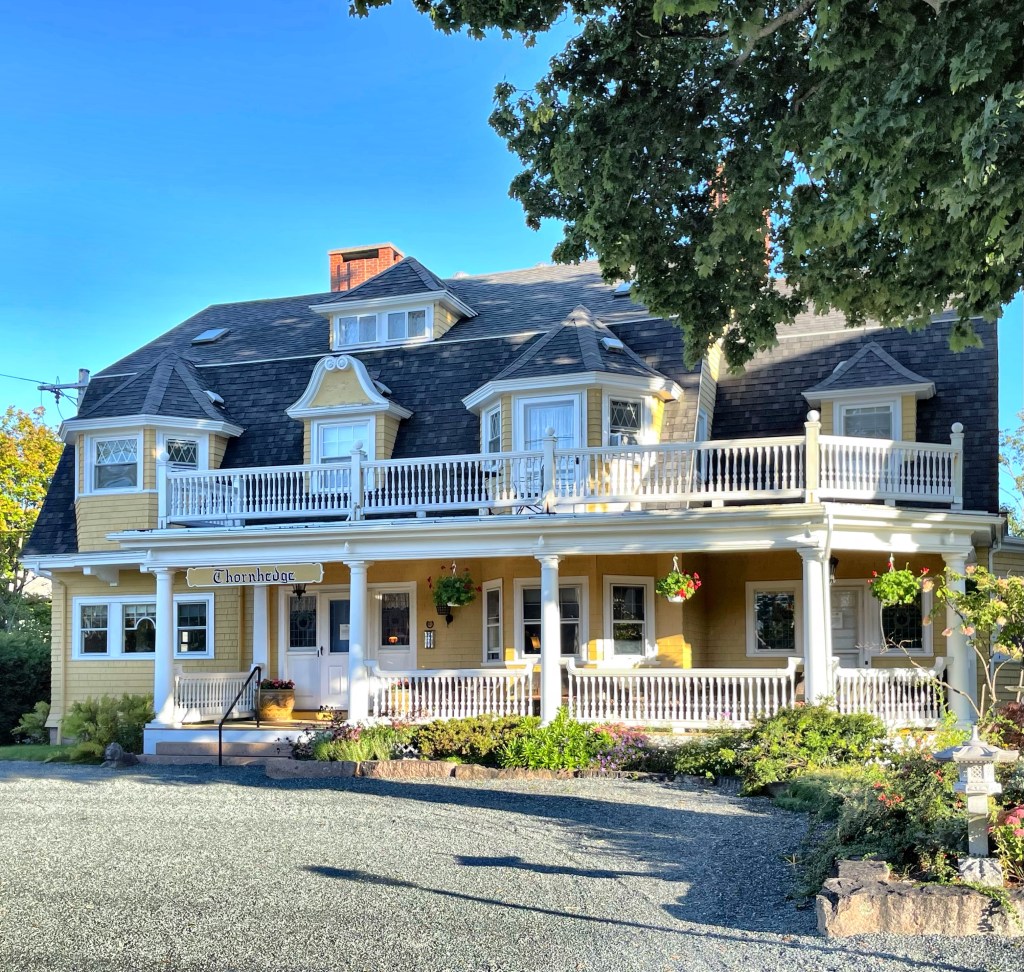
Located next door to “The Poplars” (last post), another summer cottage Thornhedge, stands out for its architectural splendor and great state of preservation. Similar to “The Poplars”, the home was built in 1900 for Lewis A. Roberts, a retired book publisher from Boston. Roberts ran the publishing house with his brothers, and they published work by authors including Emily Dickinson, Fyodor Dostoyevsky and George Sand, the first American edition of Treasure Island by Robert Louis Stevenson, and had their greatest commercial success with Little Women by Louisa May Alcott. The business was purchased by Little and Brown Publishing in 1898. Lewis Roberts died in 1901, only a year after completing Thornhedge, and the house came under the care of his son, Lewis Niles Roberts. Mr. Roberts kept the house as a summer residence until 1920, then sold it to the family of William F. Frick, a prominent judge from Baltimore. The home became an inn by the 1970s. Thornhedge is a Queen Anne style cottage which was originally organized with the first and second floor serving as the living quarters and the top and bottom floors for the servants. The laundry, servants dining hall, and kitchen were out of sight in the finished basement, with a dumb-waiter to bring hot food to the butler’s pantry. The third floor was the servants’ living quarters.
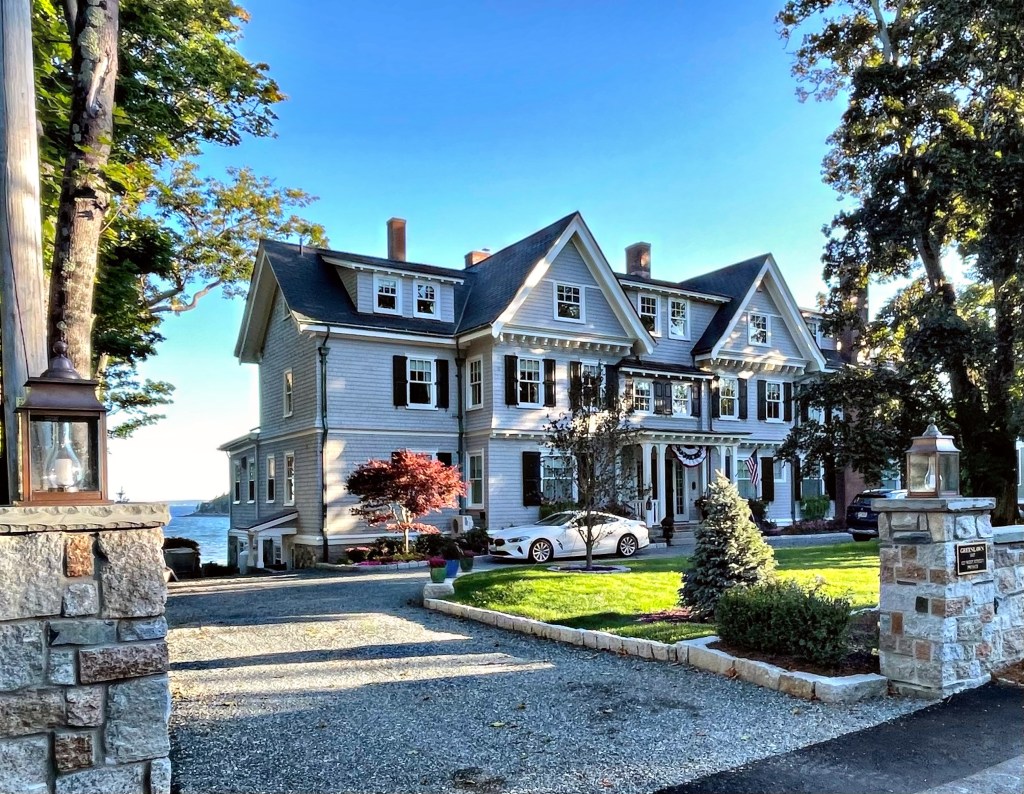
West Street in Bar Harbor was laid out in 1886, and developers laid out house lots on both sides, with larger, more expensive land right on the water. One of the earliest homes built on the street is Greenlawn, constructed in 1887 for William Rice, an industrialist who co-founded Rice & Hutchins, a shoe manufacturing company with main offices in Boston. The architectural firm of Rotch and Tilden, comprised of partners Arthur Rotch and George Thomas Tilden. Both had studied at the Massachusetts Institute of Technology and at École des Beaux-Arts in Paris. Both had worked at the architectural firm of Ware and Van Brunt, and would be best known for their Gilded age mansions in New England. By 1896, the cottage was owned by William L. Green, which is likely when the cottage’s name “Greenlawn” stuck. The house recently sold for $4.25 Million and the interiors are gorgeous!
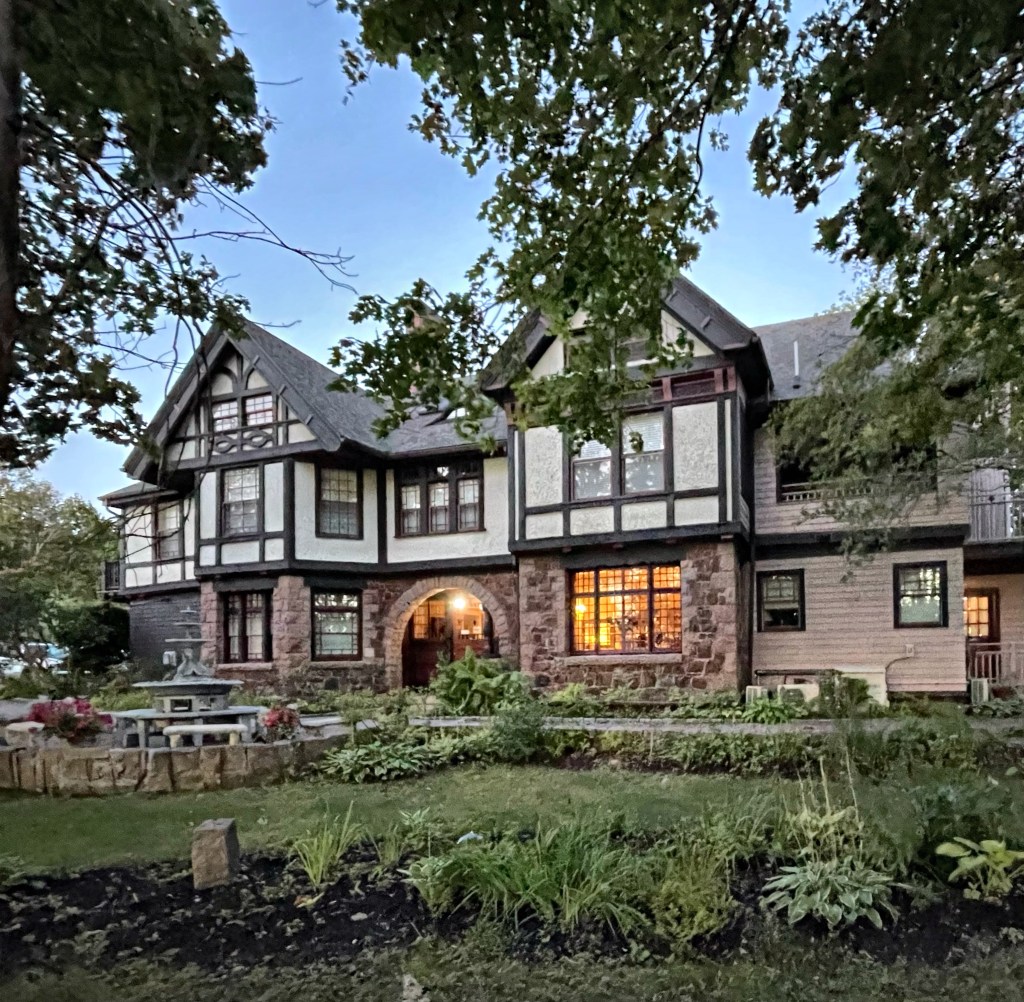
One of the earlier summer cottages in Bar Harbor is Ullikana, a Queen Anne style cottage, verging on Tudor Revival style. The cottage was built in 1885 for Alpheus Hardy (1815-1887) a trader in Boston. Hardy gained his wealth in shipping. He got his start by buying a small and fast ship that could make the voyage to the Mediterranean and back so quickly that he and his other investors captured much of the fruit importing business. His company would grow to have over 15 ships going as far as China. Hardy hired the Boston architectural firm of Cummings & Sears to design a new summer cottage in Bar Harbor, Maine, an ever-growing rival to Newport. He could only enjoy the cottage for two years, when in 1887, while cutting coupons, he dropped the scissors, the sharp points piercing his leg. Blood poisoning followed and death resulted. The summer cottage was owned by his family as a rental cottage for a number of years until it was purchased by the Maine Central Railroad, and rented to the recently widowed Princess Miguel de Bragança of Portugal, the former Anita Rhinelander Stewart. The cottage is now an inn.
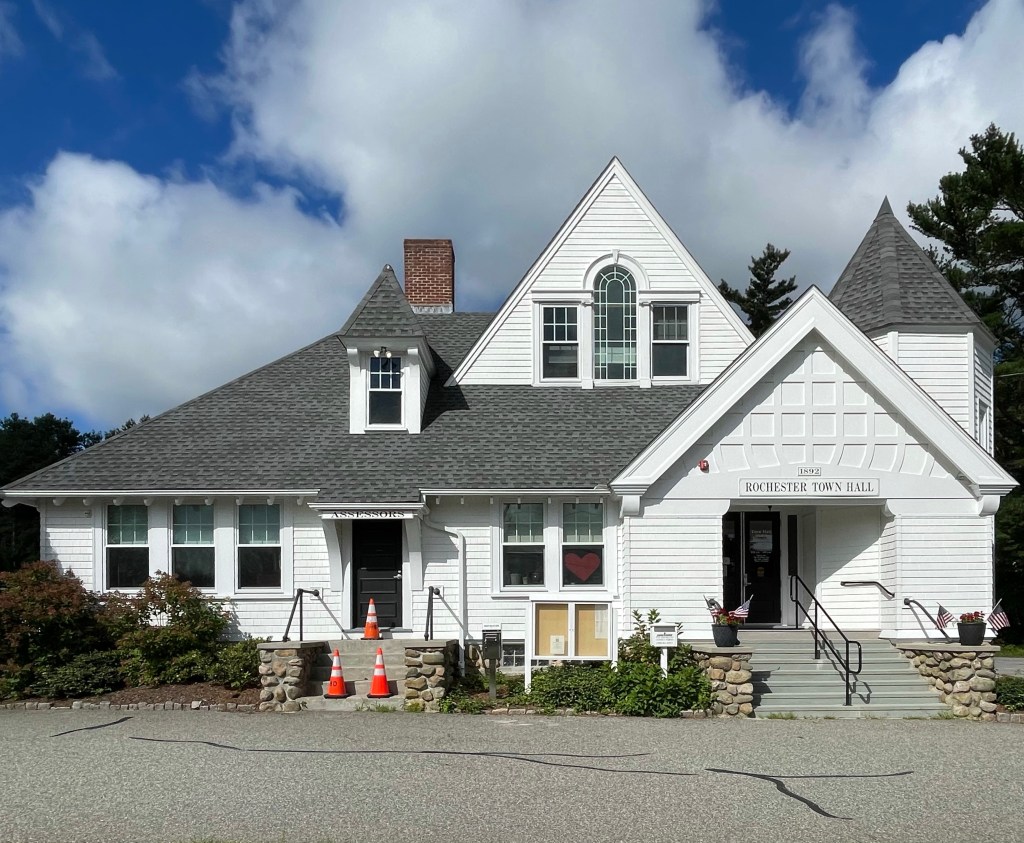
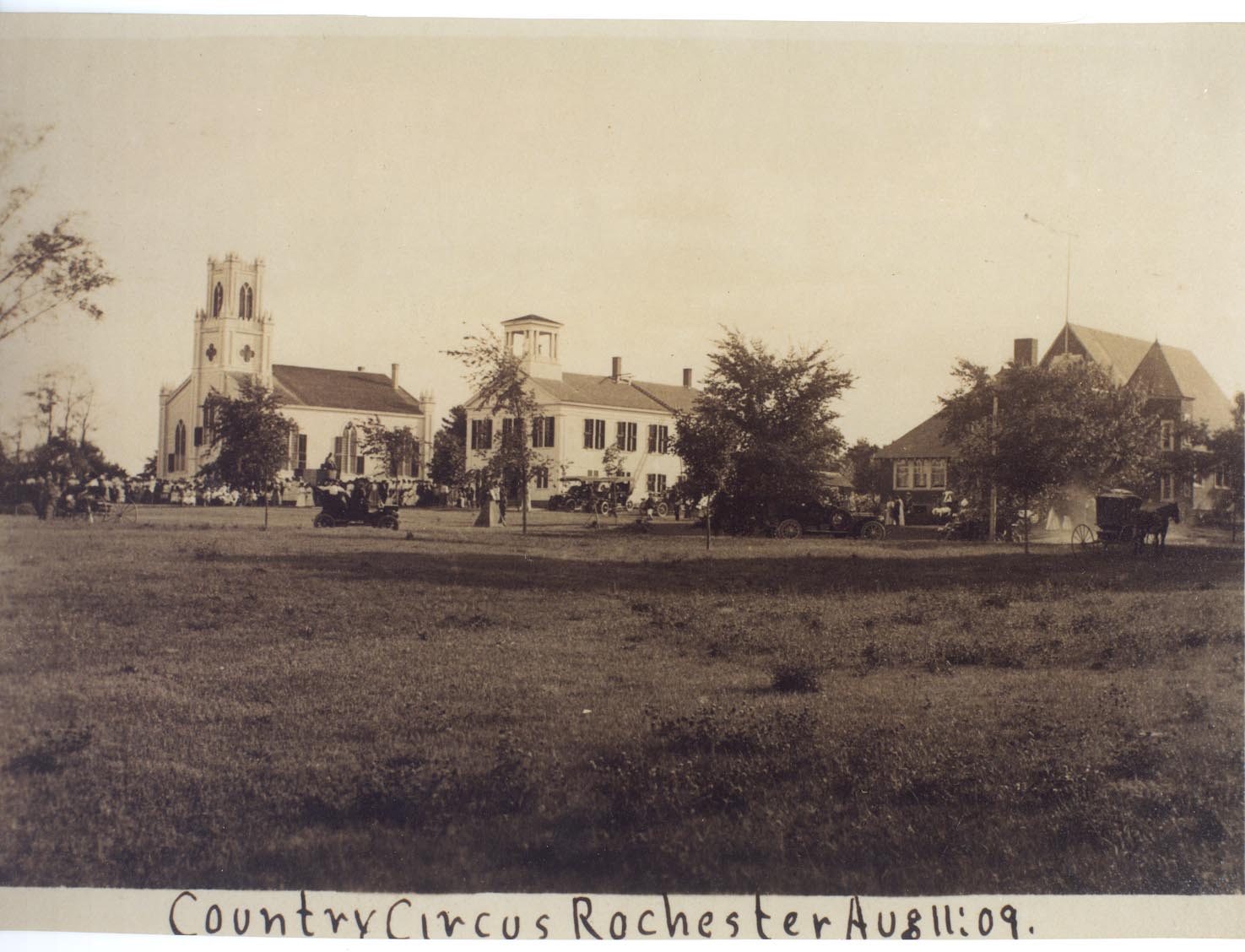
In 1679, three years after the end of King Phillip’s War, an armed conflict in 1675–1678 between indigenous inhabitants of New England and New England colonists, land that would become Rochester, Mattapoisett, Marion, and Wareham was purchased from King Phillip, and immediately divided among 32 proprietors of “Old Rochester.” The first white settlers took up residence in 1680, and the Town of Rochester was incorporated in 1686. Rochester town center was formally established in 1697 when land was set aside for a meetinghouse, burying ground and training field. Rochester’s first meetinghouse, built in 1699, served as a church and town building. A larger meetinghouse was built in 1717, and a third in 1760, doubling in size every time as the town’s population grew. The old buildings were insufficient for the growing farming town, and wealthy widow Elizabeth Leonard funded half the cost of a new town hall building. The current structure on the town green was built in 1892 and is an uncommon example of a Queen Anne style town hall in Massachusetts. The building originally was painted a darker color, common in the style, but was given a bright white paint scheme to blend in with the older buildings on the Green.
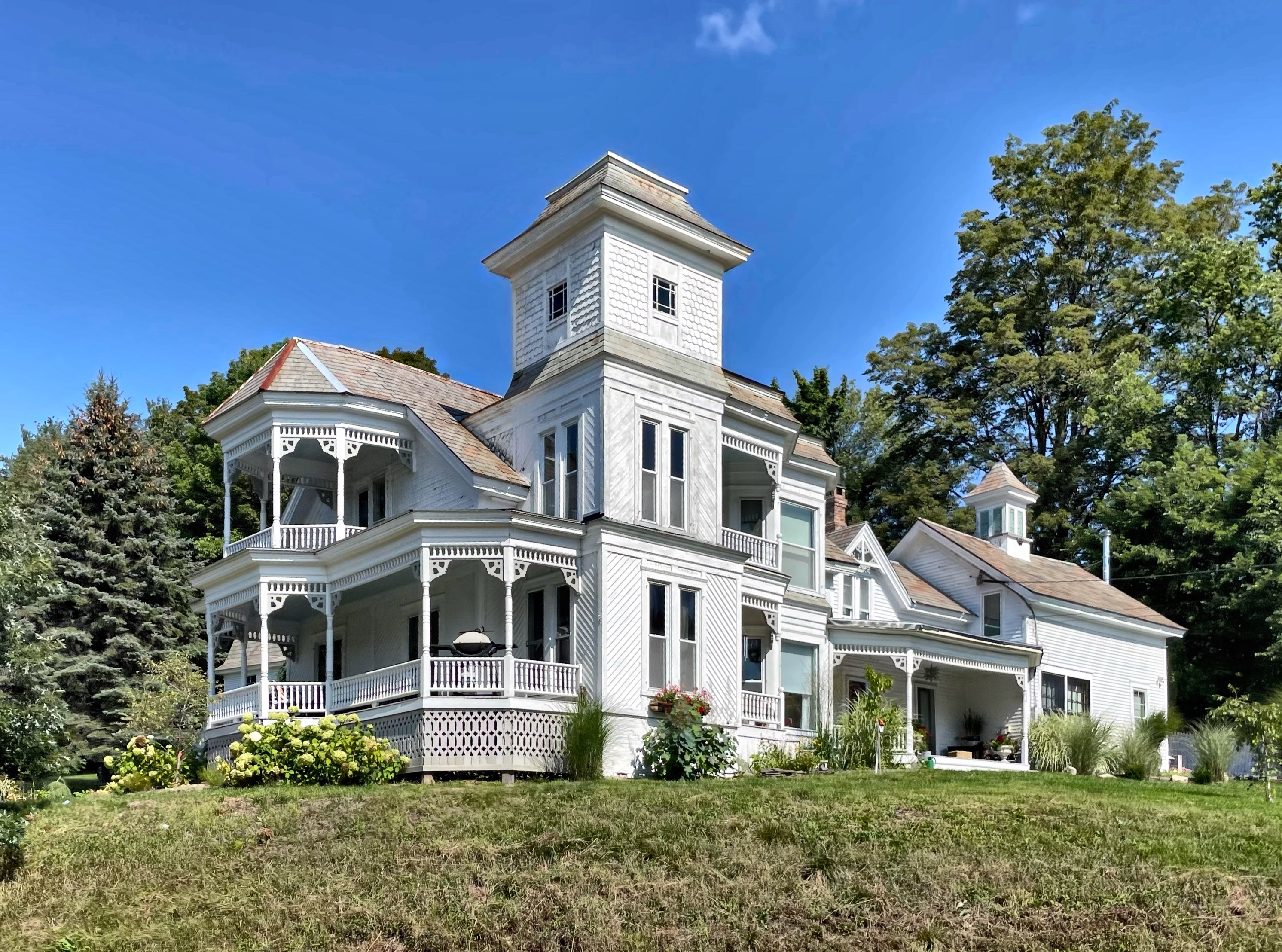
One of the most visually striking homes in little Chester, Vermont, is the Durand House. Sited prominently on a hill, the 1861 home resembles a wedding dress in bright white with intricate spindles that look like lace. The house was seemingly built for Urban Durand, one of the proprietors of the successful Durand Brothers Market in Chester village. The home has an elaborately trimmed full-front porch with a second-story polygonal balcony, and a three-story corner tower with a shallow mansard roof, all possibly later additions. The house stands out in the village, which is largely dominated by classical Federal and Greek Revival houses.
Next to the Israel Moore house (last post) in Chester, VT, the Emery Bolles house is yet another beautiful example of a snecked ashlar building in central Vermont. The town of Chester has the largest concentration of these buildings in the state in the north village, now known as Stone Village. The building method was so popular that even a couple examples sprouted up in the larger Chester Village nearby. Erected for Emory Bolles (who operated a wagon shop next door), this 1841 house possesses a 5-bay facade and a later, distinguished Victorian-era full-width porch. The porch incorporates turned posts with a central gable above the steps that carries an openwork screen.
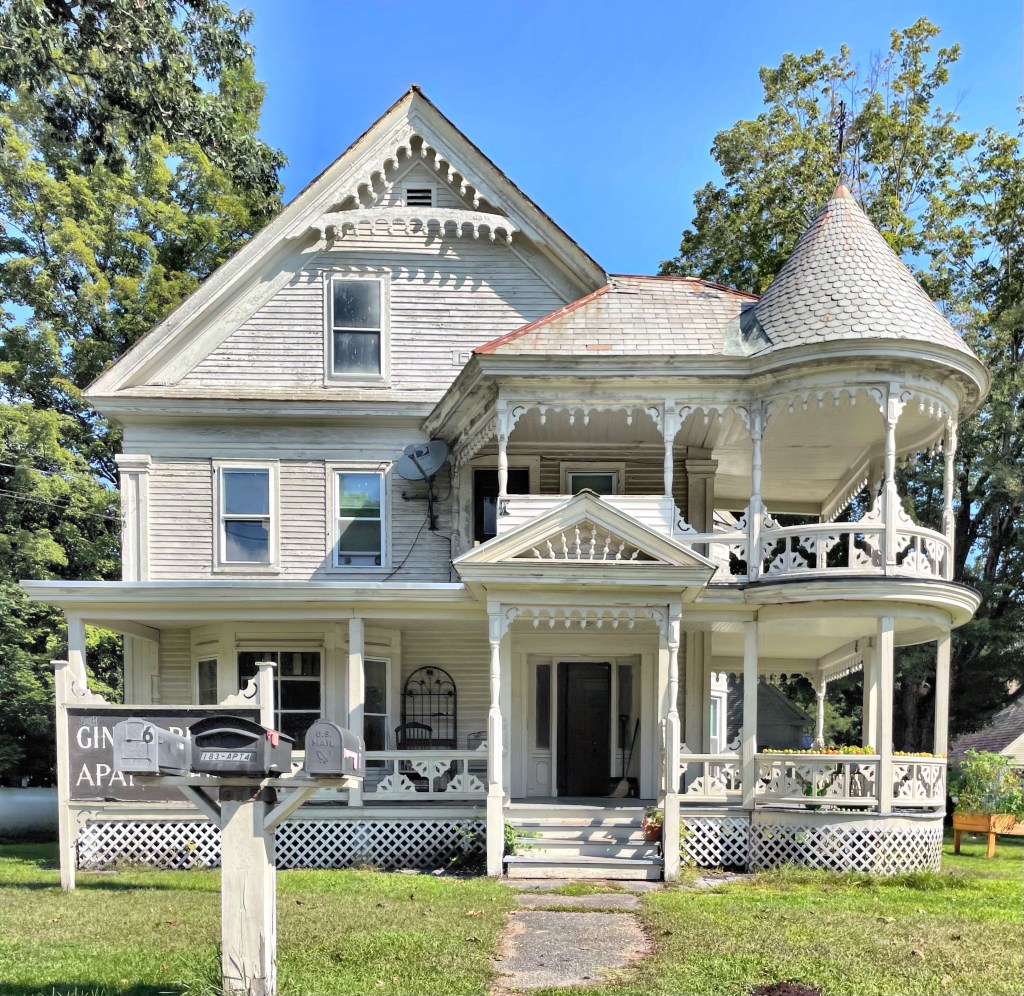
Built in the mid-19th century this former home in Chester, VT, exhibits the range in tastes seen from the Classically inspired Greek Revival style to the ornate and over-the-top Queen Anne style. The original 1850 Greek Revival design of the house survives in its temple form and classical details, augmented by a visually dominant overlay of Queen Anne features. The house was acquired sometime after 1870 by the Haselton family, whose daughter Hattie married John Greenwood. The Greenwoods undertook a major renovation of the building about 1900, adding the elaborate front porch and other features, giving it the wedding cake or lace-like appearance we see today. The home was converted to apartments in the 1960s, but retains much of its architectural details, it is best known as the Gingerbread Apartments.
This stunning Queen Anne home in Gardiner, Maine, overlooks the Kennebec River from its high position on a hill. The home was built for Hartley Jewett, who ran a busy lumber mill in town, which sold long lumber, laths, and shingles, some of which ended up on his own home. Maine was huge in the lumber industry, and it’s vast forests were often cut and sent down to cities like New York and Boston on rail to supply their own building booms.
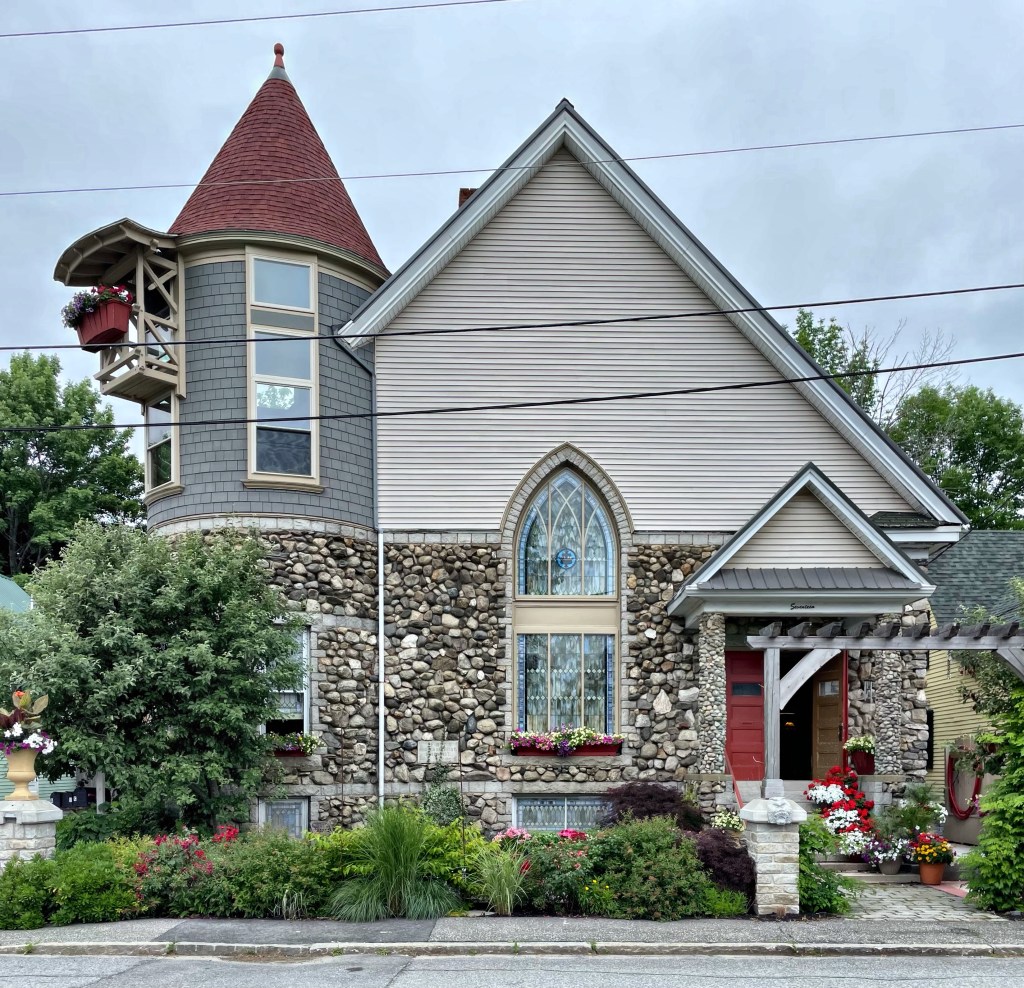
The first purpose-built Church of Christ, Scientist church in Maine is this turn-of-the-century edifice constructed in 1905 in Gardiner. Organized in 1897, this Christian Science Society of Gardiner met for several years in members’ homes and public places nearby until Palmer Noyes and his wife Caroline funded the new building. Caroline and Palmer helped establish the first such church in Chicago, after the couple witnessing a ‘healing’ and then heard Mrs. Mary Baker Eddy lecture in 1882. This church in Gardiner was seemingly designed by Caroline, who was likely inspired by architectural influences on the churches in town, from Gothic style lancet windows, to the shingle style facades. The building was eventually converted to a development center for the disabled, and is now known as “The Stone Turret”, a bed & breakfast, with amazing stained glass windows!
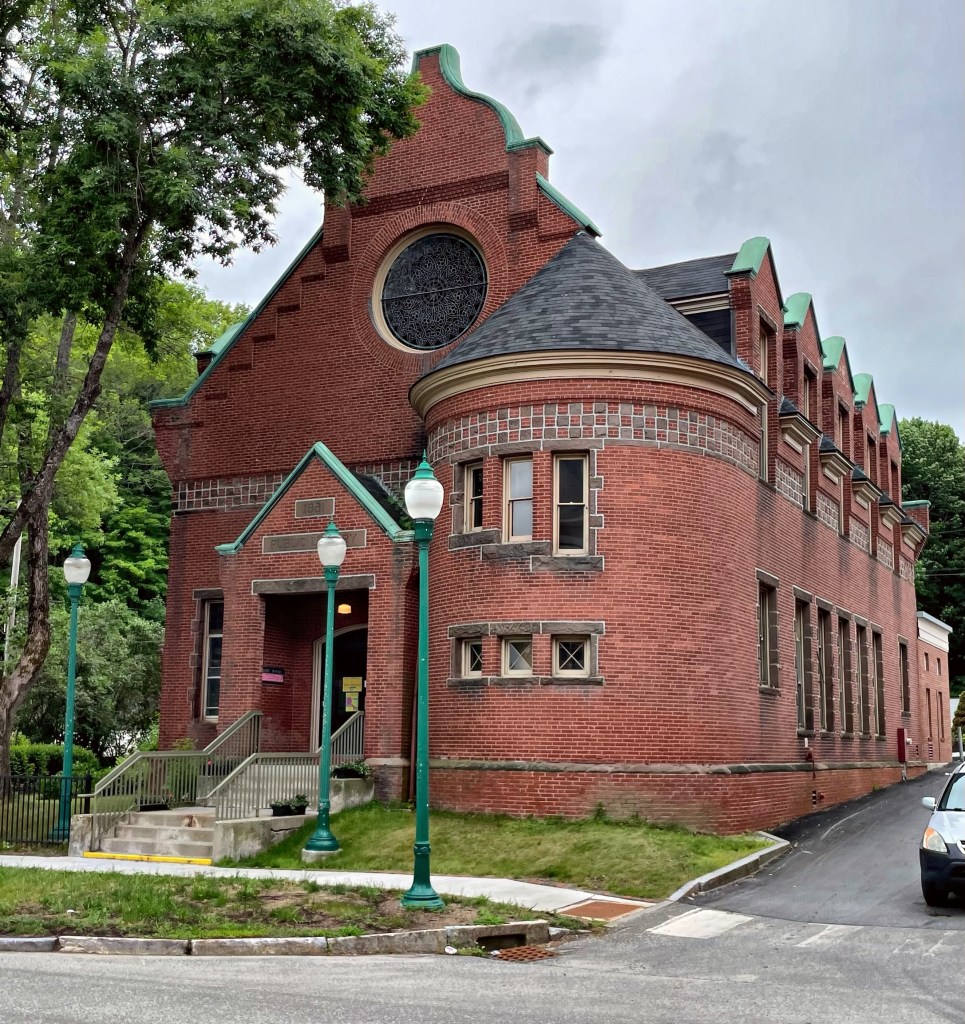
Possibly my favorite building type, the local town library buildings of New England, always amaze me with their small scale, yet architectural variety and intrigue. The library in Gardiner, Maine is no exception! This library building was constructed in 1881 from plans by Henry Richards, who was actually born in town in 1848. Henry graduated from Harvard in 1869, and soon after, took a post-graduate course in architecture at MIT. After completing schooling, he was a draftsman with Ware and Van Brunt. Soon after, he was a draftsman with Peabody and Stearns from 1872 to 1876, and then practiced architecture briefly on his own in Boston. During this time he married Laura Elizabeth Howe, daughter of Samuel Gridley and Julia Ward Howe. They moved to Gardiner, Maine and settled in a Federal house (featured previously), to learn more about Laura Richards and their house, check out the last post. Henry lived to be 100 years old! The library building is Queen Anne and Romanesque in style with a round corner tower with conical roof, brownstone and brick construction, and a stained glass ocular window with ogee parapet at the gable end roof. The small local library was added onto numerous times to hold a growing collection which includes works from Laura E. Richards, and Edwin Arlington Robinson, both Pulitzer Prize winning authors who lived in town.
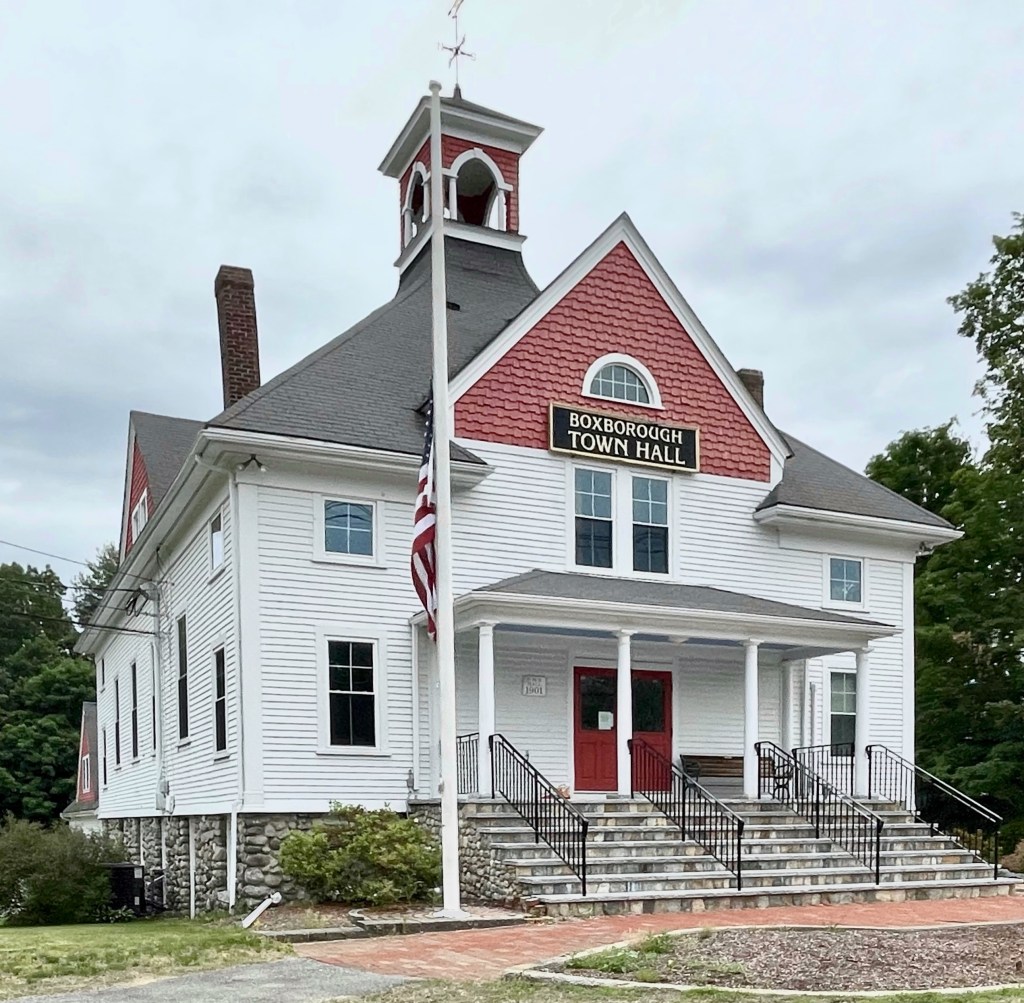
The area which became the town of Boxborough, Massachusetts, was first inhabited by the Native Americans of the Nipmuc and Pennacook tribes. Land in Boxborough was not settled by colonists until the beginning of the eighteenth century by farmers looking for fertile land to establish farms, who branched out from nearby Acton. Boxborough was formed from Harvard, Littleton, and Stow in 1783 and was incorporated as its own town. With the exception of small local industries including gristmills, sawmills, and cooperages as well as some minor boot and shoemaking, comb-making, and a lime quarry and kiln, Boxborough’s economy remained almost entirely agricultural through the 19th century. The town grew steadily and a Town Hall building was funded by the turn of the 20th century. This Queen Anne/Colonial Revival Town Hall building was constructed in 1901, atop the foundation which was constructed of locally gathered cobblestone by local volunteer farmers. Today, the town retains much of its agricultural heritage, but it is definitely under threat by subdivisions and Neo-Colonial mansions further contributing to Bostons suburban sprawl.
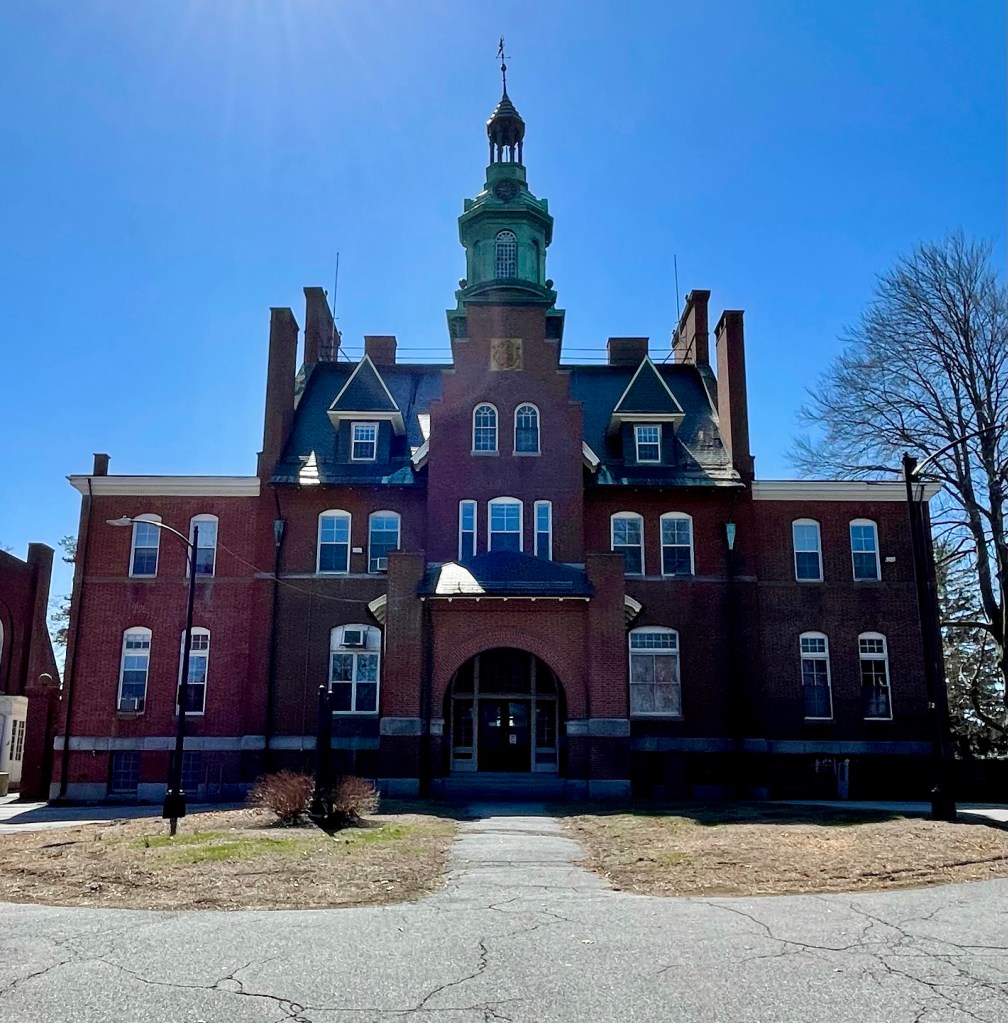
The Tewksbury State Hospital was established in 1852 as one of three Massachusetts State almshouses (along with Bridgewater and Monson). The almshouses were needed due to the unprecedented influx of Irish immigrants at that time, many of which found difficulty locating work. These almshouses represented the state’s first venture into care of the poor, a role previously filled by the cities and towns up to that time. In 1866, when Tewksbury began accepting the “pauper insane”, it became the state’s first facility to accept cases of chronic insanity specifically. Decades later, Massachusetts Governor Benjamin Butler accused the almshouse in Tewksbury in, “trading in bodies of dead paupers and transporting them for a profit to medical schools,” and “tanning human flesh to convert to shoes or other objects”. The facility was later investigated, and no conclusive evidence was found. In the late 19th century, a major rebuilding (and re-branding) campaign to upgrade the old almshouse by replacing its early wood-frame buildings with more durable and fireproof masonry ones was undertaken. One of the earliest “new” buildings was this Queen Anne-style Administration Building, standing at the head of the former entrance drive, which creates a fairly foreboding presence. This building was designed by Boston architect John A. Fox, and showcases the epitome of Queen Anne institutional design. The hospital runs today much like a traditional campus, with some of the older buildings unused, providing a strange composition. The former Administration Building is now home to the Massachusetts Public Health Museum.