Juniper Ledge Cottage // 1889

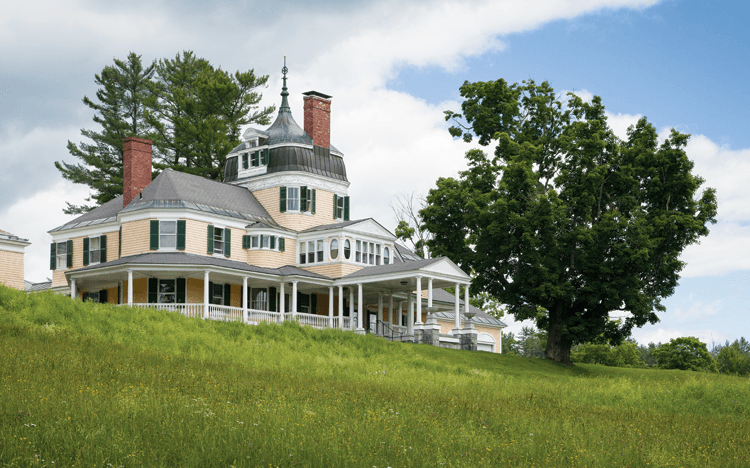
Ellen Kemble (Bartol) Brazier was born in New York City in 1844, the eldest of four children of Barnabas and Emma Bartol. Her father had many business interests in sugar refining and the family was able to travel the world from his wealth and success. The family spent most of their time in Philadelphia, but like many of the city’s wealthy residents, they often summered elsewhere. Ellen Bartol married Joseph Harrison Brazier in 1866 and they had two children. When her father Barnabas died, Ellen inherited some of his remaining fortune and as a part of high society, she had a summer cottage in Kennebunkport built. Working with Maine architect John Calvin Stevens, she oversaw the designs of Juniper Ledge, this gorgeous, eclectic shingled residence in the Cape Arundel summer colony. Ellen would summer at the cottage until her death in 1925, but before she died, she joined her daughter in the 1910s and 1920s at Women’s Suffrage events and fundraisers, helping to pass the 19th Amendment, allowing women the right to vote in the United States. Ellen is buried in the West Laurel Hill Cemetery in Philadelphia next to her husband, not far from her parents.

“The Dory” Cottage // 1888

Before Miss Gerrard purchased the Glen Cottage (last post) in 1900 in Kennebunkport, Maine, she had already summered in her own summer cottage nextdoor for over a decade. In 1888, she hired an architect from New Jersey to furnish plans for this charming shingle and stone cottage as her summer retreat. The cottage features a prominent brick and rubble stone chimney facing the street with a gambrel roof. The entrance is tucked away under a recessed porch and looks to be the original dutch-door. I can’t imagine how amazing summers in this house would be!

Nesmith-Kent Cottage // 1891

One of the most iconic summer “cottages” in Kennebunkport’s late 19th-early 20th century summer colony is the Nesmith-Kent Cottage, located next door to the often photographed St. Ann’s-by-the-Sea summer chapel. The cottage was built for Julia and Mary Nesmith, the daughters of John Nesmith a wealthy industrialist and textile manufacturer from Lowell MA. The sisters named the cottage “The Pebbles”, and spent their first night there on July 24, 1891. The half-timbered shingled house stood at the edge of the ocean near a former War of 1812 fortification. The sisters sold the property in 1910 to Arthur Atwater Kent, prominent radio manufacturer based in Philadelphia, who invented the modern form of the automobile ignition coil. Kent renovated the cottage extensively, increasing its size, and renamed “The Pebbles”, “At Water’s Edge” in a cheeky play on his last name. In 1919, he expanded again, purchasing a lot adjacent to his mansion which was the old fort constructed to protect the ships moored in the harbor during the War of 1812. In early 1919, workmen uncovered a few bones of what was calculated to be a seven-foot-tall man and two skulls of white men that had clearly met their end at the hands of Native people; one pierced by an arrow and the other scalped. The Kennebunkport Historical Society has one of these skulls in their collections. Today, the Nesmith-Kent Cottage is owned by the St. Ann’s-by-the-Sea congregation as their rectory.

Former Vermont State Hospital // 1890

The former Vermont State Hospital campus in Waterbury, Vermont, is a 36.3-acre campus of institutional buildings that have been converted for use as state government offices. A sprawling array of more than 17 structures, the hospital, which historically treated mental disorders, was first funded by the Vermont State Legislature in 1888. Construction began on the plans by the Boston architectural firm of Rand & Taylor in 1890. The architects designed the landmark main administration and auditorium building at the core, which is built of brick on a rusticated stone foundation and under a steep hipped slate roof. The building is connected by single-story links to two-and-a-half-story wings, which are attached to clustered two-story cylindrical wards. In planning the hospital, Rand & Taylor stressed the isolation of patients and stressed the importance of light and air in each room and restricted height of the building to facilitate egress from upper floors in the event of fire or emergency. The asylum has a dark history in that Dr. Eugene A. Stanley, the Superintendent from 1918–1936, was an advocate of eugenics and espoused forced sterilization and advised the Eugenics Society based on his patients records. From this, the word, “Waterbury,” became used in a derogatory sense, and did harm to the town for years. The hospital was closed in 2011 due to flooding in the aftermath of Tropical Storm Irene, and after a thorough renovation by architects Freeman French Freeman and Goody Clancy, the complex re-opened in 2015 as State Offices with renovated historic assets and modern, contextual new buildings.

Dr. Henry Janes House – Waterbury Municipal Center // c.1890

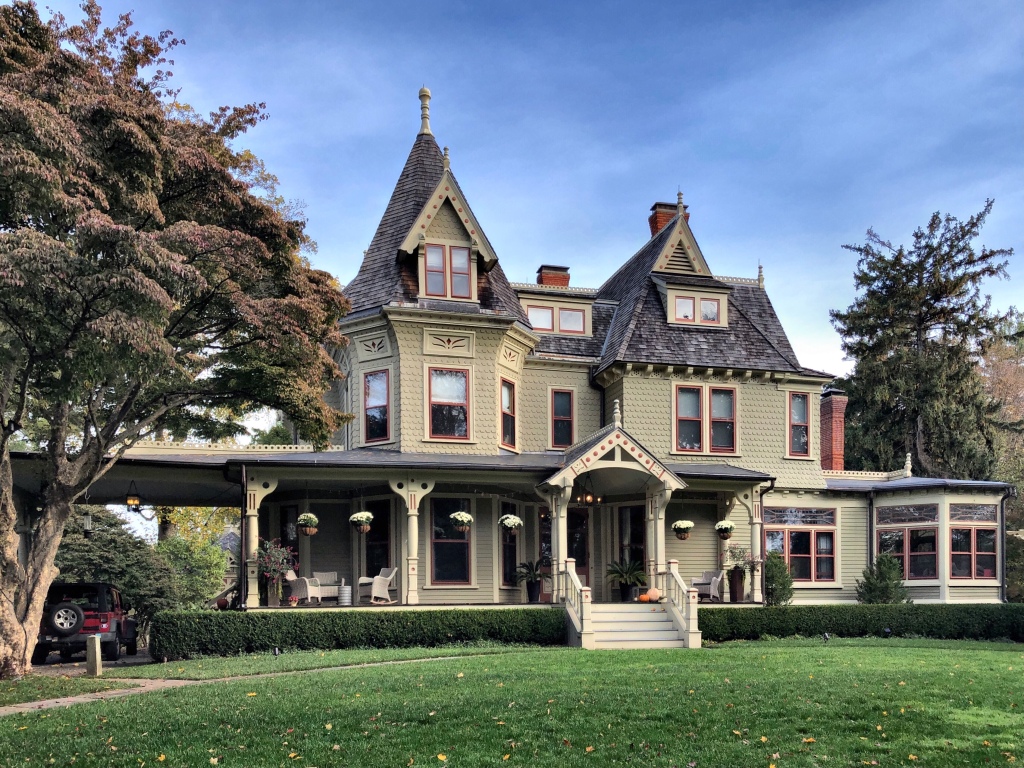
Probably best known for being in charge of all the military hospitals in the Gettysburg area after the bloodiest battle of the Civil War, Waterbury, Vermont native, Dr. Henry Janes (1832-1915) had a decorated career and gave much to his country and hometown. Janes attended local schools before enrolling at St. Johnsbury Academy, later graduating from New York City’s College of Physicians and Surgeons in 1855. After a few years working in NY and MA, he moved back to Waterbury to take up a private practice. This was disrupted by the Civil War where he was a major surgeon on the front lines and had over 250 surgeons under his command. After returning home from the war, Dr. Janes was involved in politics and business, and had a home built in town. According to local historians, this present home of Janes was built in 1890, but it definitely could date to the 1870s with Stick style features. Upon his death, the Dr. Janes home was gifted to the town for use as a public library. When Tropical Storm Irene hit the region in 2011, the town offices were destroyed and Vermont Integrated Architecture was hired to expand the Janes House adding space for town offices, meeting space, a modern library and to reconfigure the historic home for the Waterbury Historical Society. Everything about this is perfect, down to the paint colors!

Stagecoach Inn // 1826

Built by the Carpenter brothers in Waterbury, who also designed and built the neighboring Congregational Church (last post), this large structure was a stagecoach stop on the road to Stowe for much of the nineteenth century. Briefly, the Inn served as a private residence for Albert and Annette “Nettie” Spencer. Nettie grew up in Waterbury and married Albert who owned rubber factories in Ohio and invested in real estate in Burlington. At one time, the Spencers’ residences included their Waterbury house, a suite at the Waldorf Astoria in New York City, a house in Newport, an apartment in Paris, as well as one in London. Albert died in London, and Nettie continued living in Waterbury until her death in 1947, approaching 100 years of age. Within a year, the property was sold and the owners reopened the main house as a sort of boarding house. The property was restored and operates today as the Old Stagecoach Inn.

Roswell B. Fitch House // c.1850

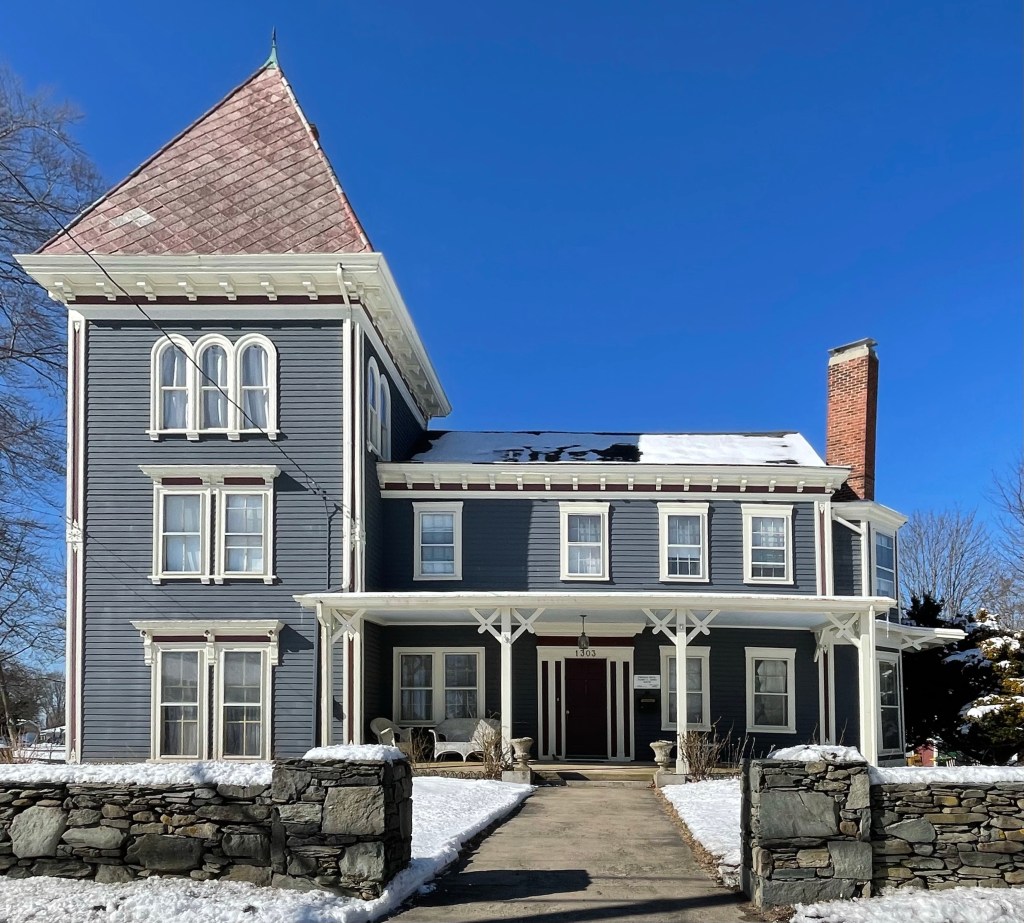
Roswell Burrows Fitch (1833-1908) was born in the seaside village of Noank to parents Elisha and Mary P. Fitch. At twelve years of age he commenced to be self-supporting, and from then until he was fourteen, occupied a clerkship in a general store in town. In his teens, summers were spent aboard ships fishing for a livelihood, and his winters attending school. Upon completing his education, he became clerk in a store, and was afterwards engaged to assume the management of a union store which was erected for the special purpose of being placed under his charge. The store, located on Main Street in Noank, was eventually fully purchased by Fitch, and he did well financially. He may have had this house built or merely bought it years after it was built in the mid-19th century. When he sold his business in 1890, he “Victorianized” the classically designed Greek Revival style house with Queen Anne embellishments. The renovations in 1890 included an octagonal tower, an elaborate porch, a two-door entry likely replaced the sidelights and transom, brackets and applied decoration at the gable and cornice, and a Palladian window which was a Colonial-inspired addition. Hodge-podge or eclectic houses are some of the most fun!

Former Noank Methodist Church // 1902

Adaptive reuse of old buildings always makes me so happy to see! Besides the obvious benefit of preserving an old building which contributes to the history and character of an area, there are clear environmental benefits to renovating older buildings for new uses when older uses are no longer viable. In 1902, the village of Noank was bustling with workers in the shipyards, many of whom attended or hoped to attend religious services close to home rather than travelling to adjacent towns. As a result, the local Methodist church-goers had this building constructed. Architecturally, the building is a hodge-podge of styles with interesting lancet windows as a nod to the Gothic style, shingle and clapboard siding which reads Queen Anne. The Noank Methodist Church merged with the Groton Methodist Church to form Christ United Methodist Church, which moved to a new building in 1972. The former church was converted into a residence. Preservation wins!

Pembroke Hall – Brown University // 1896

Brown University from its founding in 1764 until 1891 never admitted women. Brown’s all-male student body was first challenged in 1874, when the university received an application from a woman (who to this day is still unnamed). The Advisory and Executive committees decided that admitting women at the time was not a good proposal, but they continued to revisit the matter annually until 1888, when they began work to establish a separate women’s college affiliated with Brown. After similar institutions like Radcliffe (affiliated with Harvard) and Barnard College (affiliated with Columbia) were established in 1879 and 1889 respectively, Brown had a blueprint for how to operated the new women’s college. Professors at Brown would work alongside women educators and taught many of the the same courses to men as they did for female students. Pembroke Hall was the first building for Pembroke College and was built in 1896 from plans by local firm Stone, Carpenter and Willson in the Elizabethan Revival style. The building was designed to be multi-purpose with administrative offices, classrooms, reception rooms, and a library in the attic. Pembroke College was officially merged with Brown University in 1971, which was long overdue. The building is one of the finest on Brown’s now co-educational Ivy-league campus.

The Atherton // c.1890

About ten years after the nearby Carlisle building (last post) was completed by owner Jonas Gerlusha Smith (1817-1893), he began construction on another large, apartment hotel next door. He again retained architect Arthur Vinal, who was acting City Architect for the City of Boston to furnish the plans on the building, which would be attached to the older portion which fronts Gray Street behind. The building is extremely well-preserved and has some stunning metal bays with decorative details which really pop!