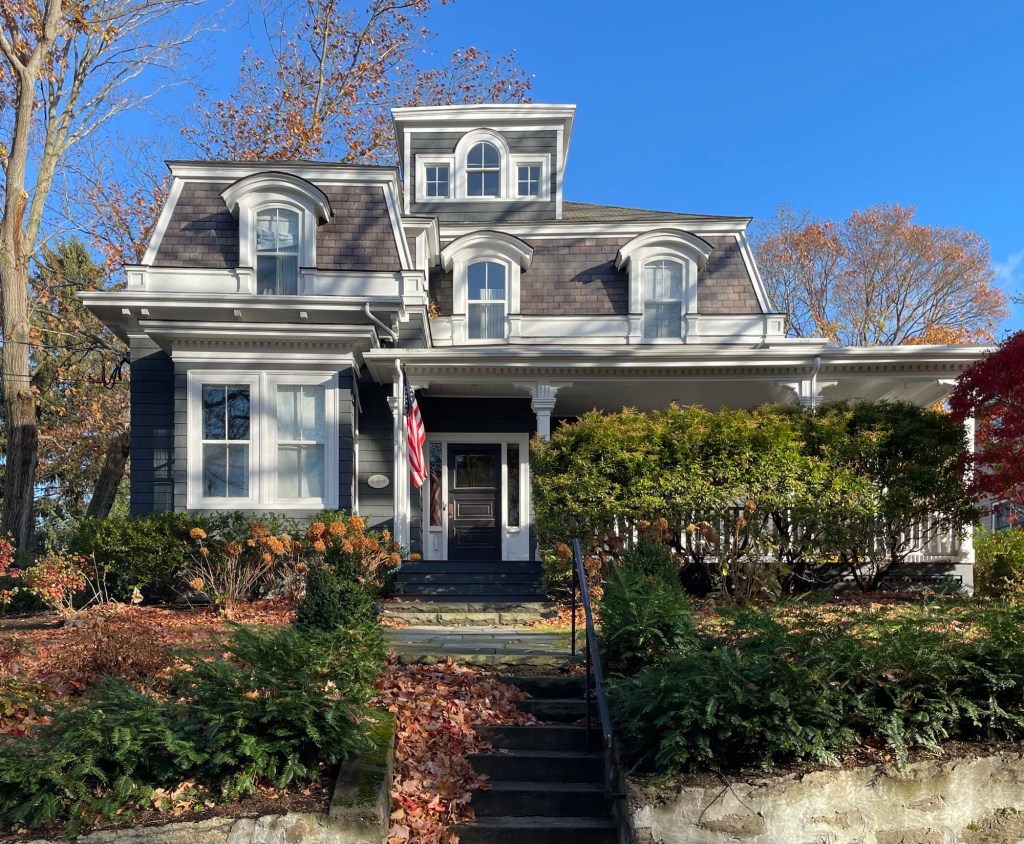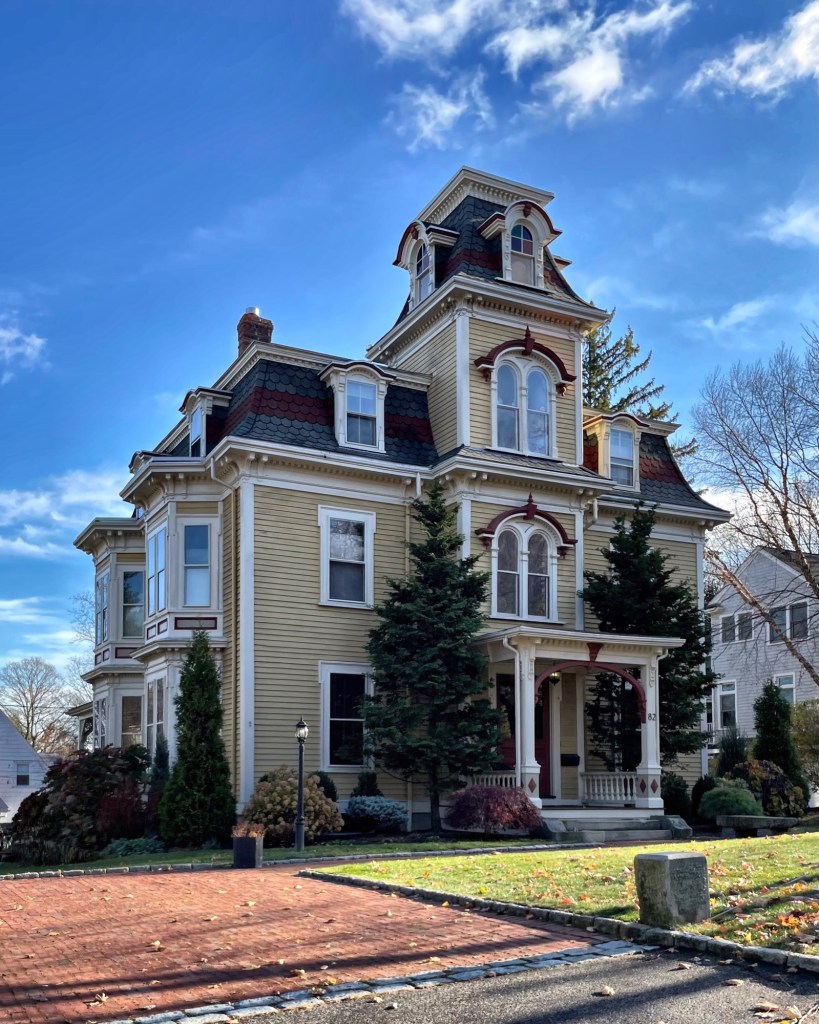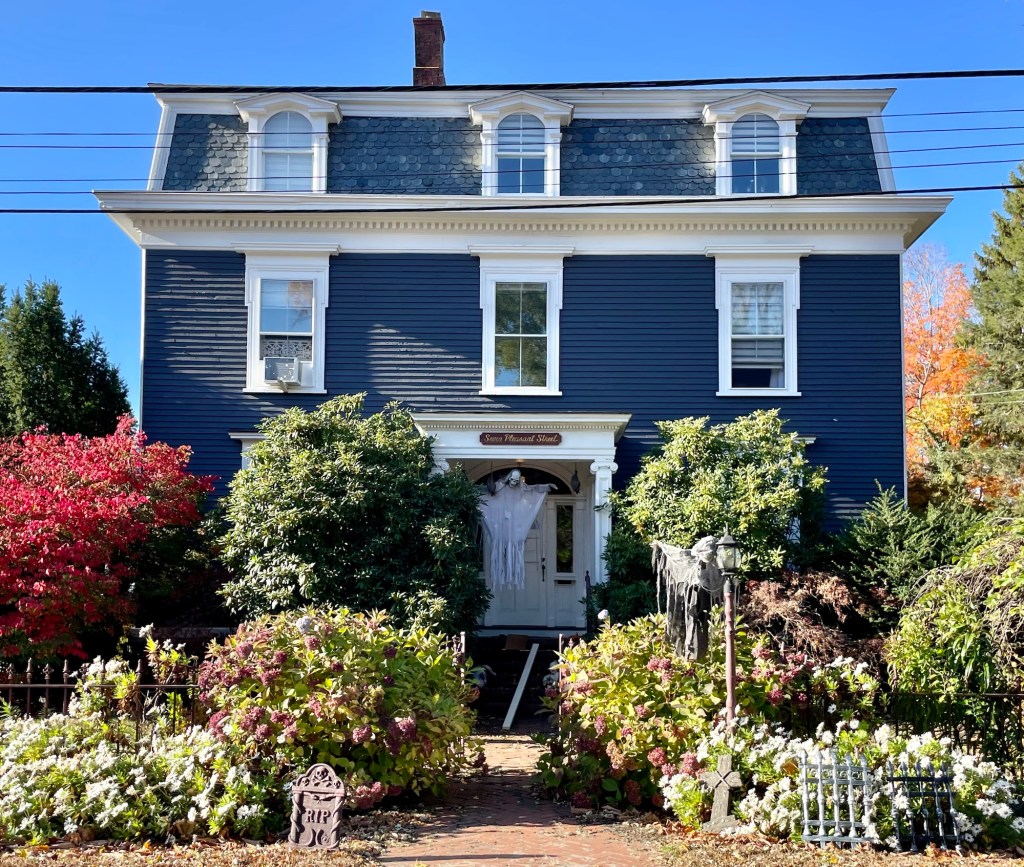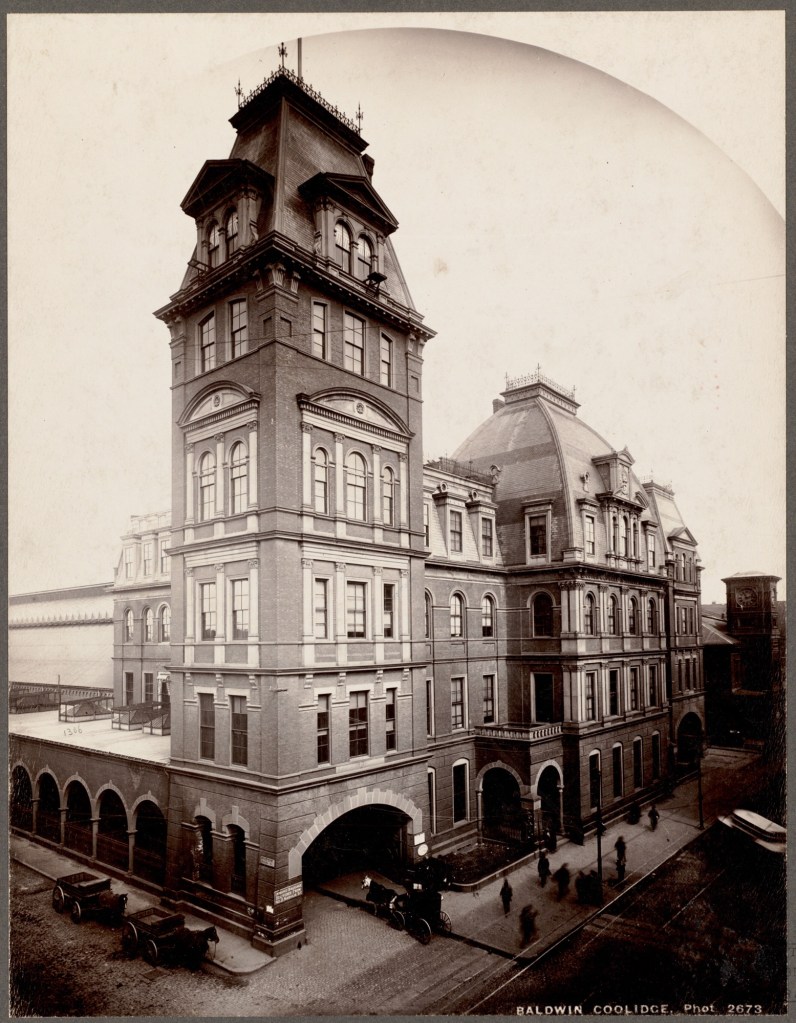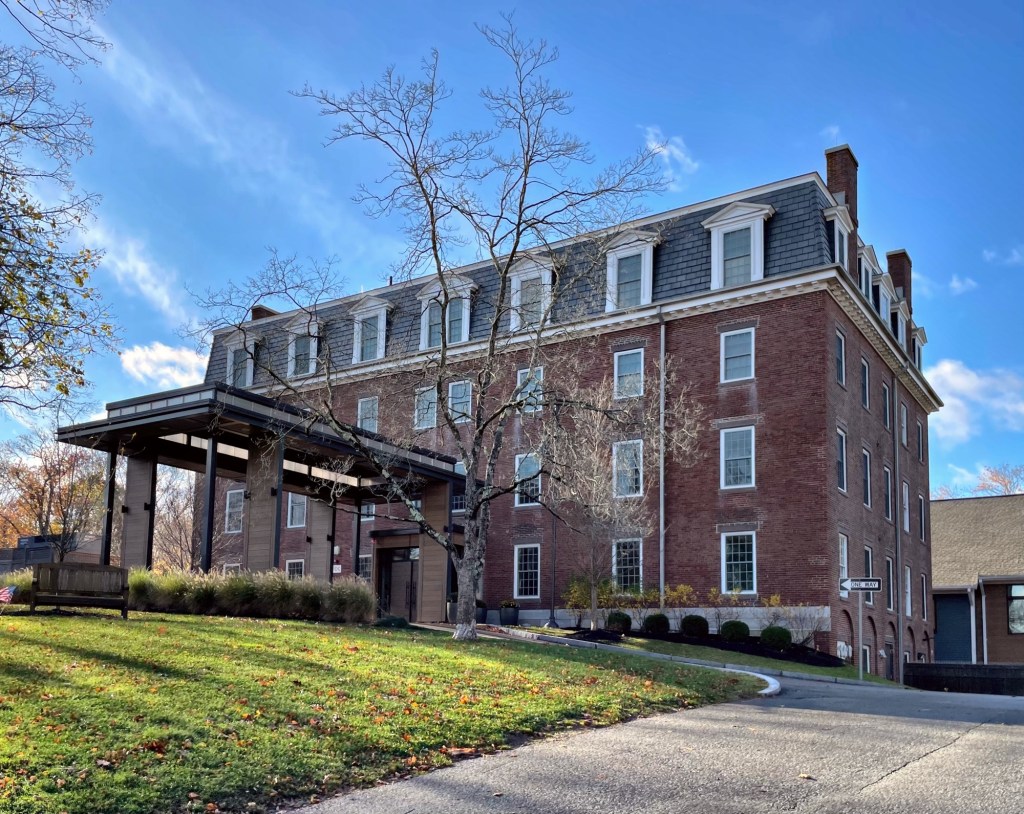
Welcome back to the Bread Loaf Campus! For more early history and context of the complex, check out the post on the Bread Loaf Inn. By 1900, owner Joseph Battell’s enterprise exceeded the capacity of the original inn, and cottages were added to accommodate more guests visiting his new permanent home in the mountains of Ripton, Vermont. An early cottage built by Battell is this late-Mansard structure, named Birch Cottage. The structure clearly took cues from the Bread Loaf Inn, built over a decade earlier, and originally had two floors of porches wrapping around the entire structure.
The Breadloaf Inn is a rare intact example of Vermont’s Victorian resort architecture that also has important associations with the environmental movement and for American literature. Located in the quiet town of Ripton, Vermont, this impressive structure was built in 1882 by eccentric philanthropist Joseph Battell. Mr. Battell attended Middlebury College in the early 1860s but he was forced to abandon his studies due to ill health. On the advice of his doctor, Battell spent a weekend at a farmhouse in nearby Ripton where the clear mountain air would help cure his ailing lungs. He so loved the beauty of the surrounding hills that he decided to buy the old farmhouse, which became known as the Bread Loaf Inn, named for Bread Loaf Mountain not far away. Over the years, numerous new buildings, porches, and barns were added in order to accommodate Battell’s many friends and guests. The Inn, which was remodelled from the farmhouse in 1882, and the surrounding mountains served as Battell’s home and sanctuary for the rest of his long life. He amassed land holdings of over 30,000 acres of forest, preserving it in perpetuity until his death in 1915, becoming the state’s largest landowner when he died. Battell’s vast mountain estate was left to Middlebury College, who brought the seasonal inn back to life as the summer Breadloaf School of English. In 1926 the college added the Breadloaf Writers’ Conference, drawing such luminaries as poet Robert Frost, who spent summers at a cabin nearby. The complex is maintained by Middlebury College to this day, who do a great job at preserving the original buildings.
This perfect historic commercial building sits on Pascal Avenue in Rockport, Maine, in a section of the village more-so dominated by residences than larger commercial blocks. That may be the reason for the Enos E. Ingraham Store having a certain small-scale and residential quality. The block was built sometime after 1875 and has been known as the Enos E. Ingraham Store, after the longtime owner of the same name. The Ingraham Store is Second Empire in style with the prototypical mansard roof, bracketed cornice, and projecting bay window.
Union Hall sits in the middle of the charming coastal village of Rockport, Maine. The Second Empire style building was built around 1856 as an original mixed-use structure with the first level containing retail spaces, the second level as a hall, and third level providing either office or living spaces. Rockport’s Union Hall was also once home of the town Post Office, a barrel factory, and a residence before it began to suffer from neglect and deferred maintenance at the end of the 20th century. In 2010, the owners underwent a massive restoration of Union Hall, which included: structural remediation to wood framing, a new elevator, slate roof repair, all new mechanical, electrical and plumbing systems, masonry repointing, restoration of windows and doors and more. These types of restorations are vital to small New England towns, providing jobs and the properties are often occupied by local small businesses, as is the case here!
In 1868, James Wilkinson Clapp (1847-1931) married Eliza Tuckerman and they soon after moved into this large Victorian-era house on St. Paul Street in Brookline. James was the second son of Otis Clapp, a politician, publisher, and promoter of homeopathy. Otis Clapp operated a large homeopathic pharmacy, Otis Clapp & Son, which continued as a business after his death, evolving to encompass different areas of medical technology. It was one of the oldest-operating pharmaceutical manufacturers in the United States by the time it was acquired by Medique in 2008. The business allowed James, at about 22 years old, to build this stately home for him and his new wife to move into. The residence is Second Empire in style with Stick style ornamentation, and while mostly obscured by vegetation all year, it commands the heavily trafficked corner of Brookline.
Prior to 1850, the area today known as the Longwood neighborhood of Brookline remained largely farmland on the banks of the Muddy River, the border of Boston. In the first half of the 19th century David Sears (1787-1871) and Amos Lawrence (1814-1886), both prominent Boston businessmen, bought up large tracts of what had been Sewall’s estate. The arrival of the Brookline Branch Railroad (now the MBTA Green Line D branch) served as an impetus to develop the area more fully. Some of the houses built by Lawrence and Sears became homes to friends and business associates, but neither lived in the area. One of the rented houses built and rented by David Sears is this Second Empire cottage likely built in the 1860s. The house was long-rented to wealthy families until the Sears heirs sold the house to Nathan Leo Amster and his wife, Estelle Dreyfus who was raised in Boston. Nathan L. Amster was a railroad executive who eventually became president of the Manhattan Railway Company. When the purchased the cottage, the Amster’s hired Boston architect Clarence Blackall to renovate and “modernize” the home, which added the Classically inspired elements. The couple did not appear to live in the house long, as they spent most of their years in their Fifth Avenue NYC residence. The Sears-Amster Cottage remains an important early house in the Longwood development of Brookline.
Henry Baxter (1821-1897), a doctor and owner of a local mill and multiple area farms, built one of the most remarkable Second Empire style houses in New England, and it can be found in the small town of Highgate, Vermont! Dr. Baxter was said to have acquired an earlier Federal period house on the site in the 1860s and began planning a high-style Mansard estate here for his family. The earlier Federal house was incorporated as a rear ell and the new Second Empire mansion was built in front. Architecturally, the house stands out for its bellcast mansard slate roof topped by a square belvedere with arched windows and heavy scrolled brackets. His patented medicine, Dr. Baxter’s Mandrake Bitters, was sold throughout Vermont in the late 19th century and afforded him the wealth to erect this stately home. There are many unsubstantiated claims of Dr. Baxter “performing experiments on his children” for the sake of people to state that the house is haunted, but this appears to be lore in poor taste. It is said that the house was also a stop on the Underground Railroad, but that appears unproven as well. After Dr. Baxter’s death in 1897, the property became a lodge and restaurant. A basement bar was built and during prohibition, was said to have hosted the likes of Al Capone. Today, Highgate Manor, with its larger-than-life lore, remains one of New England’s most important and high-style Second Empire houses in one of the most unlikely places. It goes to show that it is worth exploring all of New England!
The Derby House Hotel is located on Main Street in Derby Center, Vermont and was built in 1896 by Ms. Luvia A. Rickard, a widow. Since its construction, the hotel has been at the center of both the commercial and social activities of Derby Center and is one of the town’s few Second Empire style buildings. While built in the Second Empire style, then in declining use in Vermont, the Derby House Hotel was adorned with high-style touches including elaborately detailed porches and hardware. The rear section afforded extra living space, and a livery stable/barn provided for the guests’ horses and carriages. Luvia ran the hotel for extra income until her death in 1905. It appears that after, her son Harry took over the hotel for a few years until he sold the property to Albert C. Fellows, a local businessman. Tourism never really took-off in the early-mid decades of the 20th century, and the hotel was converted to apartments, a use that remains to this day.
Martha Martin Stewart Haskell (1831-1906) was born in Derby, Vermont and was among the town’s most distinguished residents. Through her parents, Horace Stewart and Catherine Hinman, and her husband, businessman Carlos Haskell, who died in a tragic accident at the age of 41, Martha Haskell inherited a considerable fortune. She would build this stately Second Empire style mansion in the village after her husband’s untimely death and devoted much of her time to local affairs. Decades later, her idea to establish a public library and opera house for the benefit of the border communities came to fruition when she and her son funded and oversaw planning of the Haskell Free Library and Opera House, which was built a stone’s throw from her home.
In the mid-19th century, Roxbury was seen as a country retreat for wealthy Bostonians. Many purchased large estates of land and built mansions where they would find peace and solitude from the polluted Downtown areas. As the need increased for more workers, old farms and estates were subdivided, and single family homes, row houses, and multi-family homes sprang up to accommodate the growing population with the advent of trolley service in 1887. This is one of those estates that were demolished. This house was seemingly built for Colonel William Vinson Hutchings after the conclusion of the American Civil War. The stone mansion featured ample porches and a large stone stable amongst winding dirt paths and mature trees. The property was eventually purchased by Henry and Agnes Pfaff, of the Pfaff Brewing Company nearby. The lot was subdivided by 1895 with houselots carved out of the larger estate. By the 1930s, the stone mansion and stable were demolished, leaving just the stone gatehouse (next post) as the last survivor of this once great Roxbury estate.