Sprague Hall // 1889

Built in 1889, this interesting structure is located away from the rocky coastline of Cape Elizabeth, a lasting remnant of the agricultural history of the town. The building was constructed as the Cape Elizabeth Grange Hall. The National Grange of the Order of Patrons of Husbandry, is a social organization in the United States that encourages families to band together to promote the economic and political well-being of the community and agriculture. The Grange organization, as it is often known as, had grange halls all over the country, where farming community members would gather to discuss issues and challenges that needed addressing. The building echos late 19th century architectural styles, blending multiple to create an elegant composition, wrapped in wood clapboard and shingle siding. In 1916, the hall was purchased by P. W. Sprague from the Cape Elizabeth Grangers to insure its use and upkeep – and it is still the home of the Patrons of Husbandry, Cape Elizabeth Grange #242.

Cape Cottage Casino and Theater // 1899

The Cape Cottage Casino and Theater was one of several amusement parks developed in the late 1890s by Portland’s electric railways in order to increase business on their trolley lines. Residents of Portland would be able to take a surface trolley to the outskirts of the city in record time, and soak up the sun at luxurious summer communities. The Cape Cottage Casino and Theater was designed by iconic Maine architect John Calvin Stevens, completed in 1899. The casino represents the best in Neo-Classical design, with a full-height, projecting classical pediment supported by bold ionic columns. A wide entablature is accentuated with dentils and modillions; and at the entry, the main front door has a fanlight and is flanked by two small windows, creating a Palladian motif. In 1922, due to the demise in the trolley ridership, partly caused by the rise in personal automobile, the casino was sold off and the Cape Cottage Park Company then hired E.C. Jordan & Company, civil engineers, to subdivide the land and retained John Calvin Stevens and his son as consulting architects. Roughly 50 house lots were platted, resulted that were arranged around the former casino, which was extensively downsized and remodeled as a private residence. While the side wings were removed, the building does retain much of its architectural integrity, while its sheer size has been severely diminished.

312 Ocean House Road // c.1870

This charming home in Cape Elizabeth, Maine looks to have been built after the American Civil War, as an interesting Italianate cottage. The home is clad with scalloped shingle siding which works well with the paired round headed windows facing the street. The deep overhanging eaves are supported by brackets. Running under the eaves on the sides are octagonal windows, a very unique detail. The home is located at the center of town, away from the summer cottages which sprouted up along the rocky coastline in town starting around this time. It was converted into condominium units sometime in the late 20th century.

David Calhoun House // 1915

I normally am not a fan of dark houses, but I really like this one, but some of the amazing detail is harder to see due to the singular, dark paint color. This home in Cape Elizabeth was built in 1915, during the housing boom in the early 20th century when the formerly sleepy farming town saw massive development as it became a summer resort and bedroom community of Portland. Owner David A. Calhoun hired the Portland firm of Miller & Mayo to design this home, and they pulled out all the stops for a modest budget. Calhoun moved to Maine in the 1880s and became a founding member of the plumbing and heating firm of Willey & Calhoun, quickly making a name for himself. The two-story home has a shingled exterior, a cross-gambrel roof and a shed dormer on the front facade. The main entry door is flanked on either side by small windows. The house is a great blending of Colonial Revival and Shingle styles.

Nantasket Beach Bath House // 1935

A part of any large public beach in Massachusetts is the public bathhouse, where visitors can go to the bathroom, change, and store belongings in lockers. Ever since the Massachusetts Parks System of Boston acquired land at Nantasket Beach, a bathhouse was here for visitors. The earlier building by Stickney & Austin burned down and was soon replaced. This amazing Art Moderne bathhouse features a central mass with wings adorned by glass block. The architects Putnam & Cox created a whimsical 1935 Moderne design that blends into the sandy beach. The building suffered from the salt air and cold winters and went through a massive restoration in the late 1990s, it was then re-opened and re-named after Mary Jeanette Murray, a state representative.

St. Paul’s Cathedral, Burlington // 1973

St. Paul’s Church in Burlington, Vermont, was organized in 1830, when Burlington’s population was about 3,500. About 55 Episcopalians met at a local hotel and laid the groundwork for the parish. In 1832, the fledgling parish dedicated its new building, a neo-Gothic limestone structure, which was enlarged multiple times as the congregation grew as the city did. In 1965, the Diocesan Convention voted that St. Paul’s Church be designated a Cathedral Church of the Diocese (one of two in the state). Just six years later, it was destroyed by fire, sparked by an electrical malfunction in the basement, leading to a new evolution of the church. At the time of the fire, the City of Burlington was engaged in massive urban renewal projects. As a part of this program, the City offered to swap the land on which Old St. Paul’s had stood for a spacious new tract overlooking Lake Champlain and the Adirondacks. Although the decision to change locations was a contentious one, the parish did accept the offer. When discussing designs for a new cathedral, there was a strong desire to make a new statement in architecture, diverging from the traditional Gothic or Colonial designs seen all over the country. An international competition was held to determine the architect of the new Cathedral. The winner was the local firm Burlington Associates, now Truex, Cullins & Partners. Completed in 1973, the Cathedral is made of stressed concrete. The structure stands strong and firm, yet is welcoming. Windows provide sweeping views of Lake Champlain and the distant Adirondacks.

Fletcher Free Library // 1904

On July 14, 1873, Mrs. Mary L. Fletcher and her daughter, Miss Mary M. Fletcher, gave the city of Burlington, VT, $20,000 for the founding of the Fletcher Free Library. Half of this sum was to be spent on books; the other half was used to start an endowment for the library. By 1901, the library had outgrown its location in the old City Hall building. In the same year, Andrew Carnegie made a gift of $50,000 for the construction of a new library. In 1902, an architectural competition was created with entries from Boston, New York, Buffalo, Montpelier, Vermont, and Lowell, Massachusetts, but a young Burlington architect, Walter R. B. Willcox won the commission. Willcox designed the new ornate library that year and in August, 1904, the new library was dedicated and opened for business. In the early to mid-1970’s there was some pressure from the citizenry to demolish the Carnegie building and rebuild on the site, which coincided with Burlington’s large urban renewal policies in the downtown area. In response, a group of Burlington residents formed The Committee to Save the Fletcher Free Library Building. A petition was circulated, and as a result, the building was added to the National Register of Historic Places in 1974. In 1977, a grant of $234,000 made possible the stabilization and external repair of the building, and later an addition was constructed, to allow the historic library to meet the needs of the much larger city.

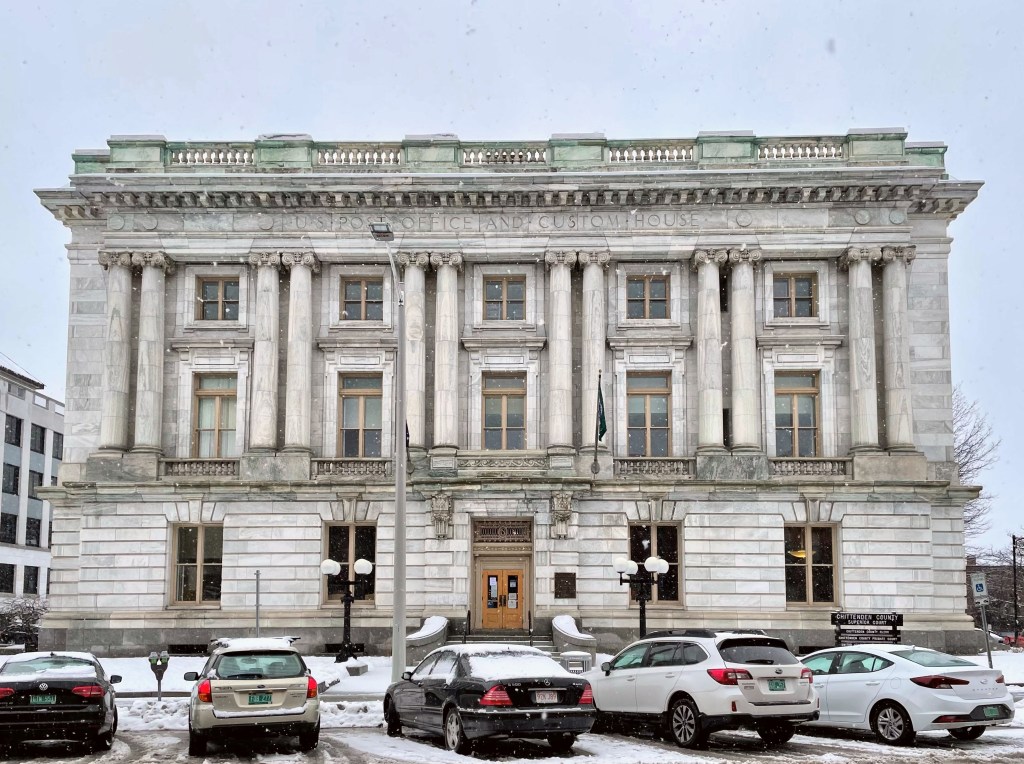
Chittenden County Superior Courthouse // 1906

The Chittenden County Superior Courthouse in Burlington, Vermont was built in 1906 and is one of the most bold architectural designs in the city. The building was actually constructed as the U.S. Post Office and Custom House for Burlington, but changed use in the 1980s after the Old County Courthouse was destroyed by fire. The building was the work of U.S. Treasury architect James Knox Taylor. Taylor designed, many major eastern federal buildings during the late 19th and early 20th centuries. He provided plans for this Beaux Arts structure with a well-appointed exterior finished in marble and dressed granite. Beaux-Arts architecture depended on sculptural decoration along conservative modern lines, blossoming in the United States in the early 20th century after many American architects studied at the École des Beaux-Arts in Paris, particularly from the 1830s to the end of the 19th century.
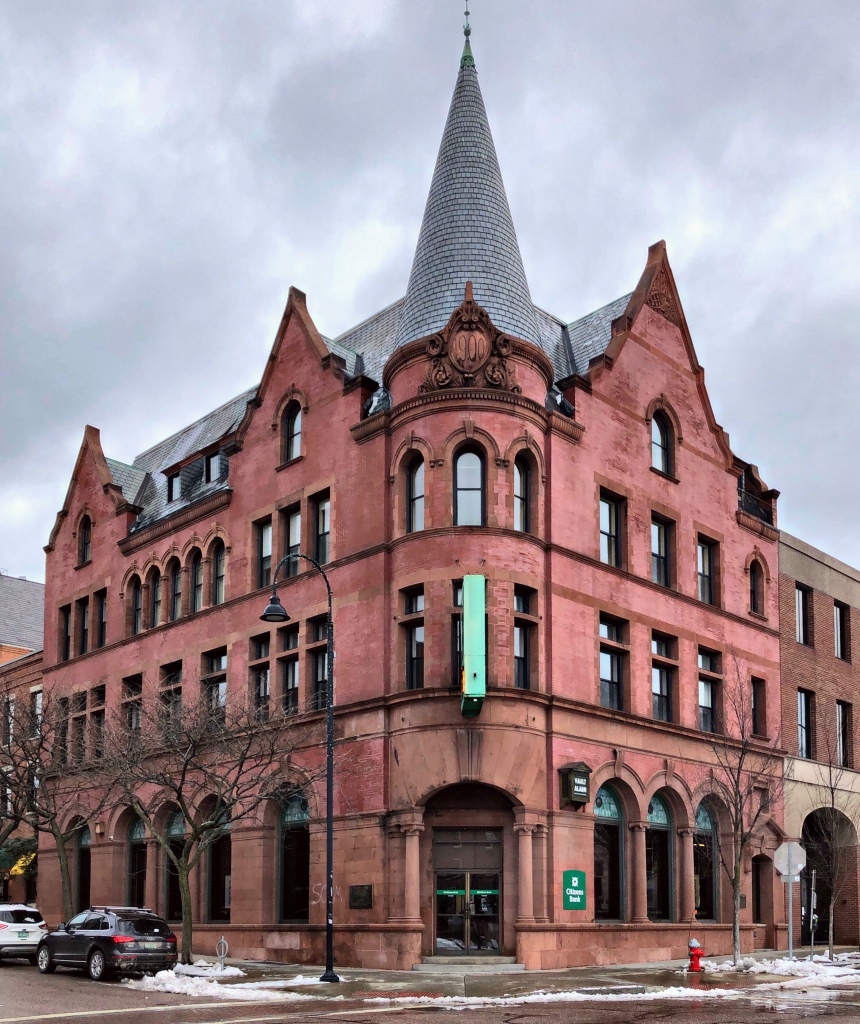
Burlington Savings Bank // 1900

The Burlington Savings Bank building, constructed in 1900, is one of the most architecturally sophisticated buildings in Downtown Burlington, Vermont. The design uses a brick and brownstone facade with prominent wall dormers and a corner tower with conical roof which harkens back to the chateaus and estates of Europe. The recessed corner entrance is framed by free-standing Ionic columns which support a brownstone segmental arch, which helps command the corner presence. The Burlington Savings Bank opened for business on January 1, 1848, and operated under that title until 1988 when it merged with the Bank of Boston to become the Bank of Vermont, which in 1995, was purchased by KeyBank. The corner building is now occupied by Citizens Bank, which continues this buildings legacy as a castle of finance in the city.

Burlington Trust Co. Building // 1891

This narrow, four-story commercial block is located near the Burlington City Hall, and fronts the park it sits on. Constructed in 1891 from local redstone in a unique Romanesque Revival style, the building stands out as one of the most unique in the commercial downtown area. The building was built for the Burlington Trust Company from plans by Clellan W. Fisher, an architect who soon after joined a firm with Stephen C. Earle in Worcester, MA. The design features an unusual checkerboard pattern of inlaid red and white ashlar paired with a stone cornice which similates dentils and brackets. The building is now home to a Burton snowboard retail store, a company started in Vermont in 1977, now the leading snowboard company in the country.