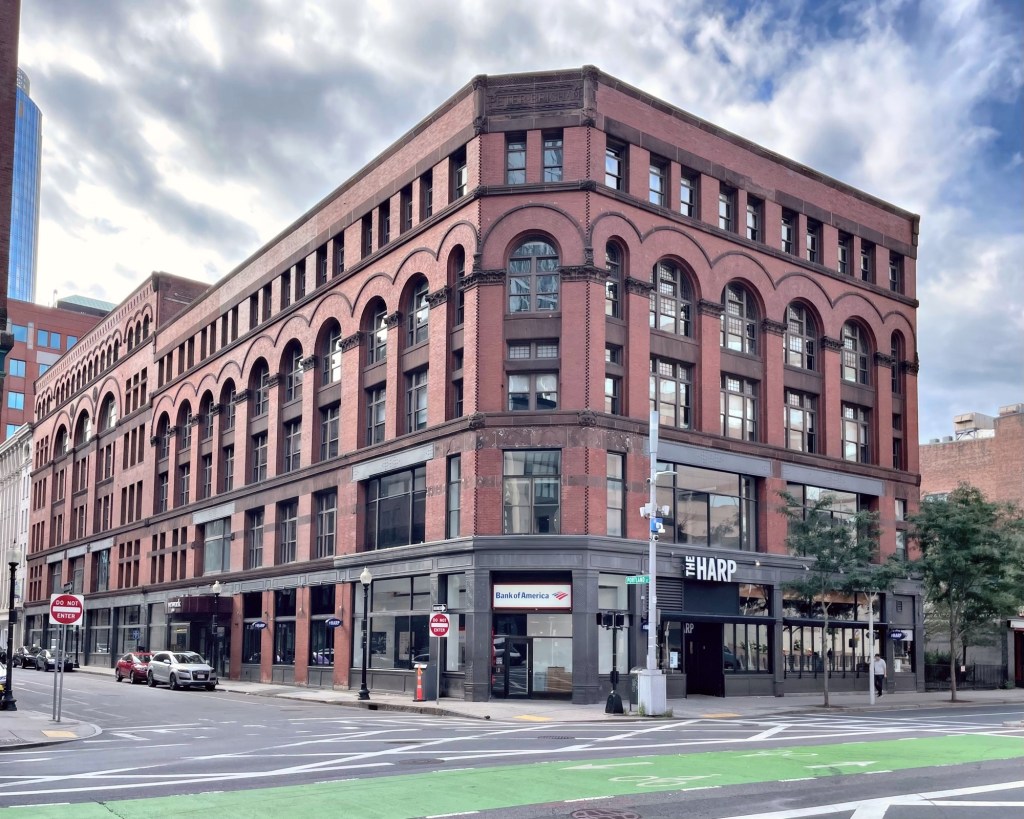
Boston Flatiron – The Boxer Hotel // 1900

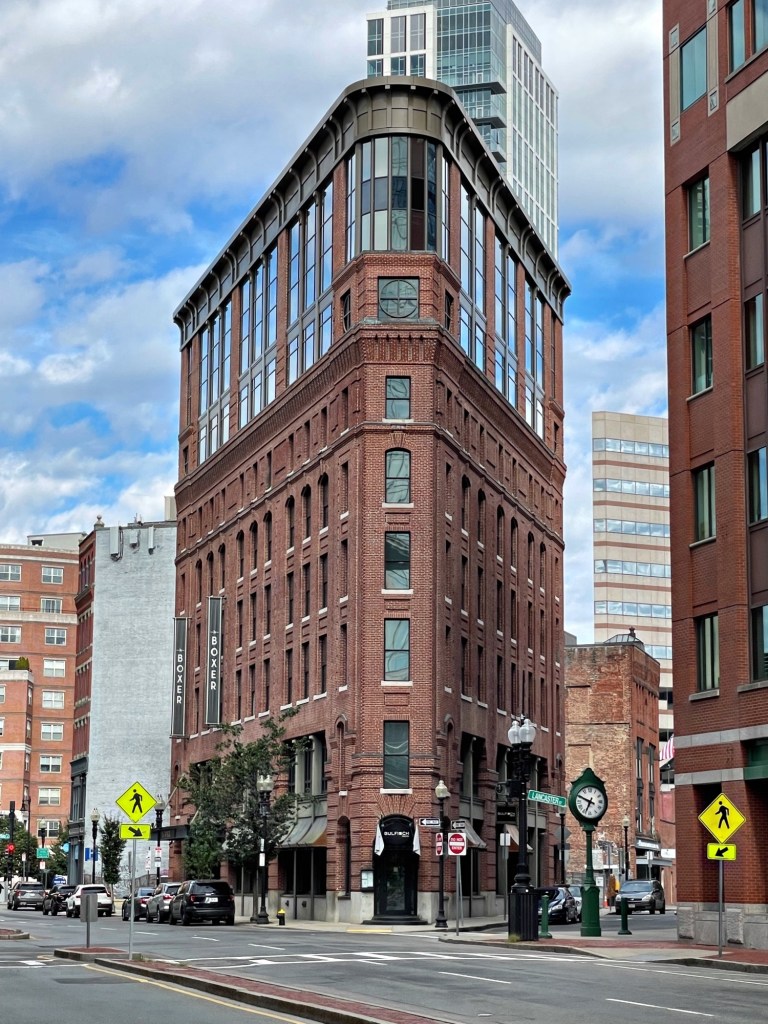
The interesting street-layout of the Bulfinch Triangle area of Boston created some oddly shaped triangular building lots which for decades, saw only small, modest wood-frame structures built upon them. By 1900, Boston’s own Flatiron Building (built two years before New York’s more iconic example) was constructed on this site and it has been an icon ever since. The structure was built by ownerCharles Pelham Curtis III (1860-1948), who was born in Boston and graduated from Harvard Law School and became a police commissioner and attorney in the city before moving into real estate development. He hired architect Stephen Codman to design this commercial block, which was rented out to local businesses and professional offices. The building has been home to a hotel for a number of decades, with a major renovation undertaken beginning in 2000, 100 years after the building was constructed. Three floors were added to the top of the original six-story, which are Modernistic in design with large expanses of windows within three center bays that align with the bays of the original building and which are defined by brick piers. The hotel today, The Boxer Hotel, perfectly blends the history of the building with modernity and style. What a gem of a building!
Peter Bent Brigham Building // 1888

Located at the corner of Causeway and Portland streets in the Bulfinch Triangle Historic District of Boston, you will find the Peter Bent Brigham Building, one of the best examples of the Richardsonian Romanesque architecture style in the city. The building was built by the estate of Peter Bent Brigham (1807-1877), an interesting character in Boston’s history. Peter B. Brigham was born in Vermont and eventually moved to Boston and began his career selling fish and oysters in Boston. A self-made, hardworking man, Peter would eventually own a restaurant in the city and began making connections with the movers and shakers of town. With his success, he began investing in real estate and would become a founding director of the Fitchburg Railroad. Peter died in 1877, he never married nor had children. His estate valued in the millions and was to be spent 25 years after his death, for a hospital “for the care of sick persons in indigent circumstances”. The money appreciated to $2,000,000 by 1902 and was used to establish the Peter Bent Brigham Hospital, now Brigham and Women’s Hospital. His family, who also received a substantial amount of money in the will, built this building, hiring the firm of Hartwell & Richardson to design the 1888 corner and the later, larger 1891 addition. The commercial building was rented to stores and professionals and even retains Peter B. Brigham’s name in the facade carved in terra cotta.

Point Allerton Life Saving Station // 1889

The United States Life-Saving Service was a United States government agency that grew out of private and local humanitarian efforts to save the lives of shipwrecked mariners and ship passengers. It began in 1848 when the congress appropriated $10,000 to establish unmanned lifesaving stations along the New Jersey coast south of New York Harbor. That same year the Massachusetts Humane Society also received funds from Congress for lifesaving stations on the Massachusetts coastline. It was decided to establish a life saving service station at Point Allerton after 61-year-old Joshua James and his crew rescued 29 people from four vessels wrecked in the Boston Harbor during the great storm of November, 1888. The United States Corps of Engineers had this Queen Anne style life saving station built at the northern shores of town, overlooking the Boston harbor. Joshua James became the Keeper of the station at 62, seventeen years past the mandatory retirement age of 45 for a federal appointment with the new U.S. Life–Saving Service. The station is the best-preserved of 32 stations that once lined the Massachusetts coast (most have since been demolished or adapted to other uses). It is now operated as the Hull Lifesaving Museum.

A. M. Donna end House // 1928

Abraham Malcolm Sonnabend was born in Boston on December 8, 1896, the son of Esther and Joseph Sonnabend. Sonnabend graduated from Harvard College in 1917 in order to enlist at the outbreak of the Great War. At the end of World War I, Sonnabend joined his father’s real estate organization. He married Esther Lewitt in 1920, and by 1927, he had increased his real estate holdings to a net worth of $350,000. Just before the 1929 stock market crash, Sonnabend hired Boston architect Sumner Schein to design this Tudor Revival style home, on a site formerly occupied by a larger Queen Anne style residence. Built in 1928, the Tudor Revival house features clinker brick walls with cast stone trim and a two-story castellated bay all capped by a slate roof. The enterprising A. M. Sonnabend would eventually outgrow this modest Tudor home after he got into hotels as investments. In 1944, Sonnabend (with seven partners) acquired a package of Palm Beach, Florida hotels for $2.4 million including the Biltmore, Whitehall and the Palm Beach Country Club. He would sell the Biltmore to Conrad Hilton for a massive profit. In 1956, Sonnabend created the Hotel Corporation of America (HCA) and grew the business to new heights. The 1928 Sonnabend House is significant architecturally and as the first purpose-built property by the late-developer.

Westover School // 1909

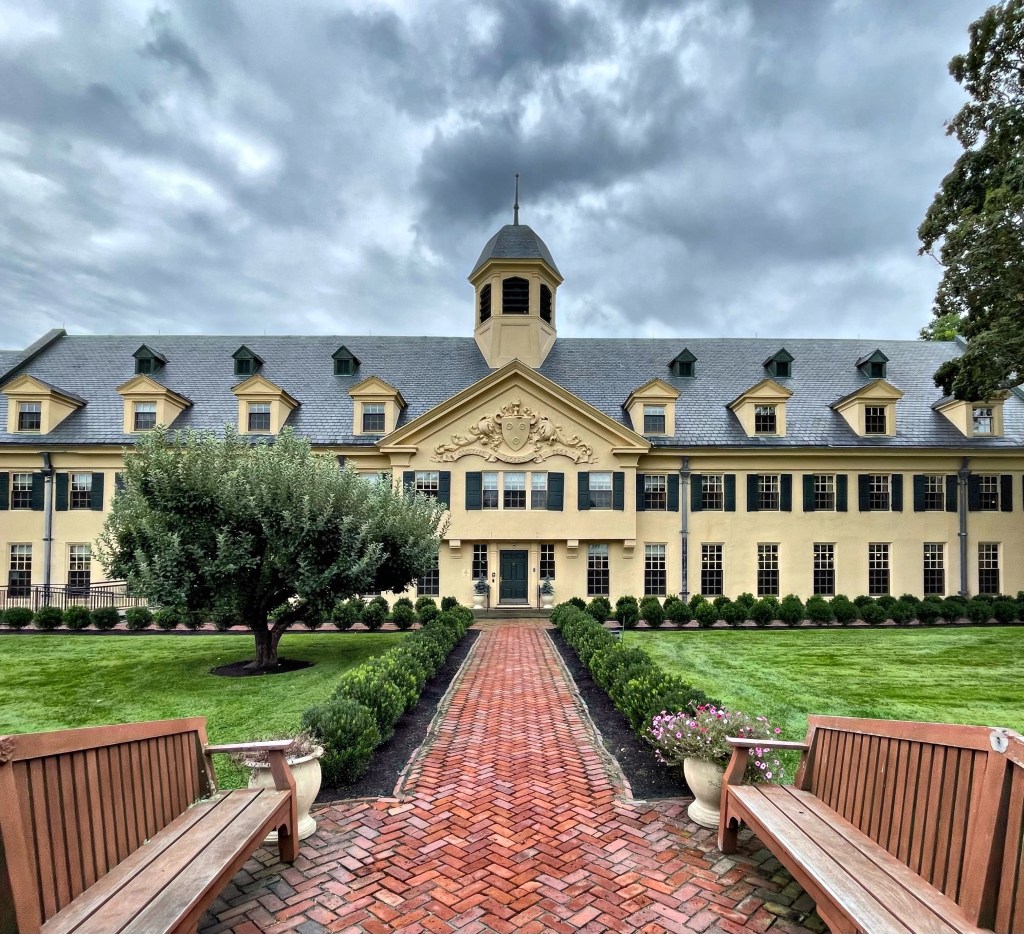
At the heart of the rural community of Middlebury, comprised largely of Connecticut farmers, far from the hustle and bustle of the world, Mary Robbins Hillard (1862-1932) sought to create a girls school to “provide young women with a liberal education in a community which would contribute to the development of their character, independence and sense of responsibility.” To accomplish this, they needed a school, and Mary hired her good friend (and architect) Theodate Pope Riddle to design the private girl’s school campus and main buildings on a site fronting the town green. The school opened in 1909 with125 pupils, slightly over capacity. For the design Theodate Pope Riddle – who was one of the first American women architects and a survivor of the sinking of the RMS Lusitania – took inspiration from English Arts and Crafts and historical precedence in English schools with large open courtyard plans. Originally finished in a gray stucco, the building enclosed a quadrangle at the rear. Inside, administration offices, reception rooms, living rooms, a library, gymnasium, chapel, dining rooms, infirmary, and (of course) classrooms lined the interiors on a closed loop to allow students and teachers access to all parts of the building without ever stepping outside in the cold New England winters. The Westover School remains active and one of the highest ranked private schools in the area today, and with a more cheery yellow coat!

Lester Thurber House // 1895

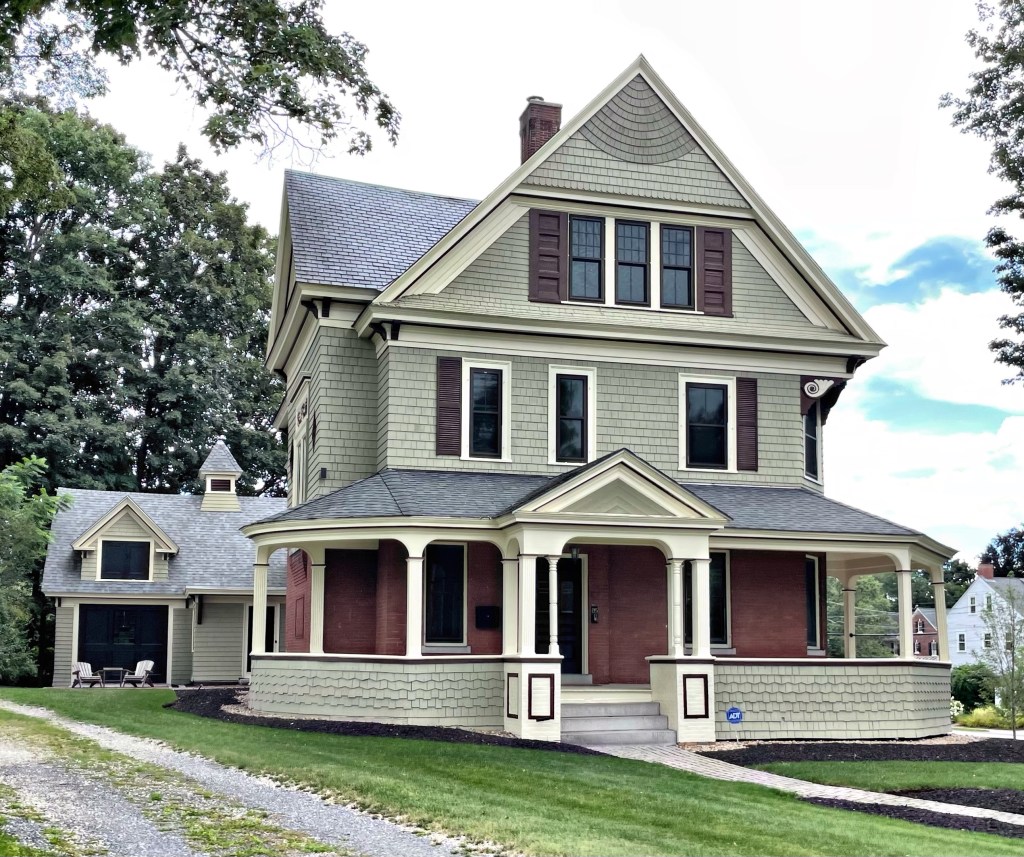
As Victorian styles of architecture fell out of vogue in the late 19th century, New England towns and cities alike, saw a revival of Colonial designs which dominated building styles throughout much of the next century. Early examples of Colonial Revival tend to blend Queen Anne (Victorian) and Colonial motifs under one roof, which makes for exuberant yet refined designs. The Lester Thurber House in Nashua, New Hampshire was built in 1895 and is an ornate example which preserves elements of the Queen Anne style in its asymmetry and high gables, but with Colonial pediment scrolls and classical columned porch. Lester Freeman Thurber (1858-1935) was born and raised in Vermont and was engaged in the political arena there, serving as private secretary to Gov. Roswell Farnham of Vermont, 1880-2. He moved to Nashua in 1882 and was BUSY! He served in both branches Nashua city government, was member for six years on the board of education, member N.H. House of Representatives, 1895, served on railroad committee; was a delegate to Republican National Convention, 1908, and was a member of many local fraternal organizations and clubs. The Thurber House has suffered from some deferred maintenance of sorts, but is a great local example of the transitional Queen Anne/Colonial Revival styles in Nashua.

Dr. Eugene F. McQuesten Residence // 1887

Dr. Eugene Forrest McQuesten was born in Litchfield, NH, on October 11, 1843. He enrolled at local schools before graduating from theJefferson Medical College in 1866. He practiced medicine in Lynn, Massachusetts for two years before moving to Nashua, New Hampshire to run a medical office. He worked in Nashua for years, later being nominated President of the New Hampshire Medical Society. In 1886, he purchased a house lot on Nashua’s Concord Street and razed the existing dwelling, building this stunning brick residence a year later.

General George Stark House // 1856

Inspired by suggestions from books by Andrew Jackson Downing, the Gen. George Stark House is one of the finest dwellings in the Italian villa style in New Hampshire. Located on a triangular plot just north of Downtown Nashua, the house was built in 1856 by a man who, though then only in his early thirties, was one of New Hampshire’s most experienced civil engineers and surveyors, and was the superintendent of the Nashua and Lowell Railroad. General George W. Stark (1823-1892) was born in Manchester, N.H., and as a young man worked on surveys of the canals and factories being built in the late 1830s in his native city. In 1836, during the first days of railroading in northern New England, Stark was employed with the engineers who laid out the route of the Nashua and Lowell Railroad. He climbed the ladder, eventually working as treasurer and assistant superintendent of theHudson River Railroad, subsequently rising to the position of superintendent. He later became superintendent of the Nashua and Lowell Railroad, whose route he had helped to plan, and in 1857, at about the time he saw the completion of his Italianate villa, he became managing agent of the Boston and Lowell line. In the same year, he was commissioned Brigadier General of the Third Brigade of New Hampshire Militia, giving him his title, General. The Stark House was occupied by General Stark and by members of his family until the property was acquired by The First Church of Christ, Scientist, about 1928. Today, it houses offices but retains a distinct residential character regardless.

Elijah Shaw House // 1889

This Queen Anne Victorian residence sits at 85 Concord Street in Nashua, New Hampshire. Built in 1889-90 for Elijah Shaw, the house is one of a dozen or so well-preserved Victorian-era mansions along the prominent street. Elijah Morrill Shaw (1826-1903) was born in Kensington, NH and spent many of his early years working at woolen mills all over the Northeast until the outbreak of the American Civil War. Obeying his country’s call to arms, at the time of the Rebellion, he entered the army in 1861 and was later promoted to Captain in 1863. After the war, he continued working at mills all over the region until 1888 when he was hired by the Nashua Manufacturing Company. He built this house soon after his arrival and remained there until his death in 1903. The dwelling and rear carriage house are clad in shingles with the house built with a brick first floor.

Charles Hoitt House // 1895

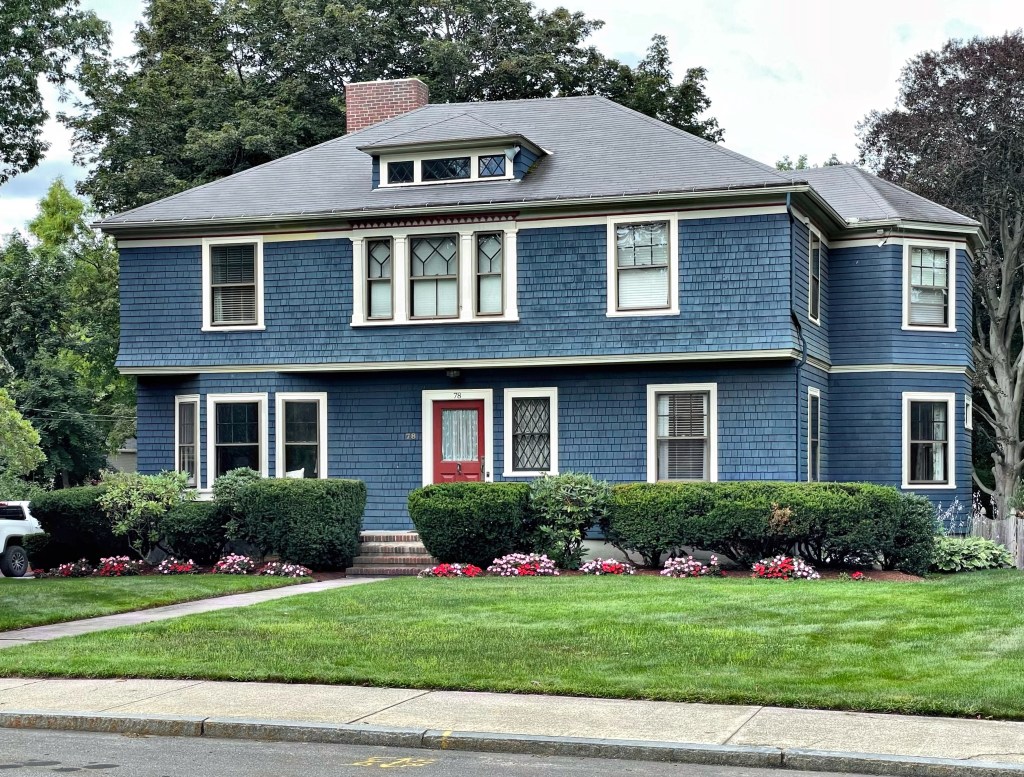
Charles William Hoitt (1847-1925) was born in Newmarket, New Hampshire, the son of William K. A. and Sarah C. (Swain) Hoitt. His father was a descendant of John Hoyt, one of the original settlers of Salisbury, Massachusetts. On the maternal side he is a descendant of Phineas Swain who served at Bunker Hill on the American side. Charles enrolled at Dartmouth College in 1867, and was graduated in the class of 1871. He moved to Nashua to work as Master of the Mt. Pleasant School and later worked as an usher at the Lincoln Grammar School in Boston. He eventually gave up teaching as a profession and returned to Nashua and worked at a local law office. He was admitted to the Hillsboro bar in 1877, and worked as a City Solicitor and later as Justice to the Nashua Police Court. With his standing, he erected this fine house on Concord Avenue, with a deep lot where he raised rare exotic birds. Judge Hoitt served in the New Hampshire House of Representatives in 1901 and in 1907, was appointed by Theodore Roosevelt to be the United States Attorney for the District of New Hampshire. His residence in Nashua blends Queen Anne, Shingle, and Colonial Revival styles elegantly. The property was purchased in the 1920s by the Unitarian Universalist Church of Nashua as a parsonage, a use it held until it was sold in 1977 to a private homeowner. The shingled porch was removed during the time it was a parsonage, but the house remains in excellent condition today!