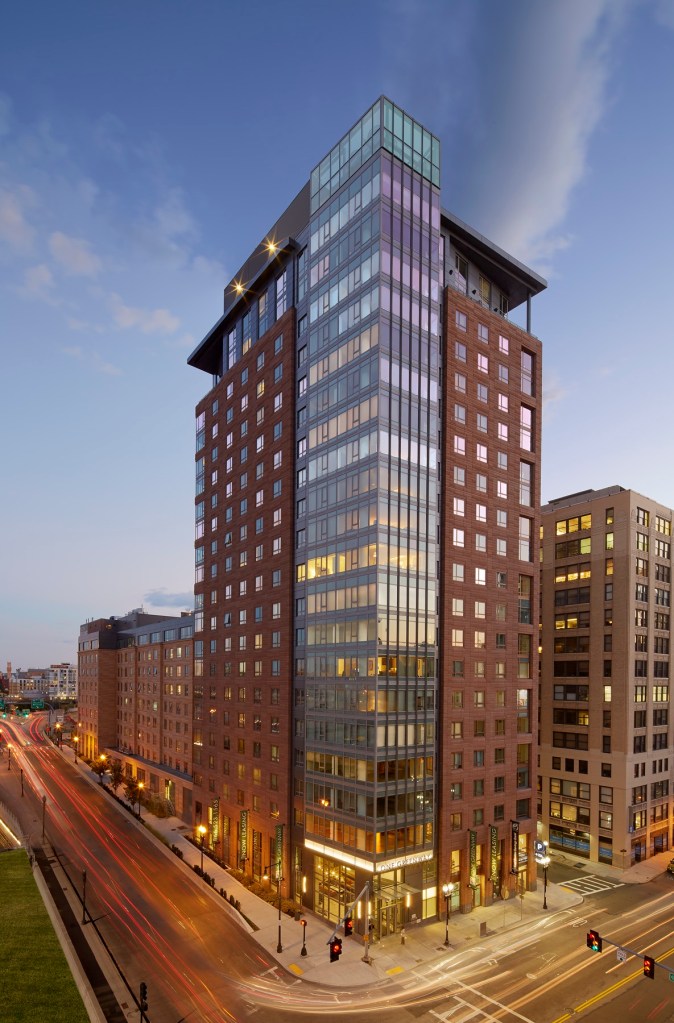
One Greenway // 2015

Replacing a vacant lot bordering I-93 at Kneeland Street, the One Greenway development provides much needed housing and design as one of the gateways into the Chinatown neighborhood of Boston. A result of community engagement, One Greenway is one of the largest new affordable housing projects in recent memory. The project restores the urban fabric that was lost half a century ago to the construction of major highways, which cut through the community and provides much-needed affordable housing in one of the nation’s oldest and largest immigrant communities. When the elevated highway was moved underground and the Rose Kennedy Greenway was laid out, parcels adjacent were available for reuse, and this was one of the last to be redeveloped. The building mixes 217 market-rate apartments and 95 affordable apartments, to create a mixed-income development, hopefully the future, as to not segregate affordable housing to less-desirable parts of cities. Designed by the firm Stantec, the building creates a solid street wall at the corner, and provides amazing open space at the rear in the form of a well-designed park designed by Crosby, Schlessinger, and Smallridge. The use of beige terracotta panels makes the large building more inviting, compared to the cold and sterile new apartment buildings going up all over the city and region.
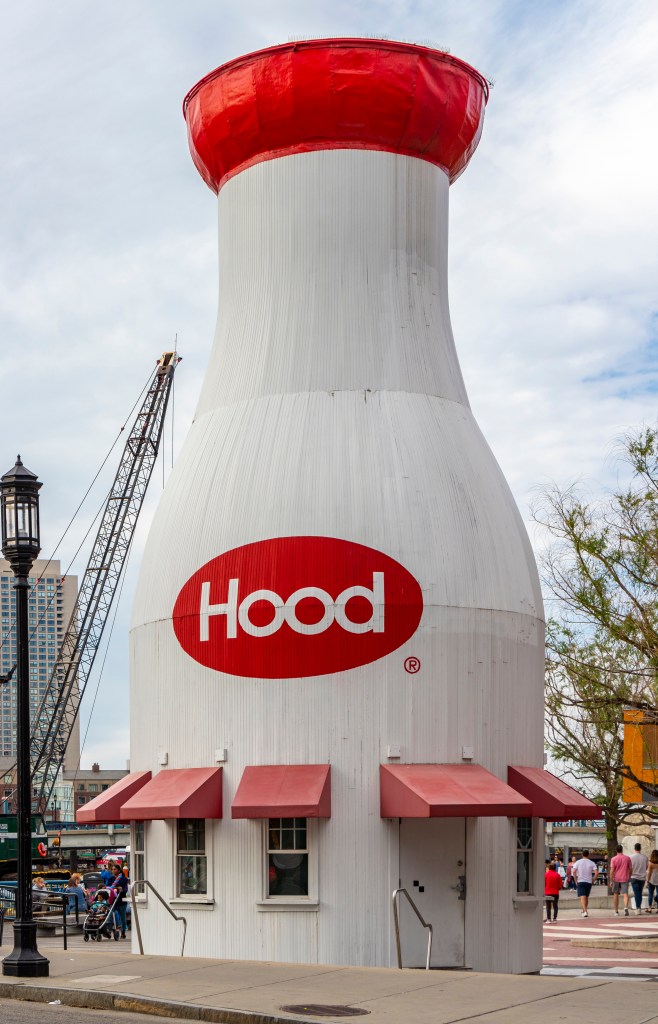
Hood Milk Bottle // 1934

Photo courtesy of Brandon Bartozek

Boston’s iconic Hood Milk Bottle has been an iconic fixture in the city’s built environment for decades, but do you know about the history behind it? The architectural oddity was born in 1933-4 in Taunton, Massachusetts, the brainchild of Arthur Gagner who created it as roadside attraction in which he could sell his homemade ice cream. The Milk Bottle beckoned to local families with its impressive size (the structure is 40 feet tall, 18 feet wide, weighs 15,000 pounds, and would hold 58,620 gallons of milk, if it were a real milk bottle)! As car ownership became commonplace, giant donuts, coffee pots, hot dogs, and other surreal shapes rose up on roadsides across the country, enticing motorists to pull over from the busy, new freeways. Gagner peddled sweet treats from his whimsical wooden stand for a decade before selling the building to the Sankey family, who also used it to sell ice cream. But by 1967, the bottle had been abandoned. In 1974, photographer Walker Evans took a Polaroid of the forlorn building, which brought Hood Milk, native to Charlestown, to the table. With a quote of $25,000 to repair it, Hood agreed to cover that cost if the Bottle could be renamed The Hood Milk Bottle, and the structure was to be located on City Hall Plaza, until the architect of the plaza called the Mayor’s Office stating their displeasure with that idea. They then contacted the newly relocated Boston Children’s Museum, who agreed to locate the bottle on their property. The Hood Milk Bottle was delivered to the Museum in 1977 from Quincy (where the repairs were made) on a barge with two fire boats steaming alongside, on a voyage the Hood Company dubbed the “Great Bottle Sail”, where it has remained to this day. It recently underwent a $350,000 renovation, restoring it to its former glory. So no crying over spilled milk!

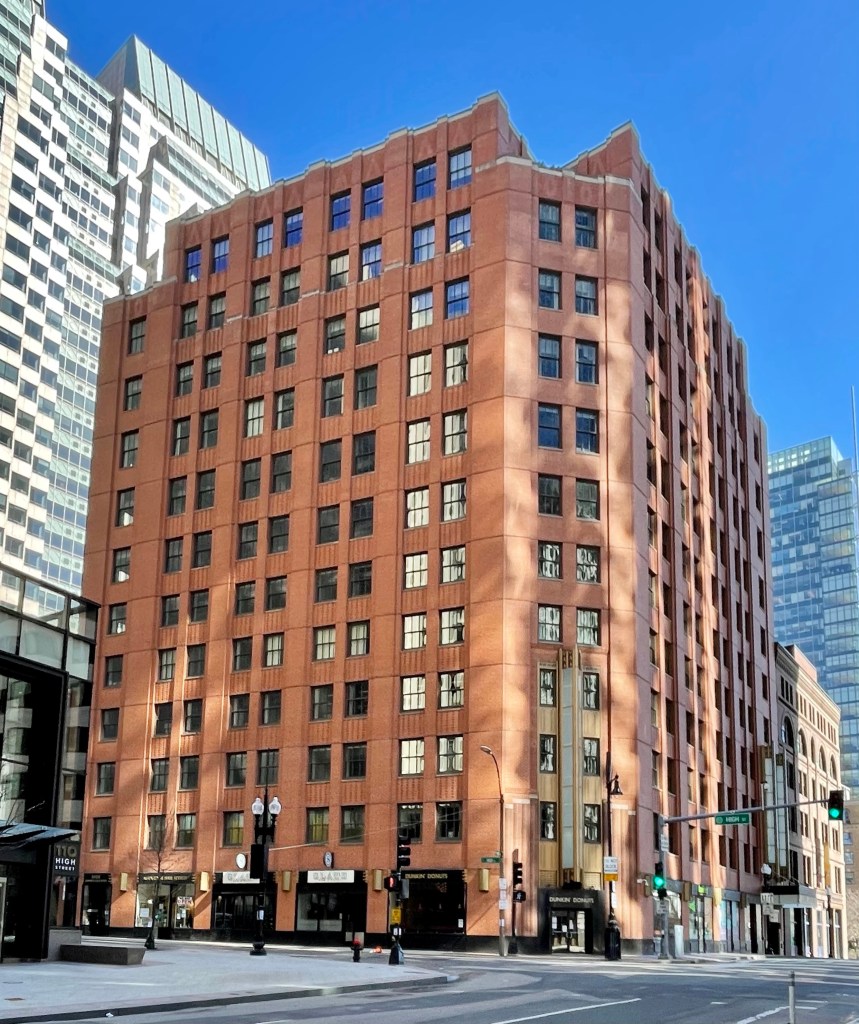
Western Union Building // 1930

While Boston doesn’t have as many iconic Art Deco buildings as New York or Chicago, we do have some that pack a punch! Located at the southern end of Downtown Boston, the Western Union building at the corner of Congress and High streets served as a headquarters for the third district in Western Union’s eastern division. Western Union was founded in 1851, and ten years later, built the first transcontinental telegraph line. The company made a brief foray into the telephone field but lost a legal battle with Bell Telephone in 1879 and thereafter concentrated solely on telegraphy. In the 20th century, Western Union diversified its operations to include: leased private-line circuitry, a money order service, as well as telegrams and mailgrams. The company’s Boston building was designed at the same time as their New York City headquarters, designed by Ralph Thomas Walker, and the buildings are strikingly similar, just with the Boston building on a smaller scale. The building in New York is among my favorite Art Deco buildings ever, as the use of red brick in varied patterns creates such a stunning composition. Amazingly, in 2004, water infiltration behind the original brick façade of the Boston building necessitated the removal and replacement in-kind of the entire brick façade. The existing signage and light fixtures, designed in the Art Deco style were added at that time.

The Charlesgate // 1891

One of the most grand apartment hotels in Boston, The Charlesgate, serves as one of many architectural anchors for the Back Bay neighborhood from Kenmore Square. The apartment hotel was constructed in 1891 and so named after the Charlesgate Park which was created by landscape architect Frederick Law Olmsted as part of the glorious Emerald Necklace park system. The Back Bay Fens was the first park designed by Olmsted for the City of Boston. Creating the Back Bay Fens was as much a sanitary as an aesthetic project, because the water was heavily polluted and often stagnant; Olmsted envisioned Charlesgate as the meeting point of the Back Bay Fens with the Charles River. The apartment hotel was actually designed and was financed by the architect, John Pickering Putnam, and members of his family. The basement and first story are constructed of Indiana limestone with the remainder of brick, with limestone trimmings. A picturesque effect is obtained by grouping the bays in pairs, and surmounting each pair with gables in the Queen Anne style, and by relieving these features against a high roof of green slate. The building originally featured 30 apartments and has since been reconfigured into over 50. The architectural landmark is one of the best statement-pieces in the neighborhood, and shows that apartment design can be done very very well!

Mount Vernon Congregational Church // 1892 & 1984

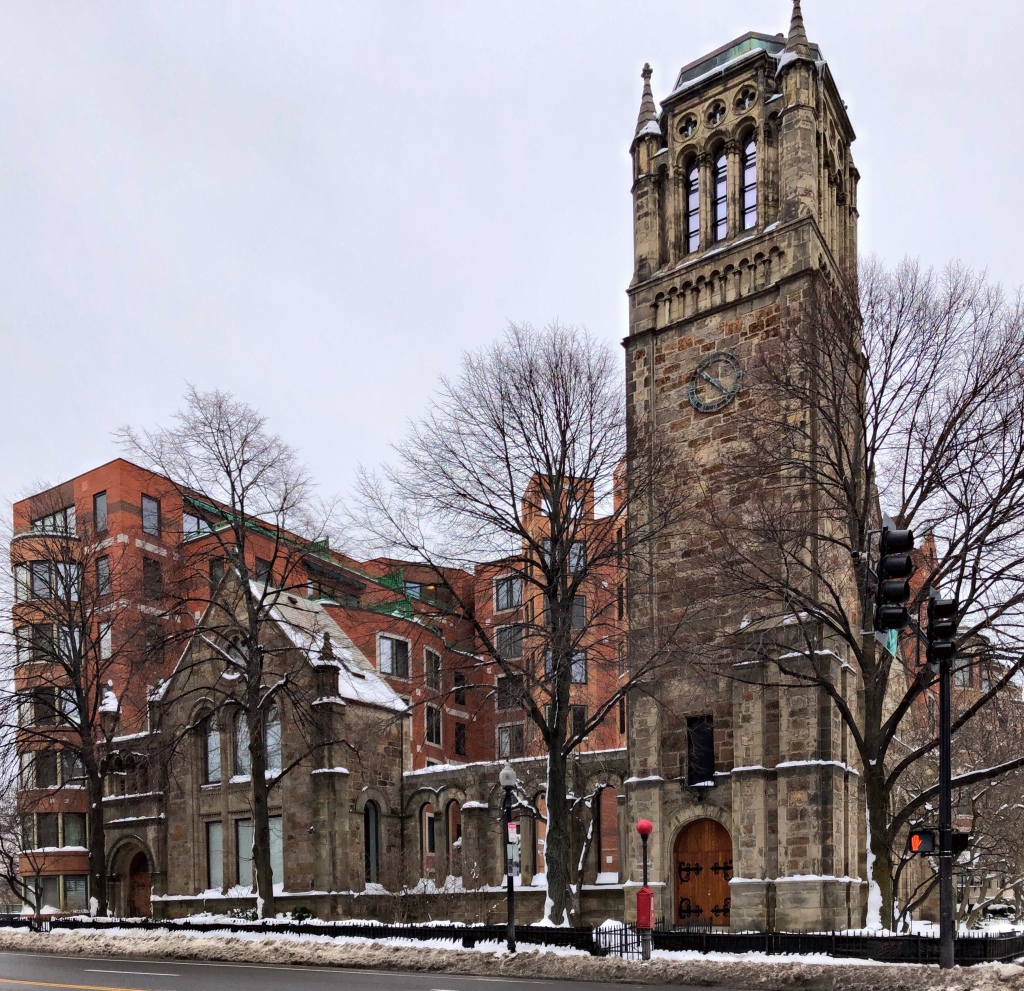
The Mount Vernon Congregation Church was founded in 1842 and originally was located in Ashburton Place on Beacon Hill (which I featured previously). As its members moved to the Back Bay, the congregation decided to build a new church in the western portion of the neighborhood. They hired architect C. Howard Walker to design the new church building, with stained glass windows by John LaFarge and Louis Comfort Tiffany added as memorials to several members of the congregation over subsequent years. As originally designed, the church had a 45-foot high steeple on top of its 85-foot square tower, but over the years it became structurally unsound, and it was removed just before the Hurricane of 1938, which toppled many steeples all over the region. In 1970, the church merged with the Old South Church in the Back Bay. In 1977, developers proposed to remodel the church building into retail and office space. The proposal was approved by the Boston Redevelopment Authority in January of 1978. Before work could commence, a fire destroyed much of the church building leaving a shell of Roxbury Puddingstone walls and the tower, the developer pulled its funding and the building’s future was uncertain. One year later, architect Graham Gund purchased the building. Gund was familiar with adaptive reuse projects, like his restoration of the Middlesex County Courthouse in Cambridge for his own office in Cambridge in the 1970s. Gund redesigned the building into 43 condominium units called Church Court. What are your thoughts on the architecture?

Isabella Stewart Gardner Townhouse // 1860

152 Beacon (center) and 150 Beacon (right) demolished. Courtesy of Boston Athenaeum.

In 1860, David Stewart, a merchant from New York, built a townhouse on Beacon Street in Boston’s Back Bay neighborhood as a wedding present for his twenty year old daughter, Isabella Stewart, and her new husband, John (Jack) Lowell Gardner. The house was originally numbered 126 Beacon, but re-numbered as 152 Beacon ca. 1862 when homes were built on the south side of the street. The home was the city dwelling of the young couple, who also owned “Green Hill” in Brookline, and an estate on the North Shore. Isabella Stewart Gardner began amassing a large collection of art and their Back Bay home was insufficient to display it all. In 1880, John purchased the neighboring home at 150 Beacon from Andrew Robeson, a wealthy merchant from Fall River, whose main home is now the headquarters of the Fall River Historical Society. Soon thereafter they combined the two houses, with the address of 152 Beacon, to provide greater space for the display of the growing art collection being assembled by Isabella. After her husband’s death in late 1898, Isabella Gardner pursued plans for a new home that would provide a suitable setting for her art collection. She purchased land in the Fenway and began construction on her mansion, Fenway Court, now the Isabella Stewart Gardner Museum. One year after completion of Fenway Court, the two townhomes were purchased by Eben Draper, who razed them for his mansion in 1904 (see last post).

Governor Draper Mansion // 1905

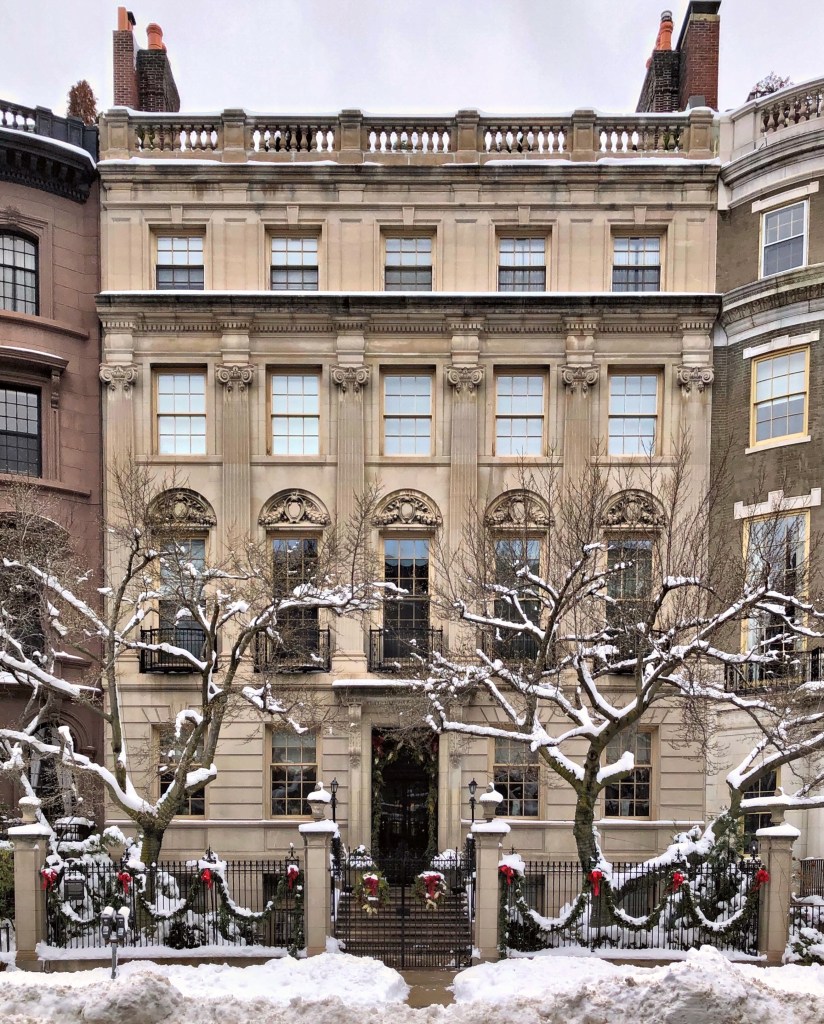
Adjacent to the Warren House (last post) on Beacon Street in Boston’s Back Bay neighborhood, this massive mansion is one of my favorites on the street. Built in 1905, and designed by architect Alexander Wadsworth Longfellow, Jr. an amazing local architect, and nephew of poet Henry Wadsworth Longfellow. The grand mansion was the home of Eben Sumner Draper and his wife, Nancy. Eben Draper was a manufacturer of cotton machinery in the Draper Corporation, founded by his father in Hopedale, MA. Draper graduated from MIT and entered his fathers business, which upon the time of his graduation, was the largest plant for manufacturing cotton machinery in the world. In 1905, Draper was nominated and elected as Lieutenant Governor of Massachusetts, the same year he had this mansion constructed. In 1908, Draper was elected Governor, and served two terms under the Republican Party, pushing a pro-business, and anti-reform agenda, a bill legalizing the merger of the Boston and Maine Railroad with the New York, New Haven and Hartford Railroad, signaling approval of what was seen as monopolistic business practices, something the Draper Corporation was known for in Hopedale. The former single-family home was converted to six condominium units in 2000. Fun fact: the Draper Mansion replaced the 1860 home David Stewart, a merchant from New York, built as a wedding present for his daughter, Isabella Stewart, and John (Jack) Lowell Gardner. Isabella would later create the beloved and iconic Isabella Stewart Gardner Museum. The couple purchased the adjacent townhome in 1880 to store their growing art collection.

Warren House // 1913

This stunning townhouse on Beacon Street in the Back Bay neighborhood of Boston was constructed in 1913 for George Eddy Warren and his wife Frances Knowles Warren. The home, designed by Parker, Thomas & Rice, is one of the more elegant Classical Revival townhomes in the city, with its symmetrical, prominent bowfront, piano nobile with full-height windows, classical lintels, and thoughtful use of brick and stone construction. George E. Warren was a coal dealer, who was selected to head the U.S. Army’s Raw Materials Division during WWI for his expertise. During the war he was in charge of the fuel and forage division, overseeing an important aspect of 20th century warfare, petroleum manufacturing and distribution. His wife Frances was the daughter of Francis B. Knowles, a co-founder of Rollins College in Florida, the oldest institution of higher learning in the state of Florida. Frances volunteered her time in Boston as President of the YWCA, progressing women’s empowerment and social justice in the city. After successive ownership, the townhome was acquired by Emerson College and combined with its neighbor on the interior. In 2000, the home was reverted back to a residence and houses two condominium units.

Hartt House // 1899

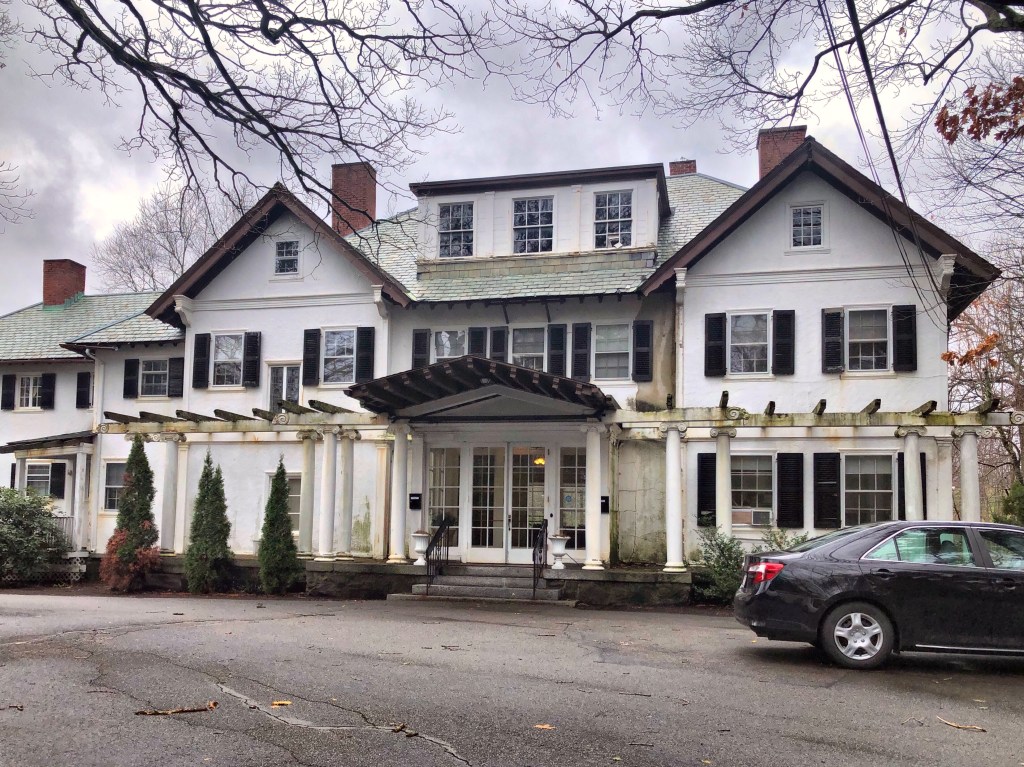
The area just west of Jamaica Pond between Boston and Brookline can be characterized as a neighborhood of well-preserved 19th and 20th century homes and large, former estates converted to institutional use. The Hartt House in Brookline, off Goddard Ave, was built in 1899 for Arthur Hartt and his wife Augusta Batchelder. Arthur worked as a clerk with the New England Mutual Life Insurance Company in Downtown Boston and built a couple large estates in Massachusetts, including a summer home in Marion. The Colonial Revival home sits on a hill, setback off the street, with a landscape designed by the Olmsted Brothers. The property was bought in the 1970s by the Hellenic Association of Boston, who turned the home into offices and the former barn into a chapel. The home appears to be suffering from some deferred maintenance, but is in overall good shape.

Jennings House // 1949

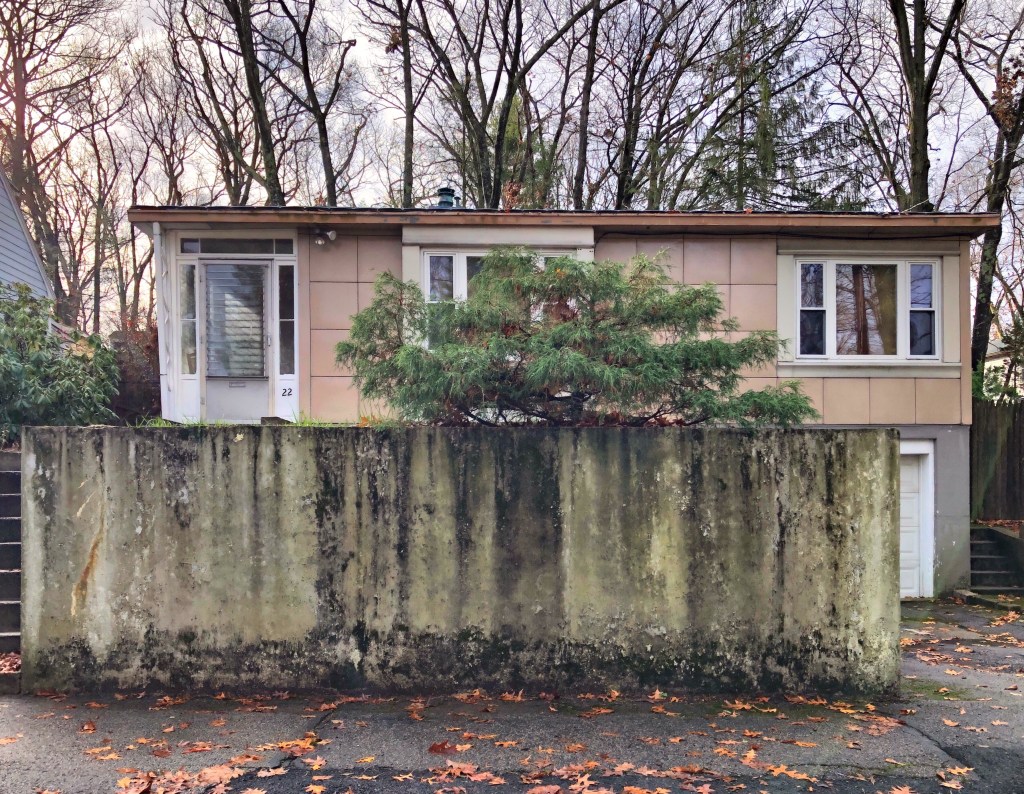
Tucked away on an un-assuming side street in South Brookline, you will find this oddly fascinating home. Without architectural history knowledge, you may think it is just a normal 1940s house, but it’s actually a Lustron House! Between 1948 and 1950, the Lustron Corp. built prefabricated metal homes across the U.S. as part of an effort to combat the housing shortage for returning soldiers post–World War II. Despite these futuristic homes being considered low-maintenance and highly durable, only about 2,500 were constructed, as the structures were seen as too costly and complex to manufacture and assemble. The homes came in just three models and came in four available colors: “Surf Blue,” “Dove Gray,” “Maize Yellow,” and “Desert Tan”. The home is covered in porcelain enamel metal panels set into a steel frame which can be replaced when damaged. At the interior, the homes had metal-paneled interior walls with mostly pocket-doors for space saving. This home in Brookline was built for Edmond and Helen Jennings, in the Westchester model in the Desert Tan color. The only major alteration is the enclosure of the porch, but it retains a high degree of integrity from when it was assembled in 1949.

What do you think of this iconic 1940s home and style?