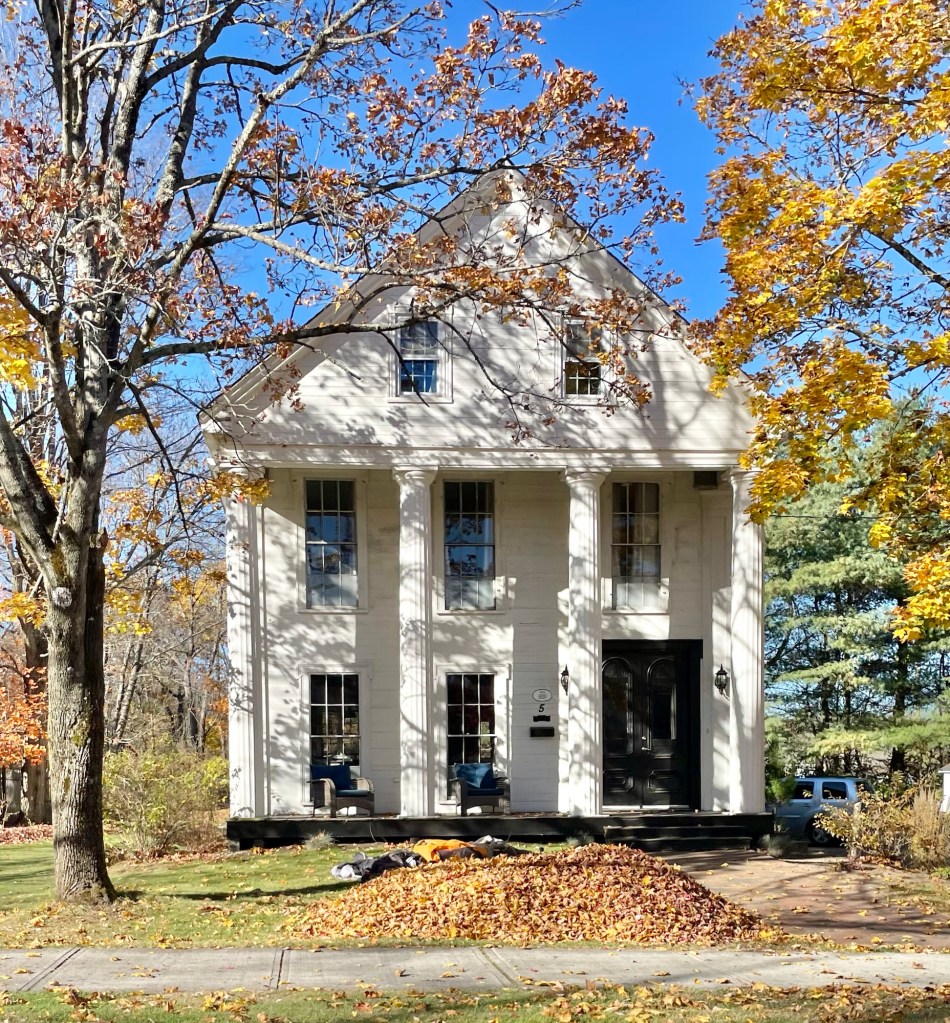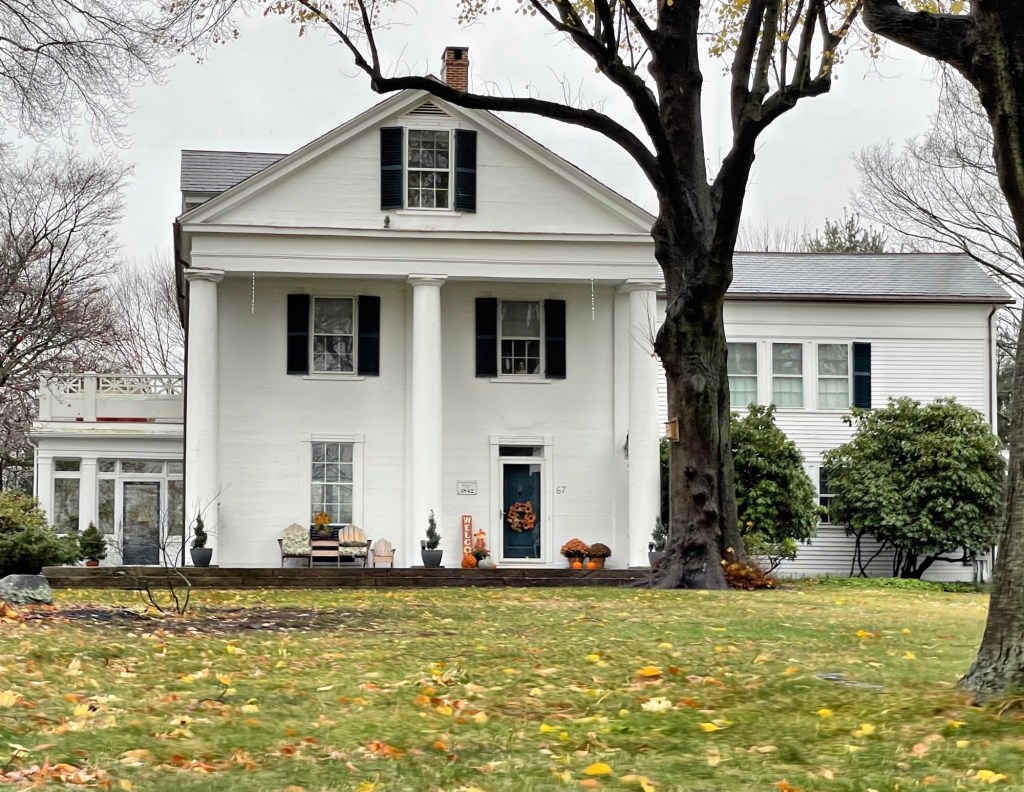
This perfect Greek Revival style house sits on Pelham Street in Newport, overlooking Touro Park and the iconic Newport Tower/Old Mill. Built around 1847 for Captain Robinson Gardner, the house exhibits flushboard siding, a heavy portico with wrought iron balcony over the door, and entablature with corner pilasters, all hallmarks of the style. The home became known as “White House” and has likely been painted white for much of its history.
This stunning house located in Newport, Rhode Island, was constructed in the Greek Revival style circa 1840 for Henry Castoff (1803‐1879). His house was one of several dwellings built in the Greek Revival style at that time in the area surrounding Touro Park. Henry was a merchant who dealt in goods from the Indies. In 1868, Henry sold this house at 115 Pelham Street to Robert P. Berry, a local dentist and inventor. Dr. Berry’s heirs sold the property in 1890 to William J. Swinburne (1822‐1897) a former soldier, coal merchant, and Mayor of Newport (1855‐1856). After Swinburne’s death in 1897, the home passed by will to his daughter Elizabeth, who never married. Elizabeth resided in the house until her death in 1918. Under the terms of her will, the home was deeded to the Newport Civic League, who established the Swinburne School there, a school for women for the study of household arts and domestic sciences. The school opened in the 1920s. The Swinburne School operated until 2002, when it was dissolved by the Newport Civic League. The contents of the building were sold at public auction and the school records were deeded to the Newport Historical Society. The building itself was purchased by a Brian O’Neill, who restored it to a single‐family dwelling.
In the late 1830s, Captain Augustus Littlefield (1803-1878) purchased a house lot on Pelham Street in Newport, Rhode Island and commissioned housewright John Ladd to design and build his new residence. Littlefield reportedly asked his Ladd to design an “authentic copy of an Italian Villa” he had seen during a trip in southern Italy. The result is a more traditional Greek Revival, temple-front house with a portico supported by four monumental columns with capitals that combine Corinthian and Egyptian lotus motifs. The minimal Italian Villa detail can be seen in the bracketed cornice and in the pediment. Built around 1836, the house remained in Littlefield’s possession until his death in 1878. The property was purchased by Charles C. Van Zandt, attorney and later the 34th Governor of Rhode Island. Gov. Van Zandt died in 1894 and was interred at Island Cemetery in Newport. The Littlefield-Van Zandt House remains a significant early, high-style Greek Revival house in the state and one with a great state of preservation.
One of the more unique Greek Revival style houses I have yet seen in New England is the Levi Starbuck Houseon Orange Street on Nantucket. The house was built in 1838 by housewright William M. Andrews who sold the completed property that year to Levi Starbuck, a wealthy sea captain for $5,000. When he bought the house, Levi Starbuck (1769-1849) was 69-years-old. Levi Starbuck is credited by some as inspiration for the character Starbuck in “Moby Dick.” He would spend the last ten years of his life in this opulent new house on Orange Street. Architecturally, the house is clad with flush siding with projecting paneled pilasters with fret patterns on the top and bottom breaking up the bays of the house.
This stunning Greek Revival house in Warren, according to historians, was built c.1800 as a cooper shop! A cooper as a professional, would make wooden barrels, tubs, and casks from wooden staves from their shops. This shop, which was originally a vernacular structure, was later renovated around 1833 into a Greek Revival style residence. On its facade, the house has two-story applied pilasters which break up the bays and smooth flushboard siding which makes the house even more stately!
The Joseph Cottrell House on Spring Street in Newport is a handsome, two-story, Greek Revival style house with flushboard siding and a traditional pilastered recessed center entry. What really stands out about this home is the two-story rounded corner bay which is finished with columned porches (since enclosed) which were likely added in the second half of the 19th century. Cottrell worked as a ship-builder in Newport, likely constructing the house and later addition himself. Developers today would never!
The Amos Chase House and Mill are located in Weare, New Hampshire, on the banks of the Piscataquog River. The house is oriented facing the road, while the mill is behind it, on the bank of the river. The mill is the only surviving 19th-century mill building in Weare. The house was built about 1836 by Amos Chase, as was a mill. That mill burned in 1844; the present mill was built by Chase as a replacement a few years later. This mill was the only one in the town to survive the New England Hurricane of 1938, although its waterwheel was washed away. Amos Chase was a tool manufacturer and one of several members of a locally prominent family operating small mills in the town. His son later used the mill in the manufacture of baskets. The large Greek Revival style home has all the hallmarks of the style, from the pediment facing the street, to the pilasters at the entrance and corners.
Elisha T. Loring (1804-1889) was born on Cape Cod and began his career in the Chilean tin and copper trades, moving to Boston in 1839. His house at 21 Mill Street in Dorchester’s Harrison Square neighborhood was built in the early 1840s, showcasing his wealth and stature in the community. Based out of this house, Loring made a large fortune in the Lake Superior mines, also known as the Calumet and Hecla mines. By 1862 he was the treasurer to the Pewabic and Franklin Mining Companies, and a decade later is listed as “President, National Dock Company.” Loring’s Dorchester mansion is Greek Revival in style and consists of a three bay by three bay main block and a substantial rear ell. The house’s original clapboards were replaced by wood shingles sometime in the 20th century. The main elevation’s pedimented center pavilion exhibits a small front porch whose Ionic columns support a heavy, cornice-headed entablature. The porch’s roof is set off by an ornate cast iron railing. The side elevation is unusually wide and culminates in broad pedimented attics containing elliptical lunette windows.
Located a stone’s throw from the Judson Manville House (last post) another uncommon brick Greek Revival style house in South Britain, Connecticut, this house stands out for its outstanding proportions and well-preserved exterior. This residence was built around 1830 for Benjamin Downs on the site of his family’s old property. The simple lines, portico at the entry supported by Ionic columns, and the window in the gable are all typical of the period.
Built in 1828 and used for years as a “house of public entertainment” for Mitchell Simeon Mitchell, this stunning home in Southbury, Connecticut has historically been known as the Mitchell Mansion. The Mansion House displays sophisticated Greek Revival features, including its temple shape, the restrained Grecian doorway, an inset Ionic-columned portico and a cornice with continuous modillions. The quality of the exterior is matched by its interior detailing, with a semicircular staircase and, at one time, a large ballroom. Records found in the house indicate that one of the carpenters was James English, later to become Governor of Connecticut. During the middle of the 19th century the property was owned by noted New York furniture maker Duncan Phyfe.