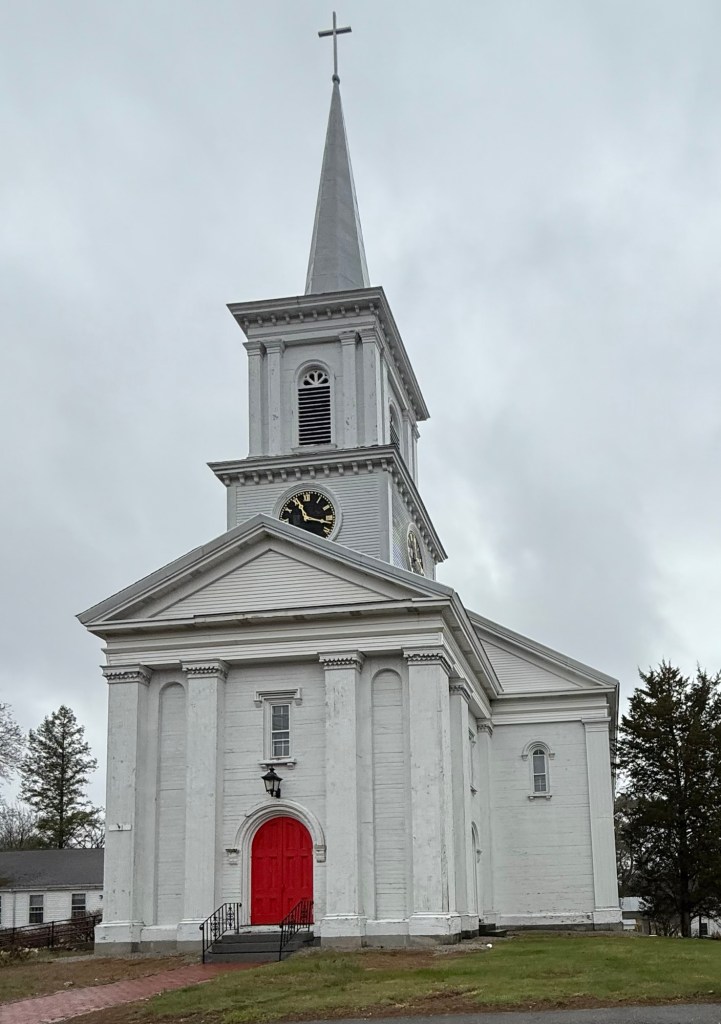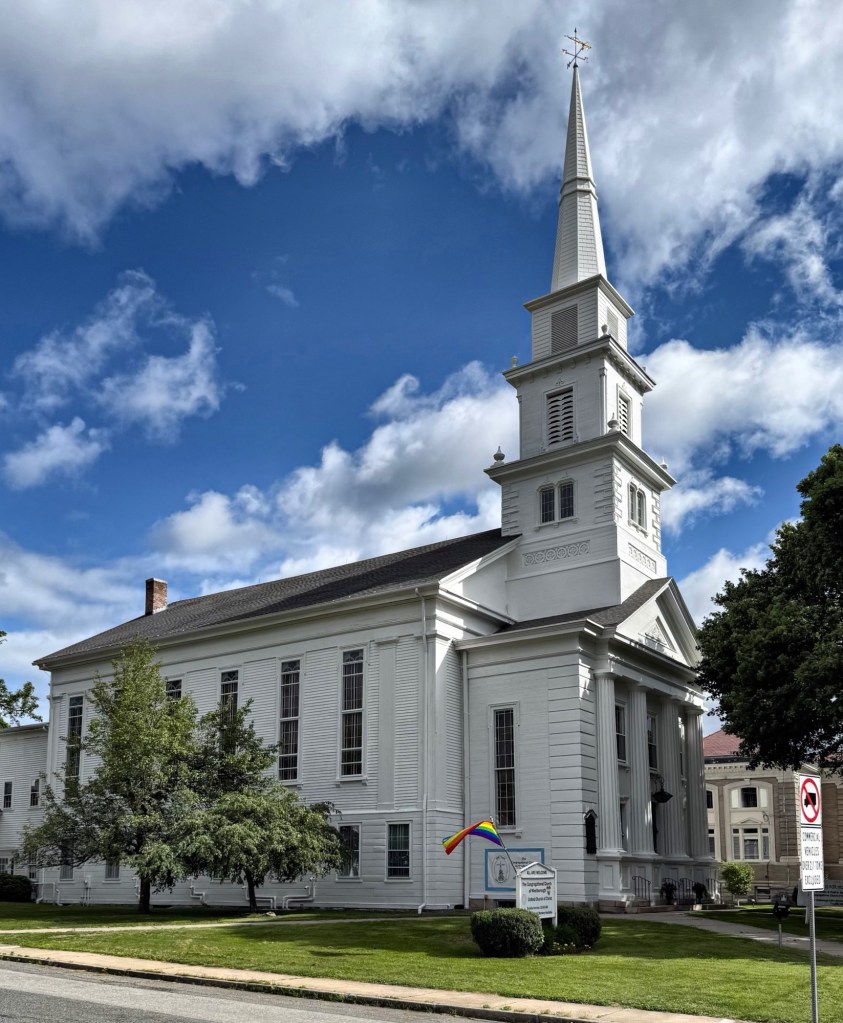
First Congregational Church of Chicopee // 1825

The First Congregational Church Society of Chicopee was organized as the Second Church of Springfield in 1751, when residents of land today known as Chicopee and Holyoke (then a part of Springfield) sought a parish church closer to their homes. Before Chicopee officially split from Springfield in 1844, the Second Church of Springfield built this Federal-Greek Revival style church building in 1825. Shepherd and Whitmarsh, prominent builders of Springfield were hired to erect the church. Both were trained under architect, Isaac Damon, thus the close resemblance to his designs for this church in Chicopee. The clapboard structure is simply designed but holds strong proportions and symmetry. The church has a four-columned portico with Ionic columns and a two-story square tower containing the belfry, blind octagonal stage with molded trim above, all capped by a dome surmounted by a weathervane. While the church now has replacement windows and plastic, ill-fitting shutters, the building is in great shape and tells the story of the early days of the development of Chicopee from sleepy parish town to industrial city.

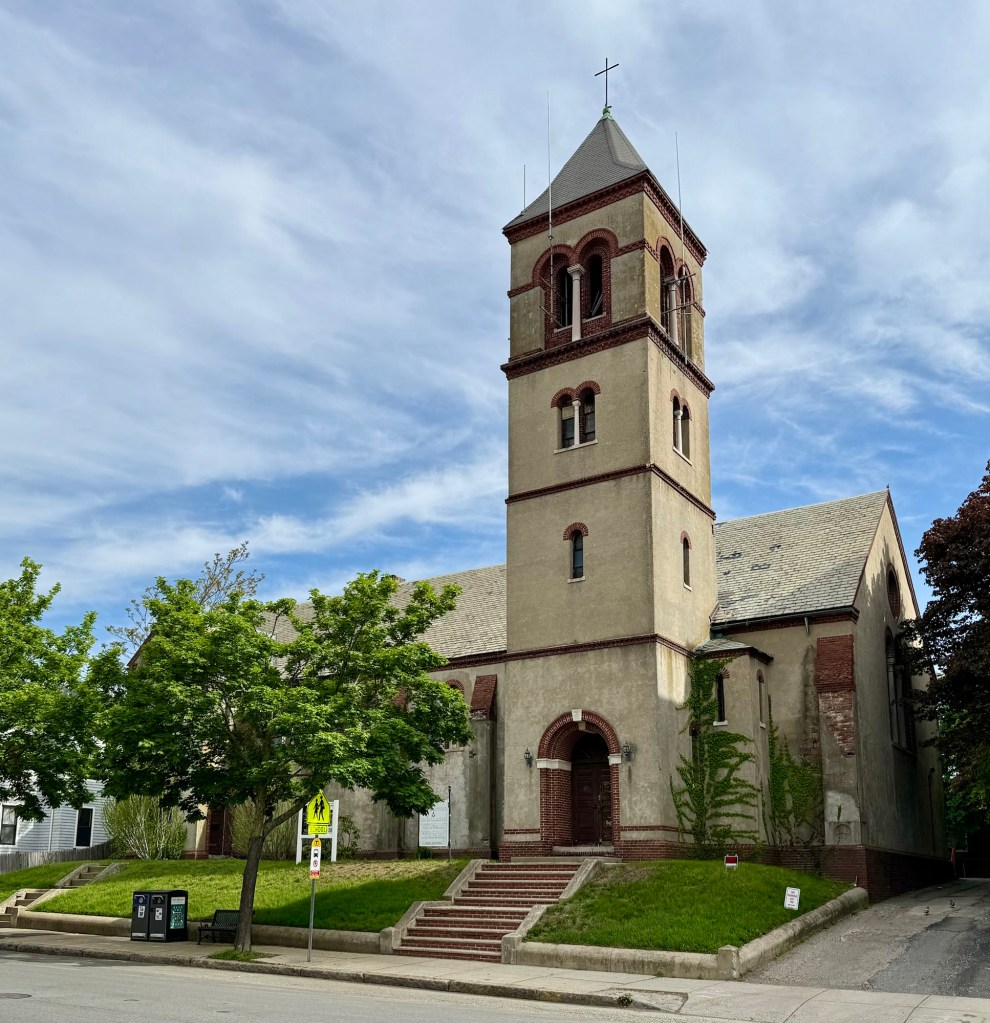
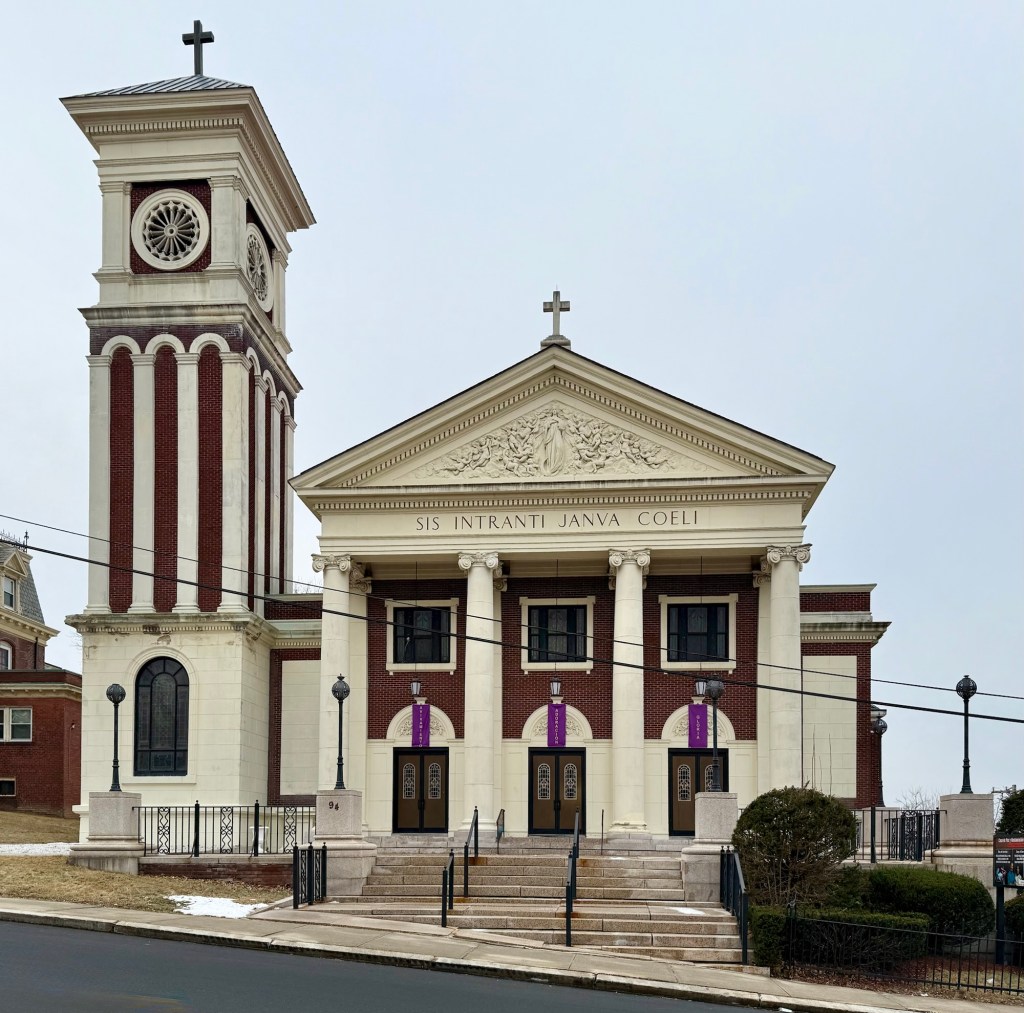
Assumption Roman Catholic Church // 1922

As Chicopee developed into one of the major industrial cities in Western Massachusetts, immigrant groups moved there, finding work at some of the major manufacturing companies. Irish and Polish churches were built and French and French Canadian residents too built their own church, where they could gather and worship in their native language. A wood-frame church was first built in the 1870s and used until it was destroyed by fire in 1912. It took a decade for the congregation to gather enough funds to purchase a new lot and build a new church, but patience was a virtue as their church is a stunner! The cornerstone for the church was laid in 1922 and the building was designed by local architect, George P. Dion, and constructed at the cost of $200,000. The building was dedicated in 1925 and is one of the finest, and most unique churches in the state. Italian Renaissance Revival in style, the church stands out for its 85-foot-tall campanile and cast-stone high-relief in the pediment at the facade. It is believed that within the relief, that depicts the figure of Mary surrounded by Cherubs, depicting the “Assumption of the Virgin,” George P. Dion used the likeness of his granddaughter as a face of one of the cherubs. The congregation moved out of the building but has been recently mortgaged to a new church, Iglesia Cristiana Casa De Paz y Restauración, showcasing the ever-changing demographics that keep our cities vibrant and stewards that do right by our collective history and buildings.

Basilica of St. Stanislaus // 1908

The Basilica of St. Stanislaus is a landmark church building in Chicopee, Massachusetts, with strong ties to the city’s industrial and immigrant past as well as a landmark of the city’s rebirth and growth. The congregation was founded and financed by Polish immigrants who had arrived in Chicopee, beginning in the 1880’s. The young Poles were determined to establish and finance their own church in which they could worship in their own native language and espouse their Polish customs and traditions with a sense of community. The church was founded at a time where Polish immigrants were settling in Chicopee, finding work at local factories. The Polish population of Chicopee surged in the late 19th into the early 20th centuries from just 200 residents in 1885 to over 9,000 in 1914. The first St. Stanislaus Church was a small frame structure built on this site in 1891. The present church was built in 1908 from the designs of architects Robert J. Reiley and Gustave E. Steinback and is Byzantine Revival in style. Constructed of brownstone with cathedral-like qualities, the facade is dominated by a pair of monumental masonry towers. Its spires are composed of copper drums which are surmounted by graceful belvederes and are pierced by arched openings. In 1991, Pope John Paul II raised the status of the church to a “minor basilica“, a classification that remains to today, one of just a handful in New England.

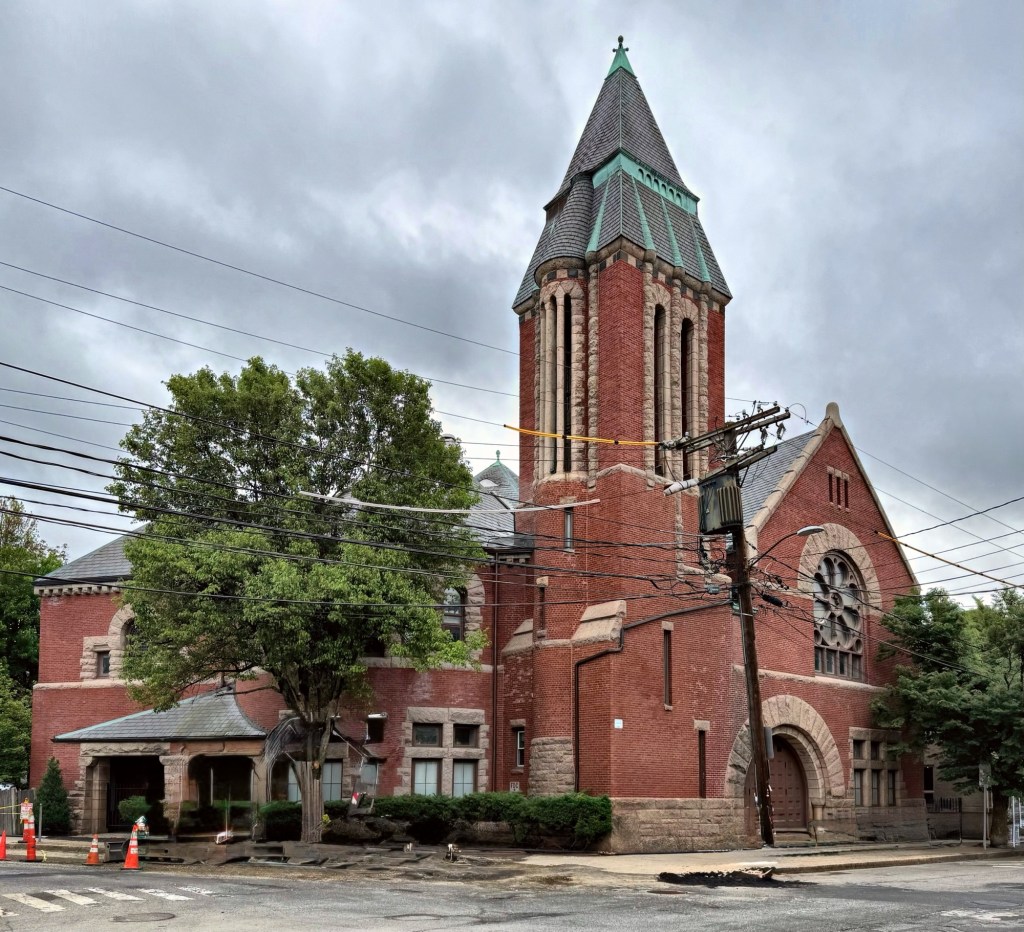
Church of the Holy Name of Jesus, Chicopee // 1857

With crop failure a common occurrence in 1830s Ireland, immigration from Irish to New England surged with workers and families looking for a better life. Labor opportunities were abundant in the newly established mill town of Chicopee, with the Irish flocking here to dig canals, build dams and mills and later work in those same buildings. Their wives and daughters would work as cooks and maids, but later as operatives in those same mills. As many Irish were Catholic, it became apparent that a Catholic congregation should be established, St. Matthew’s was first organized in Chicopee in 1838. An earlier wood-frame church was built and used for a number of years until a large site on South Street was purchased by the Diocese for a new campus. Irish-born ecclesiastical architect Patrick Keely designed the church building which was constructed between 1857-1859 in the Gothic Revival style. The church was dedicated the “Holy Name of Jesus” church and exhibited sandstone-topped buttresses, rows of pointed dormers running down the clerestory on the sides, and a prominent central steeple. In 1910, the present copper spire replaced the original steeple which was damaged and burned in a lightning strike. The complex grew throughout the 19th and 20th centuries, with a rectory, schools, convent and monastery built on the site. Sadly, due to dwindling membership and fiscal considerations, many of these buildings were demolished in the past decades. The church appears now to be closed and is still owned by the Archdiocese of Springfield. I hope something can be done to preserve this landmark structure and the remaining buildings on the site.

North Cornwall Congregational Church // 1826

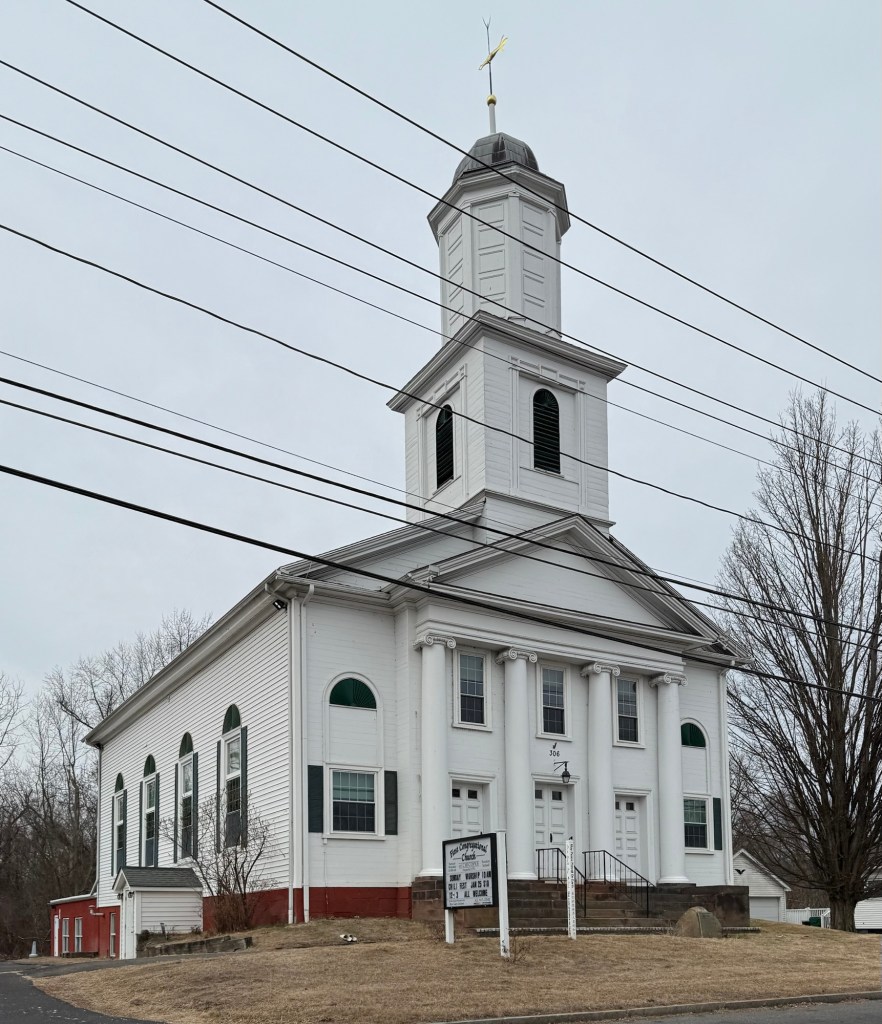
During the nineteenth century several small rural settlements dotted the landscape in Cornwall, Connecticut. In 1782, a group of “strict Congregationalists” seceded from the established Congregational church in town and constructed a “second” church in Cornwall Center. Following this, the town was divided into north and south parishes, with First Church built on the town center and the Second Church, this building, constructed in North Cornwall village in 1826. The North Congregational church is among the town’s finest Federal style buildings in the region and features three entrances with fanlight transoms and the bays of the facade are broken up by two-story fluted pilasters.

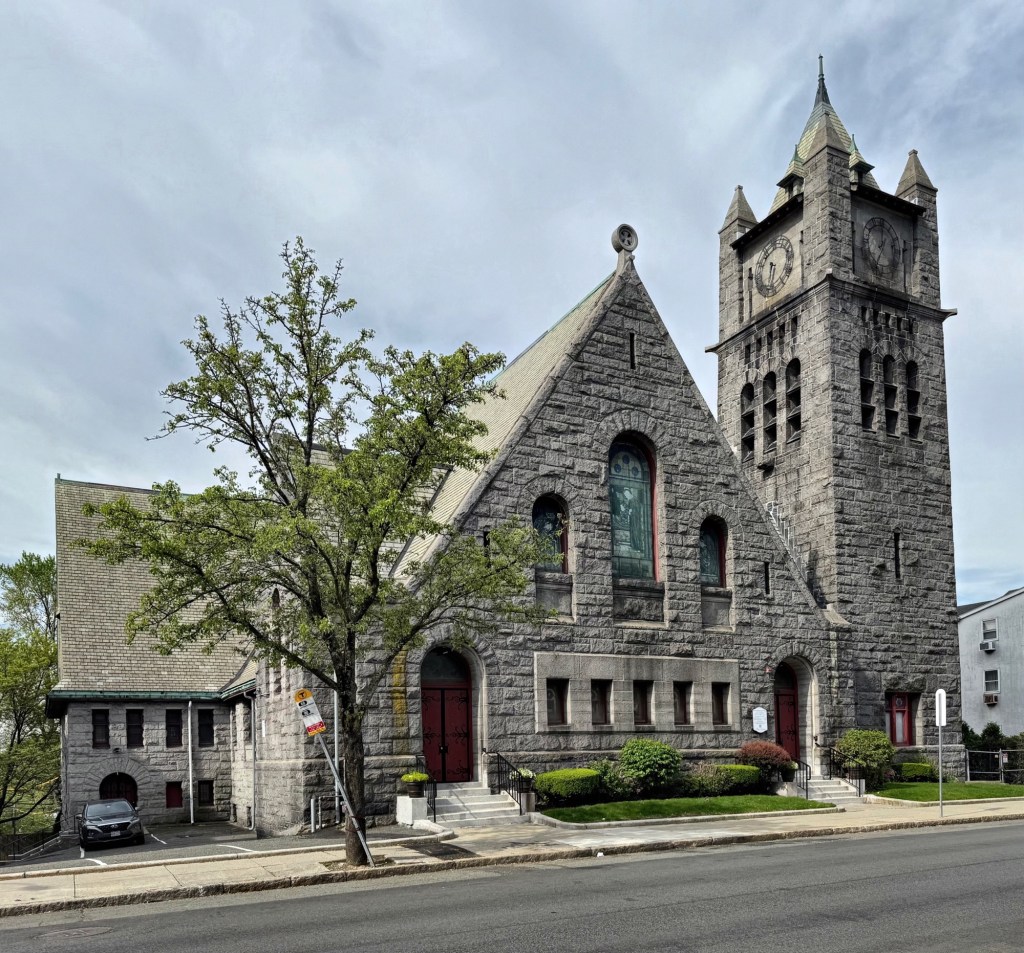
Former Newton Centre Methodist Episcopal Church // 1899

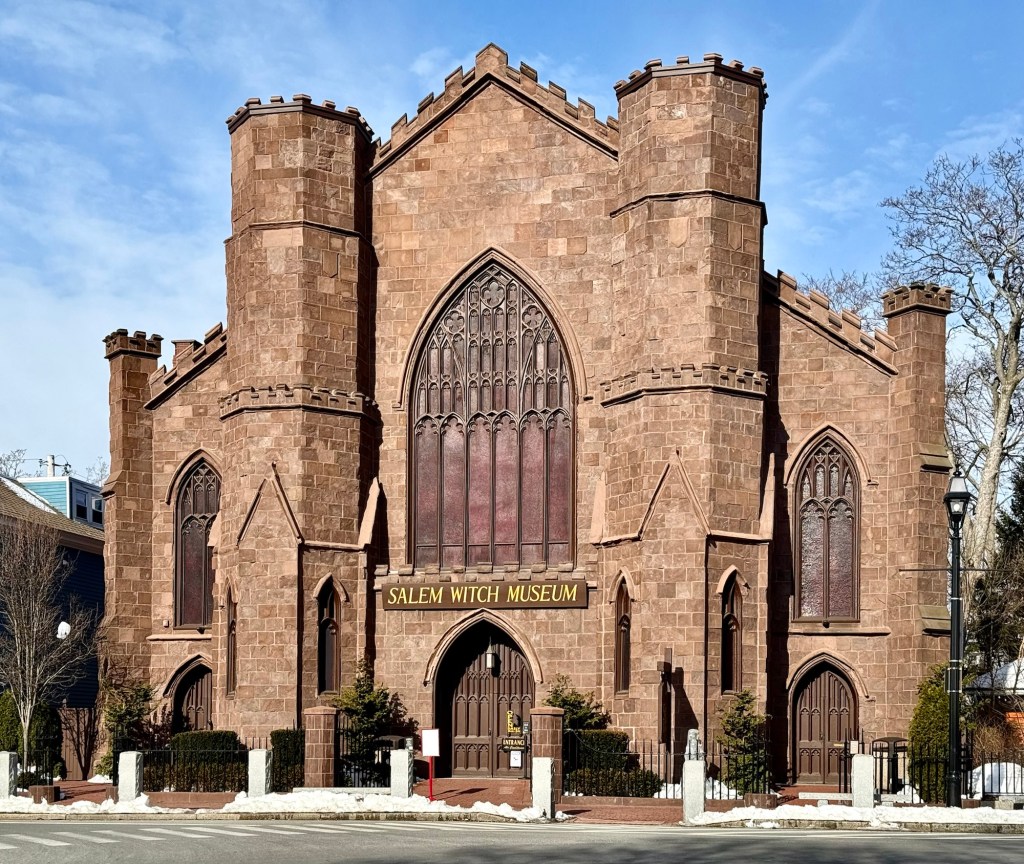
This building, the former Newton Centre Methodist Episcopal Church, is Romanesque in style, and is one of the more notable adaptive reuse projects in Newton. The church was designed by the esteemed architectural firm of Andrews, Jacques & Rantoul and completed in 1899 for the local Methodist Episcopal congregation. The edifice is built of locally quarried rubblestone, often called Roxbury Puddingstone, and trimmed with rough cut Milford granite. The granite is used at the windows, forming the arches and heads, and most strikingly in the large arched entrance. The church eventually closed and was renovated with modern windows, additions, and more, and currently houses a restaurant, bank, book store, and professional offices.

Fourth Byfield Parish Church // 1931

The Byfield Parish Church at 84 Warren Street in Georgetown, Massachusetts, was built in 1931 and is the fourth meetinghouse to occupy the site. The congregation dates to 1701, when sixteen families in this section of Rowley (now Georgetown) near Newbury were set off separate from the Rowley First Parish. Travel for religious services became too arduous, so the local residents petitioned to create their own parish, Byfield. Some accounts state that the first meetinghouse was built in 1702 and it is said to have been razed by 1746 to make way for a new wood frame church with a steeple, a spire, and a weathervane. This church burned in 1833, and it was replaced by a new meetinghouse soon after. The 1833 church was used for almost a century until, in March 1930, it was struck by lightning and burned to the ground. The congregation banded together and had this brick church built, its fourth. Completed in 1931, the Colonial Revival style building was designed by architect, George M. Champney, partner in the Boston office of Derby, Barnes & Champney. The church is sited within a historic cemetery containing the remains of many of the churches members, dating back to 1670. The Byfield Parish Church moved to a new building (its fifth) nearby in 1987, and in 1993, sold this church building to a private owner (retaining and maintaining the cemetery themselves) with the 1931 church converted to a single-family dwelling. How cool!

First Parish Congregational Church of Pownal // 1811

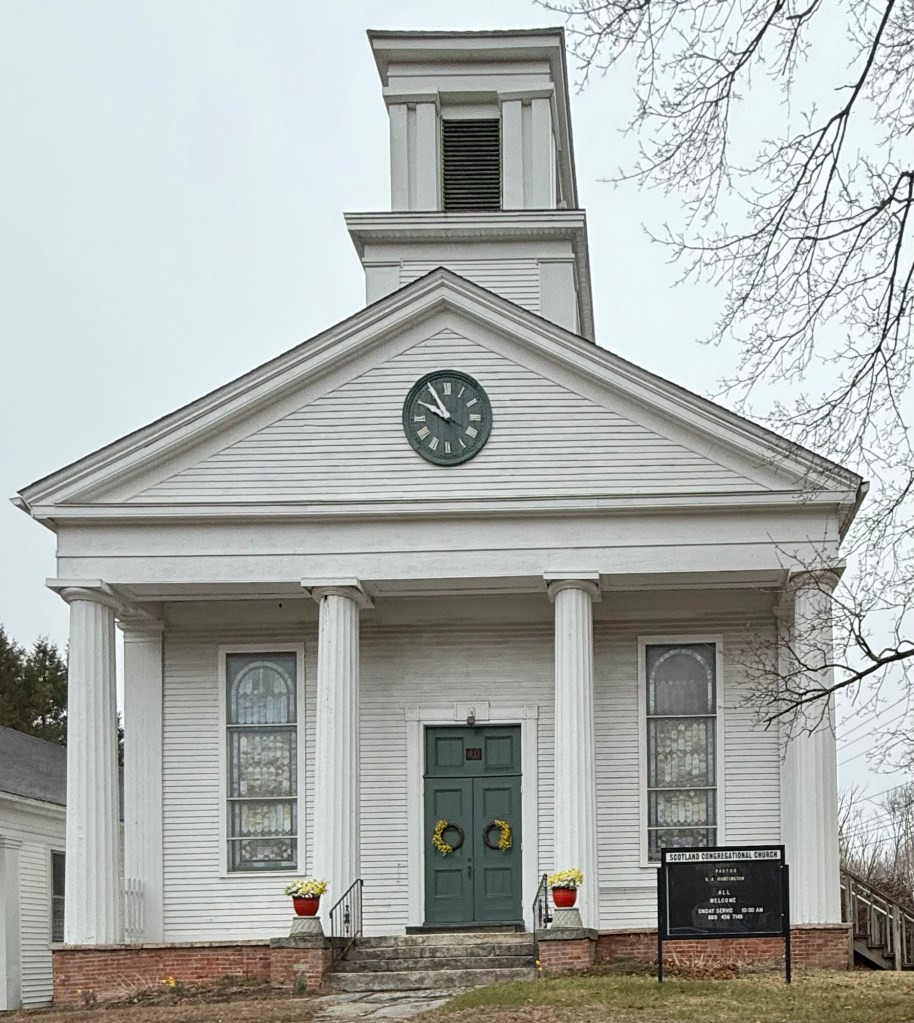
Completed in 1811, the First Parish Congregational Church of Pownal, Maine, is an excellent and well-preserved example of a vernacular Federal-period church in a rural setting. Located across from Mallett Hall and built at the foot of Bradbury Mountain, the church was built by a crew headed by master-carpenter Uriel Whitney, a Revolutionary War veteran who moved to the area after the war. He was active in this church and is buried in the church cemetery. Little remains of the original Federal Style architecture, as its current Greek Revival Style (architects unknown) dates from remodeling apparently undertaken in 1838 and 1857.

New Gloucester Universalist Meeting House // 1839

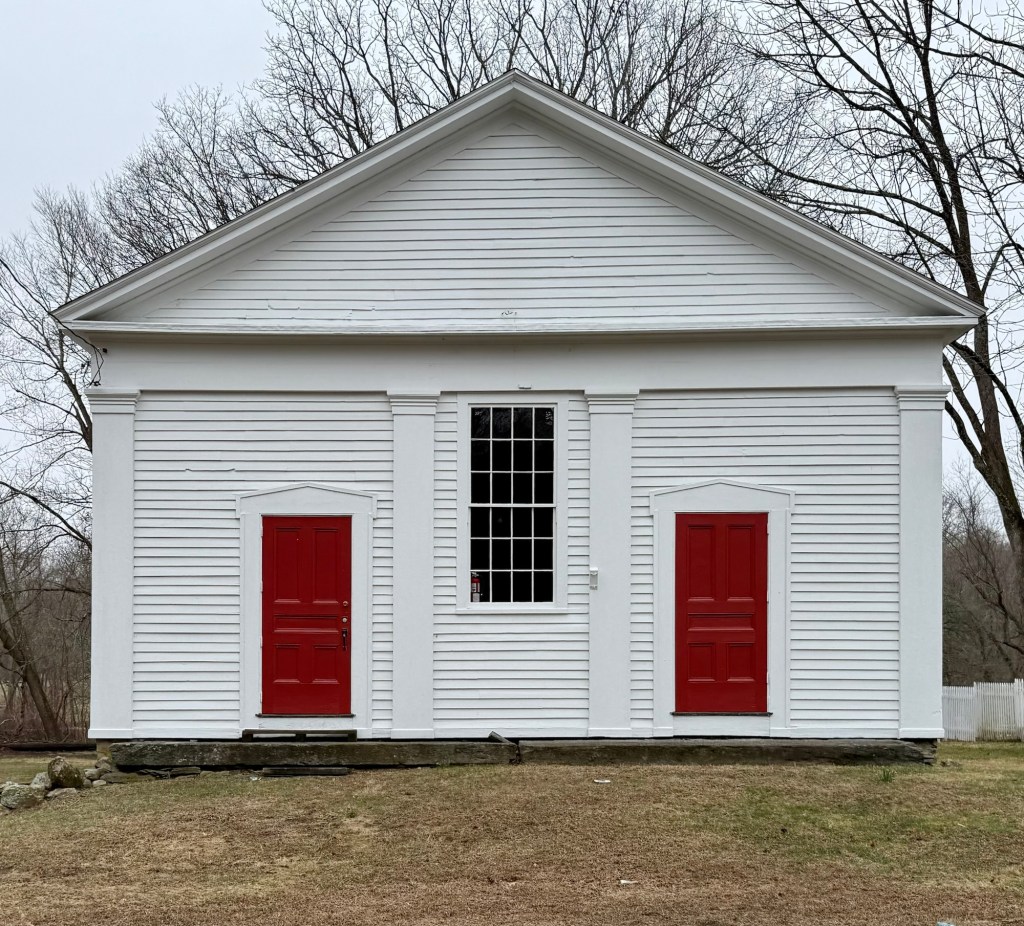
Constructed in 1839 by local carpenter/builder Jeremiah Cotton, the Universalist Meeting House of New Gloucester, Maine, is a dignified example of the Greek Revival style in a rural context. The First Universalist Society of Christians in New Gloucester was organized in 1805 with members drawn from nearby communities including those of Gray and Poland. In 1830, the congregation reorganized itself into the First Universalist Society of New Gloucester and Pownal. During its early history services were apparently held at various places in the community for it was not until November of 1838 that a meeting was called “…to take such measures for Building a meeting house as a majority of Subscribers or proprietors may think proper.” After World War I, membership began to decline and from the 1930s until the society’s demise in 1957 services were infrequently held. In 1969 the property was acquired by the New Gloucester Historical Society, who maintained and restored the building. The flushboard siding, fully pedimented gable, pilasters, and symmetrical façade containing two entry doors, all work together to display the Greek Revival style in a high-style example, but in a rural setting. The building appears to be opened periodically by the Historical Society.

Ashby Congregational Church // 1835

Combining Greek and Gothic revival styles, the 1835 Ashby Congregational Church in Ashby, Massachusetts, is a significant building showcasing the transitional tastes of ecclesiastical architecture in 1830s New England. The church had its beginnings in 1818, when a group of church members disillusioned to the current teachings separated from the town’s Unitarian roots and the accompanying meeting house, the First Parish Church. In 1820 a church for the Congregationalists was built on the opposite end of the town common. In 1835 it was sold and this, the current church building was constructed on a new site facing the Common. The original 1820 church building became the Ashby Academy and is now a Grange Hall. The design of the Ashby Congregational Church shows the leaning towards Gothic detailing wit its prominent pointed arch detailing, yet retains some traditional Greek Revival features like the two-story pediment and pilasters at the belfry.