Hennessy’s Bar // c.1826

St. Patricks Day in Boston is not the same this year. It has been a year since I have been crammed into a dimly lit, wood-paneled Irish Pub, with a pint of Guinness and good conversations with strangers. So for now, I will drink my sorrows in highlighting one of many Irish pubs in Boston, Hennessy’s. The building was constructed as one of a row around 1826 along with the adjacent buildings on the block (today containing Son’s of Boston and Blackstone Grill). All four buildings were identical and stood 3-1/2 stories as Federal style commercial buildings with retail space at the ground floor and office or residences above. The buildings were sold off separately and in the 1960s, this building was acquired by the Charlestown Savings Bank, who thought to “Colonialize” the building. They removed 1-1/2 stories and altered the openings at the ground floor (it could have been MUCH worse). The bank moved out just decades later and the building has since been home to Hennessy’s.

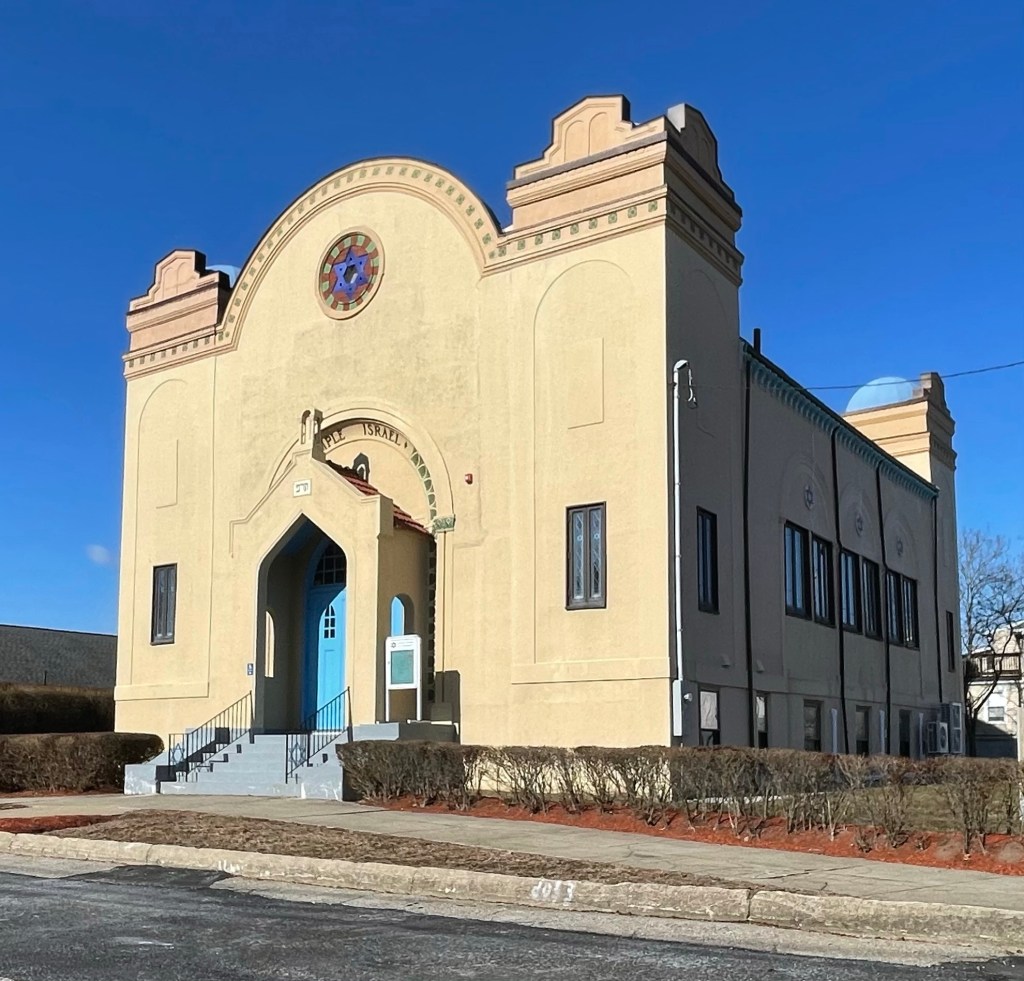
Temple Israel Synagogue // 1920

In the early 20th-century, Hull was linked by ferry, railway and road to Boston and this resort town became a popular urban recreational destination. Between 1915 and 1920, Jewish Bostonians started buying property and building summer homes in the area. The new Jewish summer residents required a temple for worship when away from their main homes. In 1920, land was purchased just north of the bustling Nantasket Beach for the erection of a place of worship. This temple was likely built by a Jewish architect/builder Joseph Rudnick, who arrived in Boston from present-day Lithuania in 1886. Unable to speak English, he hired a tutor to teach it to him, and quickly began working on constructing apartments and other buildings all over the Boston area. Temple Israel of Nantasket remains a handsome and rare example of a 1920 American
wood-framed, stucco-clad synagogue, with an active congregation.
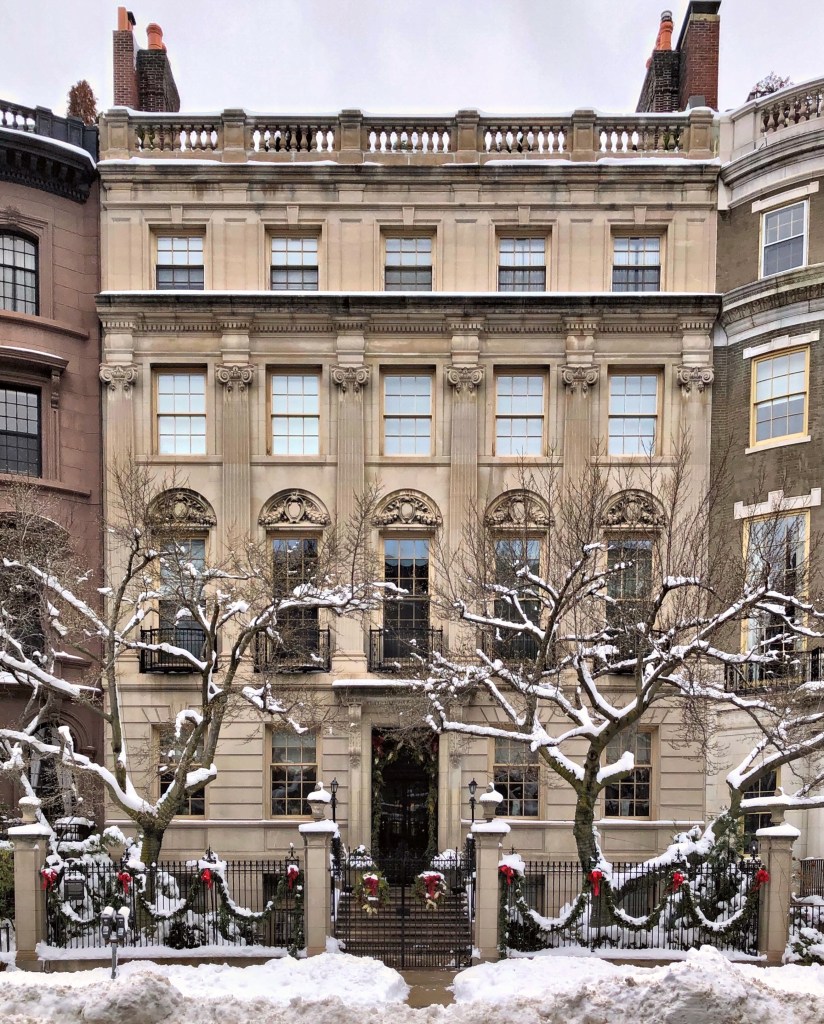
Governor Draper Mansion // 1905

Adjacent to the Warren House (last post) on Beacon Street in Boston’s Back Bay neighborhood, this massive mansion is one of my favorites on the street. Built in 1905, and designed by architect Alexander Wadsworth Longfellow, Jr. an amazing local architect, and nephew of poet Henry Wadsworth Longfellow. The grand mansion was the home of Eben Sumner Draper and his wife, Nancy. Eben Draper was a manufacturer of cotton machinery in the Draper Corporation, founded by his father in Hopedale, MA. Draper graduated from MIT and entered his fathers business, which upon the time of his graduation, was the largest plant for manufacturing cotton machinery in the world. In 1905, Draper was nominated and elected as Lieutenant Governor of Massachusetts, the same year he had this mansion constructed. In 1908, Draper was elected Governor, and served two terms under the Republican Party, pushing a pro-business, and anti-reform agenda, a bill legalizing the merger of the Boston and Maine Railroad with the New York, New Haven and Hartford Railroad, signaling approval of what was seen as monopolistic business practices, something the Draper Corporation was known for in Hopedale. The former single-family home was converted to six condominium units in 2000. Fun fact: the Draper Mansion replaced the 1860 home David Stewart, a merchant from New York, built as a wedding present for his daughter, Isabella Stewart, and John (Jack) Lowell Gardner. Isabella would later create the beloved and iconic Isabella Stewart Gardner Museum. The couple purchased the adjacent townhome in 1880 to store their growing art collection.

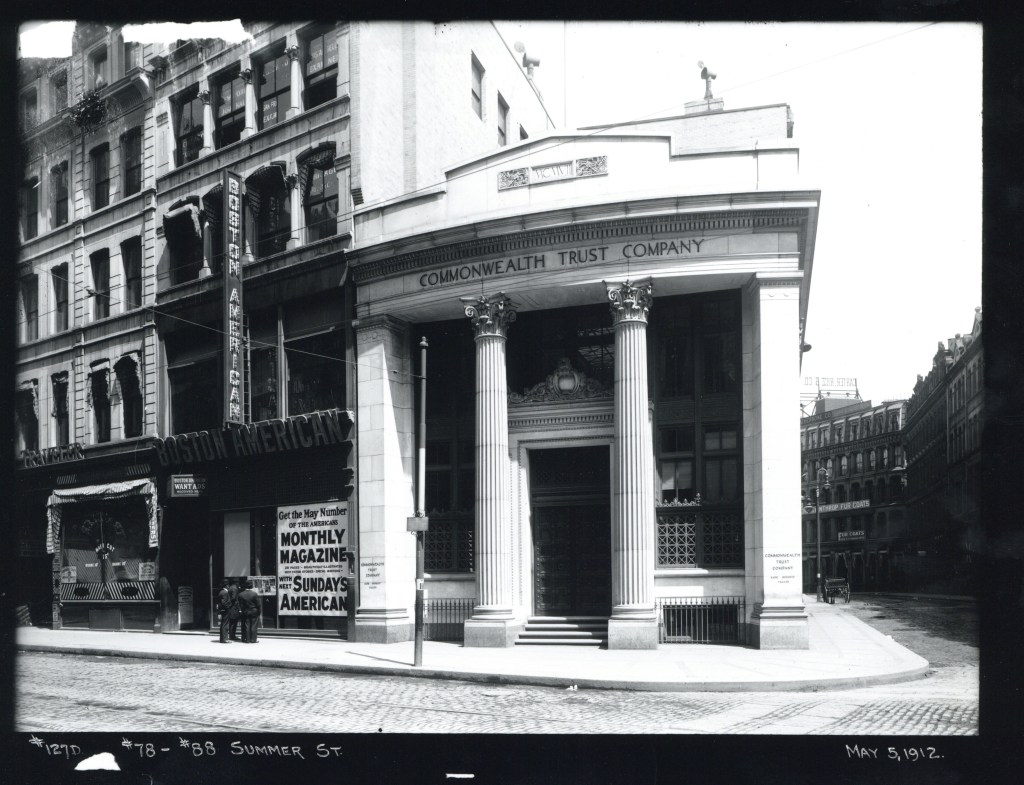
Commonwealth Trust Company // 1908-c.1974

Ca. 1910 image courtesy of Boston Public Archives.

Located at the corner of Summer and Devonshire Streets in Downtown Boston, the Commonwealth Trust Company’s two-story marble banking house commanded the corner, despite its short stature. The building, completed in 1908, was constructed with Lee marble and decorated with ornate wrought and cast-iron grilles over windows. The building was designed by the architectural firm of Parker, Thomas & Rice in the Classical mode with large, fluted Corinthian columns and boxed corner pilasters framing the recessed center entrance, Corinthian pilasters ran along the side facade. At the inside, the building was coated with Cararra and Blanco marble with paneled oak offices. At the ground floor, offices and banking stations framed the outer walls, with the safety deposit boxes located on the second floor. The building was demolished by the 1970s and replaced with a one-story minimalist Modern building (I could not figure out why the former building was razed). The new building was demolished after a few decades with a larger building, better fitting the commercial district.

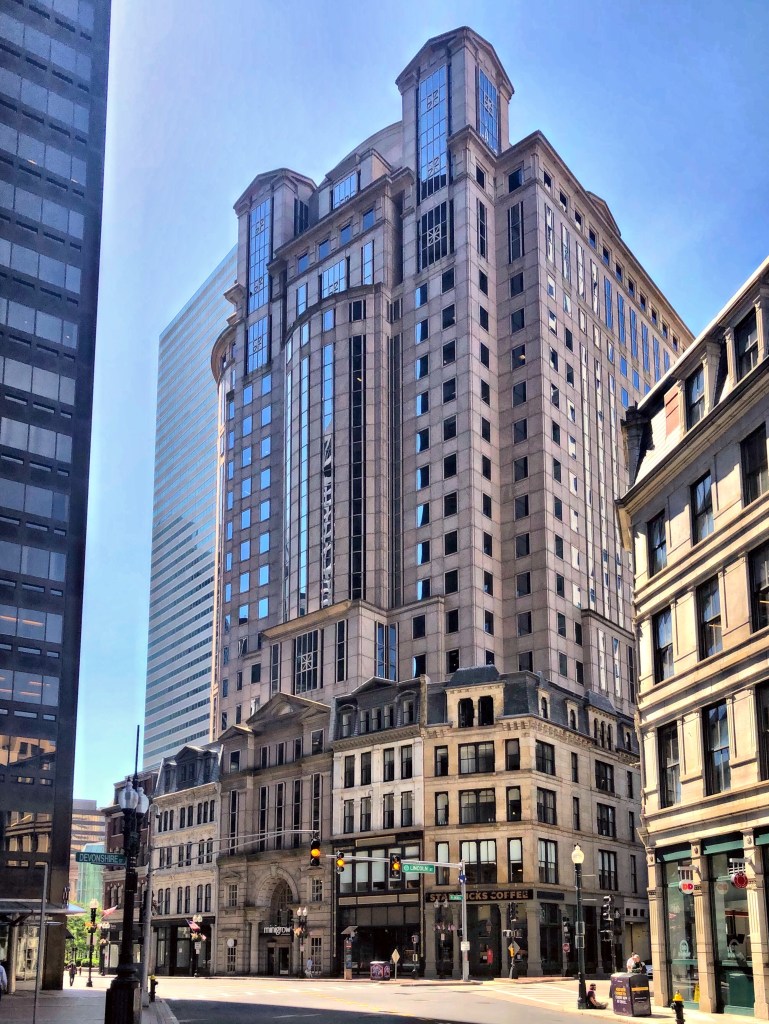
125 Summer Street // 1989

The late 1980s were a time of financial success for developers and banking companies all over the country. It seems that more skyscrapers were constructed in Boston this decade than any other of the 20th century, but working within the confines of the historic downtown of the city, left architects and developers to come up with creative ways to build here. The architectural firm of Kohn Pederson Fox was hired to construct a 20+ story office tower at the southern edge of the Financial District in Boston, while preserving the small-scale commercial buildings there. A row of four-story commercial blocks constructed after the Great Boston Fire of 1872 were retained with the tower seemingly growing out of them. The process here is known as “facadism” which is a valuable preservation tool to balance preservation with density in historic downtowns, though not always done right. This KPF design with its Post-Modern tower in concrete and granite fits well within the streetscape and maintains a walkable block downtown.

What do you think of this design?

Staples-Crafts Farm // 1750

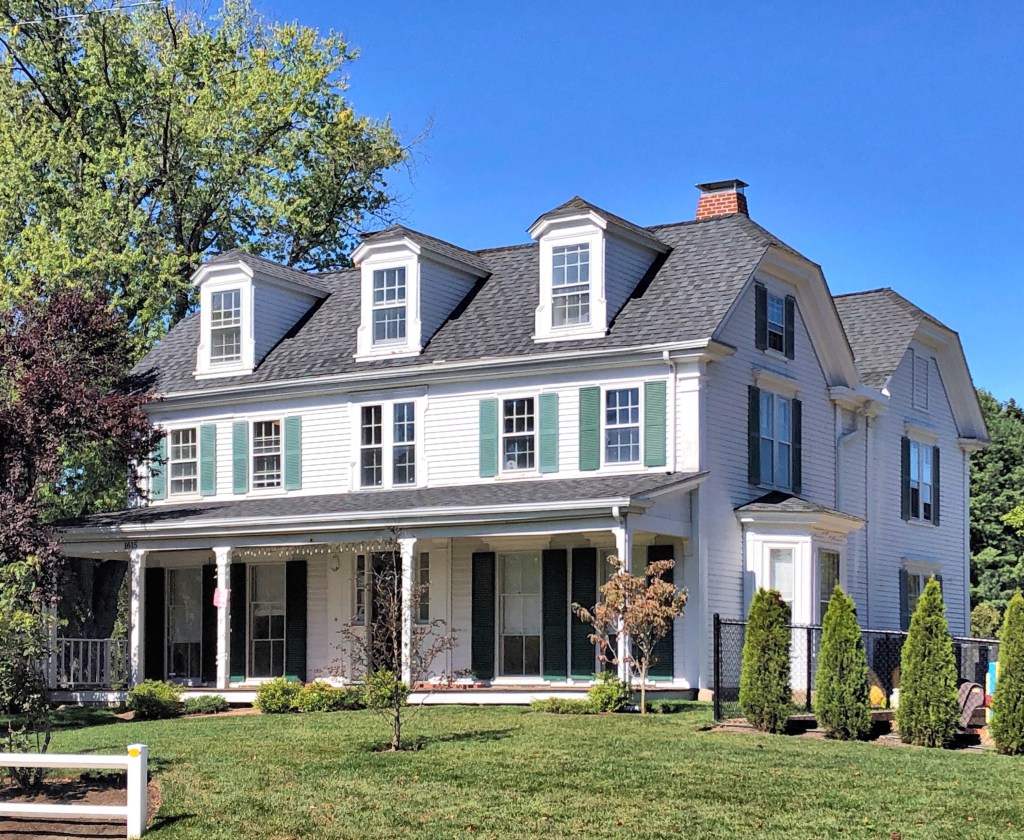
In 1688, John Staples, settled in the untouched landscape seven miles west of Boston, now known as Waban Village in the town of Newton. John was a weaver by trade but he ended up as the first public school teacher, the town clerk, a policeman, and an alderman. John married and lived in a modest farmhouse for decades here, witnessing the birth of a new nation nearby. The couple had no children of their own but raised some of Mary’s relatives including Moses Crafts, who would eventually take over the home. Craft rebuilt the house on the original foundation around 1750, constructing a colonial farmhouse two and a half stories high with five windows and two rooms across, one room wide.

Joseph Crafts died in 1821 at the age of 85, leaving no will and considerable
debts owed. The Judge of Probate ordered the property to be auctioned, and
Joseph’s son, Moses Crafts II, made the winning bid of $5.50 for the house,
barn, and a large tract of land! In 1824, Moses Craft II sold the property to his cousin William Wiswall, who gave the house a Federal period remodeling.

By the late 19th century, the home and ample farm land were acquired by William Strong and his wife Mary. William, President of the Massachusetts Horticultural Society, used the property for some time as a nursery, with apple orchards and rose gardens. After his petitioning for a train station in Waban, he parceled up the farmland into large house lots for sale, seeing the neighborhood shifting to a suburban village. He soon after built the Strong Block, the first commercial building here.

Elihu Kent Jr. House // 1787

In 1775, when news of the Battle of Lexington reached Suffield, Elihu Kent Sr. (1733-1814) at the age of 42 took command of a local militia of 59 men the next day, along with his son Elihu Kent Jr., 18, and his slave Titus Kent, and marched to Springfield, before heading toward Boston. Initially, slaves were discouraged from enlisting in the Continental Army as the Continental Congress was trying to appease the southern states into fighting in the Revolution. England offered freedom to slaves who fought for their side. forcing the Continental Congress to do the same in order to keep a balance. The militia later ended up on Long Island and Kent Jr. was captured by British forces and confined for a long time as a prisoner of war in the old Rhinelander Sugar House in New York. After his return to Suffield, Elihu Kent Jr. had this Georgian home built for his family.

Boylston Building // 1887

2019 image courtesy of Brandon Bartoszek.

Built by the Boylston Market Association, replacing the former Boylston Market (1810-1887) in Downtown Boston, the Boylston Building is a great example of late 19th-century commercial design in Boston. The Association hired German-born architect Carl Fehmer (who also designed the amazing Beaconsfield Terrace housing in Brookline) to design a structure that would stand up to the architectural landmarks along Boylston and Washington Streets nearby. Fehmer’s design exhibits many features of the emerging Commercial style (also known as Chicago school style) of architecture which promoted new technologies of steel-frame construction in commercial buildings with masonry cladding, while clearly showcasing the Romanesque round arch windows. In the mid-20th century, this area of Downtown Boston became known as the ‘Combat Zone‘, Boston’s Red Light District, flooded with prostitution, drugs, and adult video stores. The Boylston Building was occupied by an adult video store and dive pizza shop. The building and area surrounding are different today, but you can always find some characters nearby!

King House // 1880

Located at the corner of Commonwealth Avenue and Fairfield Street in the Back Bay neighborhood of Boston, this MASSIVE townhome exudes wealth and prestige. The home was built in 1880 as the home of iron and steel manufacturer George Parsons King and his wife, Sarah Williams (Lothrop) King. The home was designed by architect William Whitney Lewis and took over a year to build, even with numerous skilled craftsmen. The Kings lived in the Hotel Vendome two blocks away while this home was being built. The brownstone and brick Victorian Gothic townhouse has its main entrance on Fairfield Street within an arched vestibule. The home remained a single family home through numerous later owners until 1979 when it was converted to six condominium units, all still with plenty of space.