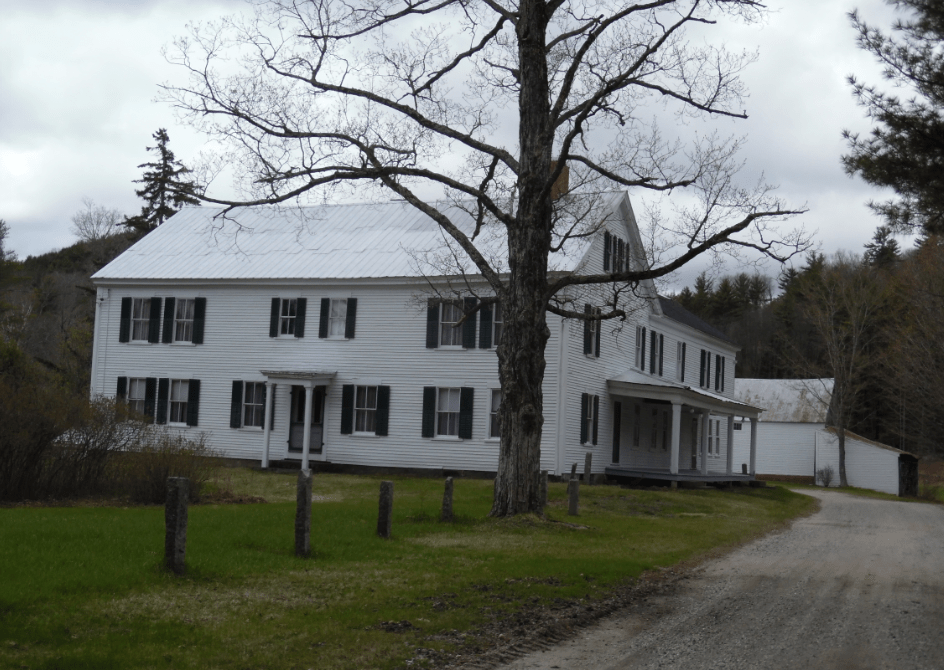
Wadsworth Hall is a significant and hidden estate house located in rural Hiram, Maine. The house was built in 1800 for Peleg Wadsworth (1748-1829), an officer during the American Revolutionary War and a Congressman from Massachusetts representing the District of Maine. He was also grandfather of noted American poet Henry Wadsworth Longfellow. General Wadsworth’s primary residence, now known as the Wadsworth-Longfellow House in Portland, Maine, was built in 1785–86. Following the war, Wadsworth was granted 7,800 acres of land by the state in 1790 for his war service, the land was located here in Hiram. General Wadsworth would build this large Federal period home. After, he gave his Portland home to his daughter Zilpah and her husband Stephen Longfellow, parents of the poet Henry W. Longfellow. Wadsworth, in his role as a leading citizen in Hiram, opened his house for meetings and town functions, and even used the large hall for militia drills during bad weather.
This large Federal style home in Rockport is a rare extant example of a spite house in Maine. The story goes… James McCobb, an Irish immigrant, arrived in what is now Phippsburg in 1731. Living in a log cabin with his Irish-born wife, Beatrice, he raised a large family of 10 children, among whom was Thomas McCobb (1778-1815), who became a sea captain. In 1774, James built a handsome Federal period house for his second wife, Hannah Nichols, with whom he had three children (twin daughters, and a second son, also named Thomas). He married a third time in 1782 to Mary Langdon Storer Hill, who had a son, Mark Langdon Hill, from a previous marriage, who ended up marrying one of McCobb’s daughters, one of the twins, who was a half-sister to Thomas. While Captain Thomas McCobb was away at sea, the Hills, which included Thomas’ half-sister/wife of Mark Langdon Hill, broke his father’s will and took the homestead for themselves. When Captain Thomas McCobb returned from his voyage and discovered what had happened, he vowed to build the most beautiful house in Maine and one that would dwarf the one he had been deprived of. The house was promptly dubbed “The Spite House”.
This house was built in 1806. Ironically, Captain Thomas apparently never married and left no descendants, as a result, when he died in 1815 in Boston, the house was given over to the Hill family. The house had fallen into disrepair and was purchased in 1925 by Donald Dodge of Philadelphia, who moved the house, to save it from demolition, over 85 miles by boat from Phippsburg to Rockport. He also transported a 1796 house from South Harpswell to be used in the construction of the wings that were subsequently added onto the Spite House. The property now sits on Beauchamp Point, not visible from the street, in a desirable enclave of summer residences, with sweeping views of the Atlantic Ocean.
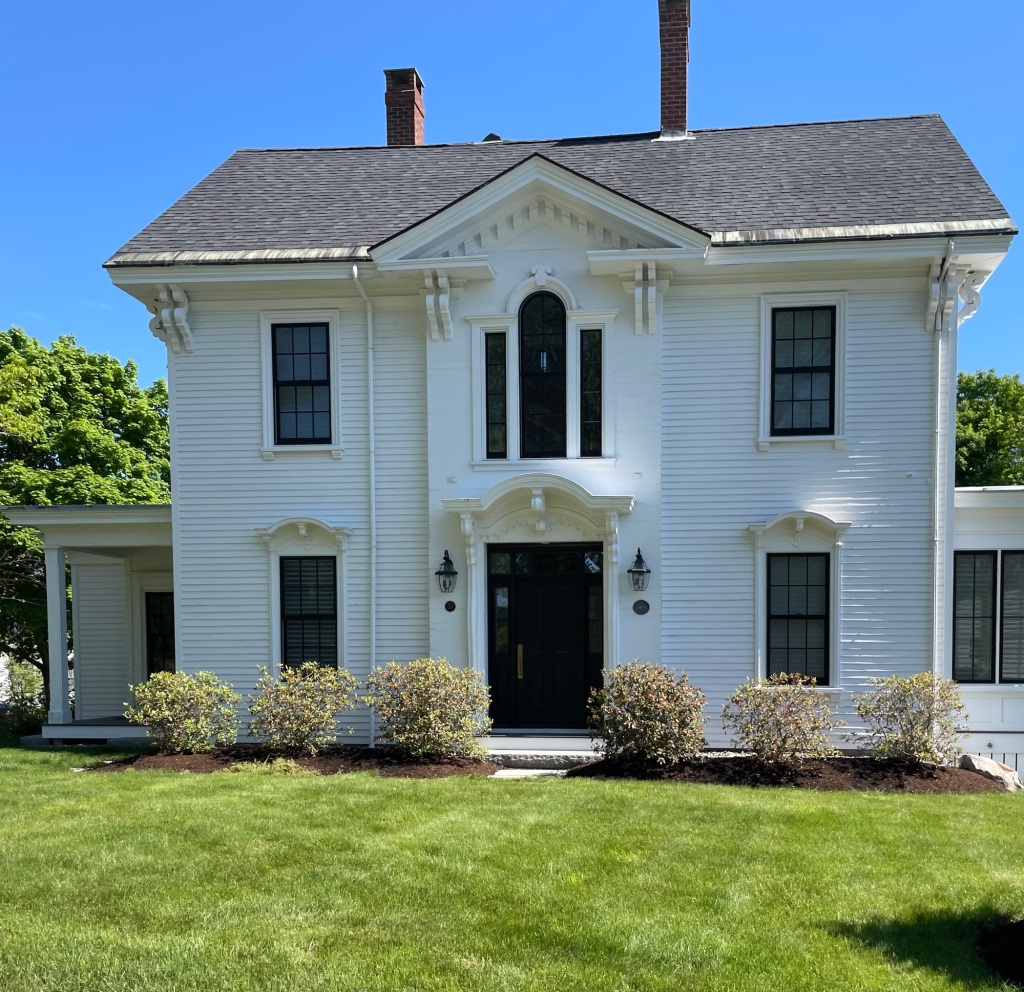
This stately Italianate style house is located at 46 Pascal Avenue in the quaint coastal town of Rockport, Maine. Built around 1855 by and for John Achorn (1825-1898) a ship-joiner and carpenter in town. Due to his profession in carpentry, Achorn is the likely culprit as the builder who designed the house and detailed the delicate pendant brackets, Palladianesque window, and the addition of the flushboard center bay.
This perfect Greek Revival cape house sits on Pascal Avenue, the main street that cuts through the center of Rockport, Maine. The house dates to the 1840s or early 1850s and was owned by the Dillingham Family for a few generations. The original owner may have been Josiah Dillingham (1796-1861), a mariner and sea captain. Josiah died in 1861, and the property was inherited by his eldest son, Josiah Winslow Dillingham (1829-1895) who went by Winslow, seemingly to differentiate himself from his father of the same name and same profession. The Dillingham family home is a quintessential Greek Revival cape with central portico with Ionic columns and corner pilasters with full length entablature at the facade. In true Maine fashion, the side elevations are covered in weathered shingle siding.
Located on a hill overlooking the Head Tide Village of Alna, Maine, this stately brick farmhouse has sat for roughly 200 years. According to old maps of the area, the property was occupied by the Bailey Family as far back as the land was surveyed in 1813. The property was owned by Ezra Bailey, who possibly built the house soon after as the village began to develop. By 1857, the property and its house were owned by I. H. Bailey, seemingly Ezra’s son, Isaac, who married his first cousin, Laura Palmer. The couple resided in the old homestead until they sold it in 1866, moving to Boston. The brick, Federal style house has a four bay facade with the entry door surrounded by a recessed arched relief. Above the door is a blind fan with sidelights.
Located in the Head of Tide village of Alna Maine, this large Greek Revival was once the home of prolific poet, Edwin Arlington Robinson. The home was built around 1835, likely by Edwin’s grandfather, Edward Robinson. The home was inherited by Edward’s second-born son, Edward Jr. Edward Jr. and his wife, Mary Elizabeth Palmer had two sons before their third pregnancy. Their third child was Edwin, but his parents did not name him until he was six months old, as it was said that they wished for a daughter. On a vacation, other vacationers decided that their six-month-old son should have a name, and selected the name “Edwin” from a hat containing a random set of boy’s names. The man who drew the name was from Arlington, Massachusetts, so “Arlington” was used for his middle name. Edwin described his childhood as “stark and unhappy” and his young adult years were plagued with tragedy with the death of a brother from a drug overdose and with his older brother marrying the woman that he was in love with. He would defy the odds and was accepted to Harvard. He became engaged in writing, specifically poetry, with his early struggles leading many of his poems to have a dark pessimism and his stories to deal with “an American dream gone awry.” He would go on to be awarded the Pulitzer Prize in Poetry three times in the 1920s. While he would likely not want to ever see this house again, it is significant both architecturally and as the home in his formative years in Alna.
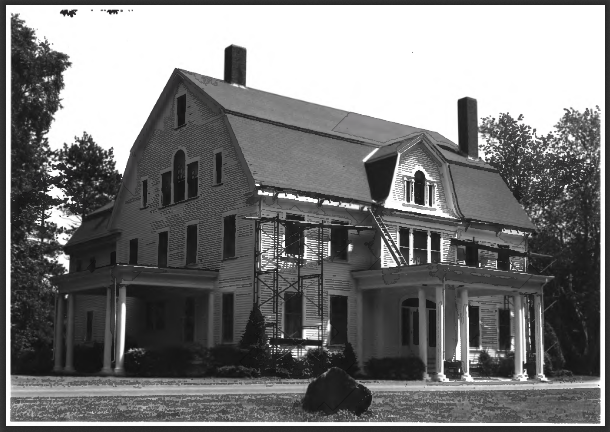
One of the largest Colonial Revival style homes I have ever seen is located in the unassuming small town of Jefferson, Maine. Built in 1903 on the northern shore of Damariscotta Lake, the house stands three-and-a-half stories tall with a broad gambrel roof and clapboard walls. The house was built for Dr. Fred W. Jackson in the Colonial Revival style by relatively unknown Waltham, Massachusetts-based architect Samuel Patch. Dr. Jackson studied medicine and for several years practiced his profession in Providence, Rhode Island. There, he built up a large medical practice and accumulated property, later marrying into a wealthy family. This house in Jefferson was the family summer estate, and Frederick was said to have owned 1,000 acres and laid out bridle paths, gardens, and landscapes in the vast estate. Across the street, a massive gambrel-roof barn was built to house his livestock as part of his gentleman’s farm.
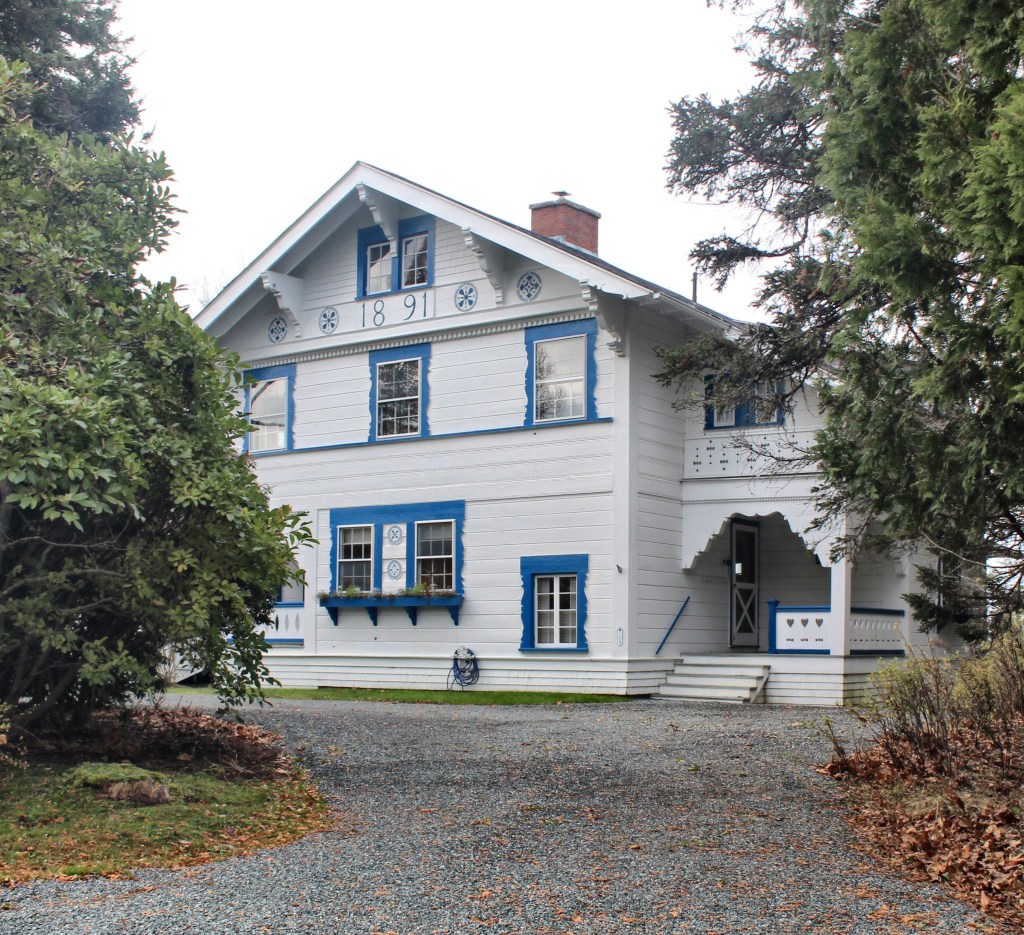
Philadelphia-based architect Lindley Johnson was hired as the official company architect by the Gouldsboro Land Improvement Company’s Grindstone Neck summer colony. As a result, he became the chief tastemaker for the bucolic neighborhood of summer cottages, chapels, and an inn (since demolished). Johnson would design a majority of the cottages in the Shingle style, taking cues from the natural topography and rugged coastlines, but he did deviate from that style a couple times; most notably for his own cottage, “Red Chalet”. While no longer red, the cottage stands out as an extremely rare example of a Swiss Chalet, with its sloping gable roof with wide eaves, exposed stickwork and oversized brackets, decorative carving, and shiplap siding.
Men from Philadelphia and New York gathered to establish the Gouldsboro Land Improvement Company in the late 1880s with the goal to develop an alternative, more quiet summer colony to rival Bar Harbor on Mount Desert Isle. Two of the early investors (and summer residents) were J. Bonsall Taylor and Carter Berkeley Taylor, brothers from Philadelphia. John Bonsall Taylor’s cottage (last post) and this cottage, built for C. B. Taylor, were constructed around 1891-2 and are typical examples of upper-middle-class summer cottages in Winter Harbor. Philadelphia architect Lindley Johnson designed John’s cottage, so it could be hypothesized that he was also architect for C.B. Taylor’s here. The house as originally built was enlarged in the early 20th century, but maintains the rustic quality and charm that so many of these Shingle style cottages possess. And that red trim really pops!





 Buildings of New England