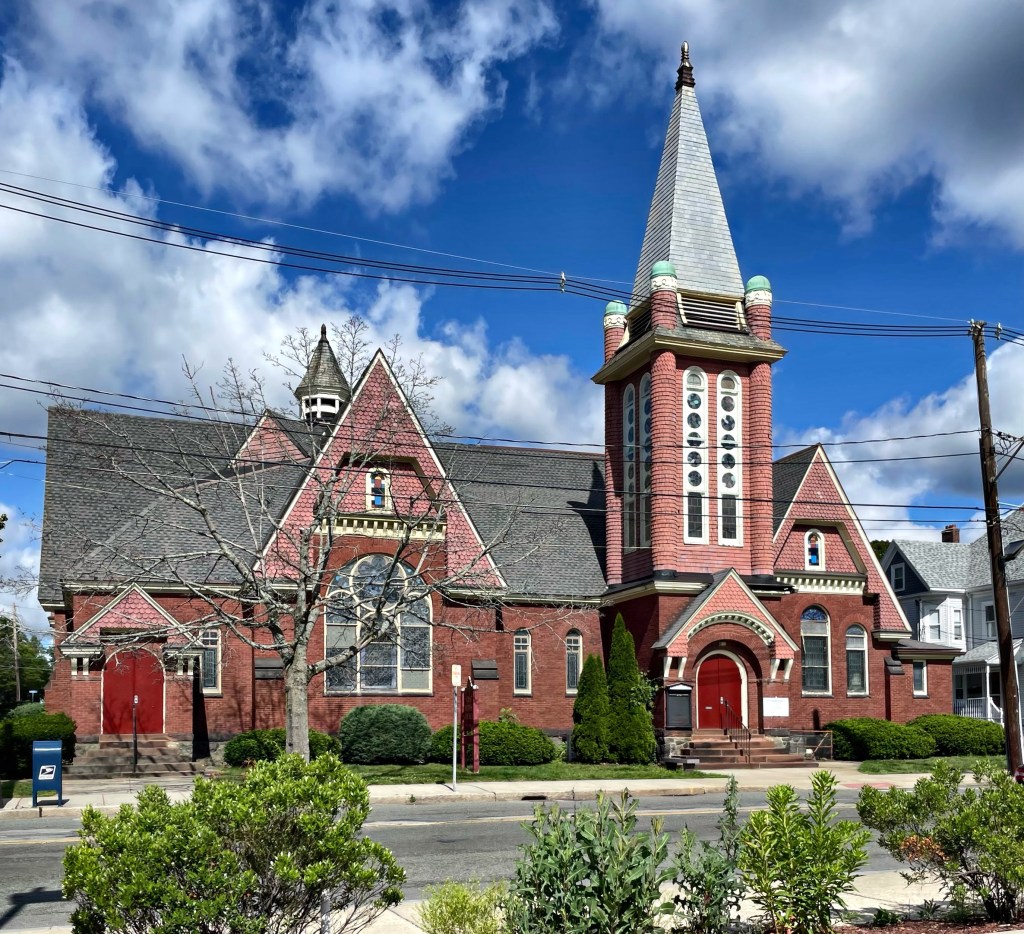
In 1891, the Baptist Society of Stoneham, Massachusetts unveiled that it had acquired funding and approved the plans for its first purpose-built church building in town. The organization met in a shared chapel in town since its founding in 1870. The new church would be unique in the Boston suburb as the only in town to be of the Queen Anne/Shingle style. A prominent site on South Main Street was acquired and work began in 1892 to erect the new house of worship. The design of the church is credited to the firm of L.B. Volk & Sons, a firm who specialized in church buildings with commissions all over the country. The church is complex in plan and combines brick and shingle siding in its construction with a prominent two-story tower with rounded corners and stained glass rondels (round windows).
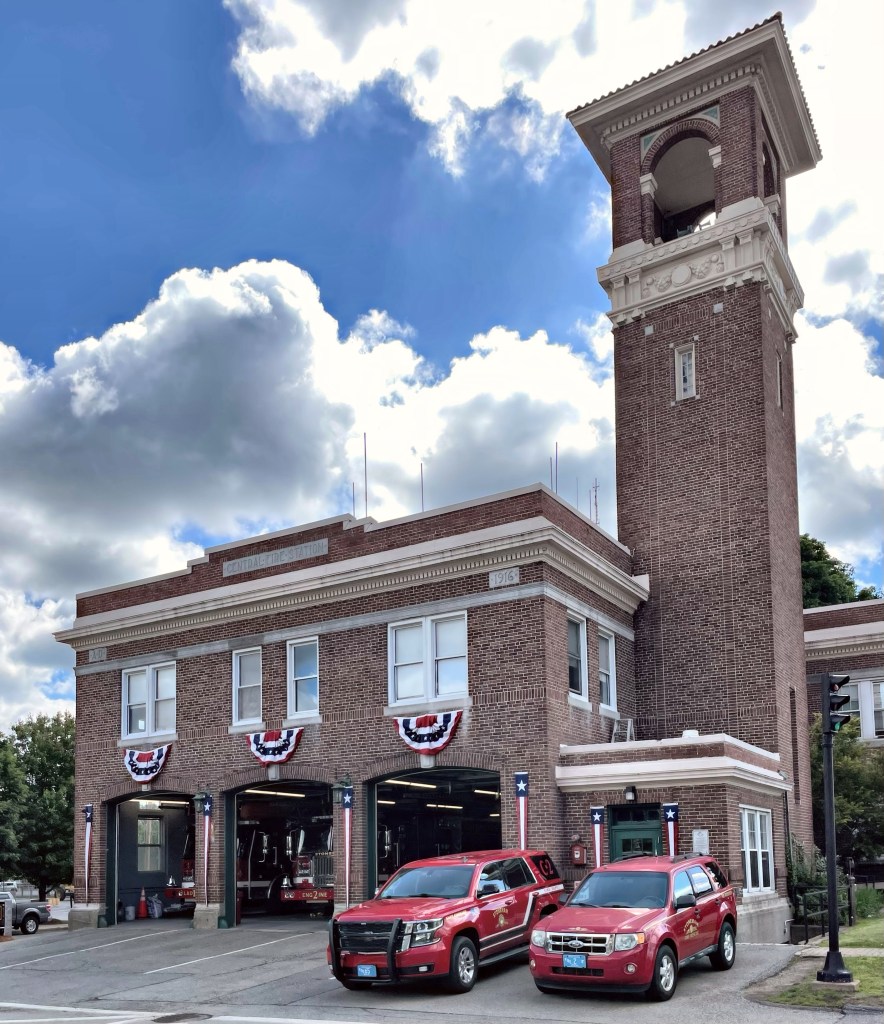
Fire stations are some of the most recognizable and iconic buildings in any city or town, but to find historic fire stations is becoming less and less common as larger trucks and facilities put a strain on the older buildings. The two-story brick Renaissance Revival fire station in Stoneham, Massachusetts was built in 1916 and continues to serve as the town’s central fire station. Its most prominent feature is its four-story hose drying tower, which is reminiscent of Italian Renaissance-era towers. The building was designed by architect Penn Varney and has been well-maintained by the town for over 100 years.
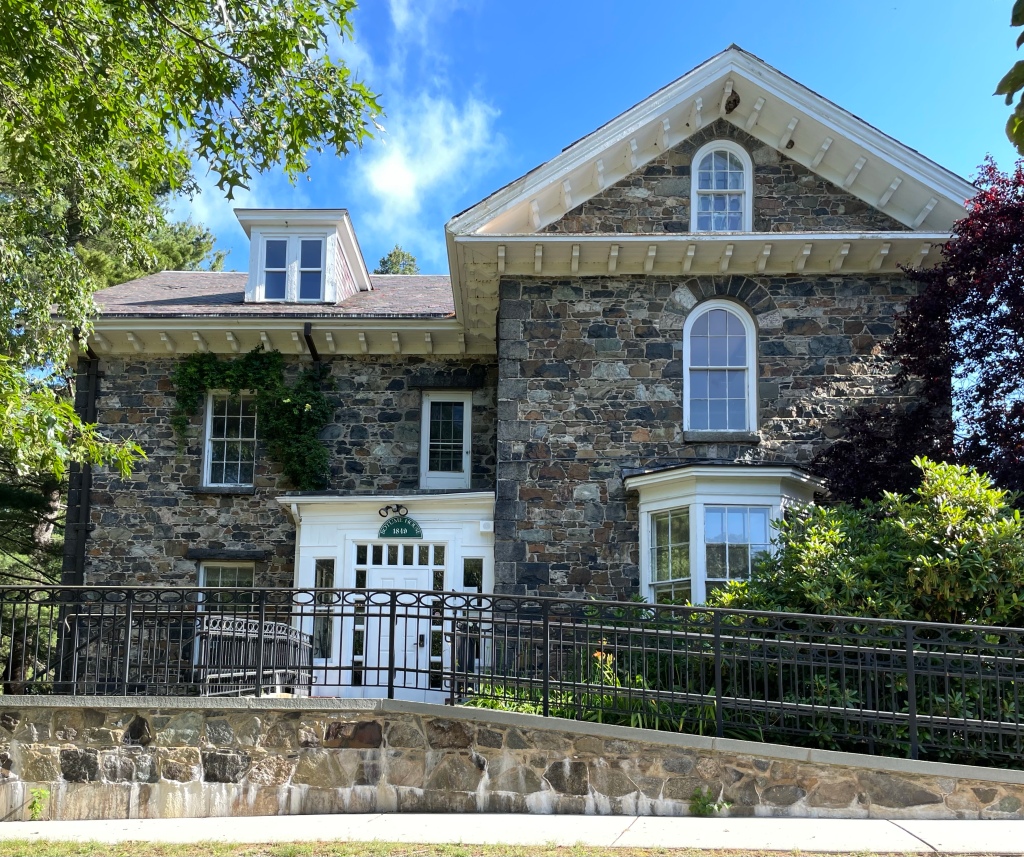
Spot Pond, now encompassed by the Middlesex Fells Reservation, became a site of country retreats for Boston businessmen in the mid-late 19th century. One of the property owners was Charles Copeland, a confectioner and ice cream dealer, had ice houses on Spot Pond where he harvested ice for production into ice cream in Boston area shops. Copeland’s main house was located near the ice houses at the eastern shores of the pond, but this home was also owned by him in the 1870s. This residence was possibly rented out by Copeland or occupied by one of his many children. It remains a great example of the Stick and Shingle styles of architecture. The residence is maintained as part of the Massachusetts Department of Conservation and Recreation’s property in the Fells Reservation park.
The Middlesex Reservoir and Spot Pond are located just north of Boston and have long been a little piece of the outdoors near the heart of New England’s largest metropolitan area. In 1894, the Massachusetts Legislature established the Metropolitan Parks Commission, which was endowed with the authority to acquire, maintain, and make recreational spaces available to the public. By 1900 the new commission had acquired 1,881 acres for the reservation. Part of this reservation, Spot Pond, is a natural water feature that for a number of years was integrated into the Boston area public drinking water supply, servicing the towns of Stoneham, Melrose, and Malden with drinking water. As part of this, gatehouses were built with hardware to open and close the pipes delivering the water to the adjacent towns. This gatehouse is in Stoneham was built in 1900 by the architectural firm of Shepley, Rutan & Coolidge, to not only protect the machinery inside, but to beautify the parkland, then maintained by the Metropolitan Parks Commission. The Renaissance Revival style building is today surrounded by a tall chain link fence, which really diminishes its presence in the landscape (but it does help prevent graffiti).
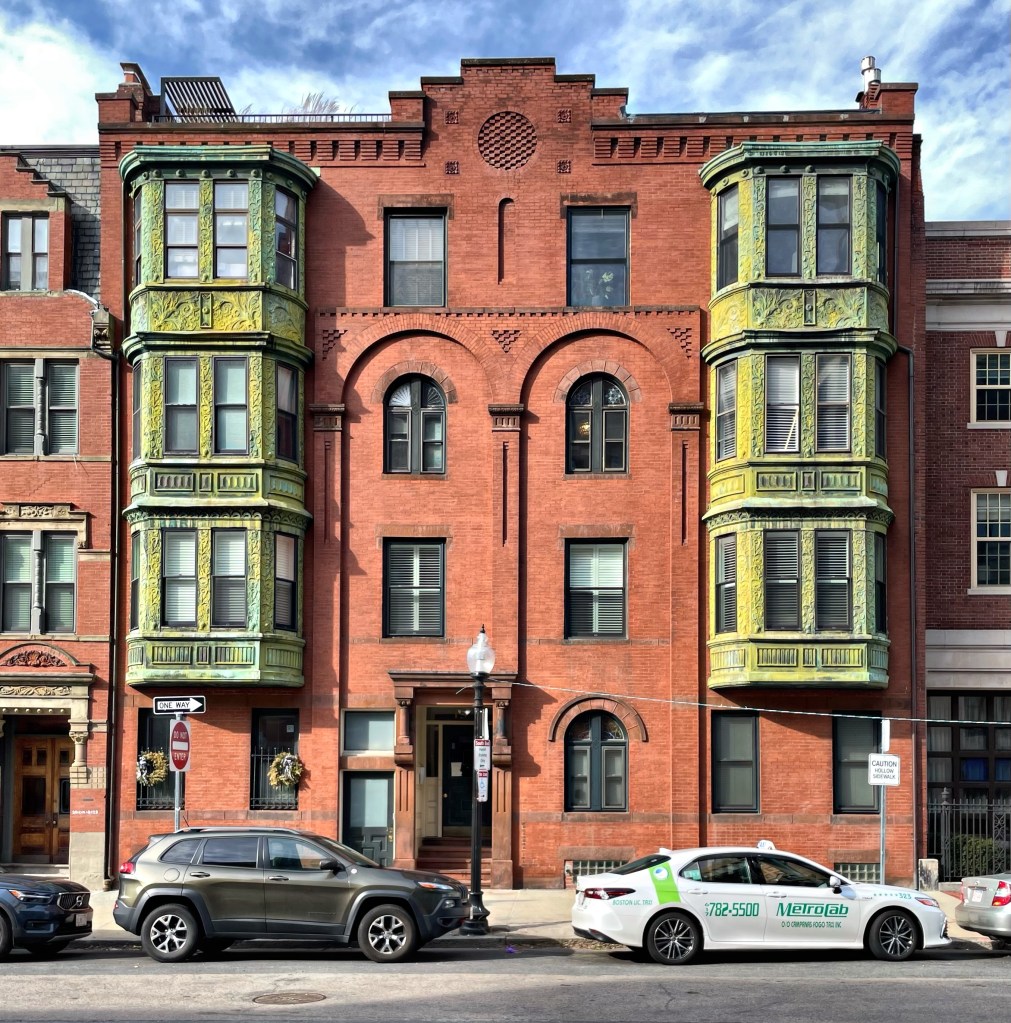
About ten years after the nearby Carlisle building (last post) was completed by owner Jonas Gerlusha Smith (1817-1893), he began construction on another large, apartment hotel next door. He again retained architect Arthur Vinal, who was acting City Architect for the City of Boston to furnish the plans on the building, which would be attached to the older portion which fronts Gray Street behind. The building is extremely well-preserved and has some stunning metal bays with decorative details which really pop!
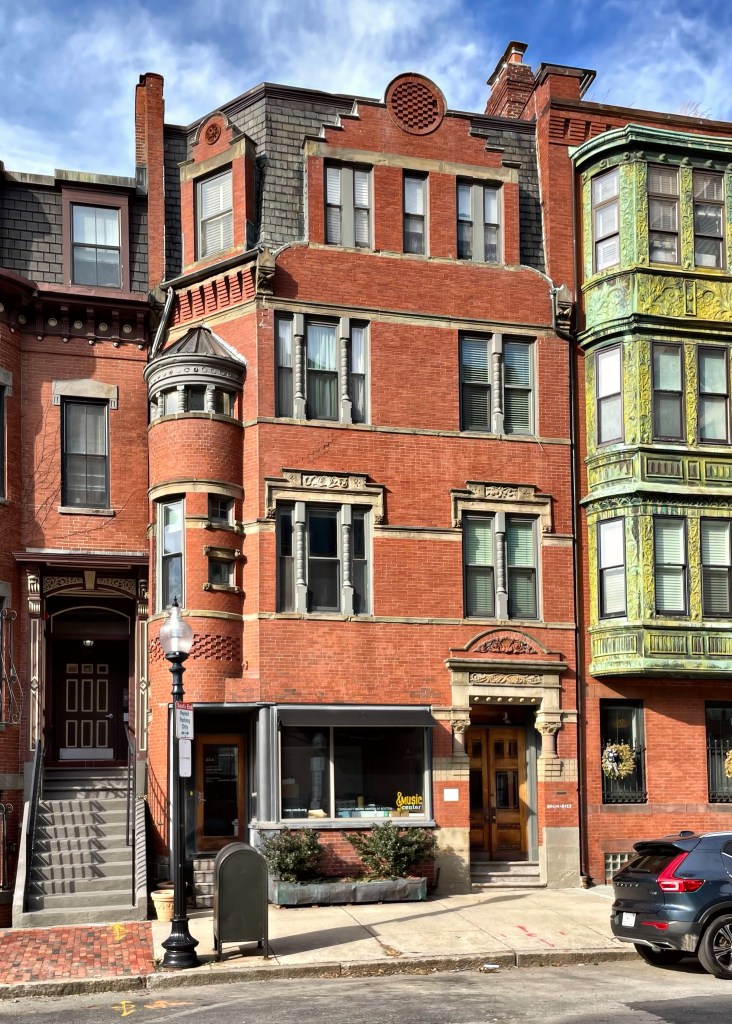
In 1880, Jonas Gerlusha Smith (1817-1893) received a permit to erect a multi-family apartment building on Warren Avenue in present-day South End. The lot was close to his personal residence at 13 Warren Avenue and would have been easy to maintain and oversee tenants in the building. Mr. Smith hired 26-year-old architect Arthur H. Vinal, who furnished the plans for the handsome Queen Anne building. Vinal would later become the City Architect of Boston from 1884 to 1887, designing the High Service Building at the Chestnut Hill Reservoir just seven years after this building. By the late 1880s, the building was known as The Carlisle and it remained in the Smith family holdings under Walter Edward Clifton Smith until the 1930s. Walter attended the Cambridge Episcopal Theological School and later worked at various churches in the Boston area, serving as pastor in his later years. He lived on Follen Street in Cambridge while he held the Carlisle for additional income. Under new ownership in 1950, a retail storefront was added to the first floor which was occupied as a florist for some years. In 1979, after years of deferred maintenance, the property was purchased by Louis G. Manzo and his son David W. Manzo, who meticulously restored the building over time into the time-capsule that it is today!
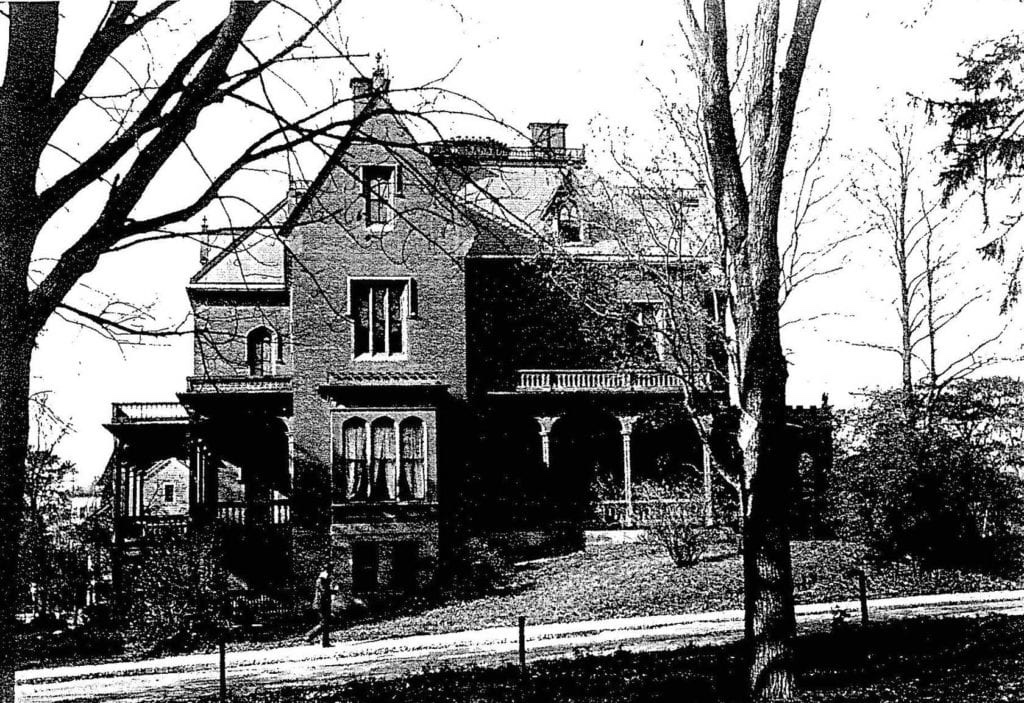
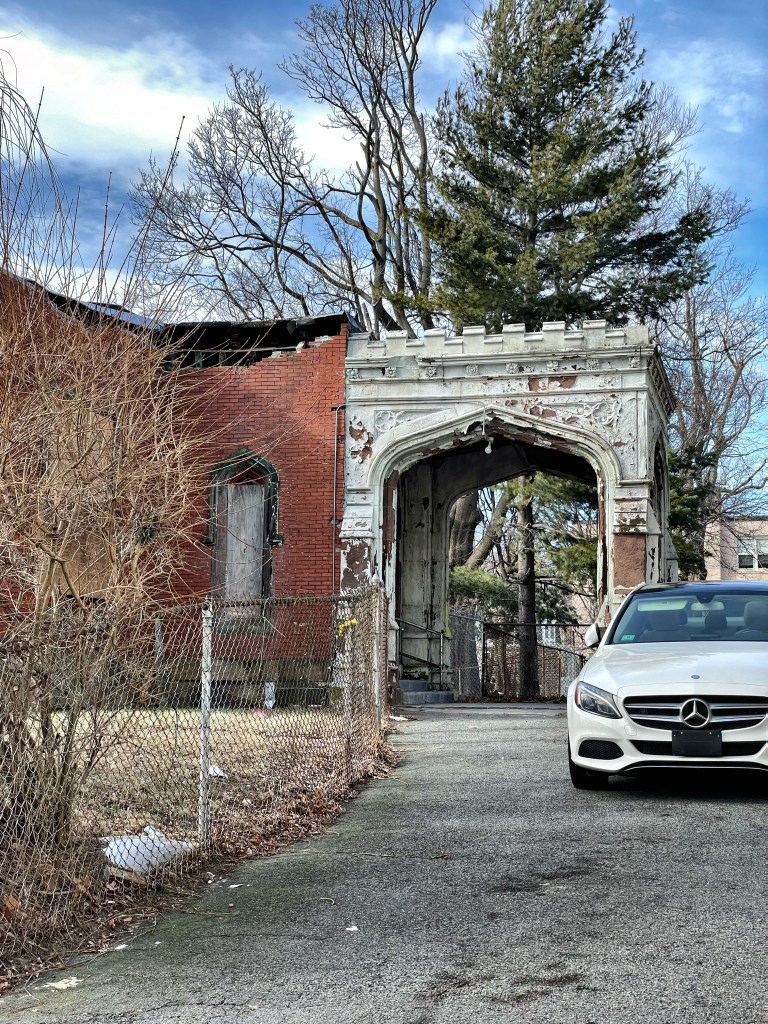
Not much remains of one of Roxbury’s once grand rural estates, but as there is some left, I want to feature it before it’s all gone, possibly any day now! Horatio Harris was born in Dorchester (present-day South Boston) in 1821 and ran a prominent auction house in Boston. He built his country estate in Roxbury beginning in 1857 in the Gothic Revival style, adding on and updating numerous times. During the Civil War, the firm of Horatio Harris & Co. obtained the contract to sell at auction all goods which were confiscated by the United States’ land or naval forces and brought to Boston. He made a lot of money and added to his land holdings and estate house in Roxbury. The mansion’s construction was timely as Roxbury was transitioning from a rural town, with farms and country estates of wealthy Boston merchants, to a streetcar suburb, increasing the land value of his holdings. The estate included nearly 30 acres of meandering paths, a lake with an island, outbuildings, and an observation tower – one of which remain today besides the ruin of the former mansion. Horatio died in 1876, in the decades following his death, his heirs began subdividing the estate, developing some and selling other plots off for houselots. By the early 1900s, Jewish people began moving into Roxbury, mixing with the predominantly Yankee population. By 1915, the Harris manor house was owned by the Hebrew Alliance of Roxbury, Inc. By the 1920s, they expanded facilities, adding a school building to the front of the former Harris Mansion, completely obscuring the facade of the old estate. In the 1940s, the upper stories were removed. Seemingly the death knell of the old Harris Villa was a fire in 2019, which gutted much of the remaining original fabric of the estate. All that remains is a bay window, some window trim details and a Gothic porte-cochere at the rear of the estate. See it before it’s too late!
Harriswood Crescent was built in 1889-90 at the height of Roxbury’s development as a streetcar suburb which coincided with the electrification of the streetcar lines in Boston. The area of Roxbury in which the Crescent is located, known at the time as Boston Highlands due to its rocky terrain and steep grades, was an extremely desirable residential location. As land values raised, middle and upper-class families looked for varied housing types that fit their demands. Seen as a great investment of the family estate, the heirs of wealthy businessman Horatio Harris (1821-1876) redeveloped lots on one side of a rocky park for fine townhouses, which were named Harriswood Crescent. The name was probably chosen for its historical associations with Boston’s Tontine Crescent and the great Georgian crescents of London and Bath in England. Architect J. Williams Beal designed the row, which was one of his first commissions upon returning to Boston in 1888 after employment as a draftsman at McKim, Mead & White and a long study in England to view architecture. Built at 15 separate units, the row of Tudor style houses is among the only of such developments in Boston, and New England at large.
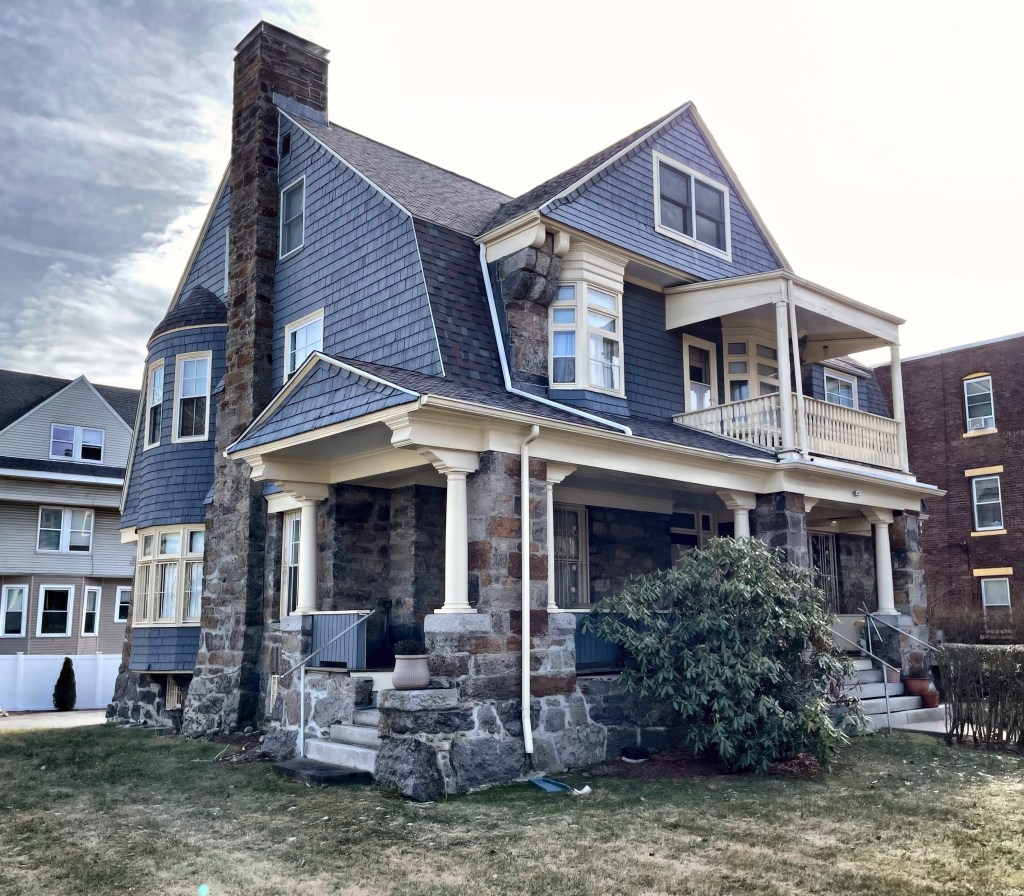
Roxbury is not well-known for its Shingle style architecture, but this example might change that! This dwelling was built around 1895 by the heirs of Horatio Harris on family land that was subdivided for house lots at the end of the 19th century. The expansive Harris estate was developed, largely on speculation and included some amazing single family homes, rowhouses and multi-family dwellings. This Shingle style home appears to have also been built on speculation and was owned by the Harris heirs for some time. The property was occupied for some time by Peleg E. Eddy and his wife Caroline in the earliest years of the house’s existence. I could not locate the architect, but it could be estimated as a design by J. Williams Beal, a local architect who was commissioned to design the nearby Harriswood Crescent development for the Harris family. The design features a Roxbury puddingstone first floor and chimney which contrast elegantly with the shingle siding.



 Buildings of New England